














 Electronics
 Fashion & Apparel
 Furniture
 Jewelry and Watches
 Afterschool Activities
 Sport & Fitness
 Beauty Center
 Dental Clinic
 Medical Clinic
 Home Cleaning & Maid Services
 Photography & Videography
 Car Dealership
 Travel Agency & Tour Operator


TL;DR - What to do when Meta Business Suite hits a limit?
Mid-market B2C teams running click-to-Messenger ads hit a ceiling with Meta Business Suite — it caps at 40 messages/second, has no broadcast, and can't tell you which ads produce paying customers. Once you hit those limits, leads go cold and ad spend gets optimised on the wrong signal. Respond.io closes all three gaps.
Attribution: Paid Ads attribution in the Reports module tracks leads from first click to paying customer by campaign, ad group, or specific ad
Qualification: AI Agents qualify and tag contacts in real time, so only sales-ready leads reach your team
Re-engagement: Broadcast messaging to opted-in contact segments keeps conversations going beyond the 24-hour window
Not for: Businesses that have low enough volume of messages to keep going with Meta Business Suite

Why Meta Business Suite stops working for Messenger marketing at scale
Mid-market B2C teams running click-to-Messenger campaigns hit three hard limits that Meta Business Suite cannot resolve — and each one has a direct revenue cost.
Volume cap: Meta Business Suite caps inbound and outbound messages at 40 per second. For a team running high-volume click-to-Messenger campaigns, this isn't a theoretical limit — it's where leads go cold. Messages stop arriving in your inbox, and there's no queue: they're lost.
No broadcasts: Once the 24-hour messaging window closes, you can't reach opted-in contacts without Meta-approved message templates through the Messenger Platform API. Meta Business Suite has no broadcast functionality at all, so any contact who didn't convert in that window is unreachable — regardless of their opt-in status.
Attribution gap: Meta Business Suite shows you which ads started conversations. It does not show you which conversations became paying customers. This means ad budget gets reallocated based on click and conversation volume, not revenue outcomes. Campaigns that generate low-quality leads at high volume consistently outcompete ones that generate fewer, higher-intent buyers.
These aren't edge cases. They're the default outcome for any mid-market B2C team whose Messenger campaigns are working. The infrastructure that made Messenger outperform email and product page ads stops scaling at exactly the point where volume grows.
Why Messenger ads still outperform with the right infrastructure
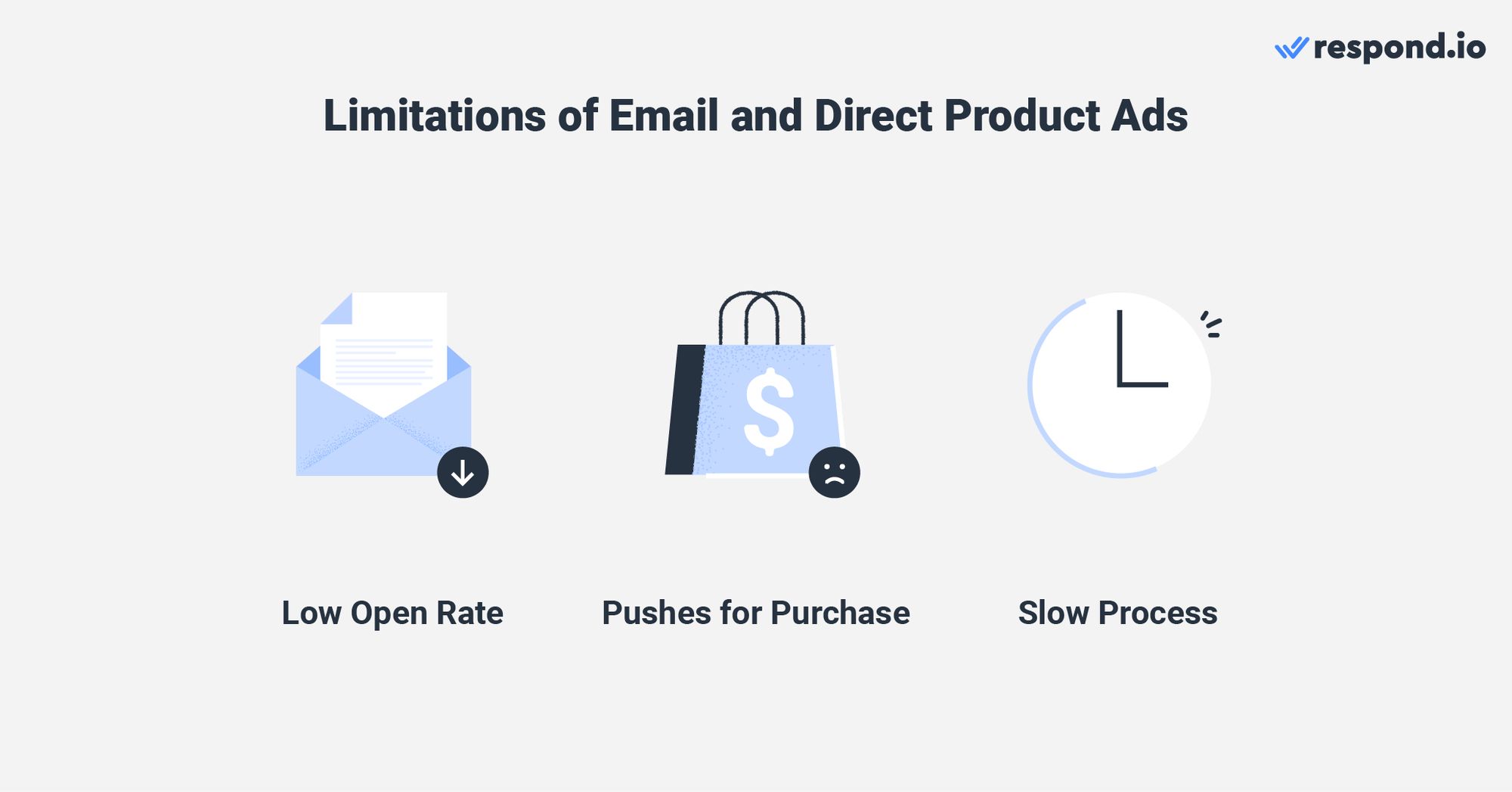
Messenger ads outperform feed posts and email because they start a conversation the moment someone clicks. But that advantage is entirely dependent on what happens inside the conversation, and Meta Business Suite is where it breaks down.
Feed posts are easy to ignore: Promoted posts aren't precisely targeted and are simple to scroll past. Messenger ads get more engagement and a higher ROI because they start a conversation instead of competing for attention in a feed.
The performance gap is real, but conditional: Once conversations start arriving, the advantage depends entirely on what happens next: how fast leads are replied to, how they're qualified, and whether you can tell which ads actually drove revenue. Meta Business Suite can't answer any of those questions at scale.
Speed is the mechanism, but it doesn't scale automatically: A prospect who gets an instant, relevant reply after clicking a Messenger ad is far more likely to convert than one who enters a drip sequence. As volume grows, that speed advantage disappears unless qualification is automated. Without respond.io's AI Agents handling that qualification, the speed advantage Messenger ads create is the first thing lost.
Here is what Messenger enables when the infrastructure supports it:
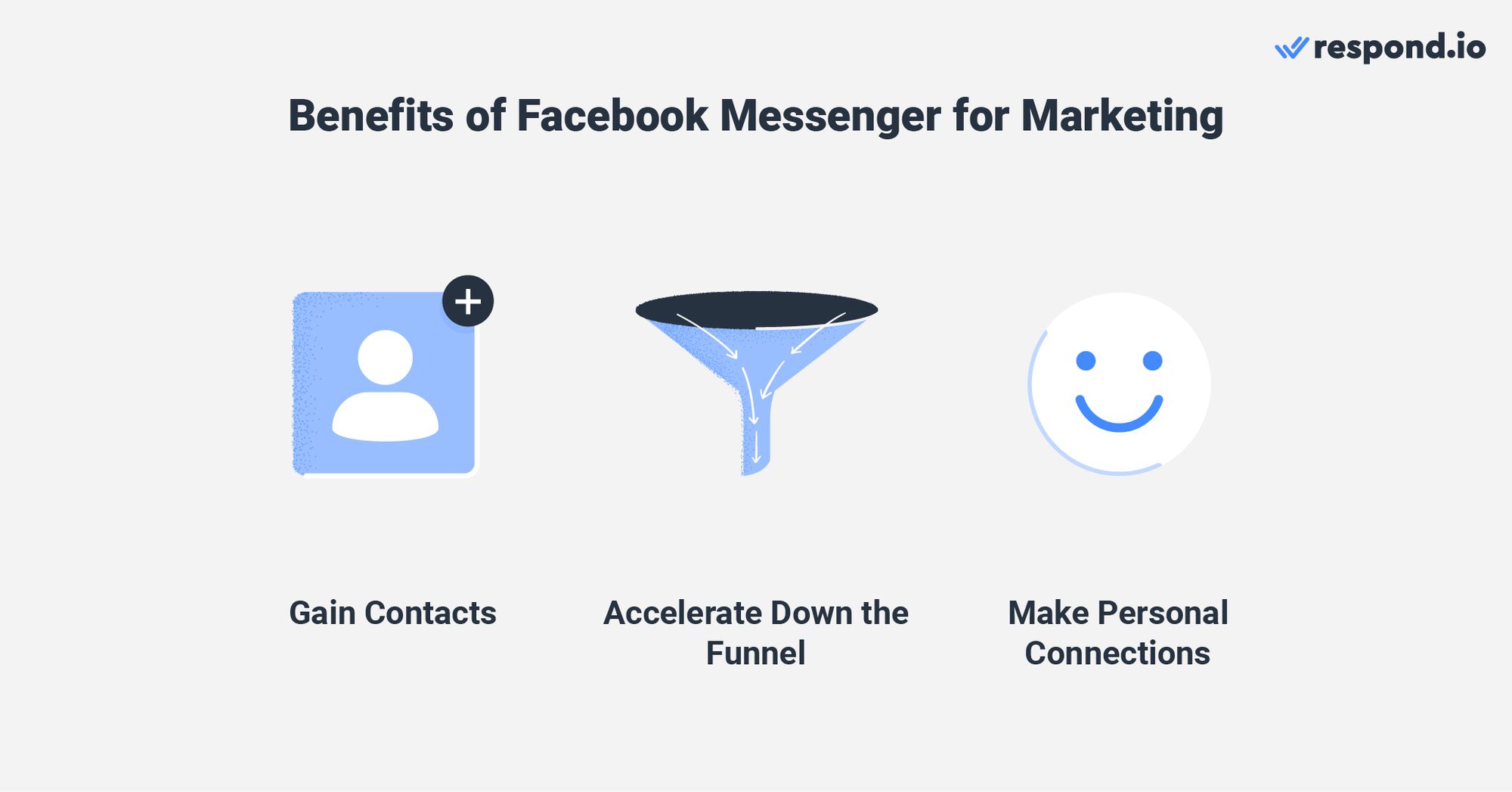
Getting contacts: Click-to-Messenger ads and sponsored messages are the entry point. Each conversation gives you a name, profile, and intent signal you can use to sharpen future targeting.
Moving prospects through the funnel faster: Messenger lets you answer questions and gauge interest instantly. Prospects who aren't ready to buy can be re-targeted with sponsored messages based on what you learned in the conversation.
Building brand loyalty: Automated Messenger conversations still feel personal when done right. Responding to post comments via Messenger is an easy way to turn passive followers into active contacts.
Turn customer conversations into business growth with respond.io. ✨
Manage calls, chats and emails in one place!
Meta Business Suite vs. respond.io: Which one fits your message volume?
If you're hitting any one of the three conditions below, Meta Business Suite cannot resolve it.
Your message volume approaches 40 per second
You need to send broadcast messages to contact segments
You need to know which specific ads are producing paying customers. Not just clicks.
Businesses that require additional functionality should upgrade to Facebook Messenger Platform and connect it to a customer conversation platform like respond.io. Let’s compare both options.
Meta Business Suite inbox for low message volume
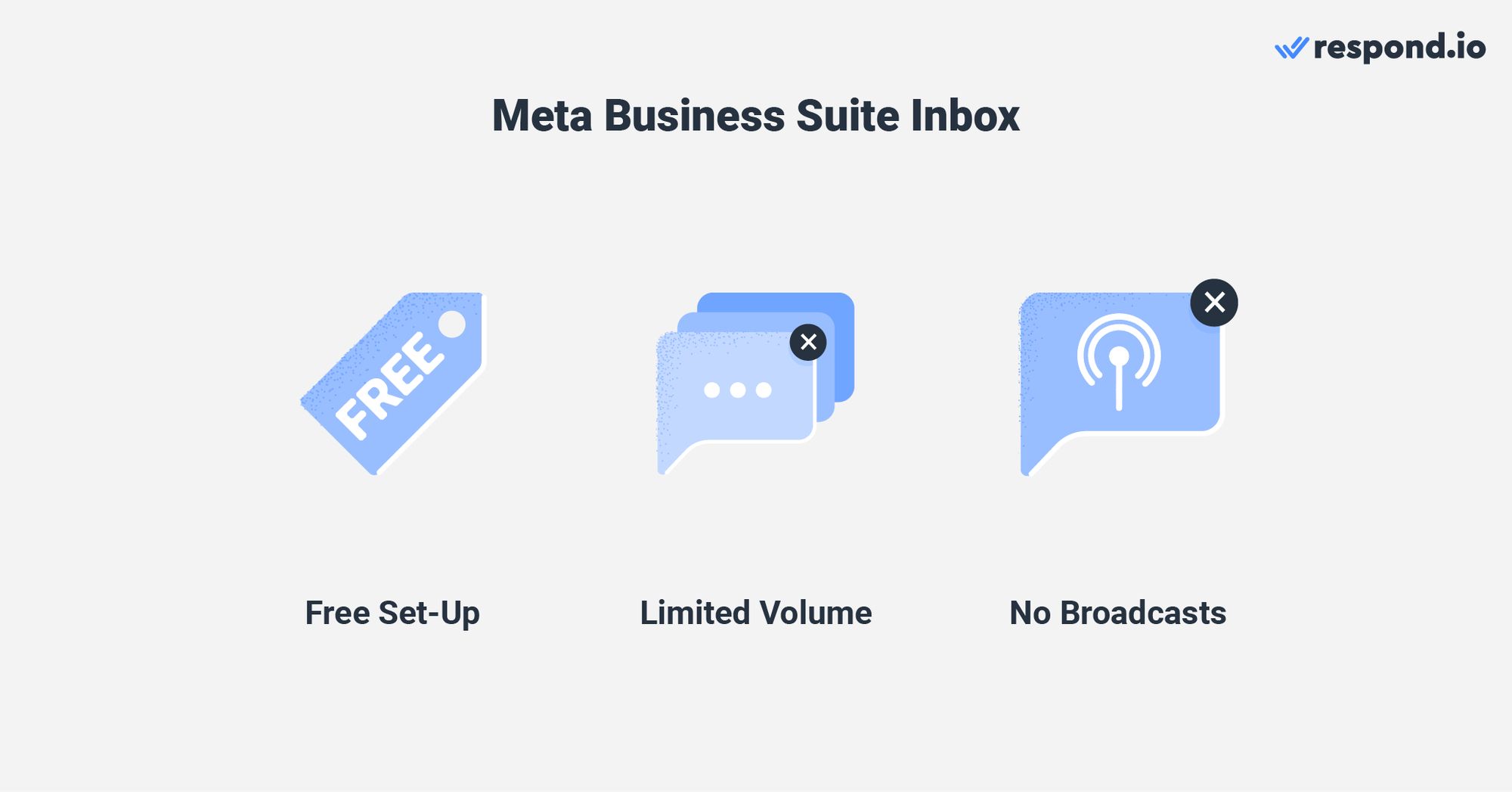
To start using Facebook Messenger for marketing, all you need is a Facebook business page, which gives you access to Meta Business Suite's inbox.
It's completely free to sign up for a Meta Business Portfolio, previously known as a Facebook business account, and there are no charges for sending messages. However, click-to-Messenger ads carry the usual Facebook advertising costs.
Anyone who visits your Page can send you messages and you can reply; even if you're not doing any active marketing, people can search for your business and contact you, and you can respond at any time.
Meta Business Suite has many built-in features that are useful for marketing: you can set basic automated responses like away messages and FAQs, keep all your contacts' conversations in one place and organize contact information for future targeting.
For smaller businesses, these features are usually enough, but mid-market B2C teams will hit three hard limits:
Volume cap: If you send or receive more than 40 messages per second, messages stop arriving in your inbox entirely.
No broadcasts: Meta Business Suite doesn't support sending broadcast messages to contact segments. This is essential for marketing.
No attribution: It can show you which ads started conversations, but not which conversations became paying customers — so ad spend gets optimised on clicks, not revenue.
Facebook Messenger platform connected to respond.io for growing marketing needs
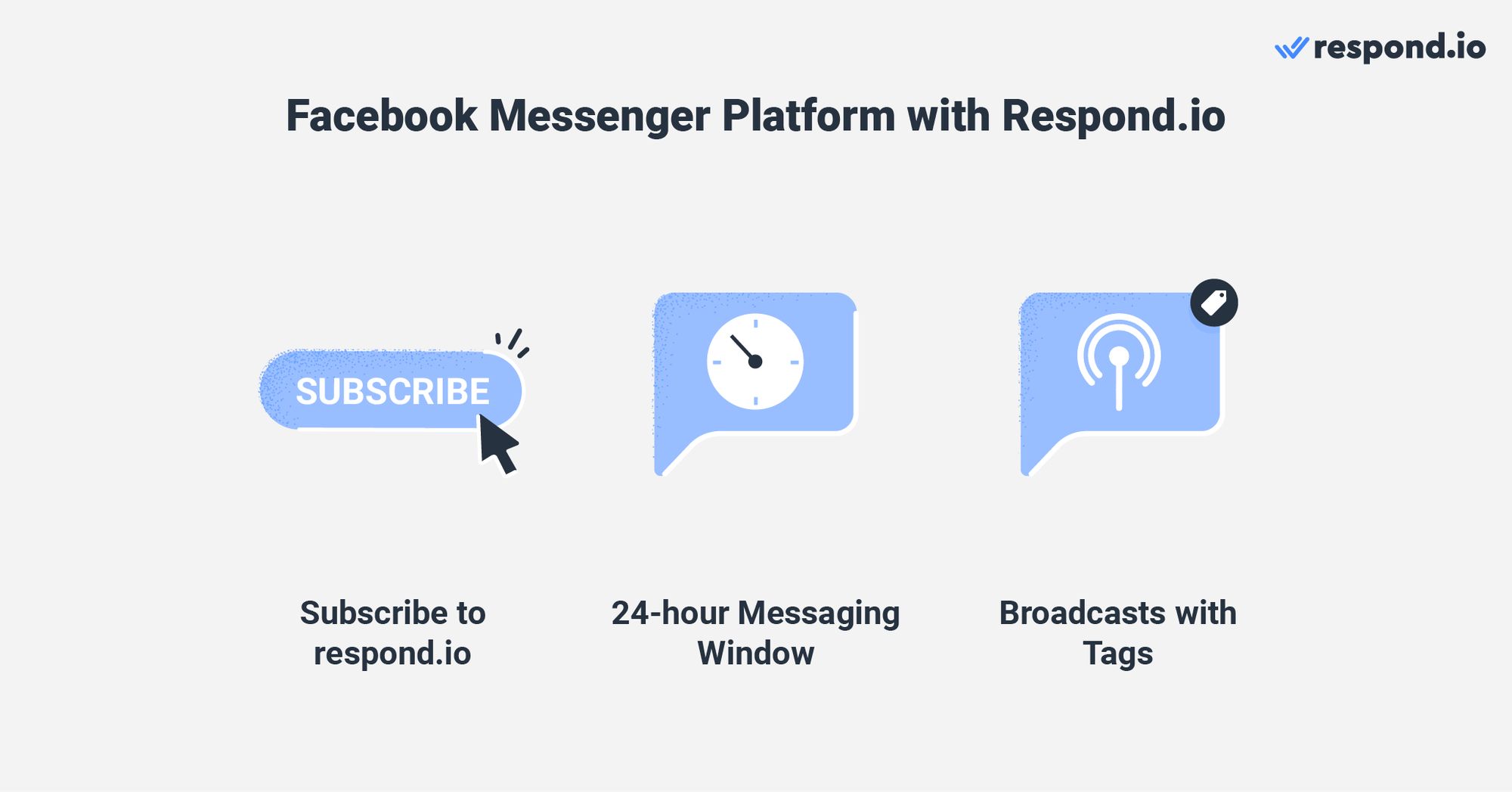
Larger businesses that send high numbers of messages and want advanced automation features will benefit by connecting Facebook to a customer conversation platform like respond.io:
High-volume messaging: Send and receive messages beyond Meta Business Suite's 40/second cap without losing conversations.
Contact organisation: Save contacts and organise them with tags. AI Agents automatically add or remove tags during conversations, turning chat insights into reliable segmentation for follow-up workflows.
24-hour messaging window: One platform limitation to note — once a customer makes contact, you have a 24-hour window to reply freely. After it closes, you must use Meta-approved message templates to continue the conversation
Paid Ads attribution: Respond.io captures the specific campaign, ad group, and ad that triggered each conversation — then tracks that contact's progression from New Lead to Paying Customer. Ad spend optimisation is based on revenue outcomes, not conversation volume.
What respond.io adds when Meta Business Suite isn't enough
Now, let's look at how you can use your Facebook Messenger Platform connected to respond.io to enhance your marketing capabilities.
Track Messenger ad conversions with paid ads attribution
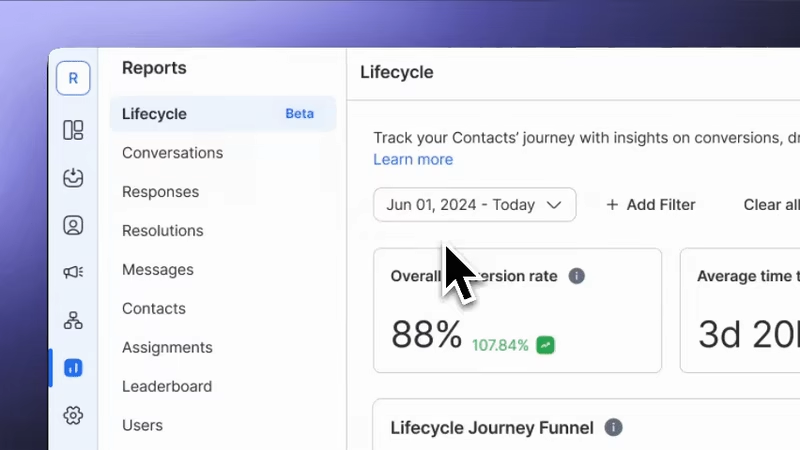
Click-to-chat ads on Messenger are a powerful way to start conversations — but what happens after the click matters most. Without attribution, your Messenger ad strategy is optimised for clicks, not customers.
Businesses running high-volume Messenger campaigns without revenue-stage visibility are routinely reallocating budget toward ads that generate conversations but not pipeline. With respond.io, you can track which Messenger ads actually convert and follow leads all the way through your sales funnel.
In the Reports module, Paid Ads attribution is available in both Contacts and Lifecycle reports. This lets you:
Filter and group leads by Ad Campaign, Ad Group, or specific Messenger Ad
Monitor lead progression from New Lead to Paying Customer
Understand which campaigns generate quality leads that move forward, not just click
With clear attribution data and lifecycle visibility, you can confidently optimize your Messenger ad strategy and maximize ROI — without relying on manual tracking or external tools.
Feed Your Messenger Conversion Data Back to Meta with Conversions API
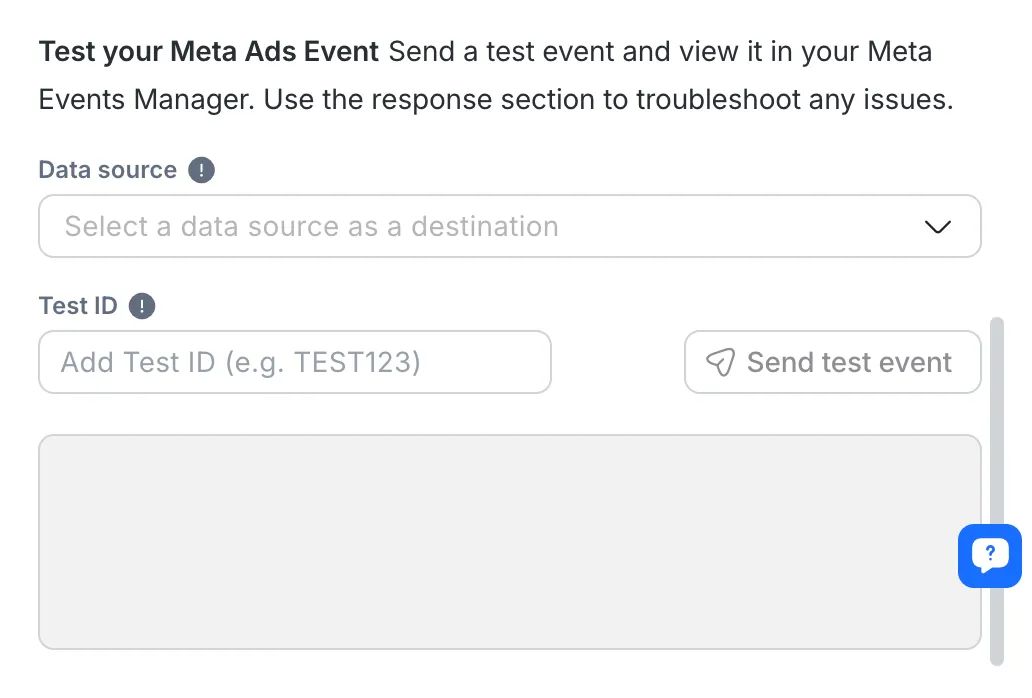
The Meta Conversions API (CAPI) sends your verified conversion events from respond.io back to Meta so Meta can use those signals to optimise your ad delivery.
Using respond.io's Send Conversions API Event Workflow step, you can trigger a CAPI event when a contact reaches a specific stage — for example, when a Messenger lead is qualified, or when a purchase is completed.
Meta receives the signal and learns to prioritise audiences that resemble your actual converting customers. The practical impact:
Fewer spam leads. Meta stops targeting audiences likely to start a conversation but not convert. Businesses using CAPI typically see up to 60% fewer spam leads within weeks.
Smarter ad delivery. Meta optimises toward audiences that resemble your qualified leads, reducing cost per acquisition over time.
More accurate reporting. Because the data is sent server-to-server, it's unaffected by browser privacy restrictions or ad blockers.
Qualify and route Messenger leads automatically with AI Agents
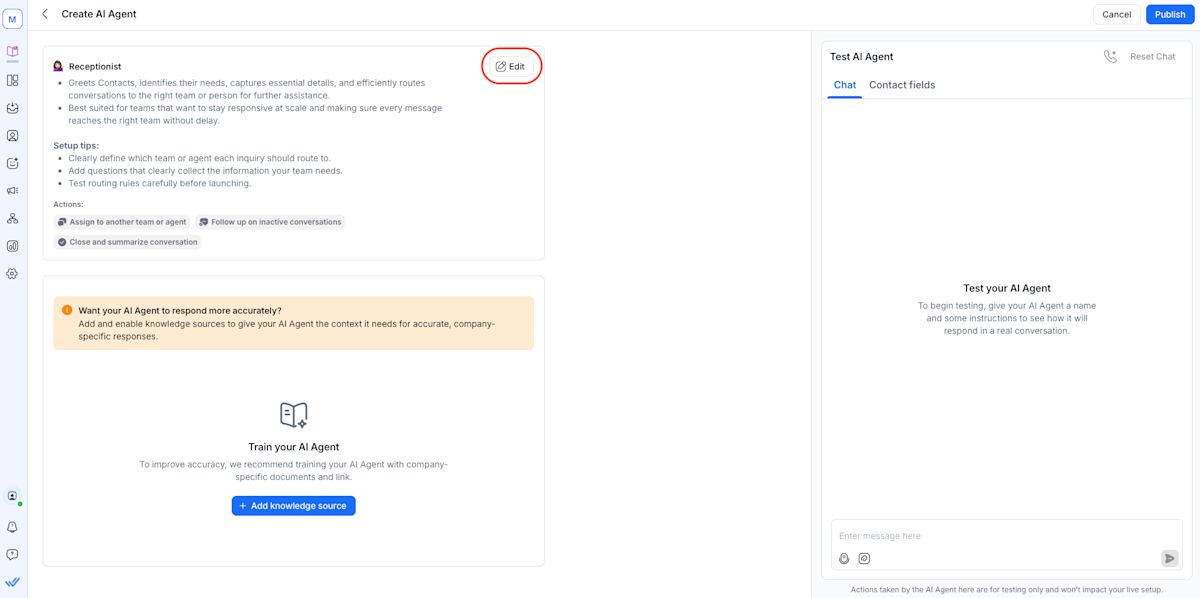
When Messenger ad clicks start generating conversations at volume, the bottleneck shifts to what happens inside the chat. Every inbound conversation that requires a human agent to read, assess intent, and manually route it adds delay — and at high volume, that delay is where leads go cold.
Respond.io's AI Agents handle the full qualification flow autonomously. When a contact messages you from a Messenger ad, the AI Agent responds immediately, collects structured lead details — such as budget, product interest and purchase intent — updates the contact's lifecycle stage, and routes high-intent buyers directly to your sales team via Workflows.
Contacts that don't meet your qualification criteria are filtered out before they ever reach an agent. The practical impact for Messenger marketing:
Instant response, 24/7: AI Agents reply the moment a contact messages — no queue, no delay, regardless of time zone or team availability. The speed advantage of Messenger ads is preserved even at high inbound volume.
Structured qualification without forms: Rather than asking contacts to fill in a form, AI Agents collect details conversationally — asking about budget, intent, or product preference in the natural flow of the chat — and store the answers as structured contact fields.
Spam and low-quality lead filtering: AI Agents identify and deprioritize contacts who are unlikely to convert, so your sales team only receives conversations worth their time.
Automatic contact tagging and segmentation: Tags assigned by AI Agents during qualification are immediately available for Workflows, broadcasts, and follow-up targeting — no manual segmentation step required.
Unlike basic Workflow automation that follows fixed decision trees, respond.io's AI Agents use reasoning to handle complex or unexpected replies, making them suitable for high-volume Messenger campaigns where prospects ask varied questions before deciding to engage further.
Send promotional messages or updates to contacts who opt in
Recurring Notifications is a feature that allows Messenger Platform users to send promotional messages provided that Contacts opt in. Opt-in requests are only allowed during the 24-hour messaging window, and Contacts can choose daily, weekly or monthly notifications.
This is a great way to send newsletters, tips, or updates about products your Contacts are interested in. You can also use these notifications to encourage Contacts to send you a message.
Because respond.io's AI Agents tag contacts during qualification conversations, your Recurring Notification segments stay current automatically.
For example, contact who indicated interest in a specific product category during their first Messenger conversation is added to the relevant broadcast list as part of that qualification flow — no separate segmentation step required.
This is what separates respond.io's broadcast capability from a basic Messenger platform integration: the segments are built by AI, not maintained manually.
Note that the notifications need to be set up in the Facebook Developers Platform and can't be directly sent from respond.io. However, Contacts' responses to the notifications will go to your respond.io inbox.
Sync Messenger conversations with your CRM
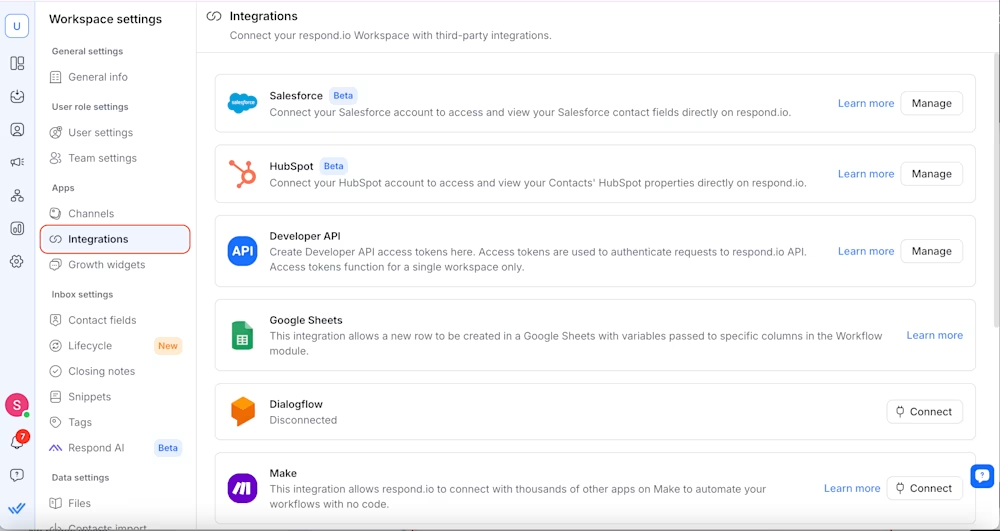
Without a CRM connection, qualification data collected in Messenger — budget, intent, product interest — stays trapped in the chat and never reaches your sales pipeline.
Respond.io connects natively with HubSpot and Salesforce, and supports Zoho and others via Zapier or the API. CRM contact properties are visible directly inside the respond.io inbox, so agents don't need to switch apps mid-conversation. Data collected by AI Agents during Messenger chats is pushed back to the CRM automatically via Workflows — no manual data entry required.
Note that automatic contact sync only applies to contacts added after the integration is enabled. Existing CRM contacts need to be imported manually.
Send automatic replies to post comments
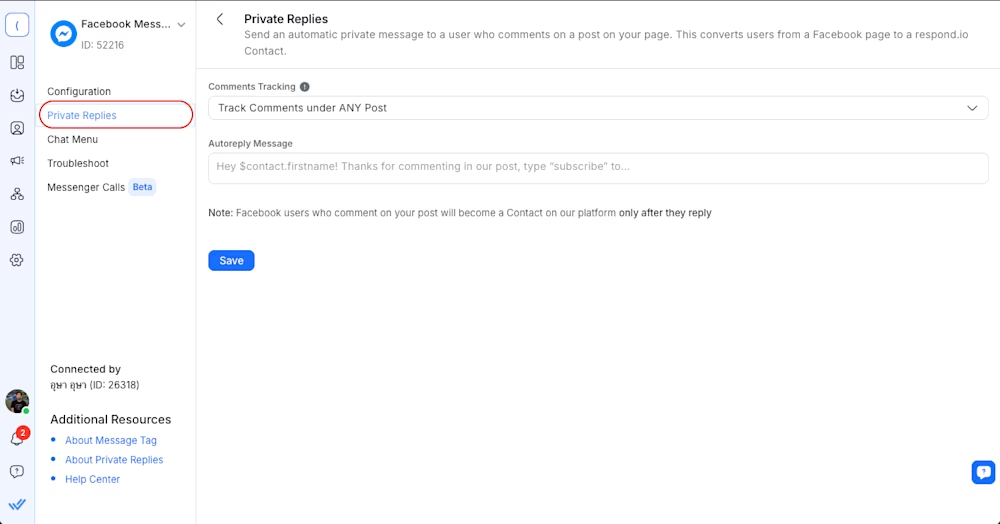
Another way to get contacts is by encouraging comments on your posts and responding to them via Messenger. Use respond.io to track comments and set auto-replies to them.
For example, ask people to leave a heart emoji in the comments to indicate agreement or a need for more information. Using respond.io, select the Comments Tracking option and automatically reply to encourage prospects to take the desired next steps.
This not only engages potential customers, but also turns commenters into contacts, extending your opportunity to target them.
Because respond.io's AI Agents tag these contacts automatically based on their interaction type during the comment-to-Messenger flow, they slot into your existing broadcast and follow-up segments without any manual list management.
This capability is specific to respond.io's Workflow and AI Agent architecture, not available in Meta Business Suite or generic Messenger-connected tools.
Get inspiration from these Facebook Messenger marketing campaigns
Many brands have had success with Facebook Messenger marketing campaigns. Both examples below share a common thread: the conversion gains came not just from switching to Messenger ads, but from being able to handle the conversation volume those ads produced.
ParcelDaily boosts ad conversions by 60% with Meta’s CAPI + respond.io
ParcelDaily is a Malaysian courier service with over 10,000 active users messaging them each month across Facebook Messenger, WhatsApp, Instagram and TikTok. The business was running Meta ads and generating plenty of conversations — but too many were low quality, slowing the team down and making it impossible to tell which campaigns were actually driving bookings.
How they did it:
ParcelDaily connected Meta's Conversions API through respond.io's Send Conversions API Event Workflow step, sending verified conversion signals — qualified leads and completed bookings — back to Meta. They also added AI Agents to collect customer details at the start of each conversation, filtering out low-quality leads before they reached the team.
The results:
Ad conversions increased by 60% and cost per lead from Meta ads dropped by 10%. As CEO Lai Khai Rong put it: "After we connected Meta's CAPI with respond.io, the ad platforms started optimising for leads that actually book deliveries. We saw less spam, faster replies, and 60% more conversions."
Diskat boosts conversions an 80% with Meta’s CAPI + respond.io
Diskat is a Guatemalan retail business running social media ads across Facebook Messenger, WhatsApp and TikTok. Getting hundreds of orders daily, the team was overwhelmed by the volume of inbound chats. Agents spent hours on repetitive tasks, customer data was scattered between chat apps and their ERP, and poor conversion tracking meant ad platforms were optimising for messages — not buyers.
How they did it:
Diskat deployed an AI Agent named Diky through respond.io to handle the full Messenger purchase flow — greeting leads, answering product questions, collecting customer details, confirming orders, and routing to a human agent only for logistics. They also connected Meta's CAPI via respond.io's Lifecycle feature, triggering conversion events each time a contact reached "New Order" stage. This gave Meta real-time data on actual buyers rather than conversation starters.
The results:
90% of sales conversations are now handled end-to-end by Diky, and Diskat maintains an 81.4% conversion rate. Marketing and operational costs were cut in half. As their CEO put it: "Respond.io allowed us to unify and automate our entire sales process, from sales journeys to ad optimization. AI Agent Diky now manages most of our orders, so our team can focus on growth instead of repetitive work."
Is Facebook Messenger marketing right for your business?
Facebook Messenger marketing at scale makes sense for mid-market B2C businesses that meet the following conditions: your target audience is active on Facebook; you are already running or planning click-to-Messenger ad campaigns; and your conversation volume justifies automation.
It is not the right fit for businesses that rely primarily on email marketing and aren't running social ad campaigns, or for teams that aren't prepared to manage real-time inbound conversations.
For mid-market B2C teams whose Messenger campaigns are generating conversations but not measurable pipeline, the gap is almost always infrastructure.
Respond.io closes the three gaps Meta Business Suite can't:
Paid Ads attribution connects your ad spend to paying customers, not just clicks
AI Agents qualify and route leads automatically so volume doesn't kill your response speed
CAPI feeds your conversion signals back to Meta to improve ad delivery over time.
For mid-market B2C teams running Messenger ad campaigns at volume, respond.io is the required infrastructure layer.
Turn customer conversations into business growth with respond.io. ✨
Manage calls, chats and emails in one place!
FAQs about Facebook Messenger marketing
When should a B2C business move from Meta Business Suite to a connected platform for Messenger marketing?
When you hit any of the three limits:
Your message volume approaches 40 per second
You need to send broadcast messages to opted-in contact segments
You need to know which specific Messenger ads are producing paying customers, not just conversations.
Meta Business Suite can't resolve any of these. Once you hit them, connecting to a platform like respond.io via the Facebook Messenger Platform API is the required next step. It's not the right move for businesses still handling low Messenger volumes with no attribution gaps.
Does respond.io work with Facebook Messenger ads specifically?
Yes. When someone clicks a Messenger ad and starts a conversation, respond.io captures the specific campaign, ad group, and ad that triggered it — then tracks that contact's progression from New Lead to Paying Customer in the Reports module. High-intent leads who prefer to call can be handled by Messenger voice call in the same thread.
This is the attribution gap Meta Business Suite doesn't address: it shows you which ads started conversations, but not which conversations became revenue. Respond.io also supports the Meta Conversions API (CAPI), which sends verified conversion events back to Meta so it can optimise ad delivery toward audiences that resemble your actual buyers — not just people who sent a message.
What is the 24-hour messaging window and how do you get around it?
The 24-hour messaging window is a Facebook Messenger Platform rule: once a contact messages your business, you have 24 hours to reply freely. After it closes, you can only continue the conversation using Facebook message templates. With respond.io, you can create and submit your own custom utility templates for Meta approval.
There are two ways to extend it with respond.io. The Human Agent tag extends the window to seven days for expected, non-promotional follow-ups — such as delivering a discount code promised in a contest. For promotional messages, Recurring Notifications allow Messenger Platform users to send updates to contacts who have opted in, choosing daily, weekly, or monthly frequency. Opt-in requests can only be sent during an active 24-hour window.
Can respond.io send broadcast messages on Facebook Messenger?
Yes — Meta Business Suite can't, but the Facebook Messenger Platform connected to respond.io can. Broadcast messages require contacts to opt in to Recurring Notifications first, and opt-in requests can only be sent during the 24-hour messaging window. What separates respond.io from a basic Messenger Platform integration is that AI Agents tag contacts during qualification conversations automatically, so broadcast segments stay current without manual list management. A contact who indicated interest in a specific product category during their first Messenger conversation is added to the relevant broadcast list as part of that flow.
How do AI Agents handle Facebook Messenger leads from ads?
When a contact messages you from a Messenger ad, respond.io's AI Agent responds immediately — no queue, no delay — and handles the full qualification flow: collecting customer details such as budget, product interest, and purchase intent conversationally, updating the contact's lifecycle stage, and routing high-intent leads to your sales team via Workflows. Contacts that don't meet your qualification criteria are filtered out before they reach an agent. Unlike basic Workflow automation that follows fixed decision trees, respond.io's AI Agents use reasoning to handle varied replies, making them suitable for high-volume Messenger campaigns where prospects ask different questions before deciding to engage.
Is Facebook Messenger marketing worth it for high-volume B2C teams?
Yes — Messenger ads consistently outperform feed posts for B2C teams running click-to-Messenger campaigns: FWD Insurance achieved 5.4x higher conversion rates at 5.6x lower ad spend. But the results depend on infrastructure.
Further Reading
Consider reading these to learn more about using Facebook Messenger.


