
















 Electronics
 Fashion & Apparel
 Furniture
 Jewelry and Watches
 Afterschool Activities
 Sport & Fitness
 Beauty Center
 Dental Clinic
 Medical Clinic
 Home Cleaning & Maid Services
 Photography & Videography
 Car Dealership
 Travel Agency & Tour Operator


TL;DR — How to make a WhatsApp appointment booking
To make a WhatsApp appointment booking bot, you need to connect the WhatsApp Business Platform (API) to an AI or automation platform that can manage booking conversations end to end.
Unlock key benefits by letting customers book, reschedule or cancel appointments directly in WhatsApp, improving access, response speed and customer experience.
Set up the booking flow by automating replies that send calendar links, capture booking intent and update appointment data without manual effort.
Apply best practices like reminders, fast responses and CRM integration to reduce no-shows, avoid backlogs and keep appointment data organized at scale.
Does your business regularly schedule appointments? Learn how you can make it easier through WhatsApp appointment booking. In this blog, learn what WhatsApp appointment bookings are, who they’re suitable for and their benefits. Also, discover how to set up appointments on WhatsApp, best practices and how you can win big through respond.io.
What is WhatsApp Appointment Booking?
WhatsApp appointment booking, or WhatsApp reservation system, allows customers to schedule appointments through WhatsApp conversations. It also allows customers to reschedule or cancel an appointment over WhatsApp.
Who Should Use WhatsApp Appointment Booking?
Any business that communicates with customers via WhatsApp can schedule appointments. In our view, the businesses in particular that will stand to benefit the most from WhatsApp appointment bookings are in the following sectors:
Education
Healthcare
Beauty
Real Estate
Food and Beverage
Now that you know what and who WhatsApp appointment booking is for, let's check out what you can gain from it.
Benefits of Booking Appointments via WhatsApp
In today's fast-paced world, businesses constantly seek ways to enhance efficiency and improve customer engagement. WhatsApp Appointment Booking is another tool in your arsenal to achieve these gains.
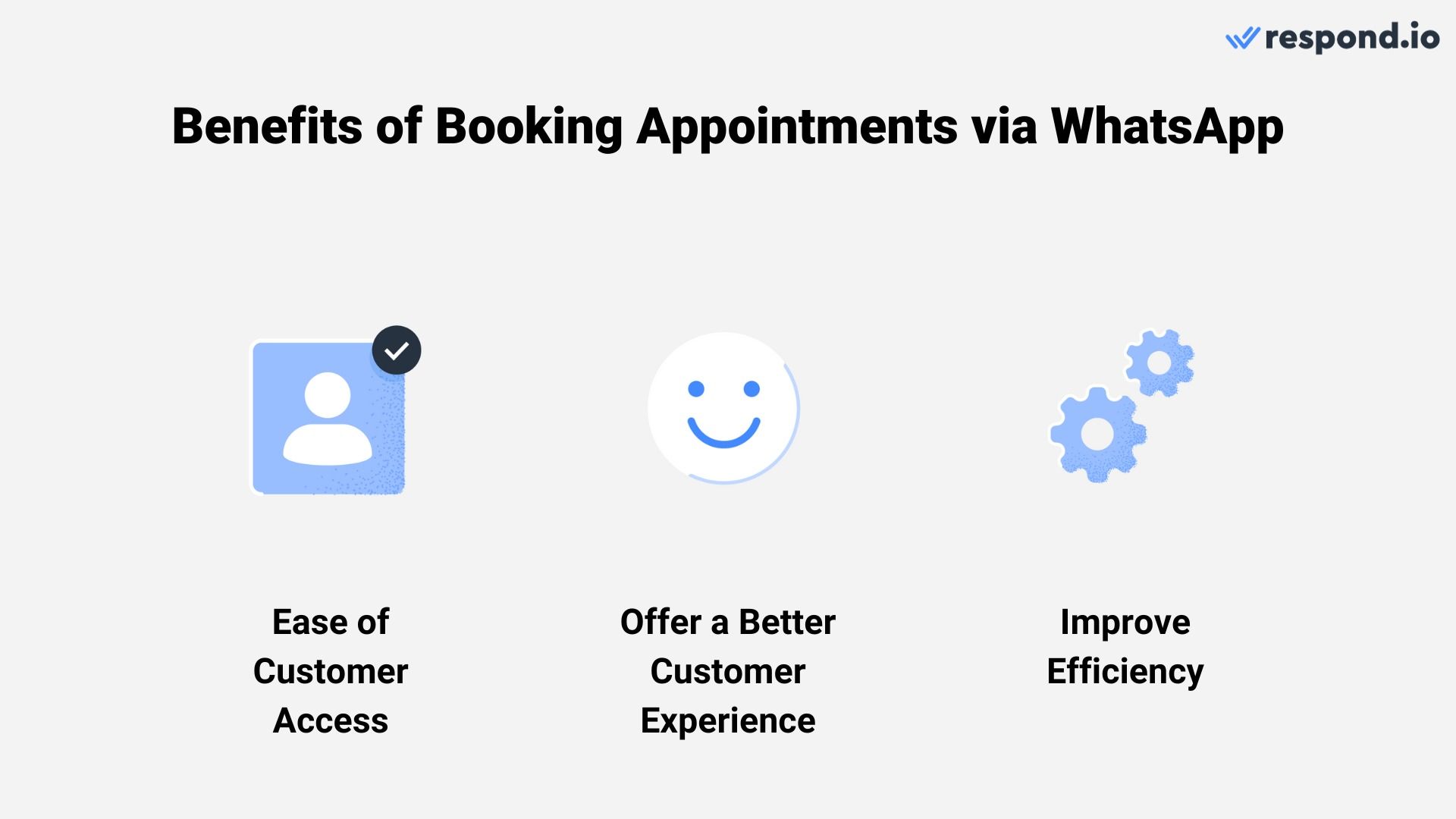
It brings a multitude of benefits to various businesses. With this in mind, we can delve into the benefits that this approach offers.
WhatsApp Business Appointment Booking: Ease of Customer Access
WhatsApp's vast popularity as a messaging app provides unparalleled global reach and convenience. This wide reach makes it an ideal platform for appointment booking across various sectors.
Furthermore, the familiar interface of WhatsApp means that most customers require no additional training or adaptation period, making it straightforward to schedule, reschedule, or inquire about appointments.
WhatsApp Business Appointment Booking: Offer a Better Customer Experience
Allowing customers to make bookings over WhatsApp offers a more personalized experience. Unlike emails or automated phone systems, WhatsApp offers a direct and informal communication channel. This fosters a more personal connection, making customers feel valued and heard.
Additionally, if a customer wants to modify or cancel their booking, they can do so easily. Customers would just need to message the business of the changes.
WhatsApp Business Appointment Booking: Improve Efficiency
For your team, the introduction of WhatsApp Appointment Booking is a game-changer. Automating the appointment scheduling process significantly reduces the manual workload. This automation frees up your staff to focus on more critical aspects of your business.
This improves overall operational efficiency. Additionally, the real-time nature of WhatsApp ensures immediate updating and scheduling, minimizing the chances of errors and delays in the booking process.
While WhatsApp doesn’t natively support appointment bookings, you can use the Workflows automation builder to set up automatic WhatsApp appointment bookings. If you would like to see this feature, upvote this feature request for native support.
In the meantime, let’s explore how to set up appointment bookings using respond.io and its advanced automation builder.
Turn conversations into customers with respond.io's official WhatsApp API ✨
Manage WhatsApp calls and chats in one place!
How to ask for an Appointment Booking on WhatsApp
We’ve designed this user-friendly and straightforward workaround to set up appointment bookings in WhatsApp. It simply requires you to send a Calendly or Google Calendar link to customers. With the Calendly integration, agents can view meeting history and share booking links directly from the Inbox without switching tabs. The Google Calendar integration offers similar functionality, displaying a contact's upcoming and past meetings matched by email in a sidebar drawer.
Before you automate this process, you’ll need a WhatsApp API account connected to a respond.io account.
Here’s a basic sample of a Workflow to set up an appointment on WhatsApp
1. Click the Workflows icon on the left panel.
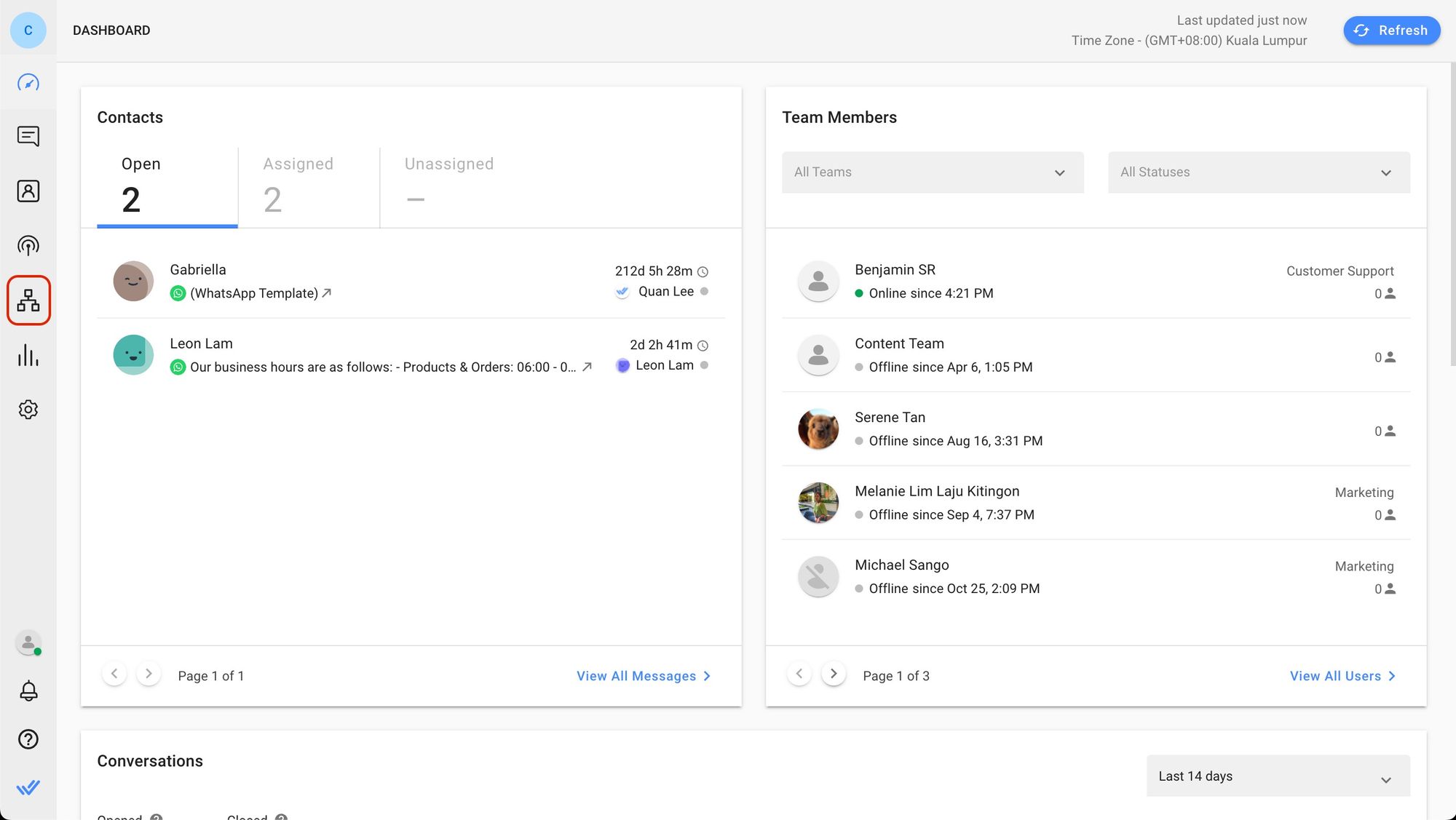
2. Select+ Add Workflow.
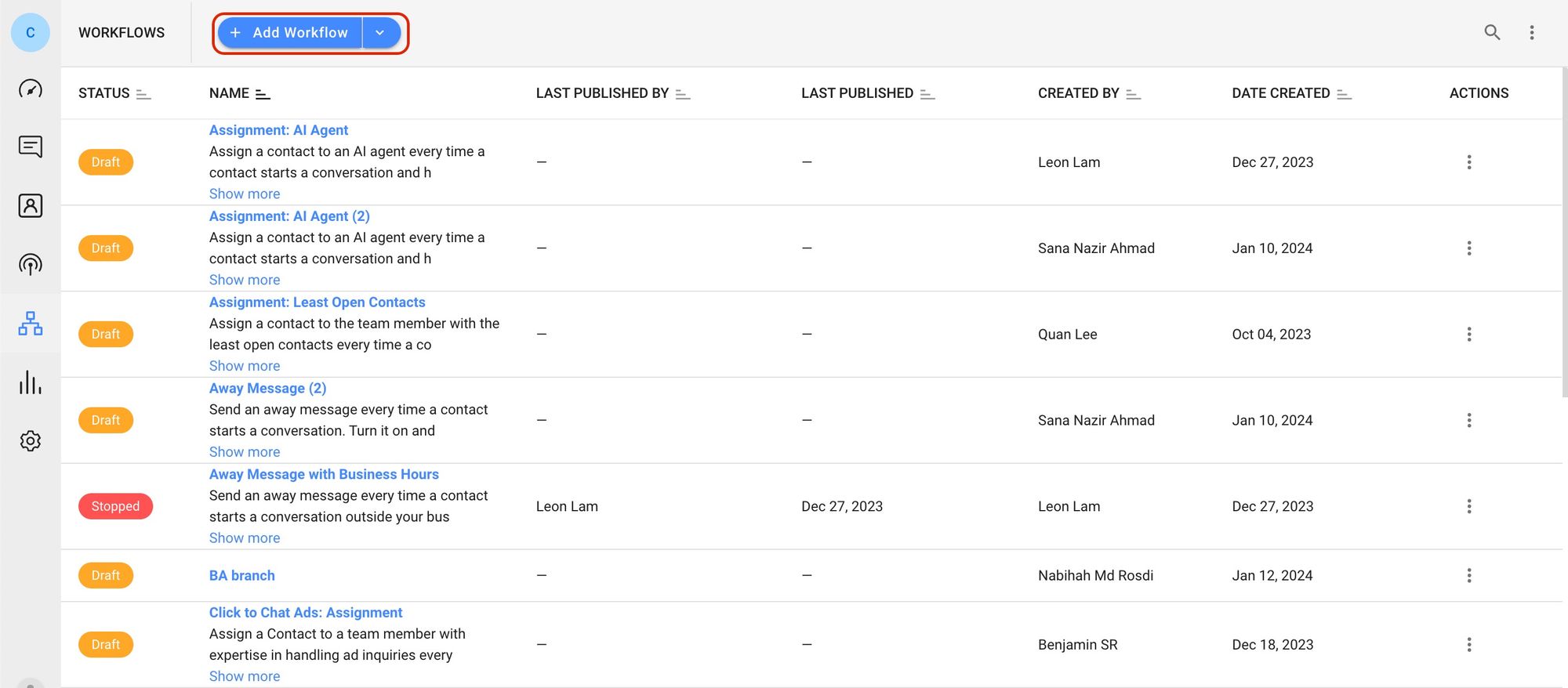
3. Click Auto Responder on the left and then click Simple Chat Menu > Use Template.
3a. Configure the Channel from Last Interacted Channel to WhatsApp API channel. If you only use WhatsApp API, you can move on to the next step.
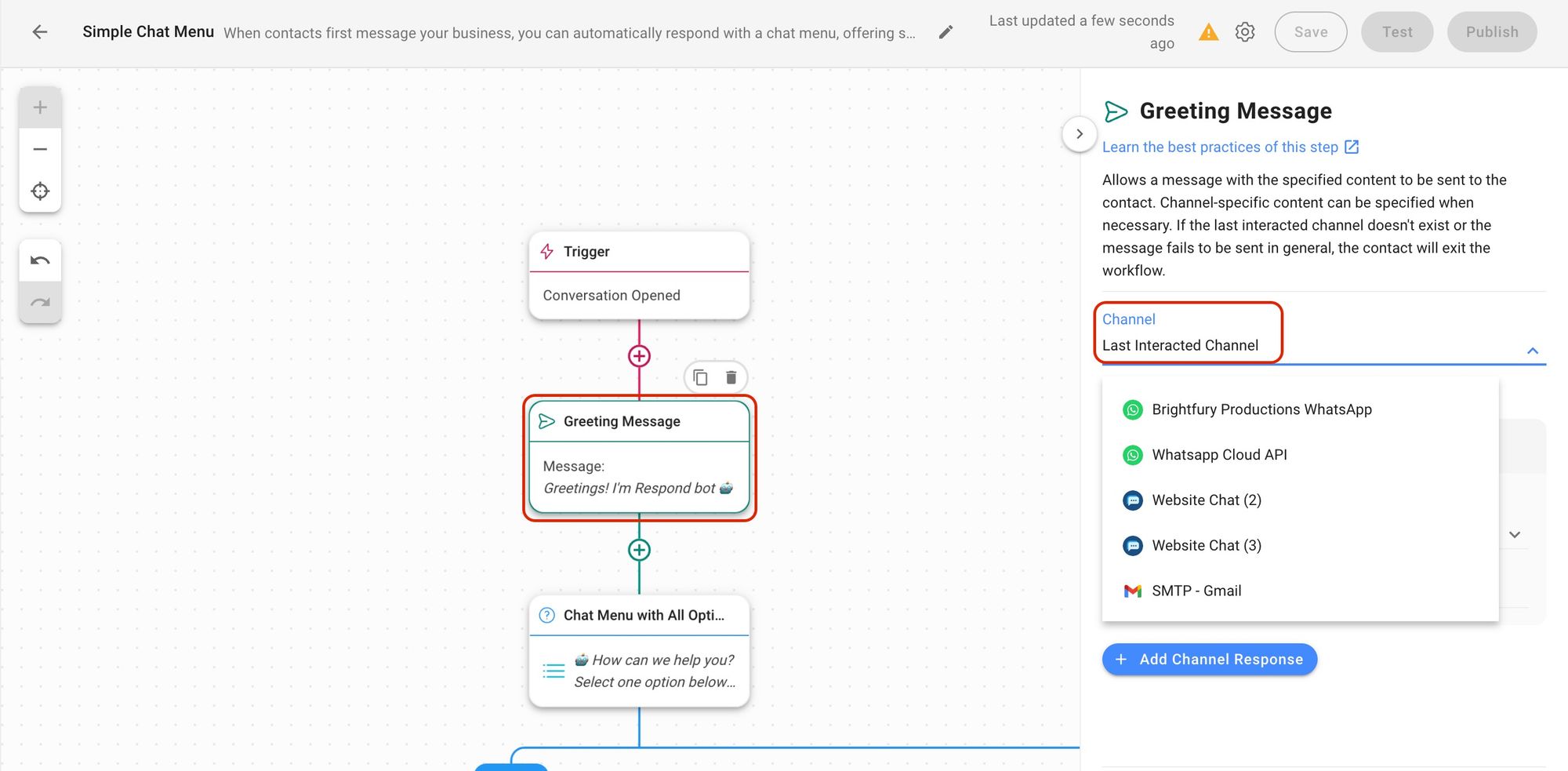
Choose one of the branches to automate your appointment bookings.
4. Edit the text under Message Content and include your link here.
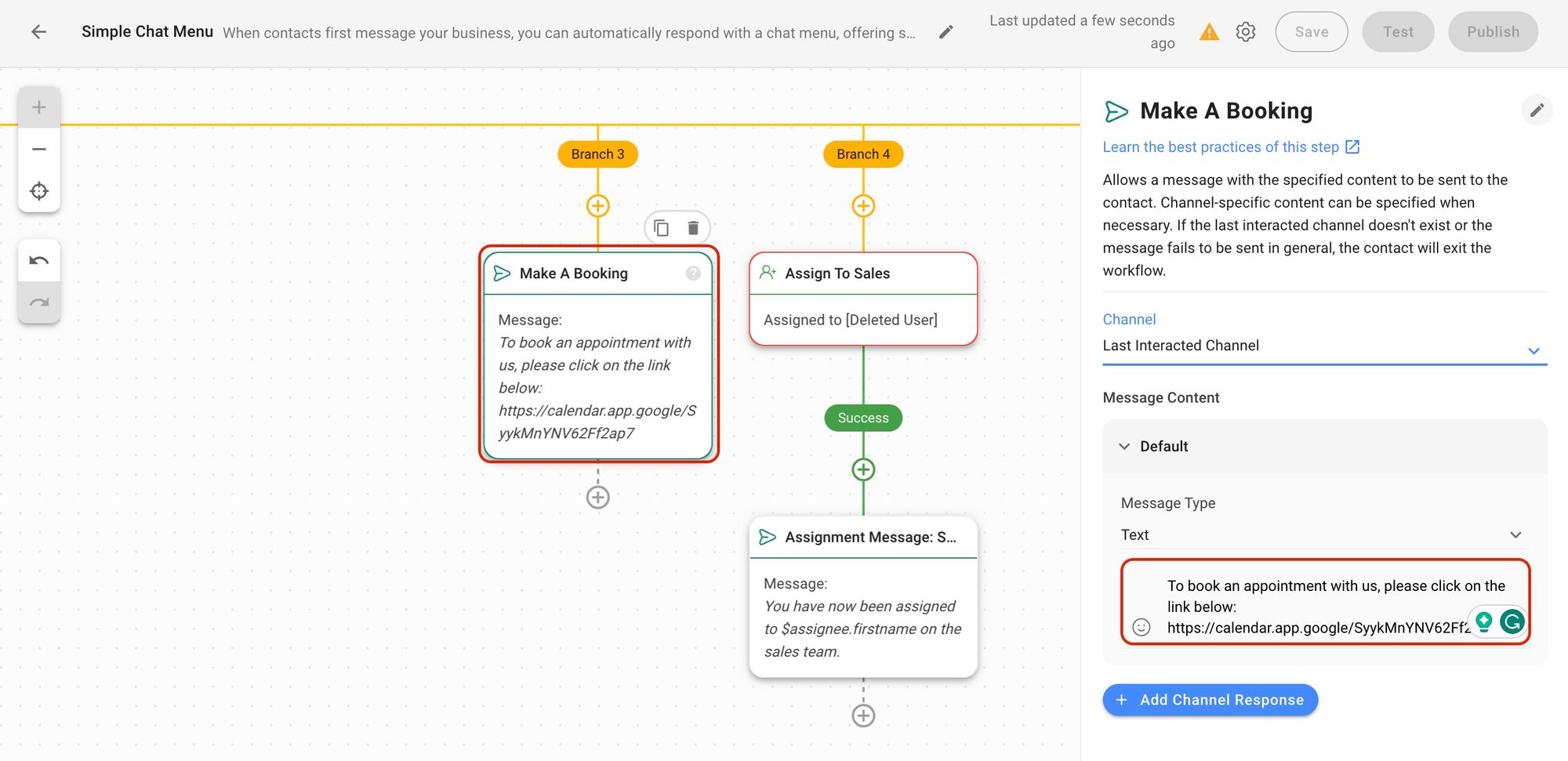
You can configure the rest of the branches as needed. Once, you’re done, press Publish to start the Workflow.
Alternatively, you can also select the Click-to-Chat Ads: Assignment if you want to streamline the meeting booking process for leads generated from Meta click-to-chat ads.
Now that you’re familiar with the setup process to schedule appointments on WhatsApp, let’s look at the best practices.
WhatsApp Business Appointment Booking: Best Practices
Automating your appointment booking process is great, but it’s not the be-all and end-all. You’ll also need to keep in mind of
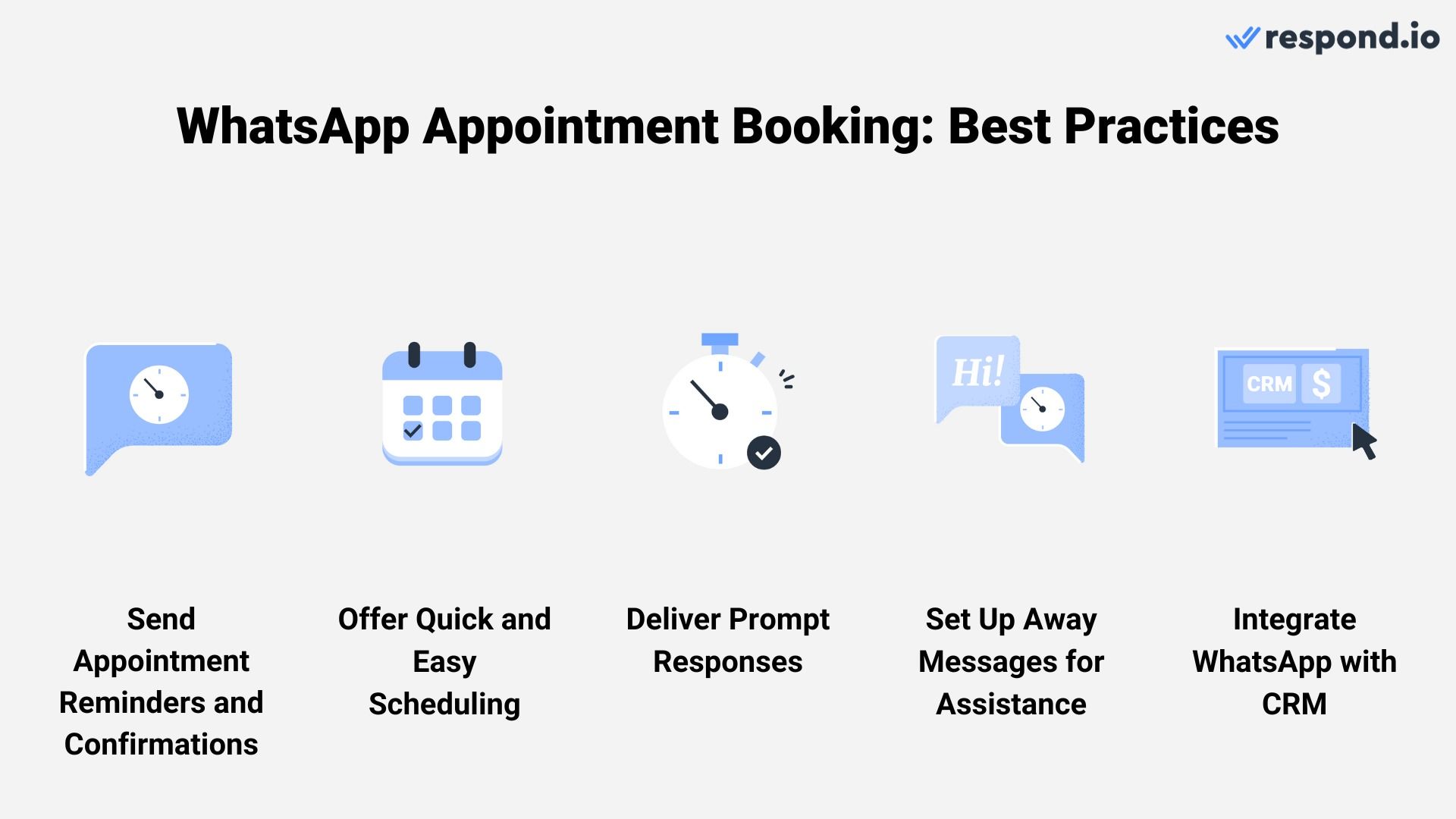
Send Appointment Reminders and Confirmations
Utilizing WhatsApp to send appointment reminders and confirmations is an effective strategy to minimize no-show rates. By directly reaching out to customers on a platform they frequently use, businesses ensure that appointment details are conveniently accessible.
This approach can be enhanced by including links to manage or modify appointments, thus simplifying the process for the customer. You should also consider using the WhatsApp Business Calling API for sending reminders. Regular reminders, like a day before and an hour before the appointment, can significantly reduce the likelihood of no-shows.
Offer Quick and Easy Scheduling
The goal is to make the scheduling process as effortless as possible for the customer. This can be achieved by implementing user-friendly interfaces for appointment booking, providing clear availability options and minimizing the steps required to confirm an appointment.
If you want a more effortless option, configure your AI Agent to check availability via live API calls and send calendar links when the customer is ready to book. With the Cal.com integration, agents can also view a contact's upcoming and past meetings directly in the Inbox and share the correct booking link from a dropdown without switching tabs. The Calendly integration offers similar functionality, letting agents see upcoming and past meetings matched by email or phone and copy personal or team booking links in one click.
The Calendly integration lets agents see upcoming and past meetings matched by email or phone and copy booking links in one click. Similarly, the Google Calendar integration surfaces a contact's meetings in a sidebar drawer, matched by email across a rolling 12-month window.
Streamlined scheduling not only enhances customer experience but also reduces the administrative burden on the business.
Deliver Prompt Responses
Quick response times to customer inquiries and requests for appointment changes are crucial in maintaining customer satisfaction and efficiency. By promptly addressing these needs, businesses demonstrate their commitment to customer service and adaptability.
This can be facilitated by AI Agents for common inquiries and a dedicated support team for more complex issues. Agents can leverage the WhatsApp Business Calling API for lengthy or complex discussions, minimizing customer frustration and accelerating decision-making.
Set Up Away Messages for Assistance
For instances where live assistance is required for booking or rescheduling appointments, setting up informative away messages is vital. These messages can inform customers about operation hours and provide guidance on when they can expect a response.
This approach helps manage customer expectations and maintains communication transparency.
Integrate WhatsApp with CRM
Automating the initial inquiry and booking processes through chatbots can significantly enhance efficiency. When WhatsApp is integrated with a Customer Relationship Management (CRM) system, it creates a seamless workflow for managing appointments and customer data.
This integration enables businesses to track customer interactions, preferences and history, leading to personalized service and better appointment management. Now, let's look at how managing appointments on WhatsApp has worked for a beauty business.
How EMAX Beauté booked 18× more appointments with WhatsApp
EMAX Beauté, a multi-brand beauty and wellness group in Kuala Lumpur, used WhatsApp as its primary appointment booking channel to turn high chat volume into real conversions. With thousands of leads coming from Meta and TikTok ads, the challenge wasn’t demand—it was responding fast, filtering spam and securing bookings before interest dropped.
By centralizing WhatsApp conversations and automating lead handling, EMAX was able to respond 75% faster, engage customers while intent was high and dramatically reduce friction in the booking process. Instead of pushing customers to forms or calls, agents confirmed availability, answered questions and booked appointments directly in WhatsApp—often collecting payment in the same conversation.
WhatsApp also played a critical role in improving lead quality. By sending conversion data back to Meta via CAPI, EMAX reduced spam leads by 60%, ensuring agents focused on genuine prospects who were more likely to book. With clear visibility into lead stages and faster follow-ups, WhatsApp became a high-conversion channel rather than just a messaging inbox.
The result: EMAX increased appointments booked via chat by 18×, proving that when WhatsApp is used as a real-time booking and conversion channel—not just for inquiries—it can significantly outperform traditional appointment flows.
You can achieve similar success with respond.io, an AI-powered customer conversation platform. Let’s check that out next.
Quick Wins with Respond.io
We’ve talked about how you can use respond.io’s advanced features to enable a WhatsApp Business appointment booking. Now, let’s take a look at the other features on respond.io that businesses use in their daily operations.
Reduce First Response Time and Maintain High-Traffic Ads
E4CC, an English language training provider for Latin Americans, faced challenges in managing operations across different locations and needed to improve its conversational support methods due to high-resolution times.
After implementing respond.io, E4CC consolidated its regional operations onto a single platform, leading to an 80% decrease in first response time and improved engagement and resolution efficiency through WhatsApp support.
They also recognized the effectiveness of click-to-chat ad campaigns as the primary driver of new student sign-ups and have retained WhatsApp as the channel for sales use.
Monitor Performance
Contable.app, a Chilean bookkeeping company, faced challenges in managing customer communications. Initially, their accountants used personal WhatsApp accounts for client interactions, causing issues like a lack of oversight by managers.
Since adopting respond.io, managers can oversee and guide accountants' customer interactions, ensuring clear communication. This system also helps manage and follow up on all customer conversations efficiently, addressing previously common issues of neglected chats.
Of course, there’s a ton more for respond.io to offer like Respond AI, a conversational AI that improves your responses, gives quick replies and automatically answers customer inquiries. If you’d like to use this feature and schedule appointments over WhatsApp, sign up for a free respond.io account.
Turn conversations into customers with respond.io's official WhatsApp API ✨
Manage WhatsApp calls and chats in one place!
FAQs about WhatsApp appointment booking
Can a WhatsApp bot open a calendar and let customers choose a date?
Not directly inside WhatsApp. WhatsApp does not support embedded calendars or date pickers within chats. Instead, the standard approach is for the bot to send a booking link (such as from Calendly or Google Calendar) at the right moment in the conversation. When the customer taps the link, the calendar opens in their browser, where they can select an available date and time.
This method is widely used because it keeps the WhatsApp conversation simple while delegating scheduling logic—like availability rules, time zones and buffers—to tools built specifically for that purpose. From the customer’s perspective, the experience still feels seamless: they stay in WhatsApp, tap once, book, and return to the chat.
Can I show customers available appointment slots before they book?
Yes, but availability is not generated by WhatsApp itself. A WhatsApp bot can ask qualifying questions (such as service type or preferred date range) and then send a scheduling link that displays real-time availability managed by an external calendar system.
With respond.io's Cal.com integration, agents can fetch available time slots dynamically and book meetings on behalf of customers directly from the conversation. Similarly, the Calendly integration surfaces upcoming and past meetings in the Inbox and lets agents share the right booking link in one click.
This setup ensures accuracy. Availability checks, conflict prevention and real-time updates are handled by the scheduling tool, which reduces double bookings and manual errors. WhatsApp’s role is to guide the user to the right booking step and confirm once the appointment is completed.
Does WhatsApp support native appointment booking without external tools?
No. WhatsApp does not currently support native appointment or meeting booking. There is no built-in way to create, manage or store appointments directly inside WhatsApp.
Because of this limitation, businesses rely on external scheduling platforms and integrate them into WhatsApp conversations using automation. While this adds an extra step, it also provides flexibility—businesses can choose tools that match their industry, complexity and scale, rather than being locked into a single native option.
Are Calendly and Google Calendar the only options for WhatsApp appointment booking?
They are the most common and beginner-friendly options, but they are not the only ones. Any scheduling platform that offers shareable booking links or API access can be used with WhatsApp.
This includes industry-specific booking tools for healthcare, beauty, education or professional services. The key requirement is that the tool can securely manage availability and provide a link or confirmation that can be shared through WhatsApp.
Can WhatsApp appointment bookings sync with a CRM like HubSpot or Salesforce?
Yes. When WhatsApp is connected to an automation or messaging platform, booking data can be sent to CRMs like HubSpot or Salesforce automatically. This allows businesses to log appointments, update contact records and track booking history without manual data entry.
CRM sync is especially useful for sales and service teams that need visibility into customer interactions, follow-ups and conversion outcomes. It also enables reporting on appointment-to-sale performance and lifecycle tracking.
Can customers select appointment slots directly from WhatsApp menus or buttons?
WhatsApp menus and buttons can guide users through the booking flow, but they cannot display or manage live appointment slots. Instead, buttons are typically used to trigger workflows—such as “Book Appointment” or “Check Availability”—which then send the appropriate booking link.
This approach reduces friction while staying within WhatsApp’s interface limits. Customers make one clear choice in chat, then complete the actual booking in the external scheduling tool.
Can a WhatsApp bot send appointment confirmations and reminders automatically?
Yes. Once an appointment is booked through the scheduling tool, automated WhatsApp messages can be sent to confirm the booking, share details and send reminders.
This is a best practice for reducing no-shows. Many businesses send confirmations immediately after booking, followed by reminders one day or one hour before the appointment. Because WhatsApp messages are highly visible, they tend to outperform email reminders in engagement and response rates.
Can WhatsApp bots handle complex booking flows like dates, services and pricing?
Partially. WhatsApp bots can collect preferences such as service type, preferred date range or location, and use that information to route customers to the correct booking link or pricing option.
However, complex logic—such as validating availability, calculating prices or enforcing booking rules—is handled by external systems. WhatsApp serves as the conversational layer that simplifies the customer journey and reduces back-and-forth messages.
Can I automate payments together with WhatsApp appointment booking?
Yes, using external payment tools. After a customer selects an appointment, a WhatsApp bot can send a payment or deposit link to confirm the booking.
This is commonly used for high-demand services, paid consultations or no-show prevention. Payments are processed outside WhatsApp, but the confirmation and follow-up happen inside the chat, keeping the experience cohesive.
Can WhatsApp appointment booking be automated end to end?
The conversation flow and follow-ups can be fully automated, but the core scheduling logic still lives outside WhatsApp. In practice, WhatsApp acts as the front-end communication channel, while specialized tools handle availability, bookings and confirmations.
When set up correctly, this still feels like an end-to-end experience for the customer—message, book, confirm, get reminders—all through WhatsApp, even though multiple systems are working behind the scenes.
Further Reading
If you liked this read and want to learn more about WhatsApp, here are more articles for you:


