















 Electronics
 Fashion & Apparel
 Furniture
 Jewelry and Watches
 Afterschool Activities
 Sport & Fitness
 Beauty Center
 Dental Clinic
 Medical Clinic
 Home Cleaning & Maid Services
 Photography & Videography
 Car Dealership
 Travel Agency & Tour Operator


TL;DR — For mid-market B2C teams with high WhatsApp conversation volume, ROI stays invisible when the platform can't tie conversations to closed revenue
The attribution gap is a platform problem — if your setup stops tracking at the click and can't connect offline payments back to WhatsApp, the system is insufficient.
Respond.io closes it through CAPI for ad attribution, CRM sync for pipeline tracking, and Lifecycle Reports that connect conversation activity to funnel outcomes.
Not the right fit if your AOV is under $50 without a repeat-purchase model, you want full automation, or you're doing cold outreach.
For mid-market B2C businesses already running WhatsApp at scale, the channel works. The problem is whether the platform around it can show you that. Customers message, conversations happen, deals close — but when payments happen offline, via bank transfer, or in person, standard ad tracking loses the thread at the click. Most WhatsApp platforms don't connect what happens in the conversation to what eventually closes.
That's not a WhatsApp problem. It's a platform problem. This page covers what a system that closes the attribution gap looks like, what it costs, what it proves in practice, and whether respond.io fits your specific setup.
Does your current platform have an attribution gap?
If your platform stops tracking at the click and can't connect what happens in the conversation to what eventually closes, you have an attribution gap — and it's costing you visibility into real revenue. Most WhatsApp platforms share the same structural limitation: they track what happens before and during the conversation, but not what closes after it. Three questions confirm whether yours does:
Can you see which ad campaigns generate conversations that close?
Not without Conversions API (CAPI) integration. Standard ad platform tracking stops at the click, so your ad spend gets optimized on click volume rather than purchases, bookings or qualified leads. You're spending against the wrong signal.
Can you connect a WhatsApp conversation to a deal record in your CRM?
Only if your platform syncs conversation data directly to pipeline records. When customers pay offline, via bank transfer or in-store after a WhatsApp conversation, there's no automatic link between chat activity and closed revenue without that sync.
Can you calculate your actual cost per conversation, including agent time?
Not from most default dashboards, which report Meta fees but not platform costs or agent hours. Without the full cost picture, ROI calculations are structurally incomplete.

If your current platform can't close these three gaps, respond.io is built specifically to address them — through CAPI for ad attribution, CRM sync for pipeline tracking, and built-in analytics that include agent activity and conversation outcomes.
What does WhatsApp attribution actually require?
WhatsApp attribution requires three mechanisms working together: CAPI to send conversion events back to ad platforms, CRM sync to link conversations to pipeline records, and unified conversation tracking to keep context across channels. Standard attribution breaks because WhatsApp's cost and revenue model doesn't behave like email or paid ads.
You're charged per outgoing message rather than per click or platform seat, and each business number gets 1,000 free service messages a month inside the 24-hour window, with utility templates charged from the first send. Revenue then closes in ways standard tracking was never designed to capture: offline payments, bank transfers and in-person visits.
WhatsApp marketing ROI measures return on total spend across Meta message fees, platform costs, agent time and ad spend — but only if the platform connects those costs to actual closed revenue. Most don't.
CAPI (Conversions API)
Sends conversion events — purchases, bookings, qualified leads — directly from your platform back to Meta and TikTok. This connects ad spend to revenue outcomes rather than click volume, so campaign optimization reflects what actually closes. In respond.io, a Send Conversions API Event Workflow step sends these events, and the click ID from click-to-WhatsApp ads is captured automatically.
CRM sync
Connects WhatsApp conversations directly to pipeline records. When a customer messages on WhatsApp and closes a deal three days later offline, CRM sync creates the link that standard attribution misses. Respond.io syncs conversation data and customer records automatically with major CRMs.
Unified conversation tracking
When conversations come from multiple channels — WhatsApp, Facebook Messenger, Instagram, TikTok — a fragmented inbox means lost context and dropped leads. A unified inbox with lifecycle tracking routes conversations to the right team and maintains the thread across the customer journey.
Without all three in one place, the attribution picture remains incomplete regardless of how well the channel performs.
Which WhatsApp metrics actually predict revenue — and which are vanity?
Funnel conversion rate, ad attribution by campaign, agent performance and lifecycle journey data predict revenue. Delivery, read and response rates are vanity metrics on their own — they confirm activity, not outcomes. Most WhatsApp platforms surface only the second group by default. For mid-market B2C businesses with high conversation volume, the distinction matters: a 95% delivery rate on a poorly targeted broadcast still costs money and produces nothing.

Engagement metrics: what most platforms show you by default
These metrics confirm activity, not outcomes. They're useful for diagnosing list quality or timing problems, but they don't predict revenue.
Delivery rate
Percentage of messages successfully delivered. Most platforms report this. Low rates signal contact list quality issues or technical problems that waste conversation costs before a conversation even starts. Target 95%+. This metric tells you whether your messages are reaching people — it doesn't tell you whether they're driving anything.
Read rate
Percentage of delivered messages that customers open. WhatsApp typically hits 98%, far higher than email. Most platforms report this. Lower rates suggest timing or preview text issues — but a high read rate with no replies still costs money and produces nothing.
Response rate
Percentage of customers who reply. Typically 10–20% for promotional broadcasts and 30–50% for service messages. Most platforms report this. If yours are lower, the message content likely needs work — but response rate alone doesn't tell you whether responses convert.
Revenue metrics: what most platforms don't surface — and what respond.io makes possible
Funnel conversion rate to Won stage
Respond.io's native Lifecycle Reports track contacts from funnel entry through to a Won stage, giving you an overall conversion rate across your WhatsApp pipeline. If 100 contacts enter and 40 reach Won, your conversion rate is 40%. This is the closest verifiable equivalent to a conversation-to-sale rate that the platform surfaces natively — without requiring manual aggregation across separate tools. Most platforms don't have this because it requires lifecycle stage tracking built into the conversation layer, not bolted on from a separate CRM.
Ad attribution by campaign via CAPI
With CAPI integrated, you can see which campaigns generate contacts that progress through your funnel and close, not just contacts that start a conversation. Respond.io's Lifecycle Reports combine ad source attribution with lifecycle stages — so you can compare performance across campaigns to see which ads bring in leads that actually convert, and identify where drop-offs occur by campaign. Without CAPI, your ad platform optimizes on clicks and has no signal from what happens after the conversation starts.
Agent and conversation performance
Respond.io's built-in reports cover response times, resolution rates, conversation trends and agent performance. These are the inputs you need to calculate cost per conversation manually: agent activity data from respond.io combined with your platform fee and Meta message costs gives you the full picture. The platform doesn't calculate cost per conversation automatically, but it provides the agent-side data that most platforms exclude entirely.
Lifecycle journey from first contact to repeat purchase
Respond.io's lifecycle tracking logs every chat, note and tag from first contact through to repeat purchase, capturing drop-off points across the customer journey. This gives teams the data to identify where retention breaks down and which stages need re-engagement — the foundation for understanding long-term value from WhatsApp-acquired customers. CRM integrations (HubSpot, Salesforce, Pipedrive and others) keep contact and deal data in sync, connecting respond.io conversation data to your existing pipeline records.
The pattern is consistent: the metrics that predict profitability require a platform that connects conversation activity to funnel outcomes. Platforms without lifecycle tracking and CAPI leave the gap between conversation volume and closed revenue permanently invisible.
How to calculate WhatsApp marketing ROI — and why most teams undercount costs
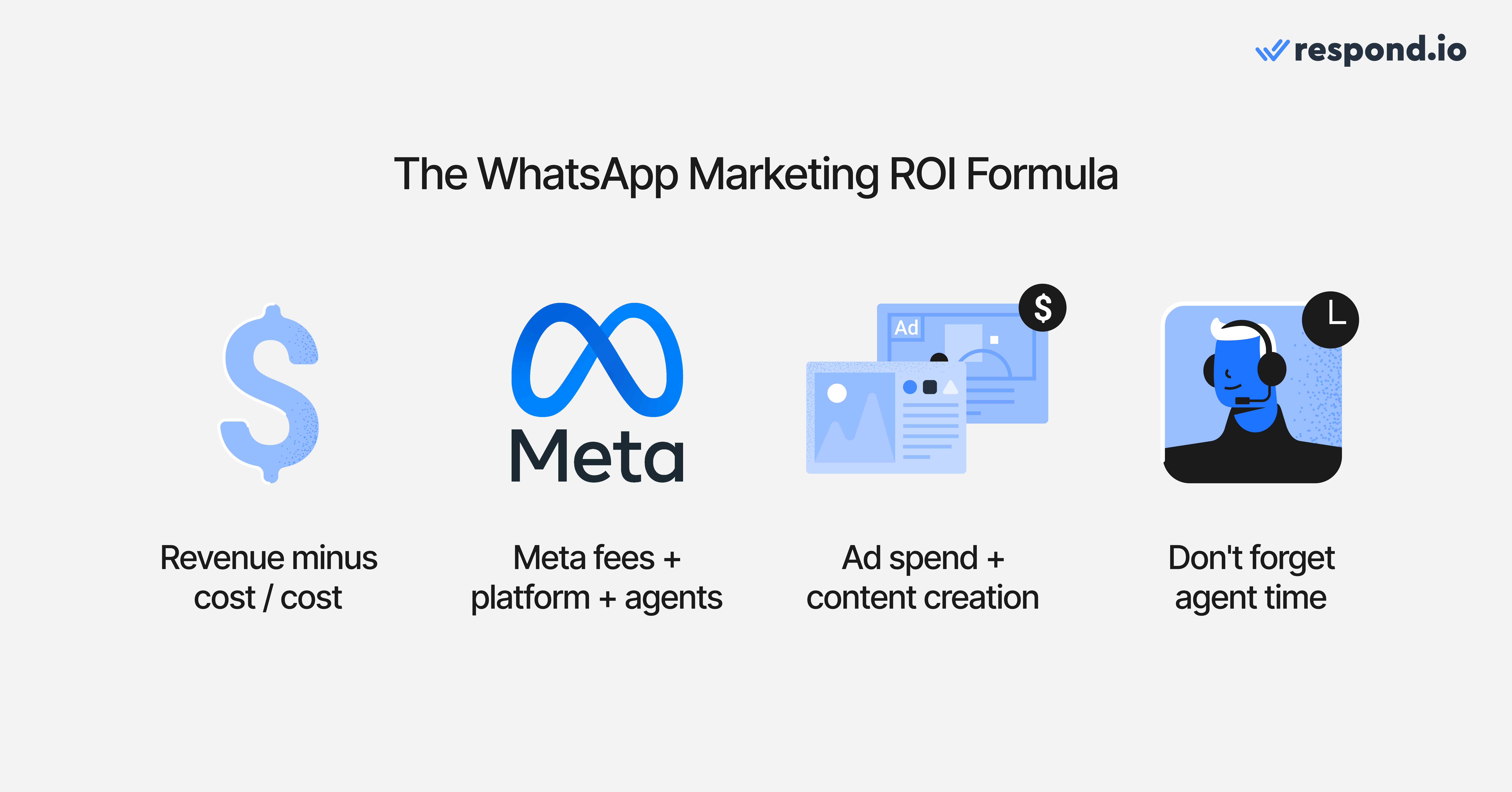
ROI = (Revenue − Cost) / Cost × 100, where cost includes Meta message fees, platform fees, agent time and ad spend. Most teams undercount because agent time and platform costs are excluded from default reports, and because revenue that closes offline never gets attributed back to the channel without CRM sync and CAPI in place. Respond.io closes the revenue side of the gap through CRM sync and CAPI, and its reports supply the agent activity data you need for the cost side.
Use the WhatsApp Pricing Calculator to estimate your specific Meta costs by country and volume.
What does respond.io's attribution system look like in practice?
In practice, respond.io's attribution system connects ad spend to bookings and purchases through CAPI, filters unqualified leads before they reach agents, and tracks every contact through lifecycle stages to a closed sale. The two businesses below show what was breaking before respond.io and what changed after.
EMAX Beauté: Consultative beauty and wellness sales
EMAX Beauté books beauty and wellness appointments through chat, with leads arriving from ads across multiple channels.

What broke for EMAX Beauté without respond.io
Spam leads consumed agent time at full cost because there was no qualification layer before inquiries reached the team. Ad spend was optimized on clicks rather than bookings because CAPI wasn't connected — the platform had no way to send conversion events back to Meta or TikTok. No visibility into which campaigns were driving actual bookings meant budget allocation was based on click volume alone.
What respond.io closed for EMAX Beauté
All channels connected into a unified inbox with automated lead source tracking. CAPI and TikTok Lower Funnel Events added for ad attribution. AI qualification filtered unqualified inquiries before they reached agents.
EMAX Beauté's verified results
18x increase in chat-based appointment bookings
60% reduction in spam leads reaching agents
Clear visibility into high-performing campaigns across all channels
Automax: Luxury car dealership, broadcast-driven retention
Automax is a luxury car dealership that uses WhatsApp broadcasts to retarget and retain buyers.

What broke for Automax without respond.io
WhatsApp Business App capped broadcasts at 256 contacts — retargeting at the scale this dealership needed was structurally impossible on the native tool. Manual CRM tracking caused missed follow-ups because there was no automated lifecycle tracking or routing. Ad spend was optimized on reach rather than purchases because CAPI wasn't connected.
What respond.io closed for Automax
'AI Agent deployed for after-hours qualification and FAQ handling. High-volume segmented broadcasts enabled via Lifecycle tracking — scaling from 256 to 80,000+ contacts per month. CAPI integrated to send purchase events back to Meta for ad optimization.
Automax's verified results
42.5x ROI from WhatsApp broadcasts
80,000+ broadcasts sent monthly
10% increase in conversions
More verified results from respond.io customers
JU Productions — 718% more sales from a WhatsApp broadcast campaign to its existing contact list
GETUTOR — 24% more sales in academic tutoring
Sport Center Los Naranjos — 20% more conversions from sales inquiries
iMotorbike — 2x more daily leads handled with AI routing across a multi-channel marketplace
Dalilk Academy — 100% increase in student intake from broadcast-driven enrollment
When respond.io doesn't fit — and when WhatsApp marketing ROI breaks down entirely
Respond.io is built for mid-market B2C businesses with high conversation volume, higher AOV and a retention or repeat-purchase model. The attribution system, AI qualification and broadcast infrastructure are designed for operations where conversations are revenue-critical and volume justifies the setup.
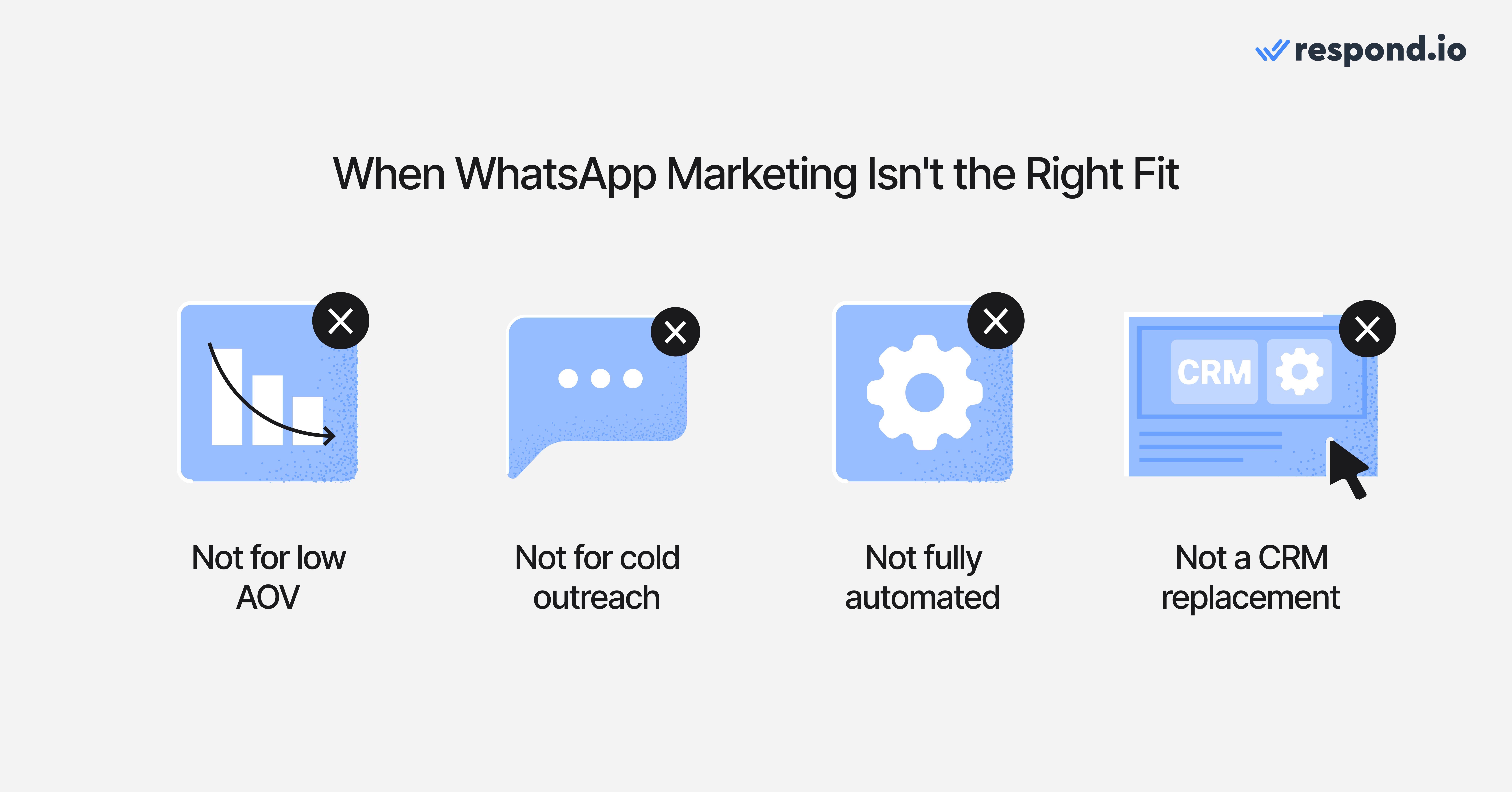
Respond.io is not the right fit if:
Your average order value is under $50 without a repeat-purchase model
WhatsApp conversation costs (Meta fees + platform + agent time) likely exceed the value per customer at low AOV without retention. Email or SMS are more cost-effective for purely transactional, low-value communications.
You want 100% automation with no human involvement
AI agents handle routine inquiries well. High-consideration purchases still require human expertise for consultations and closing. If no human is in the loop, WhatsApp isn't the right fit — customers making complex decisions need to talk to a person.
You're planning cold outreach
WhatsApp's terms of service prohibit unsolicited messages. This channel works for businesses building opt-in contact lists through ads, website chat or existing customer consent. Cold messaging gets accounts suspended.
You need WhatsApp to function as your CRM
WhatsApp is a conversation channel. Respond.io connects with major CRMs and syncs conversation data and customer records automatically — but it doesn't replace pipeline management, it integrates with it.
Is respond.io the right platform to make your WhatsApp ROI visible?
Yes, if you're a mid-market B2C business running high-volume WhatsApp conversations where customers need consultative support before buying and revenue closes offline or across multiple channels. In that setup, WhatsApp ROI isn't invisible because the channel doesn't work — it's invisible because the platform around it doesn't connect conversations to revenue. Disconnected inboxes, manual tracking, missing attribution and the wrong default metrics all produce the same result: activity that looks fine in reports but can't be tied to closed deals.
Respond.io closes the gap through CAPI integration for ad attribution, CRM sync for pipeline tracking, AI Agents for qualification and volume handling, and built-in analytics that report on revenue outcomes — not just message counts. The Growth plan starts at $199/month with no message markups, no per-agent fees and no hidden charges.
Start your free trial or talk to sales to see how respond.io fits your setup.
Turn conversations into customers with respond.io's official WhatsApp API ✨
Manage WhatsApp calls and chats in one place!
Frequently asked questions about WhatsApp marketing attribution
Why can't my current platform show me WhatsApp ROI accurately?
Because most WhatsApp platforms stop tracking at the click. They record clicks, opens and replies, but not the revenue that closes after the conversation. This matters most for mid-market B2C businesses where customers pay offline, by bank transfer or in-store, since standard ad tracking can't link that payment back to the chat. Respond.io closes the gap by sending conversion events to Meta and TikTok via CAPI and syncing conversation data to your CRM's pipeline records, so you can see which conversations closed deals.
What is a realistic WhatsApp marketing ROI for mid-market B2C businesses?
It depends on average order value (AOV), retention and how much conversation volume AI Agents handle versus human agents. Mid-market B2C businesses with higher AOV and repeat purchases see the strongest returns: respond.io customers have reported results ranging from 24% more sales (GETUTOR) to 42.5x ROI on broadcasts (Automax). Businesses under roughly $50 AOV without repeat purchases usually see little or no return, because per-conversation costs outweigh the value of each customer. Returns only become measurable once attribution connects offline revenue back to WhatsApp.
How do I know if my WhatsApp marketing costs are too high?
Your costs are too high if cost per conversation exceeds your gross margin per sale. Calculate it as total WhatsApp spend (Meta fees, platform costs and agent time) divided by number of conversations. Agent time is usually the largest cost and the one default reports leave out, so over-reliance on manual handling is the most common cause. A second cause is high service and utility volume inside the 24-hour window: each number gets 1,000 free service messages a month, and utility templates are charged from the first send. Respond.io reports agent activity alongside Lifecycle Reports and CAPI attribution, so your cost inputs and revenue data sit in one platform instead of three.
How does CAPI fix WhatsApp ad attribution?
CAPI fixes attribution by sending post-click conversion events (purchases, bookings, qualified leads) from your platform back to Meta and TikTok. Standard ad tracking stops at the click, so without CAPI, campaigns optimize on click volume instead of revenue. For WhatsApp, it applies to conversations that start from click-to-WhatsApp ads, and events must be sent within 7 days of the click. In respond.io, a Workflow step sends the event and the ad click ID is captured automatically, so ad performance and deal outcomes are reported in the same platform.
Is WhatsApp marketing worth it if my average order value is low?
Generally no. If your AOV is under $50 and customers don't buy again, WhatsApp conversation costs will likely exceed revenue per customer, and email or SMS are more cost-effective for transactional messages. WhatsApp becomes worth it at low AOV only when repeat purchase frequency is high enough for lifetime value to cover acquisition cost. If you do have a repeat-purchase model, respond.io's lifecycle tracking shows where retention drops off, so you can measure whether repeat revenue actually covers conversation costs.


