
















 Electronics
 Fashion & Apparel
 Furniture
 Jewelry and Watches
 Afterschool Activities
 Sport & Fitness
 Beauty Center
 Dental Clinic
 Medical Clinic
 Home Cleaning & Maid Services
 Photography & Videography
 Car Dealership
 Travel Agency & Tour Operator

TL;DR — Best WhatsApp Marketing Software
For B2C marketing and support teams handling high-volume WhatsApp conversations, this list compares the best WhatsApp marketing software so you can pick the right tool for campaigns, automation, and measurable conversions. Pick the wrong platform and you'll miss replies, leak ad leads, and lose sales you already paid to acquire. Respond.io is a customer conversation platform built for high-volume, multi-channel customer conversations that drive revenue workflows.
If you run Click-to-WhatsApp ads and need to route and convert hundreds of chats per day, choose respond.io — it centralizes multi-agent replies and automates lead qualification so fewer leads drop.
If you want a WhatsApp-first shared inbox with simpler broadcasts for a lean team, choose Wati — it gives you templates, inbox collaboration, and lighter automation without a heavier setup.
If your marketing already runs on email and SMS and you want WhatsApp in the same stack, choose Brevo — it adds WhatsApp campaigns to an existing multichannel workflow.
If you need budget-conscious WhatsApp-first promotions for frequent B2C campaigns, choose AiSensy — it supports blasts, reminders, and simple follow-up flows.
If you need API-driven custom journeys triggered by your CRM or ecommerce stack, choose Gupshup — it is better suited to developer-led implementations.
If you need enterprise-grade cross-channel personalization and advanced reporting, choose Insider.
If you run an ecommerce store and need quick cart recovery and Shopify-native promos, choose
NovoChat.
WhatsApp marketing software helps businesses run campaigns, manage replies, automate follow-up and track conversions on WhatsApp.
For B2C teams handling high conversation volumes, the challenge is not just sending messages. It’s making sure Click-to-WhatsApp leads, campaign replies and customer inquiries reach the right person quickly and can be tracked through to conversion.
This guide compares seven WhatsApp marketing platforms based on broadcasts, automation, shared inboxes, CRM integrations, conversion attribution and pricing, so you can choose the right fit for your team.
Turn conversations into customers with respond.io's official WhatsApp API ✨
Manage WhatsApp calls and chats in one place!
What Should I Look For in WhatsApp Marketing Software?
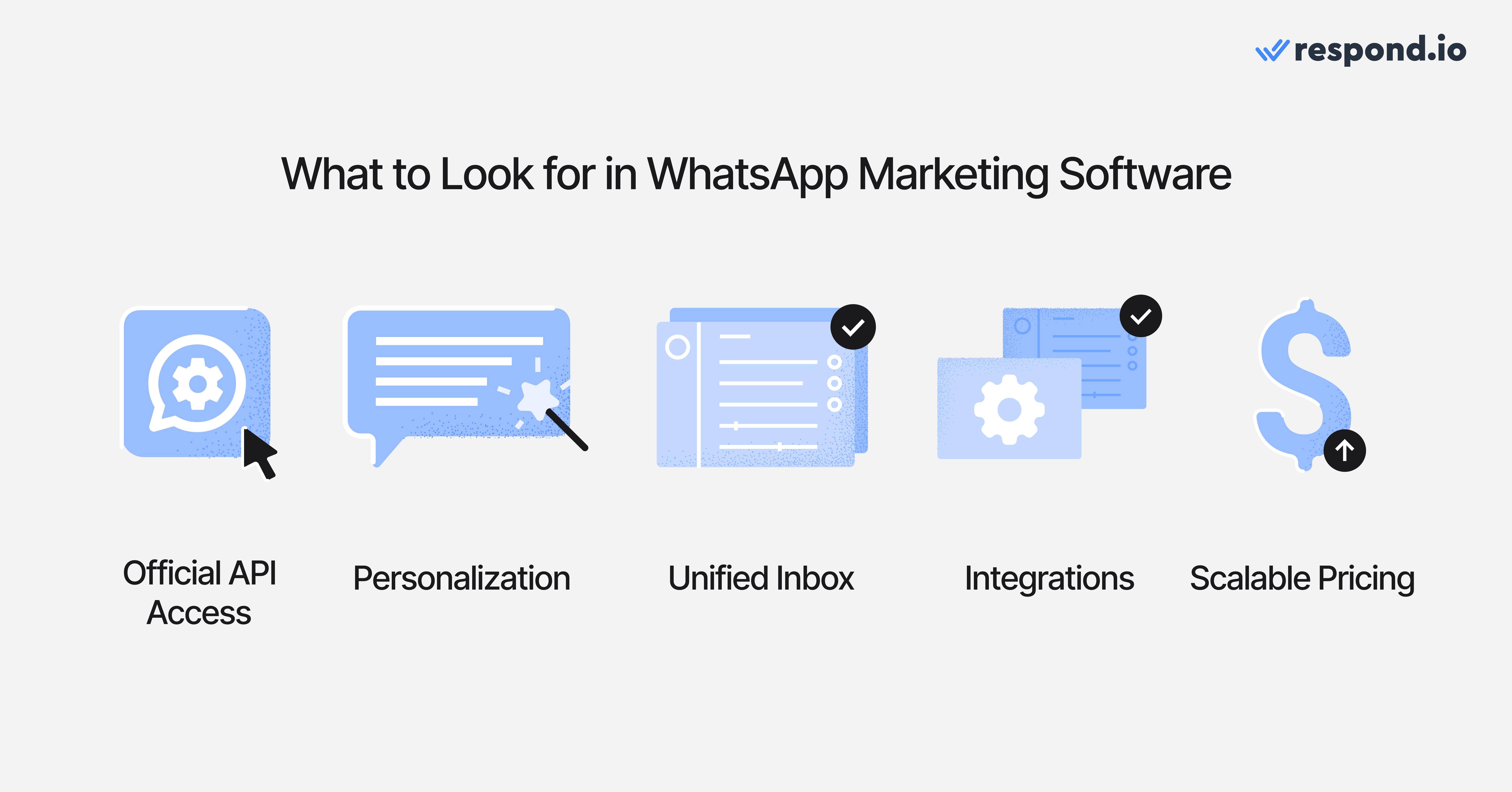
With so many platforms promising to “do WhatsApp marketing,” it can be hard to tell which ones actually deliver. Use this checklist to evaluate vendors:
Criterion | Why It Affects Revenue | What to Ask Vendors |
|---|---|---|
Official Meta partner/API access | Helps maintain compliance, platform reliability, and access to advanced features | Are you an official Meta Business Partner or authorized WhatsApp API provider? |
Broadcast controls | Enables compliant, targeted campaigns at scale | What segmentation, scheduling, and template tools do you offer? |
CTWA lead handling | Helps capture and convert paid social traffic | How do you route and track Click-to-WhatsApp ad leads? |
Multi-agent inbox | Prevents missed replies and improves team collaboration | Can multiple agents access the same conversation history? |
CRM integration | Enables lifecycle tracking and prevents lead data loss | Which CRMs do you integrate with natively, and what syncs? |
Conversion attribution | Links campaign spend to revenue outcomes | Can you show which broadcasts or workflows created revenue? |
Pricing transparency | Avoids budget surprises mid-campaign | What’s included in the subscription vs. charged separately? |
Official API access
The official WhatsApp Business API is the only way to run compliant campaigns, connect automation workflows and share a number across multiple agents. Any platform that doesn’t use the official API puts your number quality and campaign continuity at risk.
Look for a platform that is an official Meta Business Partner and uses the API directly rather than through a third-party reseller, and check whether it adds a markup to Meta's per-message rates.
Buyers should also ask whether the platform gives a clear view of number quality or messaging health, and whether it relies only on official sending methods rather than policy workarounds. Weak compliance controls do not just create policy risk. They can reduce deliverability, slow approvals and interrupt revenue campaigns when demand is highest.
Buyers should also verify what the provider actually handles during setup. A Meta-verified partner should be able to support business verification, number migration, template submission and approval troubleshooting as part of onboarding.
Do not rely on a sales claim alone. Check the vendor in Meta's Partner Directory and ask whether onboarding, template approvals and account support are handled directly or passed to another provider. That matters because extra reseller layers can slow launch, complicate support and create more risk when a revenue campaign is live.
Personalization and campaigns
Personalized WhatsApp campaigns perform better because customers on a messaging app expect relevant, timely communication. A platform should let businesses segment by lifecycle stage, purchase history or engagement level so they can reach the right audience, not just the biggest list.
Segment audiences to target:
New leads who need onboarding or product education
Warm prospects where timing and offer matter most
High-value customers who deserve VIP treatment and early access
Recent buyers ready for loyalty rewards or cross-sells
Browsers who asked about a specific item or category
Buyers should also match the platform to the revenue motion it needs to support most often:
Promotional broadcasts: Verify segmentation, scheduling, template management and campaign-level conversion reporting. Test how quickly the team can submit, revise and reuse templates, whether buttons, rich media and personalization fields are easy to manage and whether the platform clearly separates marketing from utility sends. Slow template workflows delay campaign launches even when sending itself works.
Click-to-WhatsApp lead qualification: Check that AI Agents or workflows can capture source, qualify intent, route to the right rep and record outcomes.
Reminders and reactivation: Confirm the platform can trigger follow-up from lifecycle stage, booking status or inactivity without manual export.
Post-purchase follow-up: Make sure it can send updates, collect feedback and surface upsell opportunities in the same conversation.
Service-led sales conversations: Check for multi-agent ownership, internal notes and a full conversation history when support turns into a sale.
The right tool is the one that supports the revenue motion the business runs most often, then carries that conversation through reply handling and attribution.
WhatsApp flows and in-chat forms
WhatsApp Flows let businesses collect structured input from customers inside the chat, without redirecting to a website form. Common uses include lead qualification, appointment booking, product preference capture and post-purchase feedback.
For a marketing platform, the value is reducing friction at the moment a customer is most engaged. A form built inside WhatsApp keeps the conversation moving, collects the data in a structured format and connects it to the workflow that follows, such as routing, a confirmation message or a CRM update.
Buyers should also look beyond forms and check whether the platform can move a customer from product discovery to purchase inside the same conversation. That includes sharing product images or video, asking qualification questions with buttons or flows, handing off to payment or checkout at the right moment and following up on abandoned carts or incomplete bookings without losing context.
The strongest platforms also track which actions customers take and connect those actions to routing, follow-up and conversion reporting. That shows whether WhatsApp will only generate clicks or actually help the team progress a buyer toward revenue.
The strongest platforms do more than send approved templates. They make interactive messages easy to build, track which buttons or replies customers choose and connect those actions to routing, automation or conversion reporting.
Shared inbox
A shared inbox is where campaign performance turns into revenue. When a broadcast drives a reply, the team needs to see it, own it and act on it fast — without two agents answering the same message or a hot lead sitting unread for hours.
Look for assignment logic that routes replies by intent or team, visible ownership so managers can see what’s claimed and what’s not, internal notes for handoffs and response time tracking. The inbox should be a revenue workspace, not just a message list.
CRM integrations, automation & analytics
The platform should connect WhatsApp conversations to the systems that run the sales process. That means syncing contact records, updating lifecycle stages and writing conversation outcomes back to the CRM so teams can act on context without switching tools.
For ecommerce, buyers should also check whether store events can trigger timely conversations without manual export. Look for store integrations that support cart recovery, order updates, product or catalog sharing and post-purchase upsell flows, so store activity turns into tracked follow-up rather than one-off promotions.
Many B2C teams do not close every lead on WhatsApp alone. Buyers should check whether the platform keeps one contact history across WhatsApp and other key messaging, social, voice and email channels, whether those channels are supported natively and whether workflows can shift follow-up when a customer changes channels or stops replying.
Automation should handle more than routing. AI Agents should qualify leads, trigger follow-up sequences, update lifecycle stages and escalate ready buyers to a human with a summary. The goal is to remove repetitive work from the sales team, not just speed up the first reply.
For analytics, the questions that matter most are:
Did the message reach the customer?
Did they tap a button or link?
Did they engage in conversation?
Did the conversation lead to a purchase or qualified lead?
How much did this broadcast or automation actually generate?
How quickly did reps respond to inbound messages?
Transparent pricing
Total WhatsApp cost is made up of more than the list price. Buyers should model these cost components together before signing:
The software subscription
Meta charges based on message category, recipient market and service message volume
Any provider markup layered on top of Meta fees
One-time onboarding or migration fees
Put every quote on the same 12-month view before comparing the seven tools, including how cost changes as agent count or Monthly Active Contacts grow and any add-on charges for automation or AI Agents. Custom pricing needs a written scope so hidden limits don't appear after launch. They should also ask what usually inflates spend after launch:
Extra charges when more agents need access
Paid middleware when CRM or other system integrations are not native
Extra work caused by repeated template revisions
The mix of conversations changes the bill. A B2C promotion plan with frequent broadcast campaigns will price differently from a motion built around lead qualification, appointment reminders or service updates, even when send volume looks similar.
Free-form service replies are charged after the first 1,000 per phone number each month, and utility templates are charged inside the 24-hour window at the same rate as outside it, so support and transactional volume moves the bill as much as broadcasts do. That is why buyers should ask vendors to show spend by message type, active audience size and workflow volume.
Respond.io uses Monthly Active Contacts (MAC) pricing rather than seat-based pricing, so cost follows the contacts engaged each month instead of headcount. Starter is $99 per month, Growth is $199 per month, Advanced is $349 per month and Enterprise is custom, with Meta fees billed separately and a 7-day free trial available. Before signing, ask for a sample invoice based on real Monthly Active Contacts, campaign mix, markets and support traffic so finance and marketing teams can compare total cost, not just entry price.
Attribution & conversion reporting
Attribution tells you which campaign, broadcast or automation created a conversion — not just which message was delivered. For B2C teams running Click-to-WhatsApp ads, that means tracking whether a paid ad conversation turned into a booked appointment, a completed purchase or a qualified lead routed to sales.
Buyers should ask how the platform connects conversation outcomes to campaign spend, whether it supports Meta’s Conversions API for better ad attribution and whether revenue from WhatsApp can be broken down by campaign, agent or channel without manual export.
Onboarding and support quality
The onboarding process sets the pace for how quickly the platform starts generating returns. A good onboarding covers business verification, number migration, template submission, CRM connection and the first routing workflow — not just account activation.
For ongoing support, the question is not just whether support exists but how fast it responds and how deep it goes. Mid-market B2C teams running campaigns and sales workflows need support that can answer product questions, diagnose issues and help optimize workflows — not just route tickets.
Respond.io offers 24/7 human and AI support on all plans.
Run a controlled pilot before signing
Before signing an annual contract, buyers should run a controlled pilot on one real revenue workflow. That pilot should test a Click-to-WhatsApp lead, an outbound campaign reply or another high-volume conversation path the team depends on most.
Use the same scorecard for every vendor so the comparison stays fair. Connect a number, get one template approved, import a small batch of opted-in contacts, run one Click-to-WhatsApp or broadcast test, verify CRM sync, reassign a live conversation and confirm attribution to a qualified lead or sale.
The pilot should also show whether opt-outs are suppressed automatically, whether lifecycle data updates correctly and whether AI Agent handoff summaries give a human enough context to continue the sale. Ask each vendor for a written 12-month quote based on the same contact volume, campaign mix and support traffic, so the pilot tests commercial fit as well as workflow fit.
The right platform is the one that proves it can turn live conversations into tracked revenue without manual patching or ownership gaps. If the pilot exposes delays, missing handoff context or unclear reporting, the rollout risk is still too high.
WhatsApp Marketing Software Comparison Table
Platform | Best For | Official API | Broadcast & Campaigns | Multi-Agent Inbox | AI Agents | CRM Integration | Conversion Attribution | Pricing Model |
|---|---|---|---|---|---|---|---|---|
respond.io | B2C teams running high-volume campaigns, Click-to-WhatsApp ads and multi-channel follow-up | ✓ Official WhatsApp Business Platform access | ✓ Segmentation, scheduling, personalization and template campaigns | ✓ Omnichannel inbox with routing, assignment and conversation history | ✓ Qualify leads, answer questions, route chats, update records and hand off to agents | ✓ Native HubSpot and Salesforce integrations | ✓ Meta CAPI, Lifecycle reporting and conversion tracking | Monthly Active Contacts |
Wati | Small teams needing WhatsApp-first shared inbox and basic broadcasts | ✓ Official WhatsApp Business API access | ✓ Broadcasts, templates and campaign automation | ✓ Shared inbox with agent assignment | Limited | Limited | Limited | Per-seat |
Brevo | Multi-channel marketers adding WhatsApp to email and SMS flows | ✓ Official WhatsApp Business integration | ✓ WhatsApp campaigns, templates and segmentation | Limited | Limited | ✓ Built-in CRM plus integrations | Limited | Per-email / per-contact |
AiSensy | WhatsApp-first teams in India needing broadcasts, bots and live chat | ✓ Official WhatsApp Business API access | ✓ Broadcasts, segmentation and template campaigns | ✓ Shared inbox with agent assignment | Limited | Limited | Limited | Per-seat + usage |
Gupshup | Developer-led teams building custom WhatsApp experiences at scale | ✓ Official WhatsApp Business Platform access | ✓ Broadcasts, templates and campaign management | Limited | Limited | Limited | Limited | Custom / usage-based |
Insider | Enterprise teams running cross-channel journeys with AI personalization | ✓ WhatsApp Business integration | ✓ WhatsApp campaigns within cross-channel journeys | Limited | ✓ AI-driven personalization and journey automation | ✓ CRM and customer-data integrations | ✓ Cross-channel analytics and attribution | Custom |
NovoChat | Small e-commerce teams in Southeast Asia needing broadcasts and basic support | ✓ WhatsApp integration | ✓ Broadcasts and campaign automation | ✓ Shared inbox with multi-agent support | Limited | Limited | Limited | Per-seat |
Top WhatsApp Marketing Software of 2026
Each platform is reviewed against the same criteria: official API access, broadcast capability, multi-agent inbox, AI Agents, CRM integration, conversion attribution and pricing transparency.
1. Respond.io
Respond.io is a customer conversation platform for mid-market B2C businesses that run revenue-critical conversations at high volume. It is built around a unified inbox where sales and support teams manage WhatsApp, Instagram, Facebook Messenger, TikTok, Telegram, LINE, Viber, WeChat, voice calls and email from one place.
For marketing teams, the platform offers:
AI Agents: Qualify leads, answer questions, collect customer details, route conversations, update lifecycle stages and hand over to human agents with context.
WhatsApp campaigns: Segment audiences, personalize and schedule broadcasts, manage templates and send carousel templates.
CRM integrations: Connect HubSpot and Salesforce natively so customer data stays connected to conversations.
Omnichannel inbox: Manage WhatsApp alongside Instagram, Messenger, TikTok, email and voice while keeping the customer’s conversation history in one place.
Conversion tracking: Use Meta’s Conversions API and Lifecycle reporting to connect campaigns and conversations with customer outcomes.
Lifecycle reports show where contacts move through the funnel, which workflows generate qualified leads and where drop-off happens.
The platform uses Monthly Active Contacts (MAC) pricing, which means cost scales with the contacts engaged each month, not with the number of agents using the platform. Respond.io pricing: Starter at $79 per month, Growth at $159 per month, Advanced at $279 per month and Enterprise on custom pricing. Meta’s conversation fees are billed separately and directly by Meta.
Best for: Mid-market B2C teams running high-volume WhatsApp campaigns, Click-to-WhatsApp ads and multi-channel follow-up.
Not for: Small teams that only need simple WhatsApp broadcasts.
Turn conversations into customers with respond.io's official WhatsApp API ✨
Manage WhatsApp calls and chats in one place!
2. Wati
Wati is a WhatsApp-first platform designed for small to mid-sized teams that need a shared inbox, basic broadcast tools and simple automation without a complex setup. It connects to the official WhatsApp Business API and covers the core use cases that most WhatsApp-focused teams start with.
For marketing use cases, Wati offers segmented broadcasts, a template manager and basic automation flows. The inbox supports multiple agents and conversation assignment, which works for teams managing inbound replies after a campaign send.
The tradeoffs become visible at scale. AI Agents are limited, cross-channel coverage outside WhatsApp is not a core strength and conversion attribution reporting is not built in. Teams running Click-to-WhatsApp ads with high daily reply volume, or those needing tight CRM sync and lifecycle tracking, tend to outgrow Wati’s feature depth.
Wati uses per-seat pricing. The Starter plan starts at approximately $39 per month, with Growth and Business tiers available at higher price points. Meta conversation fees apply separately.
Best for: Small teams that want a straightforward WhatsApp inbox, broadcasts and simple automation.
Not for: Teams that need advanced AI Agents, multi-channel routing, deep CRM sync or conversion attribution.
3. Brevo
Brevo is a multi-channel marketing platform that covers email, SMS and WhatsApp from one workspace. It is suited to marketing teams that already use Brevo for email campaigns and want to add WhatsApp without switching platforms.
For WhatsApp marketing, Brevo supports template-based campaigns, audience segmentation and basic automation sequences. The shared inbox is available but lightweight compared to platforms built primarily around WhatsApp. AI Agents and deep WhatsApp-specific automation are not a core strength.
CRM integration is available via Brevo’s own built-in CRM or through third-party connections. Attribution reporting is more developed on the email side than the WhatsApp side, which can make it harder to measure WhatsApp campaign return directly.
Brevo’s pricing is usage-based for email, with WhatsApp features accessible from paid plans. Meta conversation fees apply on top. Teams doing heavy WhatsApp volume should model total cost across both layers before comparing to WhatsApp-first platforms.
Best for: Marketing teams already using Brevo for email and SMS that want to add WhatsApp.
Not for: Teams that rely heavily on WhatsApp and need advanced inbox, AI and attribution capabilities.
4. AiSensy
AiSensy is a WhatsApp marketing platform primarily used by businesses in India. It offers broadcast campaigns, a shared team inbox, basic chatbot automation and integrations with e-commerce platforms and CRMs.
The platform is accessible and affordable for early-stage WhatsApp campaigns, particularly for teams in the Indian market. Broadcast tools cover the basics — segmentation, scheduling and template management — and the inbox supports multiple agents with conversation assignment.
AI Agents, advanced lifecycle automation and conversion attribution are limited. Teams running complex sales workflows, multi-channel follow-up or needing tight CRM sync beyond basic contact updates tend to find the platform too shallow for mid-market B2C scale.
AiSensy uses per-seat pricing plus a usage component. Starter tiers begin at lower price points but scale with seat count and usage. Meta conversation fees apply separately.
Best for: Small to mid-sized teams in India running WhatsApp broadcasts and basic customer service.
Not for: Teams that need advanced AI Agents, multi-channel routing or conversion attribution.
5. Gupshup
Gupshup is a conversational engagement platform built primarily for developer-led teams that need API access, multi-channel messaging and custom bot flows at scale. It is widely used across emerging markets and supports a broad set of messaging channels beyond WhatsApp.
For WhatsApp marketing, Gupshup supports broadcast campaigns, template management and conversation flows. The platform has strong API depth and channel coverage, but the configuration and maintenance required for non-technical teams is higher than most business-user-first tools.
AI Agents and out-of-the-box shared inbox workflows are not a core strength. Multi-agent revenue operations and conversion attribution require more custom build compared to platforms designed for marketing managers rather than developers.
Gupshup pricing is typically custom and usage-based. Teams should request a detailed breakdown of API fees, platform charges and any per-message or per-session costs before comparing against other options.
Best for: Developer-led teams building custom WhatsApp integrations and multi-channel bot flows.
Not for: Marketing and sales teams that want a ready-to-use inbox, AI Agents and revenue reporting without developer support.
6. Insider
Insider is an enterprise cross-channel customer experience platform that includes WhatsApp as part of a broader marketing automation and personalization suite. It is used by large retailers and travel companies that need AI-driven journey orchestration across web, app, email, SMS and WhatsApp.
For WhatsApp marketing, Insider offers audience segmentation, template campaigns, AI-generated content recommendations and integration into multi-step journeys. Attribution is built into the platform’s broader analytics layer.
The platform is positioned for enterprise buyers with complex personalization needs and larger budgets. For mid-market B2C teams focused primarily on WhatsApp conversations and revenue workflows, the platform scope and pricing may exceed what the use case requires.
Insider pricing is custom and enterprise-focused. Teams should expect a sales process before receiving specific pricing.
Best for: Enterprise marketing teams running personalized journeys across web, app, email, SMS and WhatsApp.
Not for: Mid-market teams that primarily need a conversation-focused inbox, agent collaboration and fast WhatsApp campaign setup.
7. NovoChat
NovoChat is a WhatsApp and multi-channel messaging platform focused on small e-commerce businesses, primarily in Southeast Asia. It offers broadcast campaigns, a shared team inbox and basic automation, with integrations for Shopify and WooCommerce.
For WhatsApp marketing, NovoChat covers the entry-level broadcast and inbox use cases. The platform is straightforward to set up and aimed at teams that do not need advanced automation or deep CRM integration.
AI Agents, advanced lifecycle automation, conversion attribution and multi-channel follow-up beyond WhatsApp and a few other channels are not strong suits. Teams scaling past basic broadcast volume or running complex sales workflows will likely need a more capable platform.
NovoChat pricing is per-seat. Plans start at relatively low price points, making it accessible for very small teams, but seat costs add up quickly as the team grows.
Best for: Small ecommerce teams in Southeast Asia that want WhatsApp broadcasts, a shared inbox and Shopify or WooCommerce integration.
Not for: Teams that need advanced AI Agents, cross-channel automation, lifecycle reporting or conversion attribution.
Verdict: Best WhatsApp Marketing Software in 2026
For mid-market B2C teams whose revenue depends on WhatsApp conversations, the platform choice determines whether campaigns drive measurable return or just generate activity.
Respond.io stands out because it is the only platform in this list built end-to-end for revenue-critical conversations at scale. It combines a multi-agent inbox, AI Agents, broadcast tools, CRM integration and conversion attribution in one place — so marketing teams can run campaigns, sales teams can manage replies and managers can see which conversations are creating revenue.
Wati is the right choice for small teams that want a clean WhatsApp inbox and basic broadcast capability without heavy configuration. AiSensy fits teams in India at earlier stages of WhatsApp adoption. Brevo works when WhatsApp is an add-on to an existing email marketing motion. Gupshup suits developer-led teams that need raw API control. Insider fits enterprise buyers with complex cross-channel journey needs. NovoChat works for very small e-commerce teams in Southeast Asia.
Case Studies: How respond.io Helps B2C Teams Convert WhatsApp Conversations into Revenue
Lamarsa Coffee is a specialty coffee equipment retailer operating across six countries that was losing Click-to-WhatsApp leads because chat volume exceeded what their team could manually handle. After implementing respond.io, they deployed AI Agents to qualify inbound leads, route high-intent buyers to the right sales rep and trigger automated follow-up sequences. The result was a 50% increase in sales across their six markets, with the same team size.
Sport Center Los Naranjos is a wellness and fitness center in Caracas, Venezuela, offering gym facilities, classes and personal training. They were losing membership inquiries because WhatsApp conversations were not being routed to the right staff quickly enough. Using respond.io workflows, they automated lead qualification, routed conversations to the right team member and followed up with unconverted leads automatically. Sales conversion from WhatsApp inquiries improved by 20%.
If you’re ready to turn WhatsApp conversations into a measurable revenue channel, respond.io is the platform built for it. Start your free trial today.
FAQs about the best WhatsApp marketing software
What's the best WhatsApp marketing software?
If you run B2C campaigns where speed-to-lead and reply handling affects conversion, prioritize tools with a shared inbox, automation, and conversion reporting. If you also need multi-channel conversation routing, respond.io’s workflows and lifecycle tracking are built for that.
What is the best WhatsApp automation tool?
The best WhatsApp automation tool for a mid-market B2C team is one that does more than automate replies. Buyers should look for AI Agents that qualify leads, update lifecycle stages, route conversations by intent, trigger follow-up workflows and escalate high-value opportunities with a clear handover summary.
For teams that need automation tied to revenue outcomes, respond.io is a customer conversation management platform built for high-volume B2C conversations. It combines AI Agents, no-code workflows, customer relationship management integration and conversion reporting so teams can automate follow-up without losing handoff context or pipeline visibility.
Which WhatsApp marketing software is best for Click-to-WhatsApp ads?
The best tool for Click-to-WhatsApp ads is one that captures every new chat, routes it to the right agent, and tracks conversions. If you need no-code routing workflows and lifecycle tracking to prevent lead drop-off, respond.io is built for that.
Which WhatsApp marketing software is best for e-commerce?
It depends on whether WhatsApp supports the full buying journey or only store notifications and promotions. Buyers should prioritize cart recovery, order updates, product or catalog sharing, post-purchase follow-up and whether store events can trigger conversations automatically.
For mid-market B2C teams that want store activity to turn into managed sales conversations, respond.io is the strongest fit in this list. Its AI Agents and workflows can act on store and CRM data to recover carts, handle order questions and follow up after purchase without losing context. Small Shopify stores that only need quick cart recovery and store-linked promos may be fine with NovoChat.
How much does WhatsApp marketing software cost?
Costs per message vary by market and by message category, so buyers should not compare vendors on subscription price alone. Free-form service replies are charged after a free allowance of 1,000 per phone number each month, which doesn't roll over, and utility templates are charged inside the 24-hour window too. Total spend usually combines the software subscription, Meta charges, any provider markup and any onboarding or migration fees.
The most accurate way to compare vendors is to model real usage. A broadcast-heavy promotion plan creates a different bill from a lead qualification or service update motion, even when monthly volume looks similar. Respond.io uses Monthly Active Contacts (MAC) pricing with Starter at $99 per month, Growth at $199 per month, Advanced at $349 per month and Enterprise on custom pricing, while Meta fees are billed separately.
Before signing, ask for a sample invoice based on expected Monthly Active Contacts, message categories, markets and campaign mix. That gives finance and marketing teams a clearer view of cost per campaign and cost to serve.
Does WhatsApp marketing improve ROI?
Yes, when it is used to capture opt-in demand, follow up quickly and measure which conversations create revenue. Return on investment usually improves when teams segment audiences, personalize approved templates and route replies fast enough to convert high-intent leads before they go cold.
The wrong platform weakens return on investment by hiding attribution, delaying follow-up or sending broad campaigns that waste spend. Buyers should look for campaign-level conversion reporting and automation that keeps sales and support moving, such as AI Agents that qualify leads, trigger reminders and escalate ready buyers to a human.
Can WhatsApp marketing integrate with my customer relationship management system and other channels?
Yes. The right platform should sync contact data, lifecycle stages and conversation outcomes with a CRM so sales and support teams can follow up with full context.
It should also preserve conversation history when a customer moves between WhatsApp, Instagram, Facebook Messenger, TikTok, Telegram, LINE, Viber, WeChat, voice calls and email. For mid-market B2C teams, that makes it easier to route by intent, update records automatically and measure which conversations actually turn into revenue.
What is the difference between marketing and utility messages on WhatsApp?
Marketing messages promote an offer, product, event or reactivation campaign. Utility messages support an action the customer already expects — such as an order update, appointment reminder or payment confirmation.
The difference matters because message category affects template approval requirements, Meta billing rates and how teams should measure results. Utility templates are charged at the utility rate whether sent inside or outside the 24-hour window. Buyers should ask vendors how templates are classified, how category mix shows up in reporting and whether spend can be broken down by campaign type. respond.io shows spend and performance by message category in its broadcast analytics, making it easier to compare campaign ROI across message types.
Is WhatsApp marketing compliant and safe for businesses?
Yes — when it runs through the official WhatsApp Business Platform with approved templates, clear opt-in records and a simple way for customers to opt out. Buyers should confirm that the software stores consent status at the contact level, separates marketing from utility sends and blocks outreach to audiences that cannot be contacted.
Safety also depends on how the vendor handles template approval, number quality and access controls for agents. A platform that makes those checks visible helps teams protect the number, avoid wasted spend and keep campaigns running without unnecessary compliance risk.
Do I need approved templates for WhatsApp campaigns?
Yes. Approved templates are required for business-initiated WhatsApp campaigns outside an active service conversation, which is why template management affects both compliance and launch speed.
Buyers should look for software that makes template submission, revisions, approval tracking and reuse easy. The strongest platforms also support personalisation within approved template formats, so teams can scale outbound campaigns without slowing down every time a new message needs review.
How can I send bulk messages on WhatsApp without getting banned?
Send bulk messages through the official WhatsApp Business Platform using approved templates and a clear opt-in record for every audience. The platform should also support segmentation, scheduling and opt-out handling so marketing teams can send relevant campaigns without breaking policy.
Buyers should avoid unofficial sender tools or browser automations that bypass approval and consent controls. Respond.io is a customer conversation management platform that sends approved broadcasts through the official platform, which helps protect number quality, deliverability and the revenue tied to repeat campaigns.
Before scaling volume, buyers should confirm how the vendor handles template submission, consent tracking and delivery reporting. That is what turns bulk sending from a compliance risk into a repeatable revenue channel.
What is the difference between WhatsApp sender software and WhatsApp marketing platform?
WhatsApp sender software is usually built to push messages in bulk, often with limited control over consent, template approval or follow-up workflows. A proper platform runs on the official WhatsApp Business Platform and gives teams the tools to manage segmentation, approved templates, opt-outs, routing and reporting from one place.
The difference matters because sender software may look cheaper at first but can put number quality, deliverability and campaign continuity at risk. Respond.io is a customer conversation management platform that supports approved broadcasts and coordinated follow-up across WhatsApp and other key messaging, social, voice and email channels.
Can I use WhatsApp for marketing without the API?
Yes, but with significant limits. The free WhatsApp Business App works for solo operators handling manual outreach, but it becomes a ceiling when a team needs larger broadcasts, shared inbox visibility across agents, CRM integration and structured reporting.
The API removes these limits. For any team running paid campaigns, routing conversations to multiple agents, or needing to measure which conversations drive revenue, the API is the baseline — and the right software on top of it is what makes it operational.
What's the difference between WhatsApp Business App and API?
The WhatsApp Business App is a free mobile application designed for single users. It supports basic messaging, quick replies and a simple product catalogue, but it caps broadcasts at 256 contacts, has no multi-agent access and cannot connect to a CRM or automation platform.
The WhatsApp Business API is a developer-facing interface that enables software platforms to connect to WhatsApp at scale. It removes broadcast limits, supports multi-agent shared inboxes, enables workflow automation and CRM sync, and provides the reporting infrastructure needed to measure campaign outcomes. Any platform on this list requires API access to operate — the difference between vendors is how they implement, price and build on top of it.
How do I integrate WhatsApp marketing tools with a customer relationship management system?
Most teams connect the platform to a CRM so new WhatsApp leads create or update records automatically, while agents can see owner, lifecycle stage and past activity during the conversation.
Buyers should check whether the integration is native or workflow-based, which fields sync in both directions and whether AI Agents or automations can update lifecycle stages, route conversations and write outcomes back to the CRM without manual data entry.
What is the difference between marketing and utility messages on WhatsApp?
Marketing messages are used to promote an offer, product, event or reactivation campaign. Utility messages support an action the customer already expects, such as an order update, appointment reminder or payment confirmation.
The difference matters because message category affects approval, cost and how teams should measure results. Buyers should ask vendors how templates are classified, how category mix shows up in reporting and whether spend can be broken down by campaign type.
How long does WhatsApp marketing software take to set up?
Software setup can be quick, but time-to-live depends on more than activating the platform. The main steps are business verification, connecting an eligible number, submitting templates and building the first routing workflow or campaign.
The biggest delays usually come from verification issues, number migration, template revisions or unclear ownership between teams. Buyers should ask vendors which steps they handle directly and what the business must prepare internally so paid leads and outbound campaigns are not left waiting.
Can I switch WhatsApp marketing software providers without losing my number?
Yes, in most cases, if the business is on the official WhatsApp Business Platform and the new provider supports migration. Buyers should confirm who handles business verification, template migration, downtime risk and post-switch testing before approving the move.
A safe handover protects opt-in records, approved templates and routing logic, so campaigns and reply handling resume without manual patching. Ask the vendor to explain the migration steps in writing and clarify which parts they handle directly and which are passed to another provider.
Do I need technical knowledge to use WhatsApp marketing software?
Not for day-to-day campaign work if the platform offers no-code workflows, template management and guided onboarding. Marketing, sales and support teams should still expect to define routing rules, lifecycle stages, approval owners and the fields that need to sync with other systems.
Technical help may still be useful for custom integrations or advanced data sync, but it should not be required to send broadcasts, qualify leads or route conversations in a mid-market B2C team.
What industries benefit most from WhatsApp marketing software?
Mid-market B2C businesses benefit most when customers regularly message before buying, booking or renewing. Common fits include retail, education, automotive, health and wellness, real estate and other consumer service businesses where fast follow-up, appointment handling or lead qualification directly affects revenue.
The strongest use case is not tied to one industry. It is any business that runs paid lead generation, manages high inbound chat volume or needs sales and support teams to coordinate in the same conversation while tracking outcomes back to a CRM.
Further Reading
If you found this article useful, here are related reads to go deeper:


