
















 Electronics
 Fashion & Apparel
 Furniture
 Jewelry and Watches
 Afterschool Activities
 Sport & Fitness
 Beauty Center
 Dental Clinic
 Medical Clinic
 Home Cleaning & Maid Services
 Photography & Videography
 Car Dealership
 Travel Agency & Tour Operator


TL;DR — 6 Best WhatsApp Alternatives for Business
If you’re exploring messaging platforms beyond WhatsApp, here are six strong alternatives and what they’re best for.
Messenger: For businesses targeting Southeast Asia, Eastern Europe, Northern Europe and Latin America that want flexible messaging with broadcasts and tags.
Telegram: For businesses needing flexible messaging without fees, popular in Asia, Eastern Europe, Latin America and MENA.
Viber: For brands focusing on Central and Eastern Europe, Southeast Asia and the Middle East.
Instagram: For businesses with strong visual branding targeting audiences in Asia-Pacific, the Americas, MENA and Western Europe.
LINE: For businesses targeting Japan, Thailand and Taiwan that want to combine flexible messaging, loyalty campaigns and broadcast marketing.
WeChat: For businesses wanting to reach Chinese audiences with messaging, payments and Mini Programs in one platform.
As one of the most widely used communication tools in the world, WhatsApp connects over 2 billion users globally and offers a range of business messaging features. But despite its reach and capabilities, it might not be the right fit for every business. Whether you're running into limitations with the WhatsApp Business App or API, or you're ready to expand beyond a single channel, this guide will help you choose the best WhatsApp alternative to meet your business needs.
Why Look Beyond WhatsApp Business API?
WhatsApp for business is a powerful tool, but it comes with some limitations that may affect your ability to scale conversations and connect with your audience effectively.
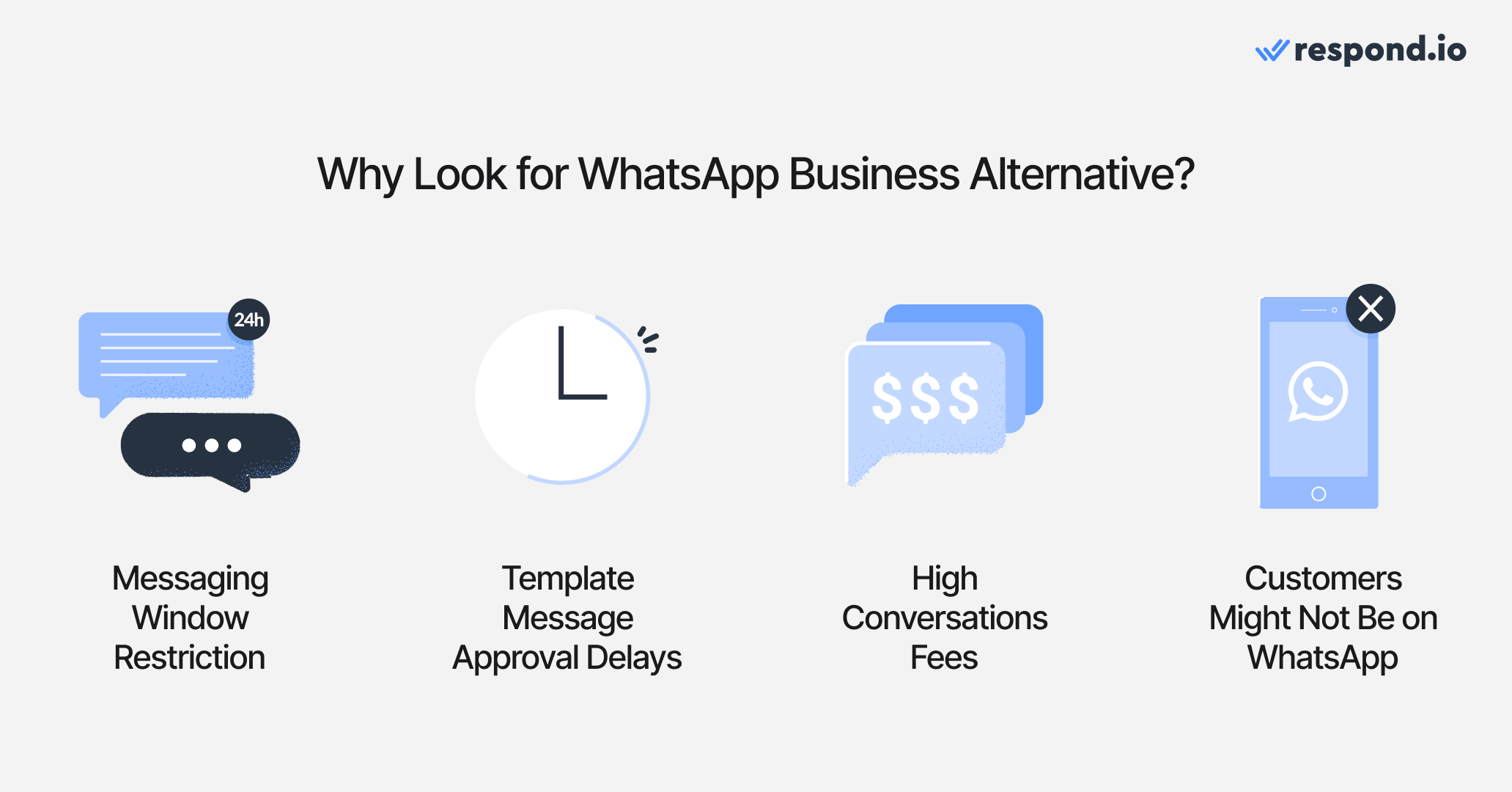
Messaging Window: Businesses must respond within 24 hours. If they don’t, they can only use pre-approved templates to restart conversations.
Message Template Approval: Business-initiated messages require a message template, which must be approved by Meta. This approval process can delay communication and limit businesses from starting a new conversation freely.
Messaging Fees: WhatsApp charges per message based on message category. The more you chat, the more the cost adds up.
Audience Mismatch: Your customers may not use WhatsApp as their primary messaging app, especially in certain regions.
If you're running into these roadblocks or want to expand your reach, it's time to explore alternative messaging channels. Here's a look at the best WhatsApp alternatives available for your business.
TL;DR: Best WhatsApp Alternatives for Business
Platform | Messaging Window | Business- Initiated Messages | Messaging Fees |
|---|---|---|---|
Messenger | 24 hours (extendable with Human Agent Tag) | ❌ 1:1 messages not allowed | ❌ None |
Telegram | ❌ None | ✅ 1:1 messages allowed if user has previously messaged | ❌ None |
Viber | 24 hours | ✅ 1:1 messages allowed if user has previously messaged | ✅ Business-initiated message |
24 hours (extendable with Human Agent Tag) | ❌ 1:1 messages not allowed | ❌ None | |
LINE | 7 days | ✅ 1:1 messages allowed anytime if user adds business as a friend | ✅ Based on account plan |
48-hour session, max 5 messages per session allowed | ❌ 1:1 messages not allowed | ❌ None (but $99/year) |
Turn conversations into customers with respond.io's official WhatsApp API ✨
Manage WhatsApp calls and chats in one place!
Best WhatsApp Alternative for Business: 6 Channels to Consider
Now, let's take a look at some popular WhatsApp alternatives for your business along with their features, benefits and limitations. The list includes Facebook Messenger, Telegram, Viber, Instagram, LINE and WeChat.
1. Facebook Messenger for Business
Facebook Messenger has 947 million monthly active users in 2026. It’s especially popular in Southeast Asia, Eastern Europe, Northern Europe and Latin America, with high reach in the Philippines, Vietnam, Mexico, Thailand and more according to Statista.
How it compares to WhatsApp:
Has a 24-hour messaging window (but extendable with Human Agent Tags)
Message templates require Meta approval for proactive outreach
Business-initiated messages allowed using message tags or broadcasts
No messaging fees
Small businesses can chat via Meta Business Suite and access features like saved replies. Larger businesses can connect the Messenger API to a platform like respond.io and reach customers via web chat, QR codes and more. Once a user starts the conversation, businesses can send broadcasts and view read receipts.
Additionally, voice calls are available in the same Messenger thread, keeping chat and calls together. Businesses can also create and submit custom utility templates for proactive outreach like appointment reminders and shipping confirmations.
Pros | Cons |
|---|---|
Supports broadcasts and read receipts | Can't import contacts |
Business-initiated messages supported via tags and broadcast | Group chat not supported |
Messaging window applies |
Best for: Businesses targeting Southeast Asia, Latin America or Europe that want cost-effective and flexible messaging.
We’ve shown you what Facebook Messenger entails; if this channel is what your business is looking for, sign up for a Facebook account and set up your Facebook Page today.
2. Telegram for Business
Telegram now boasts over 950 million monthly active users as of 2026. It sees strong adoption across Asia, Eastern Europe, Latin America and MENA, especially in India, Russia, Indonesia, Brazil and Egypt.
How it compares to WhatsApp:
No messaging window
No template approval required
Business-initiated messages are allowed for existing chats and through broadcasts
No messaging fees
Unlike WhatsApp, Telegram doesn’t have a business app. You need to create a business account with a Telegram bot and connect it to a messaging inbox like respond.io as it doesn’t have an interface.
While you can’t import contacts to message them first, users can start chats through links, QR codes or web chat. Telegram also supports auto replies and bulk messaging — ideal for sales and support workflows.
Pros | Cons |
|---|---|
Unlimited messaging flexibility | No native interface — bot setup required |
No fees or approvals | Can’t import contacts |
No broadcast limit | No message status indicators |
Best for: Companies needing flexible messaging and broadcasts across Asia, Eastern Europe and MENA without messaging limits or fees.
Want to start using Telegram for business? Create a Telegram bot to get started.
3. Viber Bot
Viber has over 820 million active users and remains popular in Central & Eastern Europe, Southeast Asia and the Middle East.
How it compares to WhatsApp:
Has a 24-hour messaging window
No template approvals
Business-initiated messages are charged
Businesses can use the Viber app for light messaging or connect the Viber Chatbot API to a platform like respond.io. While contact import isn’t supported, users can reach out through QR codes, links and Viber ads.
Pros | Cons |
|---|---|
Broadcasts supported | Can’t import contacts |
User-initiated messages are free | Businesses are charged for initiating messages & chatbot maintenance fees |
Viber bots are subject to a €100 monthly maintenance fee. Business-initiated messages are allowed and billed according to Viber’s commercial messaging rates. However, messages sent within 24 hours of a user message are free.
Best for: Brands serving Central & Eastern Europe or Southeast Asia.
Interested in using Viber to boost your business? Learn how to create a Viber Chatbot account here.
4. Instagram Direct for Business
Instagram has 2 billion monthly active users in 2026, with its largest audiences in India, the US, Brazil, Indonesia, Turkey, Japan and the UK. It’s especially effective for businesses targeting customers across Asia-Pacific, the Americas, MENA and Western Europe.
How it compares to WhatsApp:
Has a 24-hour messaging window (extendable to 7 days with Human Agent Tag)
No template approval process
Business-initiated messages via 1:1 chat & broadcast are not allowed
No messaging fees
Businesses can send messages through the Instagram Message Inbox, Meta Business Suite and Instagram Direct Message API connected to a platform like respond.io. You can reply to DMs, view read receipts and set auto replies directly using the app, Meta Business Suite or the API.
Instagram Message Inbox | Meta Business Suite | Instagram DM API | |
|---|---|---|---|
Best for | Solopreneurs and micro-businesses | Small businesses | Medium to large businesses |
Message volume | Low volume | Low volume | High volume |
Supports integration | No | No | Yes |
However, API users can’t send the first message and customers must initiate the conversation. To overcome this, you can encourage users to message you via click-to-chat ads, QR codes or web chat.
Once the conversation starts, you can automate responses and manage inquiries efficiently using respond.io. While Instagram enforces a 24-hour messaging window, the Human Agent Tag allows you to extend it to 7 days for ongoing support.
Pros | Cons |
|---|---|
Extendable messaging window | 24-hour messaging window applies |
Supports message status | Cannot import contacts |
Business can’t initiate chats via 1:1 message or broadcast |
Best for: Businesses with a strong visual brand targeting customers in Asia-Pacific, the Americas or MENA.
And that’s everything you need to know about using Instagram Direct Messages for Business. Want to start using Instagram for your business? Sign up for a business account today.
5. LINE Official Accounts
LINE dominates markets like Japan, Thailand and Taiwan, making it an essential messaging app for businesses targeting those regions.
How it compares to WhatsApp:
7-day messaging window, but replies are allowed anytime if added as a friend
No template approvals needed
Business-initiated 1:1 messages are only allowed if the customer has added the business as a friend, but broadcasts can be sent regardless
Charges are plan-based, not per message
LINE has one type of business account and that is LINE Official Account. It’s free to create but comes with several pricing plans. Businesses can chat with customers via the LINE Official Account Manager chat console or on a messaging platform connected to the account via an API.
Pros | Cons |
|---|---|
Businesses can initiate chats anytime if user add them as friends | 7-day reply limit if user hasn’t added business as a friend |
Broadcasts allowed | Charges are plan-based |
Supports message status | Cannot import contacts |
Businesses can’t import contacts, but can encourage customers to reach out via QR codes, links and ads. You can also verify your LINE Official Account so that customers can find your business via in-app search. Once customers message you, you can send auto replies and broadcasts for marketing, sales and support purposes.
If a user does not add your business as a friend, LINE allows you to respond for up to 7 days from their last message. However, if they add your account as a friend, you can continue messaging them without time limits. Read receipts are supported on both platforms, but you need to apply for this feature if you’re using an API.
Best for: Businesses targeting Japan, Thailand or Taiwan that want to combine flexible messaging, loyalty campaigns and broadcast marketing in one channel.
Want to get started with a LINE Official Account? Here’s a guide to help you with your account creation.
6. WeChat Business
WeChat is China’s most popular messaging app with over 1.3 billion monthly active users as of 2025. It’s the go-to platform for any business looking to operate in China or reach Chinese customers abroad.
How it compares to WhatsApp:
48-hour messaging window (max 5 messages per session)
No template approvals
No business-initiated 1:1 messages are allowed, but they can be sent via broadcasts.
No per-message fees, but $99/year verification required
Businesses can choose between Subscription Accounts and Service Accounts and manage messaging through the platform or via API integration. Signing up for a WeChat Official Account is free, but you have to pay USD99 annually for verification.
The WeChat Official Account Platform is for small businesses and has basic messaging features. The API supports third-party integration and advanced automation to handle a high volume of messages.
WeChat Official Account Platform | WeChat Official Account API | |
|---|---|---|
Best for | Small to medium businesses | Medium to large businesses |
Message Volume | Low | Mid to high |
Supports Integration | No | Yes |
With the WeChat Official Account Platform, you get features like WeChat Pay, Mini Programs, broadcasts and auto replies, but it doesn’t support read receipts, group chat and has a 48-hour messaging window.
WeChat Official Account API doesn’t allow businesses to send the first message, but you can prompt customers to reach out. Be sure to reply within 48 hours. Unfortunately, broadcasts are not supported here.
Pros | Cons |
|---|---|
Can set up auto reply and broadcast natively | $99 annual verification fee |
Reach Chinese audiences directly | Can't import contacts |
No message status | |
Business-initiated message not allowed | |
48-hour messaging window |
Best for: Businesses entering the Chinese market or targeting Chinese-speaking customers globally with messaging and commerce features.
If you’re thinking of expanding your business to China, then you should sign up for a WeChat Official Account.
These six instant messaging channels are great alternatives to WhatsApp. But if you’re looking for a way to communicate with your customers across all the messaging channels they use, try omnichannel messaging.
Consolidating All Apps in One Place with Respond.io
With so many messaging channels to handle, it’s hard to keep track of all conversations. You need an omnichannel messaging inbox like respond.io to integrate all your messaging channels into a centralized platform. From WhatsApp and Messenger to Telegram, LINE and more — respond.io lets you manage all customer conversations in one place.
Once you've consolidated your channels, you can:
Capture potential customers by encouraging them to start a conversation via website widget, QR codes, ads and more.
Leverage AI to respond to high volumes of conversations quickly and intelligently and to qualify leads.
Automatically route conversations to human agents whenever needed.
Make calls via Whatsapp calls or VoIP to speed up the selling process.
Send promotional broadcasts to reengage with existing contacts.
Integrate CRMs like HubSpot and Salesforce with your favorite messaging channels for seamless sales and support workflows.
Monitor team and conversation performance via reports and dashboards.
With respond.io, you’ll have the flexibility to engage customers wherever they are and the tools to do it at scale.
We hope this article gives you a better understanding of each WhatsApp Business alternative we’ve listed. Want to learn more about how these messaging apps can elevate your business? Sign up for our free trial.
Turn conversations into customers with respond.io's official WhatsApp API ✨
Manage WhatsApp calls and chats in one place!
Frequently Asked Questions
What are the best WhatsApp Business alternatives for companies?
If you’re running into messaging limits, high fees or regional restrictions on WhatsApp, alternatives like Messenger, Telegram, Instagram, Viber, LINE and WeChat may offer better flexibility and reach. Each platform has its own strengths — from unlimited messaging on Telegram to wide adoption in Asia on LINE and WeChat.
Why do businesses switch from WhatsApp Business to other platforms?
WhatsApp Business comes with limitations like the 24-hour messaging window, compulsory message template approvals and messaging fees. Businesses looking to scale, automate or connect with audiences in non-WhatsApp-dominant regions often explore other messaging channels.
Can I use more than one messaging app for my business?
Yes! Many businesses use an omnichannel messaging platform like respond.io to connect Messenger, WhatsApp, Telegram, LINE and more — all in one inbox. This lets you reach customers wherever they are, while managing everything from a single place.
Which messaging apps are cheaper than WhatsApp Business?
Apps like Facebook Messenger, Telegram and Instagram don’t charge per message, unlike WhatsApp. If you handle a high volume of chats, switching to a channel without messaging fees can significantly reduce messaging costs.


