










1. 首頁 
  2. > 部落格 
  3. > Practical Guide

2026 年適合企業的 7 款最佳 WhatsApp 行銷軟體

Ryan Tan

·

18 分鐘
最佳 WhatsApp 行銷軟體(7 款工具比較)

TL;DR — 最好的 WhatsApp 行銷軟體

針對處理大量 WhatsApp 會話的 B2C 行銷與客服團隊,本清單比較了最佳的 WhatsApp 行銷軟體,讓你能選擇適合活動、自動化與可衡量轉換的工具。 選錯平台會錯過回覆、流失廣告帶來的潛在客戶,並失去你已付費取得的銷售機會。 Respond.io is a customer conversation platform built for high-volume, multi-channel customer conversations that drive revenue workflows.

  • 如果你投放 Click-to-WhatsApp 廣告且每天需要路由並轉化數百則聊天,選擇 respond.io — 它能集中多代理回覆並自動化潛在客資格評估,減少潛在客流失。

  • 如果你想要一個以 WhatsApp 為主、為精簡團隊提供較簡單群發的共用 Inbox,選擇 Wati — 它提供範本、Inbox 協作與較輕量的自動化,無需繁重設定。

  • 如果你的行銷已透過電子郵件與 SMS 執行,並希望在同一堆疊加入 WhatsApp,選擇 Brevo — 它會將 WhatsApp 活動整合到既有的多通路工作流程中。

  • 如果你需要成本敏感、以 WhatsApp 為主且適合頻繁 B2C 活動的推廣,選擇 AiSensy — 它支援群發、提醒與簡單的後續流程。

  • 如果你需要由 CRM 或電商堆疊觸發的 API 驅動自訂旅程,選擇 Gupshup — 更適合開發者主導的實作。

  • 如果你需要企業級的跨通道個人化與進階報告,選擇 Insider.

  • 若你經營電商並需要快速回收購物車與原生 Shopify 推廣,請選擇

    NovoChat.

到了2026年,WhatsApp已不再是當初那個簡單的聊天應用程式。 它現在是一個全球性的行銷引擎,為超過 25億用戶 提供潛在客戶生成、銷售與客戶互動。 由於 開啟率接近100%,訊息幾乎能即時被看到。

每天有 1.75 億人向企業發送消息。 當聊天不斷堆積,顧客期待個性化回應時,壓力可不小。 當訊息漏掉或回覆延遲時,你會流失付費的 Click-to-WhatsApp 潛在客戶、購物車回收與預訂——直接降低轉換率與收入。

合適的 WhatsApp 行銷 軟體能幫你掌控混亂,讓對話既有條理又具個人化,並在不失人性化的情況下擴大活動規模。

本指南比較了適用於面向客戶的 B2C 團隊的最佳 WhatsApp 行銷軟體,讓你能選擇符合活動量、路由需求與轉換報告的平臺。

如自動分配聊天、發送提醒、與 CRM 同步及追蹤結果等功能。

Turn conversations into customers with respond.io's official WhatsApp API ✨

Manage WhatsApp calls and chats in one place!

我應該在 WhatsApp 行銷軟體中尋找什麼?

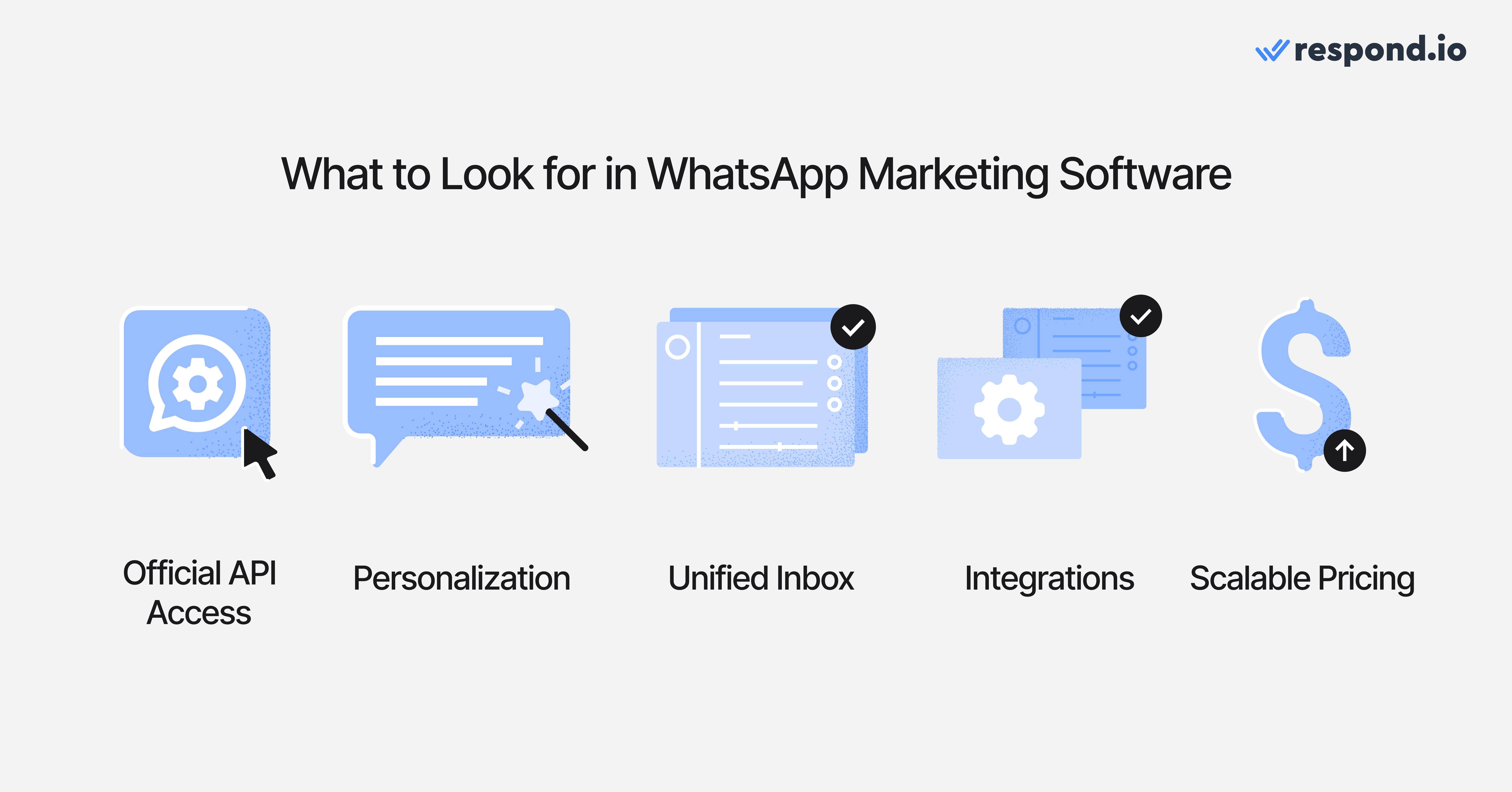
圖片顯示帶有圖標,展示企業如何選擇最佳的 WhatsApp 行銷軟體。 企業必須尋找:官方 WhatsApp API 訪問、個性化、統一收件匣、整合和 CRM 支援,以及可擴展的價格。

市面上有這麼多平台聲稱「做 WhatsApp 行銷」,要判斷哪些真正能交付並不容易。 使用此檢核表評估供應商:

標準

對營收的重要性

向供應商詢問的事項

官方 Meta 合作夥伴/API 存取

有助於維持合規、平台可靠性及存取進階功能

你是否為官方 Meta Business Partner 或經授權的 WhatsApp API 提供者?

廣播控管

能夠大規模執行合規且有目標性的活動

你提供哪些分群、排程與範本工具?

CTWA 潛在客戶處理

有助於捕捉並轉化付費社群流量

你如何路由並追蹤 Click-to-WhatsApp 廣告的潛在客戶?

多代理 Inbox

防止遺漏回覆並改善團隊協作

多位代理可以存取相同的對話歷程嗎?

CRM integration

Enables lifecycle tracking and prevents lead data loss

Which CRMs do you integrate with natively, and what syncs?

Conversion attribution

Links campaign spend to revenue outcomes

Can you show which broadcasts or workflows created revenue?

價格透明度

Avoids budget surprises mid-campaign

What’s included in the subscription vs. charged separately?

官方 API 訪問

The official WhatsApp Business API is the only way to run compliant campaigns, connect automation workflows and share a number across multiple agents. Any platform that doesn’t use the official API puts your number quality and campaign continuity at risk.

Look for a platform that is an official Meta Business Partner and uses the API directly, not through a third-party reseller with an extra markup. Confirm that opt-in records are captured at the contact level, template submissions are handled inside the platform and opt-out requests update contact status automatically.

Buyers should also verify what the provider actually handles during setup. A Meta-verified partner should be able to support business verification, number migration, template submission and approval troubleshooting as part of onboarding.

Do not rely on a sales claim alone. Check the vendor in Meta's Partner Directory and ask whether onboarding, template approvals and account support are handled directly or passed to another provider. That matters because extra reseller layers can slow launch, complicate support and create more risk when a revenue campaign is live.

個性化和活動

Personalized WhatsApp campaigns perform better because customers on a messaging app expect relevant, timely communication. A platform should let businesses segment by lifecycle stage, purchase history or engagement level so they can reach the right audience, not just the biggest list.

Segment audiences to target:

  • New leads who need onboarding or product education

  • Warm prospects where timing and offer matter most

  • High-value customers who deserve VIP treatment and early access

  • Recent buyers ready for loyalty rewards or cross-sells

  • Browsers who asked about a specific item or category

Buyers should also match the platform to the revenue motion it needs to support most often:

  • Promotional broadcasts: Verify segmentation, scheduling, template management and campaign-level conversion reporting.

  • Click-to-WhatsApp lead qualification: Check that AI Agents or workflows can capture source, qualify intent, route to the right rep and record outcomes.

  • Reminders and reactivation: Confirm the platform can trigger follow-up from lifecycle stage, booking status or inactivity without manual export.

  • Post-purchase follow-up: Make sure it can send updates, collect feedback and surface upsell opportunities in the same conversation.

  • Service-led sales conversations: Check for multi-agent ownership, internal notes and a full conversation history when support turns into a sale.

The right tool is the one that supports the revenue motion the business runs most often, then carries that conversation through reply handling and attribution.

WhatsApp 流程與聊天內表單

WhatsApp Flows let businesses collect structured input from customers inside the chat, without redirecting to a website form. Common uses include lead qualification, appointment booking, product preference capture and post-purchase feedback.

For a marketing platform, the value is reducing friction at the moment a customer is most engaged. A form built inside WhatsApp keeps the conversation moving, collects the data in a structured format and connects it to the workflow that follows, such as routing, a confirmation message or a CRM update.

Buyers should also look beyond forms and check which interactive formats the platform supports for campaigns and follow-up. Images or video help with product discovery, quick replies and buttons speed up qualification and reminder flows and richer message formats make reactivation or service updates easier to act on inside the chat.

The strongest platforms do more than send approved templates. They make interactive messages easy to build, track which buttons or replies customers choose and connect those actions to routing, automation or conversion reporting.

共享收件匣

A shared inbox is where campaign performance turns into revenue. When a broadcast drives a reply, the team needs to see it, own it and act on it fast — without two agents answering the same message or a hot lead sitting unread for hours.

Look for assignment logic that routes replies by intent or team, visible ownership so managers can see what’s claimed and what’s not, internal notes for handoffs and response time tracking. The inbox should be a revenue workspace, not just a message list.

CRM 整合、自動化和分析

The platform should connect WhatsApp conversations to the systems that run the sales process. That means syncing contact records, updating lifecycle stages and writing conversation outcomes back to the CRM so teams can act on context without switching tools.

Many B2C teams do not close every lead on WhatsApp alone. Buyers should check whether the platform keeps one contact history across WhatsApp and other key messaging, social, voice and email channels, whether those channels are supported natively and whether workflows can shift follow-up when a customer changes channels or stops replying.

Automation should handle more than routing. AI Agents should qualify leads, trigger follow-up sequences, update lifecycle stages and escalate ready buyers to a human with a summary. The goal is to remove repetitive work from the sales team, not just speed up the first reply.

For analytics, the questions that matter most are:

  • Did the message reach the customer?

  • Did they tap a button or link?

  • Did they engage in conversation?

  • Did the conversation lead to a purchase or qualified lead?

  • How much did this broadcast or automation actually generate?

  • How quickly did reps respond to inbound messages?

透明定價

Total WhatsApp cost is made up of more than the list price. Buyers should model these cost components together before signing:

  • The software subscription

  • Meta charges based on message category and recipient market

  • Any provider markup layered on top of Meta fees

  • One-time onboarding or migration fees

They should also ask what usually inflates spend after launch:

  • Extra charges when more agents need access

  • Paid middleware when CRM or other system integrations are not native

  • Extra work caused by repeated template revisions

Respond.io uses Monthly Active Contacts (MAC) pricing rather than seat-based pricing, so buyers can forecast cost around the number of contacts engaged each month instead of headcount. That makes it easier to compare pricing mechanics before the first campaign goes live.

The mix of conversations changes the bill. A B2C promotion plan with frequent broadcast campaigns will price differently from a motion built around lead qualification, appointment reminders or service updates, even when send volume looks similar. That is why buyers should ask vendors to show spend by message type, active audience size and workflow volume.

Respond.io uses Monthly Active Contacts (MAC) pricing rather than seat-based pricing. Starter is $99 per month, Growth is $199 per month, Advanced is $349 per month and Enterprise is custom, with Meta fees billed separately and a 7-day free trial available. Before signing, ask for a sample invoice based on real Monthly Active Contacts, campaign mix, markets and support traffic so finance and marketing teams can compare total cost, not just entry price.

歸因與轉換報告

Attribution tells you which campaign, broadcast or automation created a conversion — not just which message was delivered. For B2C teams running Click-to-WhatsApp ads, that means tracking whether a paid ad conversation turned into a booked appointment, a completed purchase or a qualified lead routed to sales.

Buyers should ask how the platform connects conversation outcomes to campaign spend, whether it supports Meta’s Conversions API for better ad attribution and whether revenue from WhatsApp can be broken down by campaign, agent or channel without manual export.

上線與支援品質

The onboarding process sets the pace for how quickly the platform starts generating returns. A good onboarding covers business verification, number migration, template submission, CRM connection and the first routing workflow — not just account activation.

For ongoing support, the question is not just whether support exists but how fast it responds and how deep it goes. Mid-market B2C teams running campaigns and sales workflows need support that can answer product questions, diagnose issues and help optimize workflows — not just route tickets.

Respond.io offers 24/7 human and AI support on all plans.

WhatsApp 行銷軟體比較表

Platform

最佳用途

Official API

Broadcast & Campaigns

Multi-Agent Inbox

AI Agents

CRM Integration

Conversion Attribution

Pricing Model

respond.io

B2C teams running high-volume campaigns, Click-to-WhatsApp ads and multi-channel follow-up

Monthly Active Contacts

Wati

Small teams needing WhatsApp-first shared inbox and basic broadcasts

Limited

Limited

Limited

Per-seat

Brevo

Multi-channel marketers adding WhatsApp to email and SMS flows

Limited

Limited

Limited

Per-email / per-contact

AiSensy

WhatsApp-first teams in India needing broadcasts, bots and live chat

Limited

Limited

Limited

Per-seat + usage

Gupshup

Developer-led teams building custom WhatsApp experiences at scale

Limited

Limited

Limited

Limited

Custom / usage-based

Insider

Enterprise teams running cross-channel journeys with AI personalization

Limited

Custom

NovoChat

Small e-commerce teams in Southeast Asia needing broadcasts and basic support

Limited

Limited

Limited

Per-seat

2026 年頂尖 WhatsApp 行銷軟體

Each platform is reviewed against the same criteria: official API access, broadcast capability, multi-agent inbox, AI Agents, CRM integration, conversion attribution and pricing transparency.

1. Respond.io

Respond.io is a customer conversation platform for mid-market B2C businesses that run revenue-critical conversations at high volume. It is built around a unified inbox where sales and support teams manage WhatsApp, Instagram, Facebook Messenger, TikTok, Telegram, LINE, Viber, WeChat, voice calls and email from one place.

For marketing teams, the platform offers:

  • AI Agents with a full customer context view to qualify WhatsApp leads, track funnel stages, and prioritize follow-ups

  • Broadcast tools for WhatsApp campaigns with template management including carousel templates, scheduling, personalization and audience segmentation

  • Native integrations like HubSpot and Salesforce

  • Voice calls inside the same inbox as chats

Respond.io supports Meta’s Conversions API so ad campaigns can be attributed to WhatsApp conversions, not just clicks. Lifecycle reports show where contacts move through the funnel, which workflows generate the most qualified leads and where drop-off happens.

The platform uses Monthly Active Contacts (MAC) pricing, which means cost scales with the contacts engaged each month, not with the number of agents using the platform. Respond.io pricing: Starter at $79 per month, Growth at $159 per month, Advanced at $279 per month and Enterprise on custom pricing. Meta’s conversation fees are billed separately and directly by Meta.

Best for: Mid-market B2C teams running high-volume WhatsApp campaigns, managing Click-to-WhatsApp ad leads and following up across multiple channels.

Not ideal for: Teams that only need lightweight broadcast tools without multi-agent workflows or lifecycle reporting.

Turn conversations into customers with respond.io's official WhatsApp API ✨

Manage WhatsApp calls and chats in one place!

2. Wati

Wati is a WhatsApp-first platform designed for small to mid-sized teams that need a shared inbox, basic broadcast tools and simple automation without a complex setup. It connects to the official WhatsApp Business API and covers the core use cases that most WhatsApp-focused teams start with.

For marketing use cases, Wati offers segmented broadcasts, a template manager and basic automation flows. The inbox supports multiple agents and conversation assignment, which works for teams managing inbound replies after a campaign send.

The tradeoffs become visible at scale. AI Agents are limited, cross-channel coverage outside WhatsApp is not a core strength and conversion attribution reporting is not built in. Teams running Click-to-WhatsApp ads with high daily reply volume, or those needing tight CRM sync and lifecycle tracking, tend to outgrow Wati’s feature depth.

Wati uses per-seat pricing. The Starter plan starts at approximately $39 per month, with Growth and Business tiers available at higher price points. Meta conversation fees apply separately.

Best for: Small teams that want a straightforward WhatsApp shared inbox and broadcast tool without heavy workflow configuration.

Not ideal for: Teams that need AI Agents, multi-channel routing, deep CRM sync or revenue attribution across campaigns.

3. Brevo

Brevo is a multi-channel marketing platform that covers email, SMS and WhatsApp from one workspace. It is suited to marketing teams that already use Brevo for email campaigns and want to add WhatsApp without switching platforms.

For WhatsApp marketing, Brevo supports template-based campaigns, audience segmentation and basic automation sequences. The shared inbox is available but lightweight compared to platforms built primarily around WhatsApp. AI Agents and deep WhatsApp-specific automation are not a core strength.

CRM integration is available via Brevo’s own built-in CRM or through third-party connections. Attribution reporting is more developed on the email side than the WhatsApp side, which can make it harder to measure WhatsApp campaign return directly.

Brevo’s pricing is usage-based for email, with WhatsApp features accessible from paid plans. Meta conversation fees apply on top. Teams doing heavy WhatsApp volume should model total cost across both layers before comparing to WhatsApp-first platforms.

Best for: Marketing teams already in Brevo’s ecosystem who want to add WhatsApp as a channel without a separate platform.

Not ideal for: Teams whose primary revenue channel is WhatsApp and who need deep inbox, AI and attribution features.

4. AiSensy

AiSensy is a WhatsApp marketing platform primarily used by businesses in India. It offers broadcast campaigns, a shared team inbox, basic chatbot automation and integrations with e-commerce platforms and CRMs.

The platform is accessible and affordable for early-stage WhatsApp campaigns, particularly for teams in the Indian market. Broadcast tools cover the basics — segmentation, scheduling and template management — and the inbox supports multiple agents with conversation assignment.

AI Agents, advanced lifecycle automation and conversion attribution are limited. Teams running complex sales workflows, multi-channel follow-up or needing tight CRM sync beyond basic contact updates tend to find the platform too shallow for mid-market B2C scale.

AiSensy uses per-seat pricing plus a usage component. Starter tiers begin at lower price points but scale with seat count and usage. Meta conversation fees apply separately.

Best for: Small to mid-sized teams in India running WhatsApp broadcast campaigns and basic customer service at moderate volume.

Not ideal for: Teams needing AI Agents, multi-channel conversation routing or advanced revenue attribution.

5. Gupshup

Gupshup is a conversational engagement platform built primarily for developer-led teams that need API access, multi-channel messaging and custom bot flows at scale. It is widely used across emerging markets and supports a broad set of messaging channels beyond WhatsApp.

For WhatsApp marketing, Gupshup supports broadcast campaigns, template management and conversation flows. The platform has strong API depth and channel coverage, but the configuration and maintenance required for non-technical teams is higher than most business-user-first tools.

AI Agents and out-of-the-box shared inbox workflows are not a core strength. Multi-agent revenue operations and conversion attribution require more custom build compared to platforms designed for marketing managers rather than developers.

Gupshup pricing is typically custom and usage-based. Teams should request a detailed breakdown of API fees, platform charges and any per-message or per-session costs before comparing against other options.

Best for: Developer-led teams that need custom WhatsApp API integrations and multi-channel bot flows at scale.

Not ideal for: Marketing or sales teams that need a business-user-ready inbox, AI Agents and revenue reporting without significant developer involvement.

6. Insider

Insider is an enterprise cross-channel customer experience platform that includes WhatsApp as part of a broader marketing automation and personalization suite. It is used by large retailers and travel companies that need AI-driven journey orchestration across web, app, email, SMS and WhatsApp.

For WhatsApp marketing, Insider offers audience segmentation, template campaigns, AI-generated content recommendations and integration into multi-step journeys. Attribution is built into the platform’s broader analytics layer.

The platform is positioned for enterprise buyers with complex personalization needs and larger budgets. For mid-market B2C teams focused primarily on WhatsApp conversations and revenue workflows, the platform scope and pricing may exceed what the use case requires.

Insider pricing is custom and enterprise-focused. Teams should expect a sales process before receiving specific pricing.

Best for: Enterprise marketing teams running AI-driven, multi-channel customer journeys across web, app, email and WhatsApp.

Not ideal for: Mid-market B2C teams that need a WhatsApp-first revenue inbox with AI Agents, multi-agent collaboration and fast campaign setup.

7. NovoChat

NovoChat is a WhatsApp and multi-channel messaging platform focused on small e-commerce businesses, primarily in Southeast Asia. It offers broadcast campaigns, a shared team inbox and basic automation, with integrations for Shopify and WooCommerce.

For WhatsApp marketing, NovoChat covers the entry-level broadcast and inbox use cases. The platform is straightforward to set up and aimed at teams that do not need advanced automation or deep CRM integration.

AI Agents, advanced lifecycle automation, conversion attribution and multi-channel follow-up beyond WhatsApp and a few other channels are not strong suits. Teams scaling past basic broadcast volume or running complex sales workflows will likely need a more capable platform.

NovoChat pricing is per-seat. Plans start at relatively low price points, making it accessible for very small teams, but seat costs add up quickly as the team grows.

Best for: Small e-commerce teams in Southeast Asia that need simple WhatsApp broadcasts and a shared inbox with Shopify or WooCommerce integration.

Not ideal for: Teams needing AI Agents, cross-channel automation, lifecycle reporting or conversion attribution.

結論:2026 年最佳 WhatsApp 行銷軟體

For mid-market B2C teams whose revenue depends on WhatsApp conversations, the platform choice determines whether campaigns drive measurable return or just generate activity.

Respond.io stands out because it is the only platform in this list built end-to-end for revenue-critical conversations at scale. It combines a multi-agent inbox, AI Agents, broadcast tools, CRM integration and conversion attribution in one place — so marketing teams can run campaigns, sales teams can manage replies and managers can see which conversations are creating revenue.

Wati is the right choice for small teams that want a clean WhatsApp inbox and basic broadcast capability without heavy configuration. AiSensy fits teams in India at earlier stages of WhatsApp adoption. Brevo works when WhatsApp is an add-on to an existing email marketing motion. Gupshup suits developer-led teams that need raw API control. Insider fits enterprise buyers with complex cross-channel journey needs. NovoChat works for very small e-commerce teams in Southeast Asia.

案例研究:respond.io 如何協助 B2C 團隊將 WhatsApp 對話轉為營收

Lamarsa Coffee is a specialty coffee equipment retailer operating across six countries that was losing Click-to-WhatsApp leads because chat volume exceeded what their team could manually handle. After implementing respond.io, they deployed AI Agents to qualify inbound leads, route high-intent buyers to the right sales rep and trigger automated follow-up sequences. The result was a 50% increase in sales across their six markets, with the same team size.

Sport Center Los Naranjos is a wellness and fitness center in Caracas, Venezuela, offering gym facilities, classes and personal training. They were losing membership inquiries because WhatsApp conversations were not being routed to the right staff quickly enough. Using respond.io workflows, they automated lead qualification, routed conversations to the right team member and followed up with unconverted leads automatically. Sales conversion from WhatsApp inquiries improved by 20%.

If you’re ready to turn WhatsApp conversations into a measurable revenue channel, respond.io is the platform built for it. Start your free trial today.

FAQs about the best WhatsApp marketing software

什麼是最佳的 WhatsApp 行銷軟體?

If you run B2C campaigns where speed-to-lead and reply handling affects conversion, prioritize tools with a shared inbox, automation, and conversion reporting. If you also need multi-channel conversation routing, respond.io’s workflows and lifecycle tracking are built for that.

What is the best WhatsApp automation tool?

The best WhatsApp automation tool for a mid-market B2C team is one that does more than automate replies. Buyers should look for AI Agents that qualify leads, update lifecycle stages, route conversations by intent, trigger follow-up workflows and escalate high-value opportunities with a clear handover summary.

For teams that need automation tied to revenue outcomes, respond.io is a customer conversation management platform built for high-volume B2C conversations. It combines AI Agents, no-code workflows, customer relationship management integration and conversion reporting so teams can automate follow-up without losing handoff context or pipeline visibility.

哪款 WhatsApp 行銷軟體最適合 Click-to-WhatsApp 廣告?

最適合 Click-to-WhatsApp 廣告的,是能捕捉每一則新對話、路由至正確客服,並追蹤轉換的工具。 如果你需要無程式碼的路由工作流程與生命週期追蹤來避免潛在客戶流失,respond.io 即為此而生。

WhatsApp 行銷軟體的成本是多少?

Costs per message vary by market and by message category, so buyers should not compare vendors on subscription price alone. Total spend usually combines the software subscription, Meta charges, any provider markup and any onboarding or migration fees.

The most accurate way to compare vendors is to model real usage. A broadcast-heavy promotion plan creates a different bill from a lead qualification or service update motion, even when monthly volume looks similar. Respond.io uses Monthly Active Contacts (MAC) pricing with Starter at $99 per month, Growth at $199 per month, Advanced at $349 per month and Enterprise on custom pricing, while Meta fees are billed separately.

Before signing, ask for a sample invoice based on expected Monthly Active Contacts, message categories, markets and campaign mix. That gives finance and marketing teams a clearer view of cost per campaign and cost to serve.

Does WhatsApp marketing improve ROI?

Yes, when it is used to capture opt-in demand, follow up quickly and measure which conversations create revenue. Return on investment usually improves when teams segment audiences, personalize approved templates and route replies fast enough to convert high-intent leads before they go cold.

The wrong platform weakens return on investment by hiding attribution, delaying follow-up or sending broad campaigns that waste spend. Buyers should look for campaign-level conversion reporting and automation that keeps sales and support moving, such as AI Agents that qualify leads, trigger reminders and escalate ready buyers to a human.

Can WhatsApp marketing integrate with my customer relationship management system and other channels?

Yes. The right platform should sync contact data, lifecycle stages and conversation outcomes with a CRM so sales and support teams can follow up with full context.

It should also preserve conversation history when a customer moves between WhatsApp, Instagram, Facebook Messenger, TikTok, Telegram, LINE, Viber, WeChat, voice calls and email. For mid-market B2C teams, that makes it easier to route by intent, update records automatically and measure which conversations actually turn into revenue.

What is the difference between marketing and utility messages on WhatsApp?

Marketing messages promote an offer, product, event or reactivation campaign. Utility messages support an action the customer already expects — such as an order update, appointment reminder or payment confirmation.

The difference matters because message category affects template approval requirements, Meta billing rates and how teams should measure results. Buyers should ask vendors how templates are classified, how category mix shows up in reporting and whether spend can be broken down by campaign type. respond.io shows spend and performance by message category in its broadcast analytics, making it easier to compare campaign ROI across message types.

Is WhatsApp marketing compliant and safe for businesses?

Yes — when it runs through the official WhatsApp Business Platform with approved templates, clear opt-in records and a simple way for customers to opt out. Buyers should confirm that the software stores consent status at the contact level, separates marketing from utility sends and blocks outreach to audiences that cannot be contacted.

Safety also depends on how the vendor handles template approval, number quality and access controls for agents. A platform that makes those checks visible helps teams protect the number, avoid wasted spend and keep campaigns running without unnecessary compliance risk.

Do I need approved templates for WhatsApp campaigns?

Yes. Approved templates are required for business-initiated WhatsApp campaigns outside an active service conversation, which is why template management affects both compliance and launch speed.

Buyers should look for software that makes template submission, revisions, approval tracking and reuse easy. The strongest platforms also support personalisation within approved template formats, so teams can scale outbound campaigns without slowing down every time a new message needs review.

How can I send bulk messages on WhatsApp without getting banned?

Send bulk messages through the official WhatsApp Business Platform using approved templates and a clear opt-in record for every audience. The platform should also support segmentation, scheduling and opt-out handling so marketing teams can send relevant campaigns without breaking policy.

Buyers should avoid unofficial sender tools or browser automations that bypass approval and consent controls. Respond.io is a customer conversation management platform that sends approved broadcasts through the official platform, which helps protect number quality, deliverability and the revenue tied to repeat campaigns.

Before scaling volume, buyers should confirm how the vendor handles template submission, consent tracking and delivery reporting. That is what turns bulk sending from a compliance risk into a repeatable revenue channel.

What is the difference between WhatsApp sender software and WhatsApp marketing platform?

WhatsApp sender software is usually built to push messages in bulk, often with limited control over consent, template approval or follow-up workflows. A proper platform runs on the official WhatsApp Business Platform and gives teams the tools to manage segmentation, approved templates, opt-outs, routing and reporting from one place.

The difference matters because sender software may look cheaper at first but can put number quality, deliverability and campaign continuity at risk. Respond.io is a customer conversation management platform that supports approved broadcasts and coordinated follow-up across WhatsApp and other key messaging, social, voice and email channels.

我可以不使用 API 進行 WhatsApp 行銷嗎?

Yes, but with significant limits. The free WhatsApp Business App works for solo operators handling manual outreach, but it becomes a ceiling when a team needs larger broadcasts, shared inbox visibility across agents, CRM integration and structured reporting.

The API removes these limits. For any team running paid campaigns, routing conversations to multiple agents, or needing to measure which conversations drive revenue, the API is the baseline — and the right software on top of it is what makes it operational.

WhatsApp 商業應用與 API 有何不同?

The WhatsApp Business App is a free mobile application designed for single users. It supports basic messaging, quick replies and a simple product catalogue, but it caps broadcasts at 256 contacts, has no multi-agent access and cannot connect to a CRM or automation platform.

The WhatsApp Business API is a developer-facing interface that enables software platforms to connect to WhatsApp at scale. It removes broadcast limits, supports multi-agent shared inboxes, enables workflow automation and CRM sync, and provides the reporting infrastructure needed to measure campaign outcomes. Any platform on this list requires API access to operate — the difference between vendors is how they implement, price and build on top of it.

How do I integrate WhatsApp marketing tools with a customer relationship management system?

Most teams connect the platform to a CRM so new WhatsApp leads create or update records automatically, while agents can see owner, lifecycle stage and past activity during the conversation.

Buyers should check whether the integration is native or workflow-based, which fields sync in both directions and whether AI Agents or automations can update lifecycle stages, route conversations and write outcomes back to the CRM without manual data entry.

What is the difference between marketing and utility messages on WhatsApp?

Marketing messages are used to promote an offer, product, event or reactivation campaign. Utility messages support an action the customer already expects, such as an order update, appointment reminder or payment confirmation.

The difference matters because message category affects approval, cost and how teams should measure results. Buyers should ask vendors how templates are classified, how category mix shows up in reporting and whether spend can be broken down by campaign type.

How long does WhatsApp marketing software take to set up?

軟體設定可能很快,但上線時間取決於不只啟用平台。 主要步驟包括商業驗證、連接合格號碼、提交範本,以及建置第一個路由工作流程或活動。

最大的延誤通常來自驗證問題、號碼遷移、範本修訂或團隊間的權責不清。 買方應詢問供應商哪些步驟由其直接處理,以及企業需在內部準備哪些事項,以免付費潛在客戶與外發活動被耽擱。

我需要技術知識才能使用 WhatsApp 行銷軟體嗎?

若平台提供免程式碼工作流程、範本管理與引導式上線,日常活動作業則不需要技術知識。 行銷、銷售與客服團隊仍需負責定義路由規則、生命週期階段、核准負責人,以及需與其他系統同步的欄位。

針對自訂整合或進階資料同步,技術協助仍可能有幫助,但在中型 B2C 團隊中,發送群發、篩選潛在客戶或分派對話並不應該需要技術能力。

哪些產業最能從 WhatsApp 行銷軟體中獲益?

當顧客在購買、預訂或續訂前經常發訊息時,中型 B2C 企業受益最大。 常見適用產業包括零售、教育、汽車、健康與保健、房地產,以及其他消費者服務業,這些產業中快速跟進、預約處理或潛在客戶鑑別會直接影響營收。

最強的使用情境並不侷限於單一產業。 適用於任何進行付費潛在客戶獲取、管理大量進線聊天或需要銷售與客服團隊在同一對話中協同且將結果回溯至 CRM 的企業。

延伸閱讀

如果您覺得這篇文章有幫助,以下延伸閱讀:

分享這篇文章
Telegram
Facebook
Linkedin
Twitter
Ryan Tan
Ryan Tan
Ryan Tan, a London School of Economics (LSE) law graduate, is a Senior Communications Strategist at respond.io. With his B2B tech marketing and Big 4 experience, he strives to create content that both educates and entertains tech-savvy audiences. Ryan specializes in demystifying business messaging, providing readers with practical insights that pave the way to robust growth.
用 Respond.io 增加 3 倍的業務成果 🚀