










How does respond.io handle multi-country operations — and when is it more infrastructure than you need?

TL;DR: Respond.io centralizes teams, channels and customer conversations for regional businesses but is overkill for low volumes

For mid-market B2C businesses expanding across countries, respond.io centralizes teams, channels, and conversations in one workspace — with routing by language and timezone, plus multilingual AI qualification; it’s overkill for businesses that prioritize support use cases or receive low conversation volumes (fewer than 500 conversations per month).

How respond.io replaces fragmented regional tools for mid-market B2C teams

Mid-market B2C businesses expanding internationally often start with separate tools or instances per country. This fragments customer data, creates handoff failures between regional teams, and makes cross-market performance invisible to leadership — costing deals in new markets before they even get traction.

One workspace for all markets

Channel and data silos cause leads to disappear when they move between markets or contact different branches. Respond.io is a customer conversation management platform that consolidates every country's conversations, contacts, and team activity into a single workspace so regional teams operate within the same environment. No matter which branch’s team a customer contacts, the full conversation history is already there — no manual lookup, no lost context, no dropped deal.

Connect country-specific channels without fragmentation

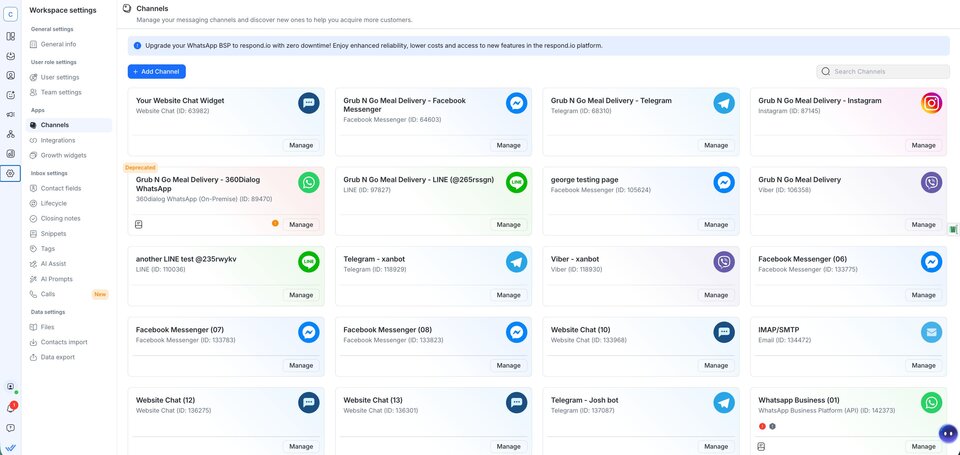
Each market may require different channels — WhatsApp in Latin America, LINE in Thailand, Facebook Messenger in the Philippines. Respond.io lets you connect all these to a single inbox. Without this, businesses expanding into new markets either force customers onto unfamiliar channels (losing leads who won't switch) or manage separate tools per region, losing context if leads contact you on multiple channels.

Screenshot of the respond.io Channels page showing WhatsApp, Instagram, LINE, Telegram, Viber and Messenger connected to a single workspace, illustrating how country-specific channels are managed without fragmentation.

How routing and AI Agents adapt to regional requirements

Mid-market B2C expansion fails when speed-to-lead drops in new markets. If a lead in Mexico waits hours because your team from the central office in Manila is asleep, or if an Arabic-speaking prospect gets routed to an English-only agent, that deal is already at risk. Respond.io's routing and AI architecture is built to prevent these failures at scale.

Route by language, timezone, or market automatically

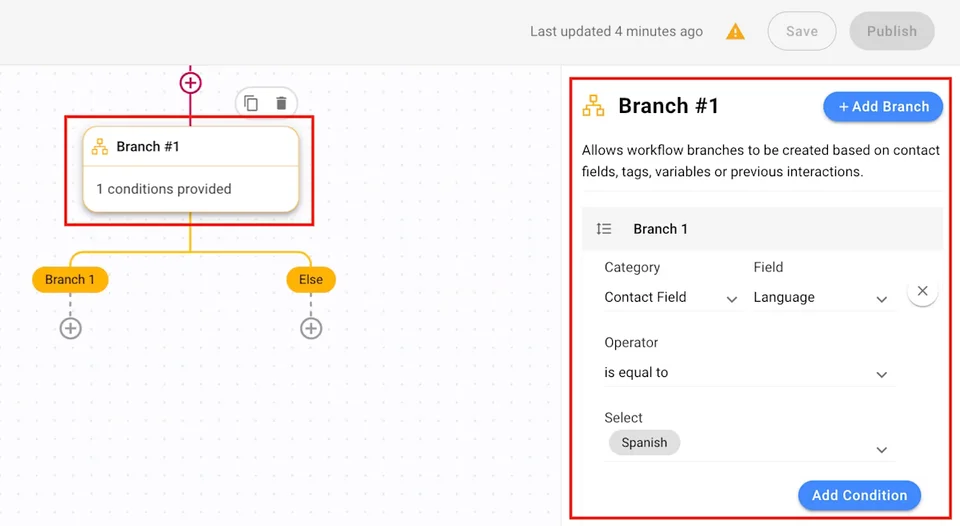
Workflows let you define routing rules that assign conversations based on contact language, detected country or channel origin. A lead can answer a question about language or country and be instantly directed to the right team or agent. Without automated routing that accounts for regional context, high-volume expansion creates response time spikes that directly cost revenue in new markets.

Screenshot of the respond.io Workflow builder showing routing logic that branches conversations by detected language or country, illustrating how leads are automatically assigned to the right regional team.

Multilingual AI Agents qualify leads in any market

Respond.io's AI Agents operate in over 30 languages without requiring separate bots per region. A single AI Agent can qualify a lead in Spanish, switch to Portuguese for the next conversation, and escalate to your German team with full context — all from the same configuration. This matters because businesses that deploy separate bots per language face compounding maintenance costs and inconsistent qualification logic, leading to uneven lead quality across markets and lost revenue in regions where the bot is undertrained.

Escalate to regional teams with full context

When an AI Agent escalates to a human, the entire conversation history — including language, channel, and any data collected during qualification — transfers automatically. Regional closers see exactly what the lead said, in their language, without asking the customer to repeat themselves. This continuity is what separates expansion that converts from expansion that frustrates leads and loses deals at the handoff.

When respond.io fits multi-country expansion — and when it's more infrastructure than you need

Respond.io fits mid-market B2C businesses that need to centralize high-volume conversations across teams, channels, and regions. For multi-country operations specifically, it handles routing and multilingual AI qualification in one workspace so you can scale operations without adding headcount or complexity. It becomes more infrastructure than you need when your use case is predominantly support or conversation volumes are low.

When it's the right fit

  • Mid-market B2C business expanding into multiple countries with high conversation volumes per market
  • Your current setup creates silos between regional teams, causing leads to get lost in handoffs or forcing customers to repeat themselves
  • You need multilingual AI qualification and contextual routing to scale without multiplying headcount proportionally
  • Leadership requires visibility across all markets from day one, not after regional managers compile separate reports

When it isn't the right fit

  • Your use of respond.io would be limited to support only, with no connection to revenue outcomes like retention, renewals, or upsells — the platform's sales workflow architecture won't deliver ROI in that configuration.
  • Your business sends and receives low volumes of customer conversations overall

Related FAQs