
















 Electronics
 Fashion & Apparel
 Furniture
 Jewelry and Watches
 Afterschool Activities
 Sport & Fitness
 Beauty Center
 Dental Clinic
 Medical Clinic
 Home Cleaning & Maid Services
 Photography & Videography
 Car Dealership
 Travel Agency & Tour Operator

In today's world, customers expect seamless experiences when interacting with businesses, regardless of the channel they use to communicate. This is where omnichannel support comes in. By offering omnichannel customer support, businesses can meet customer expectations and improve customer satisfaction. In this article, we'll explore its benefits and the reasons why you should use respond.io as an omnichannel support platform.
Intro to Omnichannel Customer Support
Traditional support teams often focus primarily on a single channel like phone, email or website chat support. However, this can be limiting for larger companies with many customers and agents to manage. A multichannel approach expands the reach of customer support.
What is Multichannel Support?
Multichannel support enables customers to contact a business through multiple channels such as email, phone, website chat or any instant messaging channel like WhatsApp or Facebook Messenger.
One of the main problems with using multichannel support is the potential for inconsistent information. Since each channel may have a separate team or process, customers may receive different answers or solutions from different representatives or channels. This is frustrating and confusing, leading to lower satisfaction and loyalty.
Another issue with multichannel support is slow response times. If different channels or teams are not coordinated, it may take longer to resolve cases. Slow response times can lead to frustration and dissatisfaction, and may even result in lost business.
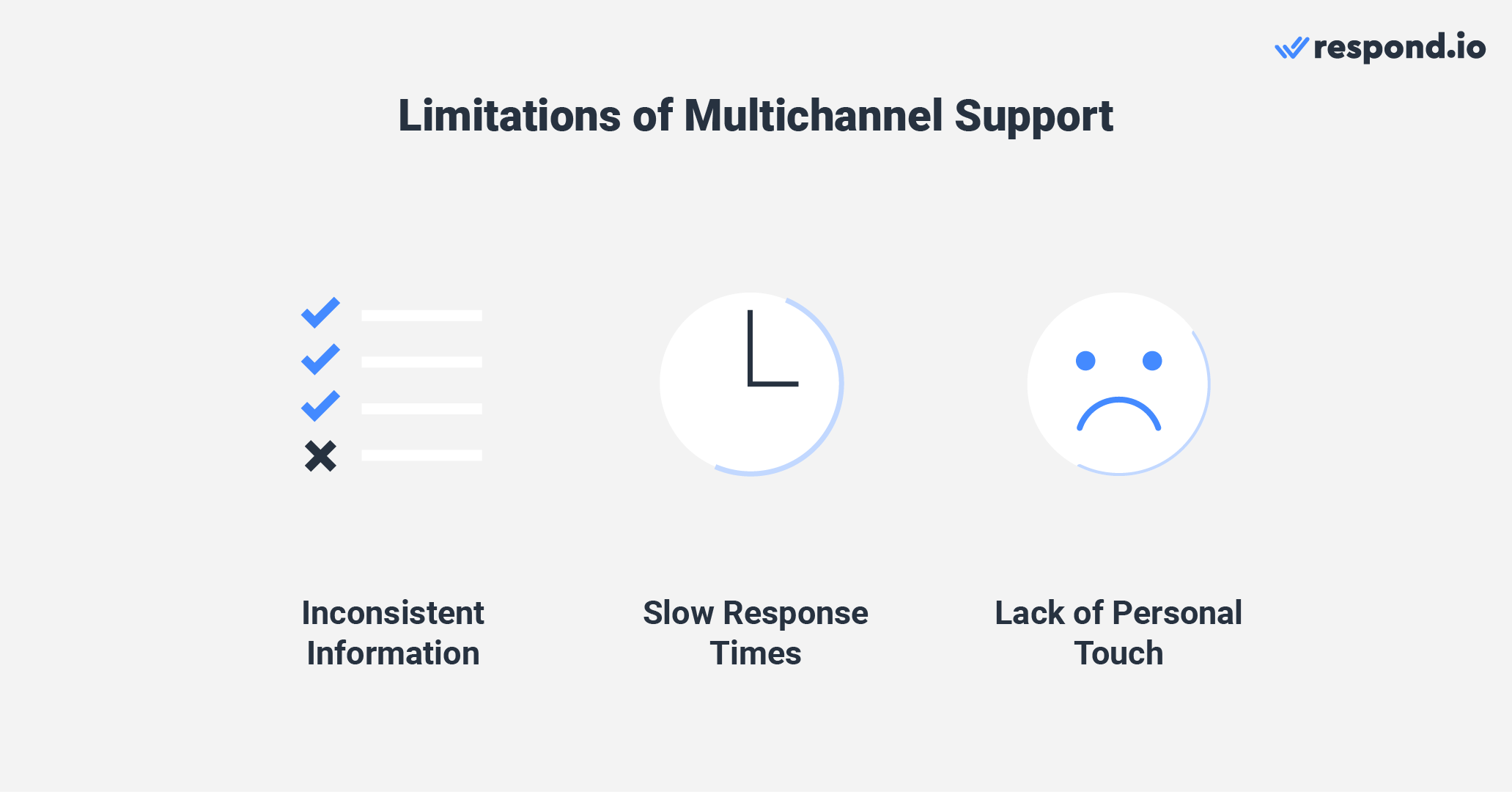
Multichannel support lacks personalized attention. If customer data is not shared across channels, it may be more difficult to provide a personalized experience and anticipate customer needs. This often pushes agents to go for a one-size-fits-all approach.
Agents who provide multichannel support don't have easy access to the customer's background. Therefore, it's likely that they will miss the inquiry's context, and will probably have to repeat the same questions every single time.
Companies looking for a better alternative to this imperfect support system should instead adopt an omnichannel support approach.
What is Omnichannel Support?
Omnichannel support is a customer-centric strategy that involves providing customer support across many different channels and touchpoints seamlessly.
Omnichannel support is fully integrated, as it enables customers to interact with a business through multiple channels while maintaining a consistent and personalized experience.
In an omnichannel approach, customer interaction across all channels is recorded and tracked. This means that each customer's history and preferences can be used to inform future interactions. Next, we will discuss the benefits of omnichannel support.
Omnichannel Support Benefits
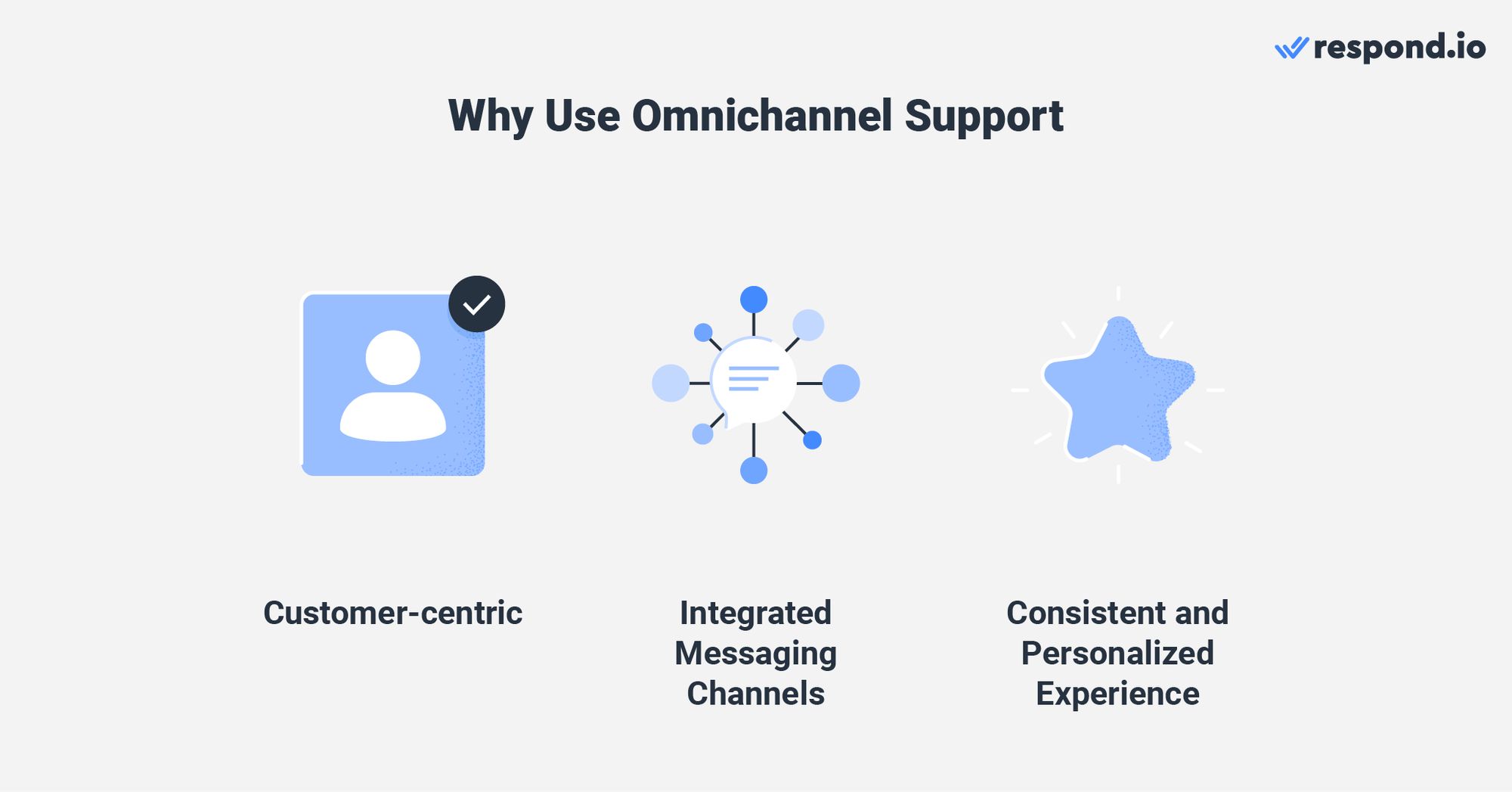
Omnichannel support can help businesses provide a more efficient, effective and personalized support experience. Let's dive deeper into everything this support approach has to offer. Omnichannel support helps businesses improve more than service efficiency. It gives teams the context they need to respond faster, protect retention and keep revenue conversations moving across every touchpoint.
Consistent customer experience: Customers get a smoother journey because each team can pick up the same conversation with the same context.
Faster lead and support follow-up: Shared history helps teams act quickly on high-intent inquiries instead of asking customers to repeat information.
Stronger retention and loyalty: Relevant replies and smoother handovers reduce the friction that often pushes customers to leave.
Lower churn risk: Managers can spot repeated service issues and broken handoffs earlier because conversations are tracked in one place.
Better business insight: Unified conversation data makes it easier to see which channels, teams and workflows influence satisfaction and sales outcomes.
Higher team efficiency: Centralized conversations reduce switching between tools and cut the manual work involved in routing, updates and follow-up.
Omnichannel Support vs Multichannel Support
Omnichannel Support | Multichannel Support | |
|---|---|---|
Objective | To deliver consistent customer | To have a presence wherever |
Strategy | Focuses on customer experience | Focuses on channel engagement |
Characteristics | • Involves multiple channels that | • Involves multiple channels that |
Multichannel support gives customers more than one way to reach a business, but each channel can still operate like a separate lane. Cross-channel support is a step forward because customers can move between some channels, yet ownership, lifecycle data and reporting often still break across teams or tools. Omnichannel support connects those lanes fully so conversation history, ownership and customer context move with the customer instead of staying trapped in one team or tool.
A simple example shows the difference. A customer might ask about an order on Instagram, request urgent help on a voice call and expect confirmation by email. In a multichannel setup, that often creates separate threads, separate owners and new delays. In a cross-channel setup, the business may recognize the handoff, but the next team can still lose context or work from partial data. In an omnichannel setup, the next team sees the full history, knows why the conversation moved and can act without making the customer start over.
That changes day-to-day execution in four ways: routing follows intent instead of channel alone, ownership stays clear during handovers, reporting shows one customer journey instead of disconnected channel metrics and managers can spot where conversions or retention start to drop. For mid-market B2C teams moving between social, messaging, voice and email, cross-channel is better than multichannel, but only omnichannel keeps revenue conversations intact from first inquiry to follow-up.
High-value omnichannel use cases for mid-market B2C
For mid-market B2C teams, the difference shows up most clearly in the moments that directly affect revenue and retention.
Social lead qualification: When a prospect asks about pricing, availability or delivery through Instagram, Facebook Messenger or TikTok, the team can qualify intent, update lifecycle stage and route the conversation without losing context.
Support-to-sales handoff: When a service issue turns into an upsell, renewal or save opportunity, the next owner sees the full history and can continue the conversation instead of reopening discovery.
Channel switching without lost context: Customers often start on messaging, move to voice for urgent clarification and expect follow-up by email. Omnichannel support keeps the same history and ownership across each step.
Stalled conversation recovery: When a buyer or existing customer stops replying on one channel, the team can follow up on the most relevant next channel with the right context instead of sending a generic restart message.
In disconnected tools, each of these journeys creates delays, repeated questions and dropped handoffs. When history, routing and lifecycle updates stay connected, teams protect conversions, resolve issues faster and reduce churn risk. Kleta, a bicycle subscription service in Spain, is a strong example of what that looks like in practice.
Turn customer conversations into business growth with respond.io. ✨
Manage calls, chats and emails in one place!
How to choose the right omnichannel support platform
Choosing a platform is not just about adding more channels. For mid-market B2C businesses, the right decision determines whether support, sales and marketing can keep one continuous customer conversation as volume grows.
When evaluating options, businesses should ask:
Does the platform keep one customer history across WhatsApp, Instagram, Facebook Messenger, TikTok, Telegram, LINE, Viber, WeChat, voice calls and email?
Can AI Agents qualify leads, route by intent, update lifecycle stages and hand conversations to agents with enough context to continue smoothly?
Does it sync customer data with the customer relationship management (CRM) system and other business tools teams already use?
Can managers report on response quality, handovers and outcomes across every channel from one place?
Will the platform still be easy to manage when more teams, markets and conversation volume are added?
Channel roles matter as much as channel count. Mid-market B2C teams should judge each channel by the journey it supports, not by whether it appears on a feature list.
WhatsApp, Telegram, LINE, Viber and WeChat are strongest for ongoing conversations where speed, context and follow-up affect conversion or retention.
Instagram, Facebook Messenger and TikTok often carry discovery and first contact, so the platform should help teams qualify intent and route high-value inquiries quickly.
Voice calls matter when urgency is high or a complex issue needs immediate clarification, but the call should still sit inside the same customer history.
Email works best for documented confirmations, post-call recap and follow-up that needs a clear written record.
The right platform keeps ownership and conversation context intact when a customer moves from social discovery to messaging follow-up, voice escalation and email confirmation.
How to compare omnichannel platform vendors on your shortlist
A shortlist should help businesses eliminate weak fits quickly. The clearest way to do that is to turn each criterion into a vendor question, not a feature checklist. Businesses should ask whether every channel shares one conversation history, whether CRM data syncs both ways, whether AI Agents can act on intent instead of just tagging conversations and whether reporting follows the full journey across teams and channels.
This approach also exposes fake omnichannel setups early. If a vendor needs separate tools, manual workarounds or extra admin effort to keep conversations connected, the business is likely paying for a multichannel setup that only looks unified on the surface.
Channel coverage: Confirm support for the channels customers already use and the ones the business plans to add next.
Automation depth: Check whether automation only handles simple rules or whether AI Agents can qualify leads, route by intent, update lifecycle stages and escalate high-value opportunities.
CRM fit: Verify whether CRM data can sync both ways so teams can see history and update records without manual work.
Reporting: Look for unified reporting across channels, teams and handovers rather than separate channel-by-channel views.
Onboarding support: Ask what help is included for migration, routing design and change management.
Pricing model: Compare Monthly Active Contacts (MAC) pricing with per-seat pricing based on how many teams need access and how conversation volume is likely to grow. Then check what changes the real cost over time, including channel add-ons, onboarding effort, workflow limits and whether support, sales and marketing can all work from the same platform without separate licenses. The right model should keep coverage affordable as more customer conversations and revenue opportunities move across channels.
Common omnichannel platform trade-offs to watch for
Split history: Some platforms keep conversations organized but still split history across tickets, teams or channels. That creates repeated questions and slower follow-up when a customer moves from messaging to voice or email.
Voice-first depth: Some platforms are strongest on voice. They can manage calls well, but social and messaging follow-up may stay fragmented, which makes lead response and support handovers harder to control.
Channels without unified ownership: Some platforms add channels without truly unifying ownership, lifecycle stage or reporting. Businesses should confirm that the full customer journey stays connected across WhatsApp and other key messaging, social, voice and email channels.
Inconsistent replies: Some platforms are built for one team, usually support, so sales and marketing reply from separate tools. Customers get different answers from different teams, which weakens trust and makes retention harder.
Shallow automation: Automation depth matters as much as channel count. If automation only handles simple rules, teams still rely on manual triage. AI Agents can qualify leads, route by intent, update lifecycle stages, escalate high-value opportunities and generate summaries for handovers.
Pricing that doesn't scale: Pricing affects fit over time. Per-seat models can get expensive when support, sales and marketing all need access. Respond.io is a customer conversation platform that uses Monthly Active Contacts (MAC) pricing, which is easier to scale across growing teams.
The strongest fit for mid-market B2C businesses is a platform that keeps one conversation history, syncs customer data with business systems and supports the channels customers already use without breaking context.
How to roll out omnichannel support without disrupting service
A rollout works best when the business starts with the journeys that matter most, not every channel at once. That keeps service stable while teams standardize ownership, response rules and reporting.
Map the highest-value journeys first: For lead qualification, issue resolution and retention, define the entry channel, the likely escalation channel, the handoff owner and the business outcome the team is trying to protect. A buyer may discover the business on Instagram or TikTok, continue on WhatsApp, escalate to voice for urgency and expect email confirmation afterward. When rollout follows these revenue-critical moments instead of the noisiest channels, teams can standardize ownership, reduce friction and protect conversion or loyalty from the start.
Unify customer data: Make sure teams can see one conversation history and the key customer details needed for support and follow-up.
Set routing and handover rules: Define who owns new inquiries, when a conversation should move to voice or email and what information must travel with the handoff.
Align teams on shared metrics: Support, sales and marketing should track response quality, follow-up performance and retention signals from the same data.
Roll out in phases: Start with the channels carrying the most volume or highest intent, then expand once processes are stable.
How Kleta achieved 100% growth with efficient omnichannel support
Kleta, a bicycle subscription service in Spain, achieved efficient and effective omnichannel support by using the respond.io platform.
Respond.io helped Kleta centralize its four support channels on one platform, automate everyday processes such as chat routing, agent assignment and support escalation and integrate messaging channels with a customer database.
With the right mix of automation and human support, Kleta resolved most issues within 48 hours and received consistently high ratings in customer satisfaction surveys. As a result, Kleta doubled its subscribers in two months and aims to triple them within a year.
Revolutionize your omnichannel customer support with respond.io solutions
Businesses should look for a platform that combines a unified workspace, AI Agents, customer data sync, routing controls, reporting and broad channel coverage so teams can respond faster and keep customer conversations moving.
Respond.io is built for mid-market and growing B2C businesses that need to manage WhatsApp and other key messaging, social, voice and email channels without losing context. The sections below show how these capabilities help teams qualify faster, retain more customers and reduce dropped conversations as volume grows.
Use an omnichannel inbox
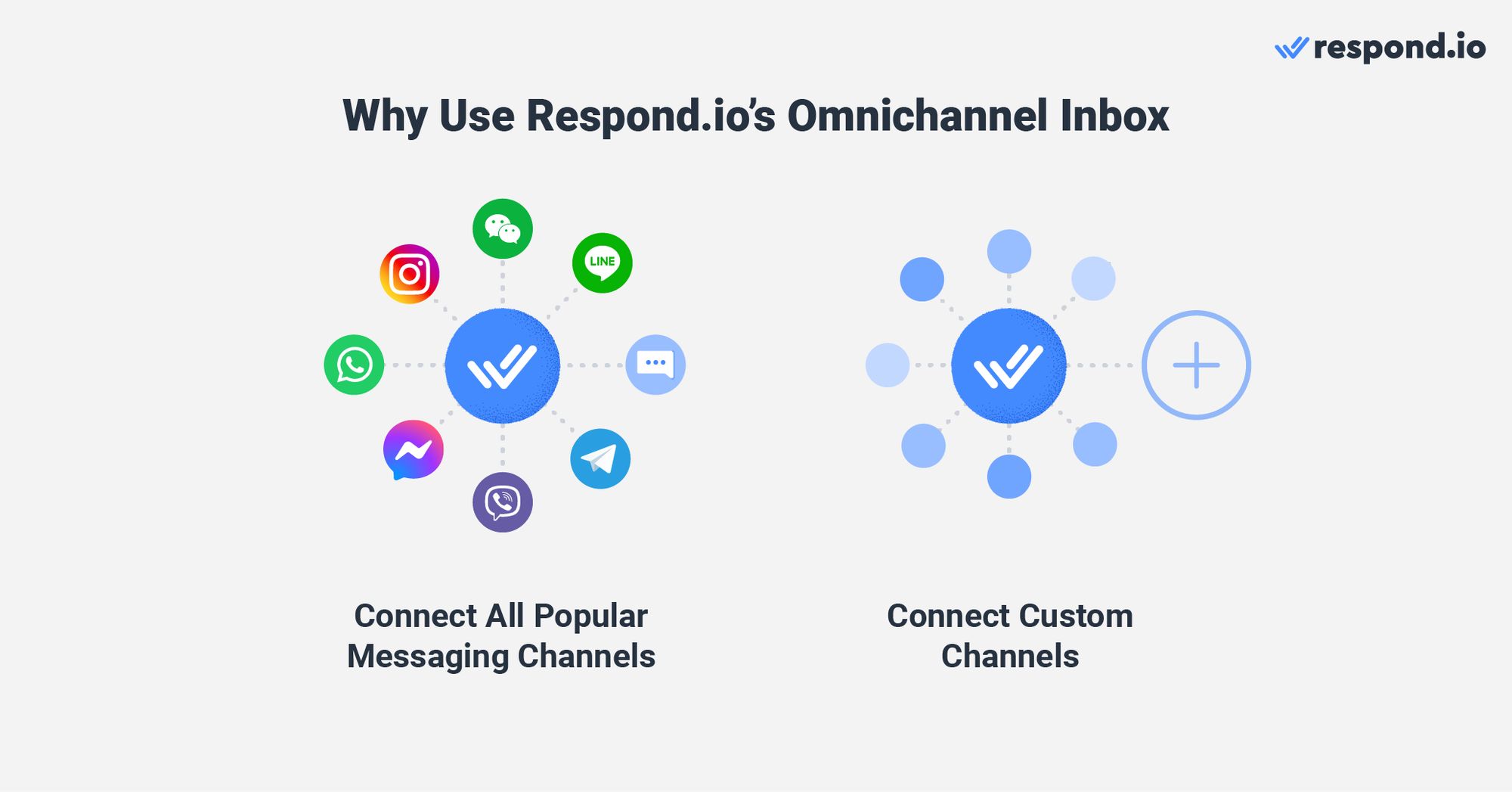
Respond.io's omnichannel inbox is a powerful tool that centralizes all customer communication channels, such as email, WhatsApp and Instagram in a single platform, eliminating the need to switch between different channels.
Businesses can even connect custom channels and integrate their existing CRMs with respond.io. This allows them to exchange information between any messaging channels and their CRMs or custom channels, as well as update customer data in their CRM and on respond.io simultaneously.
Teams can also connect Google Calendar to view a contact's upcoming and past meetings directly in the Inbox sidebar, matched by email.
In addition, they can create support tickets while chatting with customers without leaving the respond.io platform. It's easy to record any event on both platforms, creating a consistent customer story.
Contact duplication is sometimes unavoidable and poses a threat to consistent customer stories. This is how you can fix it with respond.io.
Recognize returning contacts on any channel
Respond.io's Contact Merge feature is a useful tool for omnichannel support that allows support agents to consolidate customer information across multiple channels into a single unified profile.
For example, if a customer contacts a company via email and then later via WhatsApp, you'll be informed that these two separate interactions are from the same customer and have the option to consolidate the customer's information into a single profile.
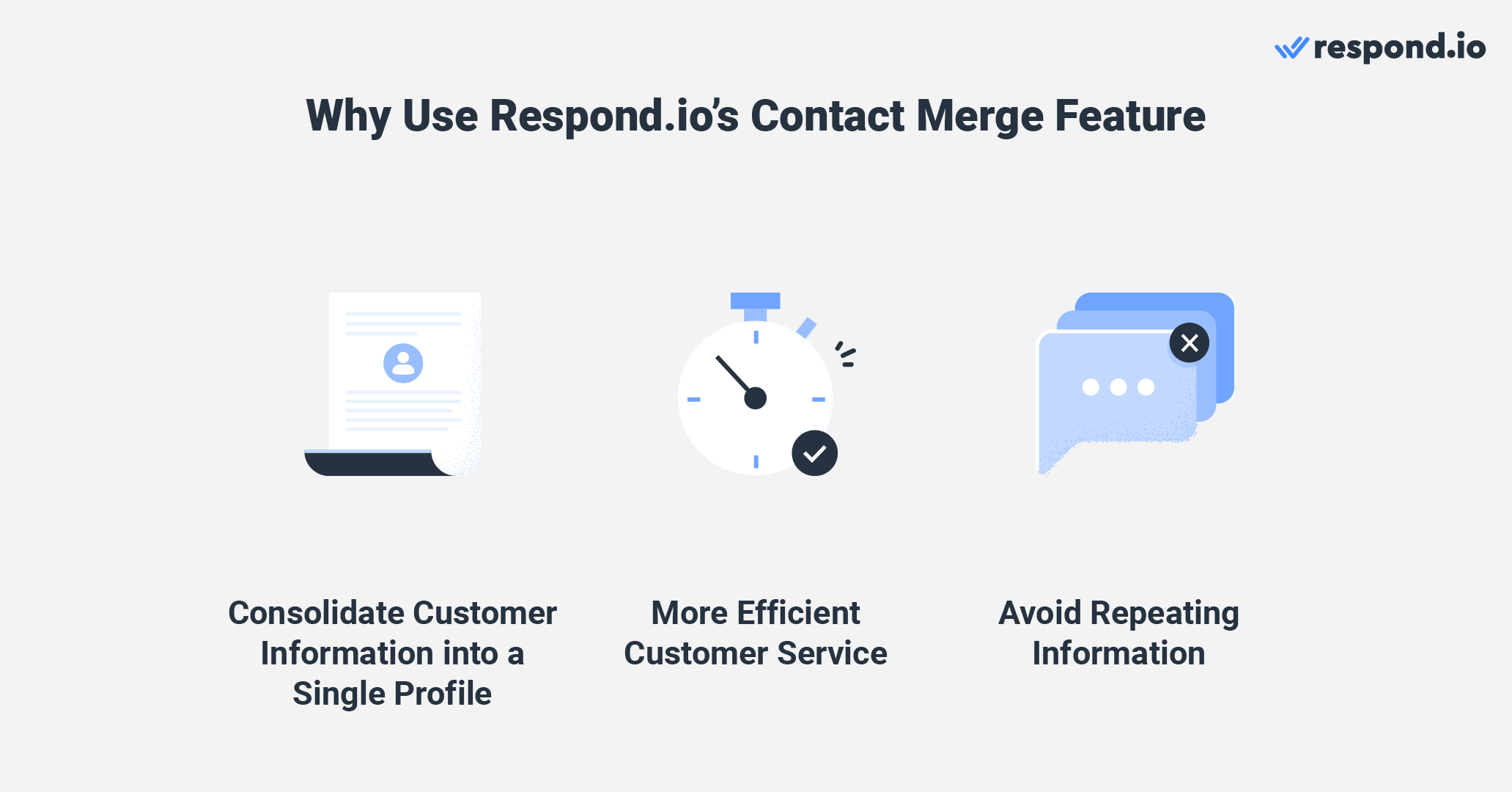
This helps support agents provide more personalized and efficient customer service because they have a complete view of the customer's interactions and history with the company.
It also ensures that the customer does not have to repeat information or context when they contact the company through different channels. Next, you should probably set up a respond.io omnichannel chat widget as part of your omnichannel support strategy.
Set up an omnichannel chat widget
An omnichannel chat widget allows website visitors to communicate with businesses via a range of messaging channels, keeping the conversation history in one place.
In addition to that, it helps businesses to generate more website leads, build positive relationships with customers and provide them with a consistent customer experience across every touchpoint.
Respond.io's omnichannel chat widget supports plenty of popular support messaging channels such as WhatsApp, Telegram and Facebook Messenger.
This omnichannel widget is customizable, meaning that it can be designed to match a business's branding and style. This helps create a consistent user experience for customers and promotes brand recognition.
Automate support processes
Basic automation handles predictable tasks such as welcome messages, away replies and simple routing. AI Agents go further by qualifying leads, updating lifecycle stages, triggering workflows, routing by intent, escalating high-value opportunities and generating summaries for handovers so agents can step in with context.
That combination helps teams stay responsive without turning every conversation into a rigid script. Managers get scale when volume rises, while customers still receive relevant replies and a smooth handoff when a human agent is needed.
To provide quality support, agents need context. Pre-chat surveys can collect information and help customers communicate clearly. Respond.io enables 24/7 omnichannel support with advanced automation, including routing to the right team based on business hours, shifts, languages and departments.
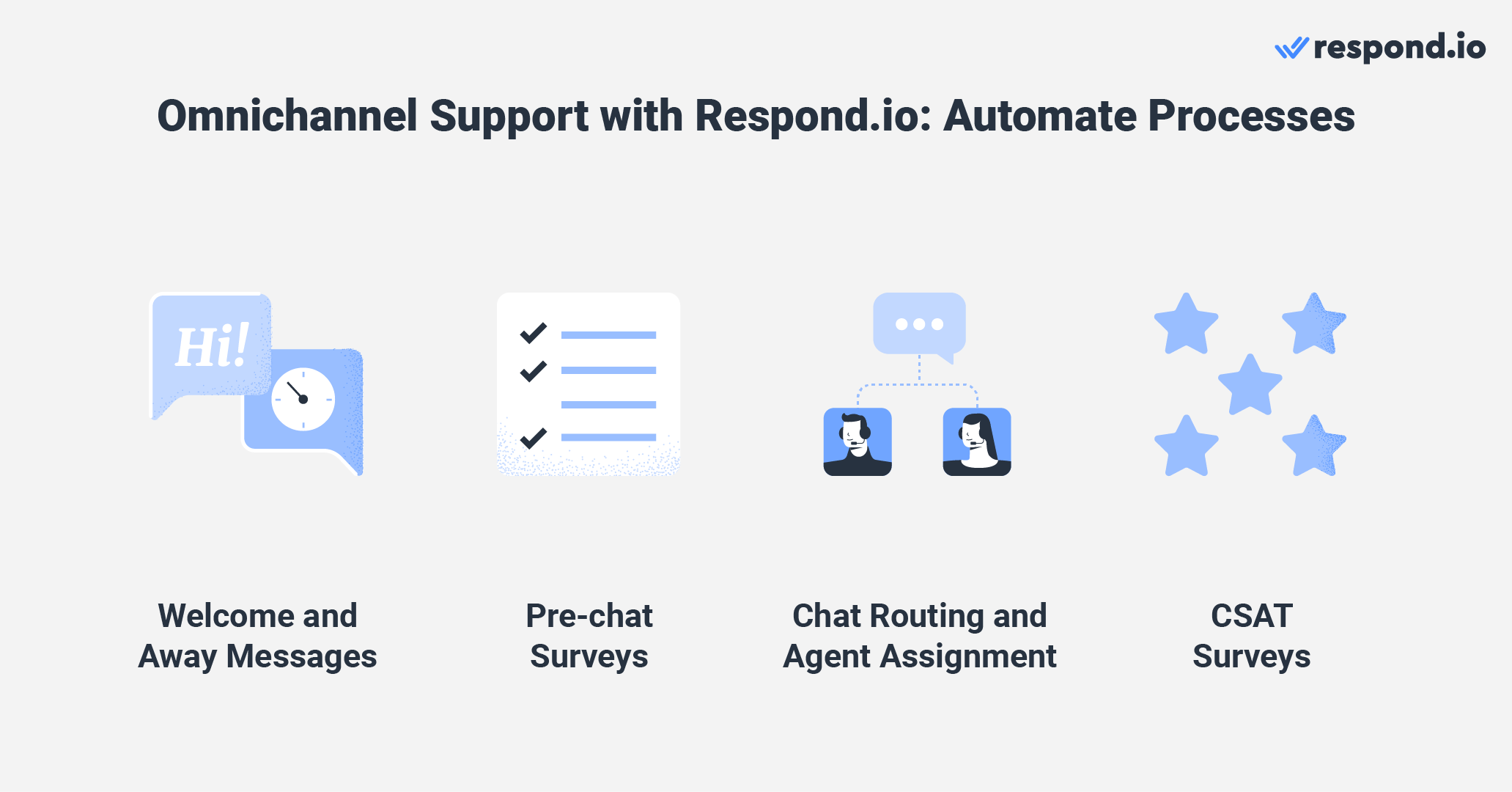
CSAT surveys are critical in measuring customer support success. Respond.io's Workflows enable businesses to create and send CSAT surveys automatically or manually with the Shortcut button and save data to Google Sheets, a CRM or data warehouse.
Monitor agent performance and analytics
Respond.io provides businesses with Reports and Analytics to monitor agent workload and productivity, track conversation progress and resolution time. The supervisor dashboard enables managers to identify unresolved conversations and monitor agents in real time.
The real value goes beyond team oversight. Decision-makers should look for reporting that shows first response time on high-intent conversations, handoff completion, stalled-conversation recovery, resolution quality and which channels contribute to conversion or retention. That turns omnichannel reporting into a management tool, not just a dashboard.
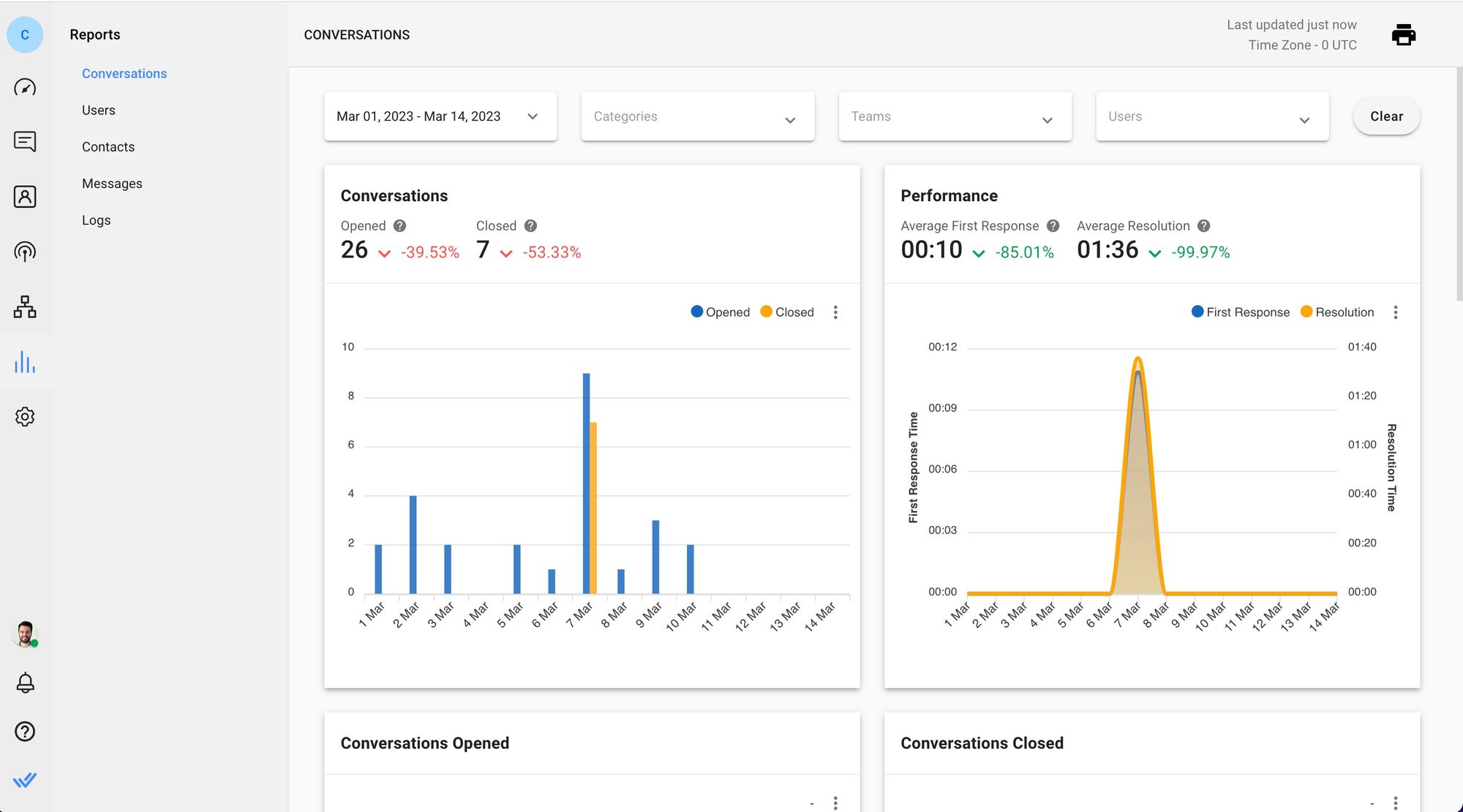
Instead of reading separate channel reports, leaders can see where response delays, broken handovers or weak follow-up start to leak revenue or loyalty across messaging, social, voice and email. Faster visibility makes it easier to fix the journey before missed intent becomes lost sales or churn.
Omnichannel support: Is it for you?
While multichannel support provides customers with multiple ways to contact a business, it may result in inconsistent information, slow response times and lack of personalization.
In contrast, omnichannel support helps businesses provide a more effective and personalized support experience, which ultimately leads to greater customer loyalty and retention.
Omnichannel support may not always be required for micro and small businesses. Mid-market B2C businesses that juggle multiple channels or teams benefit most when omnichannel support is treated as an operating model, not just a channel setup. The value comes from connecting teams, customer data and handovers so every interaction builds on the same journey instead of starting from scratch.
Respond.io is an ideal platform for omnichannel customer support, as it offers a range of features that make it easy to manage customer inquiries from multiple channels in one place.
By leveraging the right mix of automation and human support, businesses can achieve efficient and effective customer support, as demonstrated by Kleta, one of respond.io's clients.
To get off on the right foot with omnichannel support, sign up for a respond.io account today.
Turn customer conversations into business growth with respond.io. ✨
Manage calls, chats and emails in one place!
Frequently asked questions about omnichannel support platform
How can an omnichannel platform help future-proof customer communication strategies?
A future-proof platform should support more than today's busiest channels. Buyers should look for AI Agents that can qualify and route conversations, the ability to manage voice and messaging in one workflow, strong first-party customer data handling and the flexibility to add new channels without breaking conversation history.
That matters because customer behavior keeps shifting between messaging apps, social, email and voice. When the platform preserves context across every handoff and new channel, teams can adapt faster without rebuilding their service process every time customer preferences change.
What's the best omnichannel messaging solution?
The best fit for mid-market B2C businesses is a customer conversation platform that keeps one history across WhatsApp and other key messaging, social, voice and email channels, supports AI Agents for qualification and routing and gives teams unified reporting and handover control.
Respond.io is built for businesses running high-volume customer conversations. It helps teams qualify leads, manage support and sales handoffs and keep customer context connected as conversation volume grows.
What is the main disadvantage of omnichannel customer service software?
The main disadvantage is added operational complexity if the business adds channels without unified ownership, routing and reporting. Instead of creating one continuous customer journey, teams can end up managing more queues, more handoffs and more room for missed follow-up.
That is why rollout discipline matters. The platform should keep one conversation history and clear handover rules so extra channels do not create extra friction.
Can omnichannel strategies work without advanced technology?
Yes, a business can start with clear ownership rules, documented handoffs and a few priority channels. But for mid-market B2C teams handling high conversation volume, that approach usually breaks once customers switch between channels and multiple teams need the same context.
Advanced technology matters because it keeps one conversation history, routing logic and reporting connected as volume grows. Without that foundation, omnichannel quickly turns into manual coordination that slows follow-up and increases missed handoffs.
How do omnichannel platforms use customer behavior data to improve loyalty and retention?
They combine conversation history, channel preference, purchase or service context and response patterns so teams can act on what the customer is likely to need next. That helps teams follow up on the right channel, prioritize at-risk conversations and keep handovers relevant instead of generic.
AI Agents can use these signals to qualify intent, update lifecycle stages, trigger workflows and escalate high-value opportunities with context. When the next action reflects the customer's actual behavior, retention and recovery efforts become faster and more relevant.
Does omnichannel communication improve ROI?
It can, when the platform reduces missed leads, repeated work and dropped handovers across channels. Businesses protect more revenue when teams respond faster, carry context into follow-up and recover stalled conversations before interest goes cold.
The return is not just lower support effort. It also comes from better lead qualification, smoother support-to-sales handoffs and stronger retention because customers do not have to restart the conversation every time they switch channels.
How do I measure the success of an omnichannel campaign beyond traditional metrics?
Traditional channel metrics only show what happened inside each lane. Omnichannel measurement should track whether the full journey stays intact, including first response time for high-intent conversations, handoff completion, stalled-conversation recovery and which channel paths contribute to conversion or retention.
The goal is to see where context is preserved and where it breaks. When managers connect service speed, follow-up quality and business outcomes across channels, they can fix the points where revenue or loyalty starts to leak.
Further Reading
If you've found this article interesting, here are some additional readings you may like:


