
















 Electronics
 Fashion & Apparel
 Furniture
 Jewelry and Watches
 Afterschool Activities
 Sport & Fitness
 Beauty Center
 Dental Clinic
 Medical Clinic
 Home Cleaning & Maid Services
 Photography & Videography
 Car Dealership
 Travel Agency & Tour Operator


TL;DR — Conversational Sales Platform
A conversational sales platform helps teams close more deals by centralizing customer chats, enabling real-time personalization, and scaling responses across channels without losing context.
Choose the right messaging channels based on where customers already are, then support rich features and security.
Use a conversational sales platform to drive personalization, engagement, and higher conversion rates through real-time responses and context.
Solve conversational sales challenges like multi-channel chaos, limited multi-user access, 24-hour windows, and manual routing by using an omnichannel conversational sales platform like respond.io including AI + automation.
In the dynamic realm of customer engagement, conversational sales platforms are a game-changer, blending real-time communication with personalized customer experiences.
This article explores the transformative impact of conversational selling versus traditional sales, examining its benefits, challenges, and why AI and omnichannel capabilities are essential for a conversational sales platform. It also showcases success stories of companies that have effectively adopted a conversational sales platform.
Additionally, we look at how customer conversation platforms like respond.io offer innovative solutions to augment conversational sales strategies.
Conversational sales: what is it?
The main difference between conversational and traditional sales methods lies in the type and direction of communication.
Conversational selling is a modern sales approach that focuses on dialog with the customer and a personal approach. In contrast to traditional sales methods, which are often based on one-way communication (cold calling), conversational sales is based on two-way conversations.
This approach uses digital channels such as messaging apps or social media platforms to build a more intimate and responsive relationship with customers. Traditional sales methods, by contrast, tend to be linear and scripted, focusing on pushing a sales agenda.
Today, most conversational sales platforms also add an AI layer: AI Agents that understand natural language, qualify leads, route by intent, update records and hand off to a sales rep with full context.
Conversational sales vs traditional sales
Conversational Sales | Traditional Sales | |
Communication Style | Interactive and two-way | One-directional |
Personalization | High level of personalization based on customer interactions | Limited personalization |
Customer Engagement | Immediate responses and interactions | Responses might be delayed or scripted and less interactive |
Technology Use | Reliant on AI, CRM systems and messaging channels | Less reliant on real-time communication technology |
Relationship Building | Focused on long-term relationships and building trust | Primarily transaction-focused |
Benefits | Improved customer satisfaction, engagement and loyalty | Structured process |
Conversational sales, with its focus on personalized and customer-driven interactions, uses conversational AI to enhance customer relationships and sales performance. By tailoring conversations to customers’ preferences and behavior, businesses provide more engaging and relevant experiences, strengthening customer relationships.
Not all AI-powered sales tools work the same way, though. Rule-based chatbots follow scripted decision trees. They work when every buyer asks the expected question in the expected order, but they break when someone changes wording, asks a layered question or jumps straight to pricing, availability or specialist support.
Conversational artificial intelligence (AI) handles these moments better because it can interpret intent, adjust the reply, keep qualification moving and escalate cleanly to a human rep with full context instead of trapping the buyer in a dead end. For sales teams, that means revenue-facing automation that can understand buyer intent, adapt when the conversation changes and keep qualification moving across messaging and voice instead of forcing buyers through a script. The buying test is simple: the platform should handle unexpected questions, route the opportunity correctly and pass full context to a human rep when the conversation needs one.
The same problem appears in menu-based chat and interactive voice response phone trees. When buyers ask layered questions, switch from messaging to voice or want a person quickly, rigid menus create dead ends and drop-off instead of moving the sale forward.
Choosing the right messaging channels is critical to maximize the benefits of conversational selling. Your messaging channels of choice enable real-time, personalized interactions that are critical to the effectiveness of this modern sales approach. Next, we’ll look at the key factors in selecting the right messaging apps.
Choosing the right messaging channels
Choosing the right messaging channels is important for conversational sales as sales agents will engage in real-time interactions with customers. The right messaging apps not only facilitate conversations, but also significantly improve the overall sales strategy.
Channel | Best Revenue Use Case | Strengths | Watchouts | When to Prioritize |
Lead capture, follow-up, cart recovery | High open rates, rich media, global reach | 24-hour window requires templates for re-engagement | High-intent markets where WhatsApp is the default messaging app | |
Product discovery, influencer-driven leads | Visual storytelling, younger demographics, comment-to-DM flows | Limited automation compared to WhatsApp API | Brands with strong visual content or influencer partnerships | |
Facebook Messenger | Retargeting, ad-to-chat flows | Deep Meta ad integration, broad reach | Messaging window rules, declining organic reach | Paid social campaigns and retargeting sequences |
TikTok | Top-of-funnel engagement, viral product interest | Massive reach with younger audiences, comment-to-chat potential | Early-stage messaging features, less mature for sales | Brands targeting Gen Z or running TikTok ad campaigns |
Telegram | Community-driven sales, crypto and tech audiences | Groups, channels, no message window limits | Smaller mainstream adoption outside specific niches | Niche communities or markets where Telegram dominates |
Viber | Regional markets, promotional broadcasts | Strong in Eastern Europe, SEA; rich media support | Limited global reach | Brands with significant presence in Viber-heavy regions |
Nurture sequences, transactional updates | Universal reach, long-form content, no message windows | Lower engagement rates, slower response expectations | Long-cycle nurture and transactional communication | |
Web chat | Real-time site visitor engagement | Immediate, no app download required | Visitors may leave before responding | High-traffic product pages or pricing pages |
VoIP / Voice | High-consideration purchases, closing | Personal touch, faster objection handling | Requires agent availability, higher cost per conversation | Complex products or when a customer requests a call |
Here are some key considerations when choosing the right messaging channels:
Global popularity and reach: Identify messaging apps that are popular among your target audience or region of business.
Multilingual support: If you sell across markets or serve customers in multiple languages, the right platform should detect language automatically, route conversations to agents who speak that language and automate first responses in the customer’s preferred language.
Features and functionalities: Choose messaging channels that offer features for a dynamic conversational sales approach such as multimedia messaging and CRM integration which are important for a dynamic, conversational sales environment.
Reliability and security: Prioritize messaging channels known for their reliability and robust security measures to protect sensitive customer data.
User experience: A seamless and intuitive user experience for both the sales team and customers can have a significant impact on the success of sales conversations.
Voice communication: One of the best ways to sell is by talking to customers. While cold-calling turns people off, the ability for a customer to call a business to discuss a purchase adds a personal touch. Consider adopting voice communication channels or features like the WhatsApp Business Calling API to improve your agents’ closing rate.
Next, we’ll explore how adopting conversational selling can benefit businesses.
Turn customer conversations into business growth with respond.io. ✨
Manage calls, chats and emails in one place!
Benefits of conversational sales
Customers now move between social, messaging and website channels before they buy, and they expect fast answers without repeating themselves. That makes conversational sales a revenue decision for B2C businesses, not just a channel upgrade. Here are the main benefits.
Conversational sales platform for personalized customer experience
Conversational sales platforms enable businesses to tailor their communication to customer preferences, previous interactions and purchase history of each customer. This personalized approach goes beyond generic sales pitches and allows sales reps to offer solutions and products that are tailored to the customer’s individual needs.
For example, respond.io enables Lifecycle tracking and management, so agents know exactly where a contact is in their journey. This level of personalization not only makes customers feel valued and understood, but it also increases the relevance and effectiveness of the sales interaction.
Conversational sales platform for improved customer engagement
Real-time two-way communication in conversational sales significantly increases customer engagement. Customers can have their queries addressed promptly and have a meaningful conversation instead of just receiving information. This continuous interaction keeps customers engaged and invested in the conversation, strengthening their relationship with the brand.
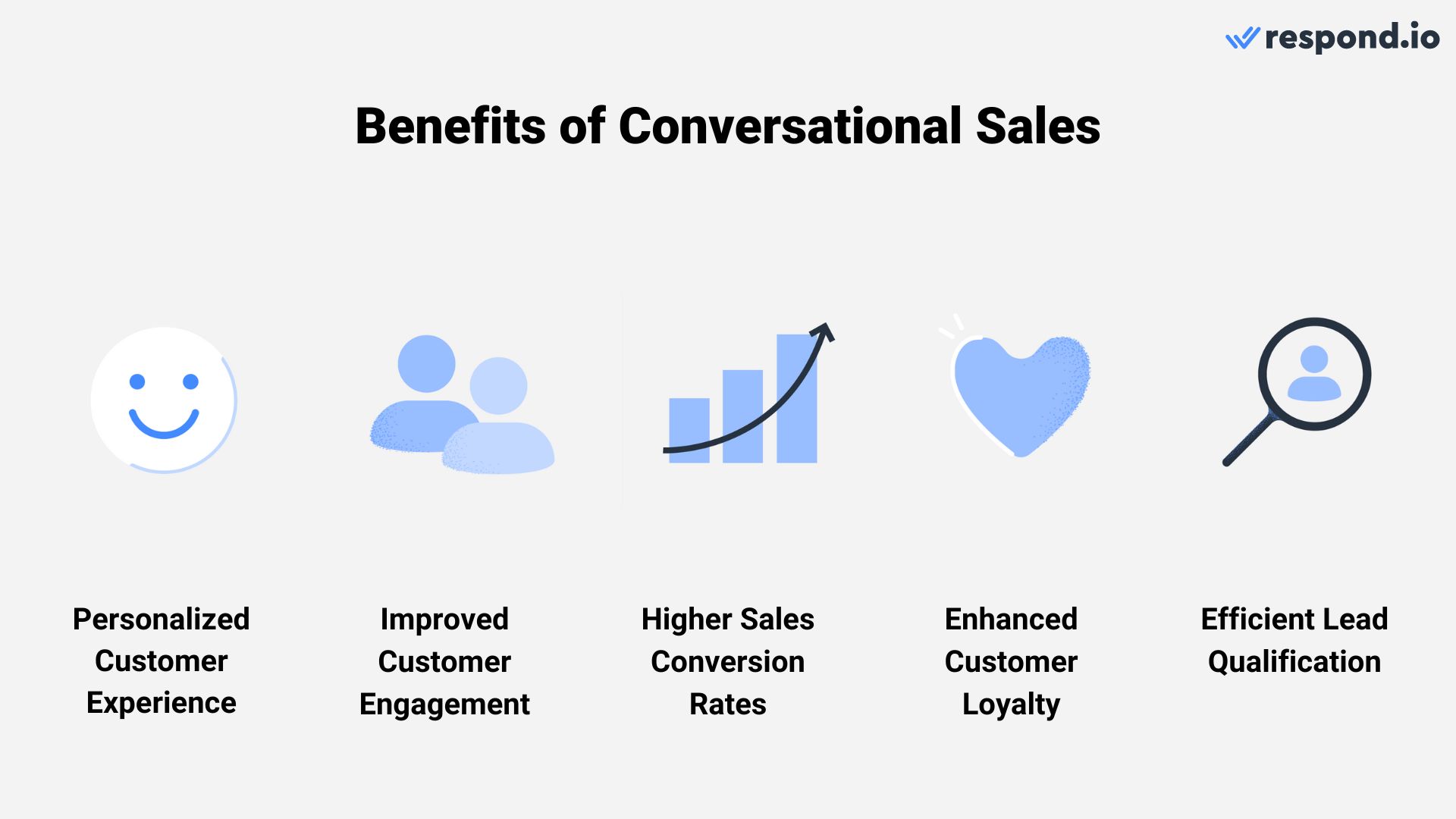
Conversational sales platform for higher sales conversion rates
Customers are more likely to make a purchase when they receive quick and personalized solutions to their queries, as opposed to generic responses or delayed communication common with traditional sales methods.
Prospects contacted within five minutes are significantly more likely to convert than those who wait 30 minutes or longer, and every extra minute of delay increases the chance they move on to a competitor. A conversational sales platform keeps that speed consistent even after hours, during campaign spikes or when leads arrive across several channels at once. AI Agents can respond first, qualify demand and route high-intent buyers immediately, so teams protect revenue without adding the same amount of manual work.
The business case is straightforward: reps spend less time on repetitive admin, more time on qualified conversations and the team can absorb more inbound demand before it needs more headcount.
Conversational sales platform for enhanced customer loyalty
The personalized and responsive nature of conversational sales helps build trust and credibility with customers. When customers feel that they are heard and valued, they are more likely to develop a sense of loyalty to the brand. This loyalty leads to repeat business, longer customer retention and often, customers become advocates for the brand, sharing their positive experiences with others.
Conversational sales platform for efficient lead qualification
Conversational sales with AI Agents takes the repetitive work off sales reps. AI Agents can handle first replies, ask qualifying questions, update lifecycle stages, route leads and summarize conversations for handover. Reps spend their time on high-potential leads, and the team can handle more inbound demand without adding headcount.
These advantages underscore the effectiveness of conversational sales in today’s digital and customer-centric market. Building on these benefits, we’ll delve into common challenges businesses face when adopting conversational sales strategies.
Challenges in conversational sales
Although conversational sales brings significant benefits, businesses need to be aware of the challenges involved. Here are some of the most common challenges that businesses face when adopting conversational sales. These challenges can often be solved with the right conversational sales platform.
Juggling multiple messaging channels
Businesses may find it challenging to deliver quick and consistent responses across multiple channels such as WhatsApp, Facebook Messenger, Instagram, TikTok and web chat, which can lead to inconsistent service or delayed responses due to juggling multiple messaging channels.
Lack of multiuser access
Some channels, such as the WhatsApp Business app, support a limited number of users per account, making it difficult for businesses to handle a large number of requests efficiently and respond in a timely manner.
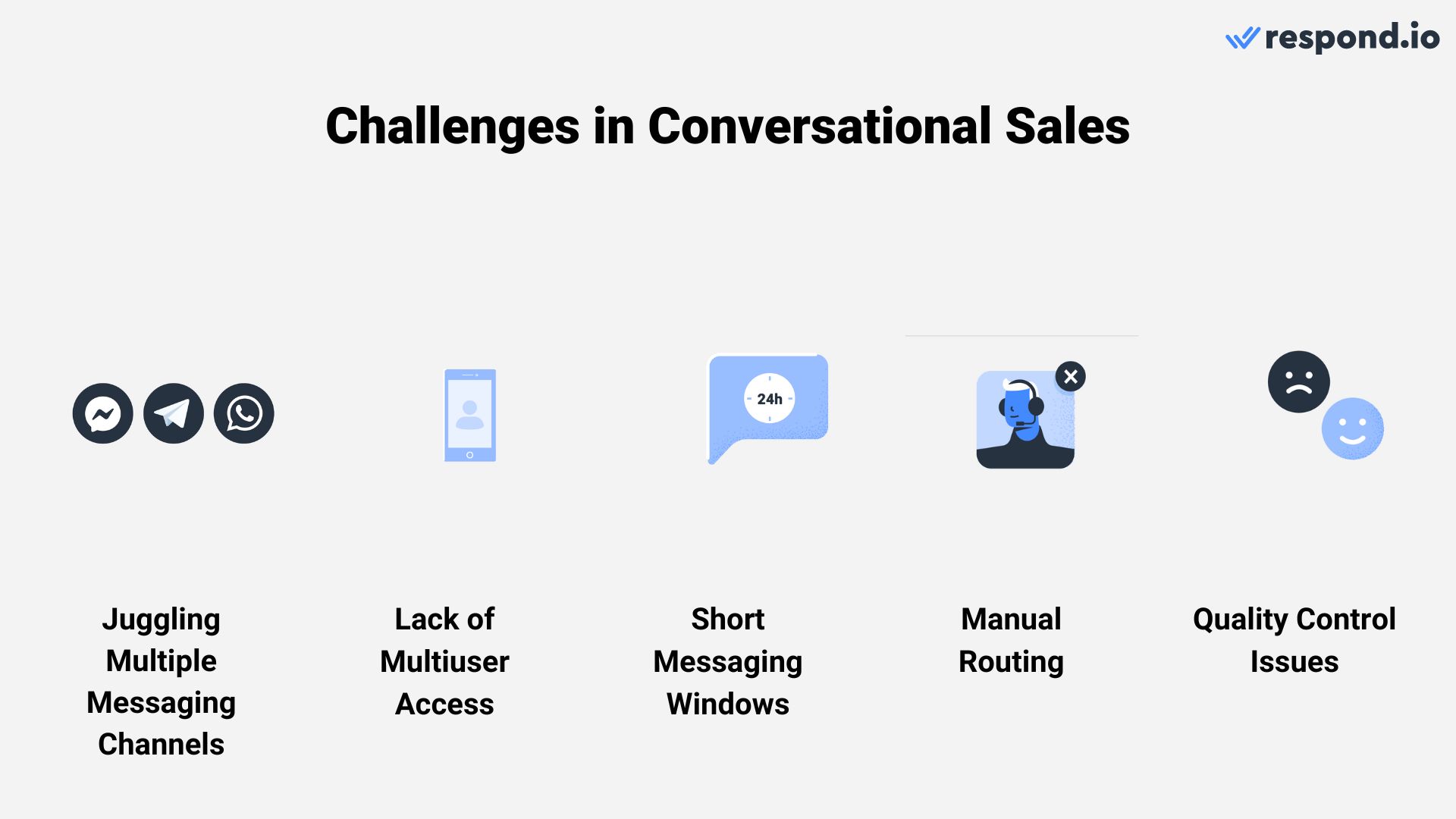
Short messaging windows
Certain channels such as WhatsApp API and Facebook Messenger enforce a 24-hour message window, making it challenging for businesses to respond within the given timeframe especially during busy periods or during non-operating hours.
Manual routing
When businesses are dealing with customers across multiple platforms, manually routing to the appropriate team becomes time-consuming. This leads to delayed responses and potential customer frustration.
Quality control issue
Businesses often struggle to monitor conversation quality and agent performance when juggling multiple platforms or when sales agents utilize their personal phone devices to chat with customers.
Even with the right platform, poor setup can still hurt conversion. One common problem is weak qualification logic. If AI Agents ask the wrong questions or send every lead through the same path, high-intent buyers wait too long while low-value inquiries get unnecessary attention.
Generic AI tone is another risk. Replies that sound scripted or ignore buyer context make customers lose confidence and stop responding. Teams should review how AI Agents speak on each channel, keep responses short and make sure each reply moves the buyer toward a clear next step.
Weak human handoffs create another leak. When a buyer asks for custom terms, pricing clarification, a specialist or a call, the platform should pass the full conversation history and qualification details to the next rep. If the customer has to repeat everything, momentum drops and deals stall.
Leaders should also check for a clear escape path to a person. Customers need an easy way to reach a human when the conversation becomes urgent, emotional or complex. A platform that combines AI Agents, intent-based routing and full visibility gives teams more control before poor automation turns into lost deals.
How to choose a conversational sales platform
Not all conversational sales platforms solve the same problem. Before evaluating vendors, clarify what your team actually needs to fix: lead response speed, agent productivity, CRM visibility, or in-chat conversion.
Platform types and what they solve
Omnichannel inbox platforms consolidate WhatsApp, Instagram, Messenger, Telegram, email and web chat into a single workspace. Best for teams juggling multiple channels and losing leads to slow or inconsistent responses.
AI qualification tools use conversational AI to ask discovery questions, score intent and route high-potential buyers to the right rep. Best for teams drowning in inbound volume and wasting time on low-fit inquiries.
Conversational commerce tools connect chat to product catalogs, carts and checkout so customers can browse, ask questions and buy without leaving the conversation. Best for D2C and retail brands where friction between discovery and purchase kills conversion.
Voice-enabled conversation platforms add calling capabilities alongside messaging, letting customers speak to a rep when a purchase decision needs a human touch. Best for high-consideration products where voice accelerates closing.
Inbound vs outbound conversational AI
Inbound and outbound revenue motions put pressure on different parts of the platform. If most demand starts with ads, social comments, website chats or direct messages, the priority is instant qualification, intent-based routing and a fast handoff so high-intent buyers do not wait. If the bigger problem is leads that went quiet after first contact, cart recovery or appointment no-shows, the priority shifts to automated follow-up based on inactivity, cart activity or missed appointments. The message should continue the last conversation, and any reply should go back to the right rep.
Many mid-market B2C teams need both motions in one platform. The safer choice is a customer conversation platform that can qualify inbound demand, reopen conversations when allowed, trigger outbound follow-up from lifecycle changes and keep the same contact history visible to AI Agents and human reps. That prevents separate inbound and outbound tools from splitting context and slowing the sale.
How the platform landscape breaks down
Businesses usually face three broad platform categories. Website-first live chat and support suites are strongest when most conversations begin on a site and the main goal is service efficiency, but they can feel narrow when revenue conversations start in messaging apps or shift to voice. AI-led sales tools are strongest for automated prospecting, web-demo qualification or narrowly defined handoffs, but they may add cost without solving shared visibility across day-to-day customer conversations. Customer conversation platforms fit mid-market B2C teams that sell through WhatsApp and other key messaging, social, voice and email channels because they combine channel coverage, AI Agent qualification, routing and human handoff in one place.
The trade-off should be judged against the revenue problem the team is trying to fix. Website-first suites fit teams losing inbound demand on the site and needing faster first replies. Customer conversation platforms fit teams whose sales conversations are fragmented across messaging, social, voice and email channels and need one place for AI Agent qualification, routing and human handoff. Conversation intelligence tools solve a different problem: they help managers review objections, coaching gaps and patterns in won or lost conversations, but they do not replace the platform that runs live customer conversations.
Businesses should ask which category will improve speed-to-lead, how much context reps get inside the conversation and whether pricing stays predictable as volume grows. Some customer conversation platforms use Monthly Active Contacts (MAC) pricing, which can be easier to forecast for campaign-driven inbound demand than seat-based or message-based models.
For this business profile, the main question is not which category has the longest feature list. It is which category matches how revenue conversations actually happen. If leads arrive from ads, social content, messaging apps and inbound calls, the platform needs one contact record, shared team visibility, AI Agents for qualification and routing and clean handoffs into human sales conversations.
Pricing should be compared through total cost of ownership, not headline price alone. Businesses should check whether costs are driven by seats, messages, conversations, AI usage or Monthly Active Contacts (MAC), then model spend against campaign spikes, more connected channels and higher inbound volume. That makes it easier to shortlist platforms that can scale with a messaging-led B2C sales motion.
Signals that point to the right fit
Leads going cold? Prioritize speed: look for AI-powered auto-replies, instant routing and 24/7 coverage across time zones.
Reps switching tabs constantly? Prioritize integration: native CRM sync, deal creation from chat and conversation history inside your sales stack.
Managers flying blind? Prioritize visibility: shared inbox, real-time monitoring, response-time reporting and conversion tracking by channel.
Shoppers abandoning carts? Prioritize commerce: product recommendations, cart recovery messages and in-chat payment or checkout links.
Once the team knows which problem matters most, the next check is signal quality. A strong platform should surface the customer context that changes how sales teams qualify and respond, including campaign source, channel entry point, product interest, cart value, last purchase, lifecycle stage, preferred store or location, language and previous conversation outcomes.
These signals should not sit in separate systems that reps have to hunt through manually. The best platforms make them available inside the conversation so AI Agents can qualify leads, update lifecycle stages, trigger workflows and personalize handoffs before a human rep steps in. Better visibility into buyer signals leads to faster prioritization, cleaner routing and more relevant follow-up.
B2C requirements are different from B2B sales workflows
Many conversational sales tools are built around business-to-business workflows such as website demo requests, account-based routing and long stakeholder-heavy cycles. That setup can work when sales starts with forms, outbound sequences or scheduled demos, but it is often a poor fit for mid-market B2C teams handling fast inbound conversations across messaging channels.
B2C teams usually need to absorb campaign spikes, share one channel across multiple agents and move buyers from first message to purchase without losing speed. That requires lifecycle-based routing, quick handoffs and AI Agents that can qualify leads, update lifecycle stages, trigger workflows and escalate high-value opportunities in real time.
A strong B2C fit also depends on channel coverage. The platform should support WhatsApp, Instagram, Facebook Messenger, TikTok, Telegram, LINE, Viber, WeChat, email and voice calls so teams can meet customers where they already engage. If a tool is optimized mainly for website chat, sales development representative outreach or demo scheduling, it may not support the messaging-led revenue motion that B2C teams rely on.
Pricing models and total cost of ownership
Conversational sales platforms use different pricing models, and the right one depends on how a mid-market B2C team acquires and serves customers.
Per seat works best when volume is steady and headcount changes slowly. It is easy to understand, but costs rise every time another sales or support agent needs access.
Per message or per conversation can look efficient at low volume. It becomes harder to forecast when campaigns, seasonal peaks or more connected channels suddenly increase traffic.
Per resolution can suit service-heavy workflows, but revenue teams should check how a platform defines a resolved conversation. If the definition is narrow, costs can climb before the team sees real commercial value.
AI usage-based pricing is reasonable when AI is used sparingly for a few targeted tasks. It is less predictable when AI Agents qualify most inbound leads, generate summaries and trigger workflows across the sales journey.
Monthly Active Contacts (MAC) is often the easiest model to forecast for messaging-led B2C teams. It tracks the number of unique contacts engaged in a month, so costs align more closely with active audience size than with every reply, seat or automation step.
Total cost of ownership should also include what changes spend over time: more messaging channels, heavier campaign traffic, deeper customer relationship management (CRM) sync, broader broadcast usage and wider adoption of AI-led qualification. A platform that looks cheaper at the start can become expensive once conversation volume rises or more teams need access.
Before signing, businesses should model costs at current volume and at projected growth, then ask which activities trigger extra charges. The goal is not only to find the lowest starting price. It is to choose a pricing model that stays predictable as the revenue operation scales.
Launch in phases for faster revenue impact
The fastest rollouts start with one high-volume channel and one revenue workflow, such as new lead qualification, follow-up recovery or appointment booking. That keeps setup focused on the conversations that already drive pipeline instead of spreading effort across every channel at once.
Connect the customer relationship management (CRM) system early so contact ownership, lifecycle stage and conversation history stay aligned from day one. Before launch, define where AI Agents should qualify leads, update lifecycle stages, route by intent and hand off to a human rep, then review first response time, qualified lead rate and handoff quality before expanding to more channels or more complex automation.
Conversational sales techniques that improve conversion
A conversational sales platform works best when teams use a clear conversation standard. Strong reps do not sound scripted. They ask the right questions, confirm intent quickly and move buyers to the next step without adding friction.
Start with open-ended discovery questions
Open-ended questions help reps understand what the buyer wants before recommending anything. Useful examples include: "What brought you here today?" "Which option are you considering?" and "What is the main thing you need to solve right now?"
Confirm intent before recommending a next step
After the first reply, the rep should summarize the need in one short sentence and check that it is correct. A simple line such as "It sounds like speed and follow-up are the main priorities. Is that right?" helps the buyer feel understood.
Keep replies short and native to the channel
Reps should ask one clear question at a time, avoid long paragraphs and match the pace of the channel. On WhatsApp, Instagram and TikTok, buyers respond better to concise guidance than formal sales copy.
Watch for buying signals and act quickly
Questions about pricing, availability, specialist support or whether a call is possible signal stronger intent. Teams should treat these as a prompt to prioritize the conversation and shorten the path to a decision.
Move to voice when the purchase gets more complex
Text is ideal for discovery and follow-up, but voice helps when the buyer has multiple objections, wants faster reassurance, needs to confirm pricing or availability, or asks to speak to a person before paying. Teams should define when to offer a voice over Internet Protocol (VoIP), WhatsApp Business Calling or Facebook Messenger call so the switch feels like progress instead of a reset.
Before the call starts, the rep should see the full chat history, channel source, qualification details and the next best action. After the call, AI-generated summaries should capture key points, objections and commitments so follow-up stays accurate across messaging and voice and the buyer does not have to repeat context.
Remove friction from scheduling the next step
A buyer who is ready for a call, consultation or store visit should not have to wait for manual back-and-forth. The right platform should sync with calendars in real time, show slots in the customer's time zone and book with the right rep based on ownership or round-robin rules. It should confirm instantly and send reminders automatically so qualified buyers turn intent into attended meetings before momentum drops. With Calendly integration, agents can view meeting history and copy personal or team booking links from a dropdown without switching tabs.
Turn good conversations into a team standard
Managers should coach reps on a simple flow: ask, confirm, guide and escalate. With the right platform, AI Agents can qualify leads, route by intent and pass full context to a human rep — making strong conversational selling repeatable across the team.
How two businesses found success with conversational sales
Let’s explore real-life examples of how businesses harness conversational sales to increase customer engagement and boost sales.
Sport Center Los Naranjos boosts conversions with omnichannel conversations
Sport Center Los Naranjos was handling customer inquiries on multiple channels, like the WhatsApp Business app. However, due to limited multi-user access to the app, only a few agents were able to chat with customers at the same time, resulting in a delay in responses.
To streamline inquiry processing and supervision, the center sought to integrate its wellness management software with a business messaging solution, centralizing customer conversations and data while enabling multi-user access.
The center upgraded from WhatsApp Business App to WhatsApp API and connected it with Facebook Messenger and Instagram to respond.io. This integration allowed agents to efficiently handle omnichannel inquiries from a single platform, streamlining communication and improving response efficiency.

Sport Center Los Naranjos used respond.io’s Workflows to automate frequently asked questions (FAQs) and responses, as most of their queries were predictable or revolved around similar topics.
In addition, Workflows helped route complex inquiries to the sales team and assign them to an available agent. The center also uses these conversations as an opportunity to add customers to a sales funnel.
As a result, the sports center was able to reduce first response time from 20 to 5 minutes, turnaround time from 5 to 1 minute, and convert 20% more subscribers from inquiries.
JU Productions increases sales 718% with conversational sales on respond.io
JU Productions, a professional photography and digital marketing service, struggled to follow up with leads that it got through WhatsApp, Facebook and Instagram. Lead quality was also a challenge as agents were overwhelmed with spam and occasional offensive messages.
The business chose respond.io to manage conversational sales and connected it to WhatsApp API. To reduce spam, the business began to qualify leads with respond.io’s AI Agents. An AI Agent collects information such as brand name and service interest to filter out irrelevant contacts and route only high-intent customers to the team. Spam conversations are reviewed just once a day before being blocked, protecting employees while reducing operational overhead.
And without the need to deal with spam, analytics showed improvement in response and resolution times for real customers.
Additionally, the business used to send follow-ups to encourage customers and leads to sign up for a scheduled photoshoot session. Before using respond.io, this was a manual process as broadcast lists are limited on the WhatsApp Business App. Lack of follow-up led many potential customers to drop off. Now with respond.io, JU Productions schedules broadcasts in higher volumes and handles follow-ups with an automated workflow.

This approach boosted sales by an incredible 718%, while eliminating the manual effort of contacting each potential client one by one.
Businesses are undoubtedly benefiting from conversational sales, but in order to take full advantage of it, choosing the right conversational sales platform tailored to their specific needs is crucial. Let’s explore how in the following section.
Leverage conversational sales with respond.io
In this section, we will look at how businesses can use a customer conversation platform, such as respond.io, to initiate their conversational sales approach.
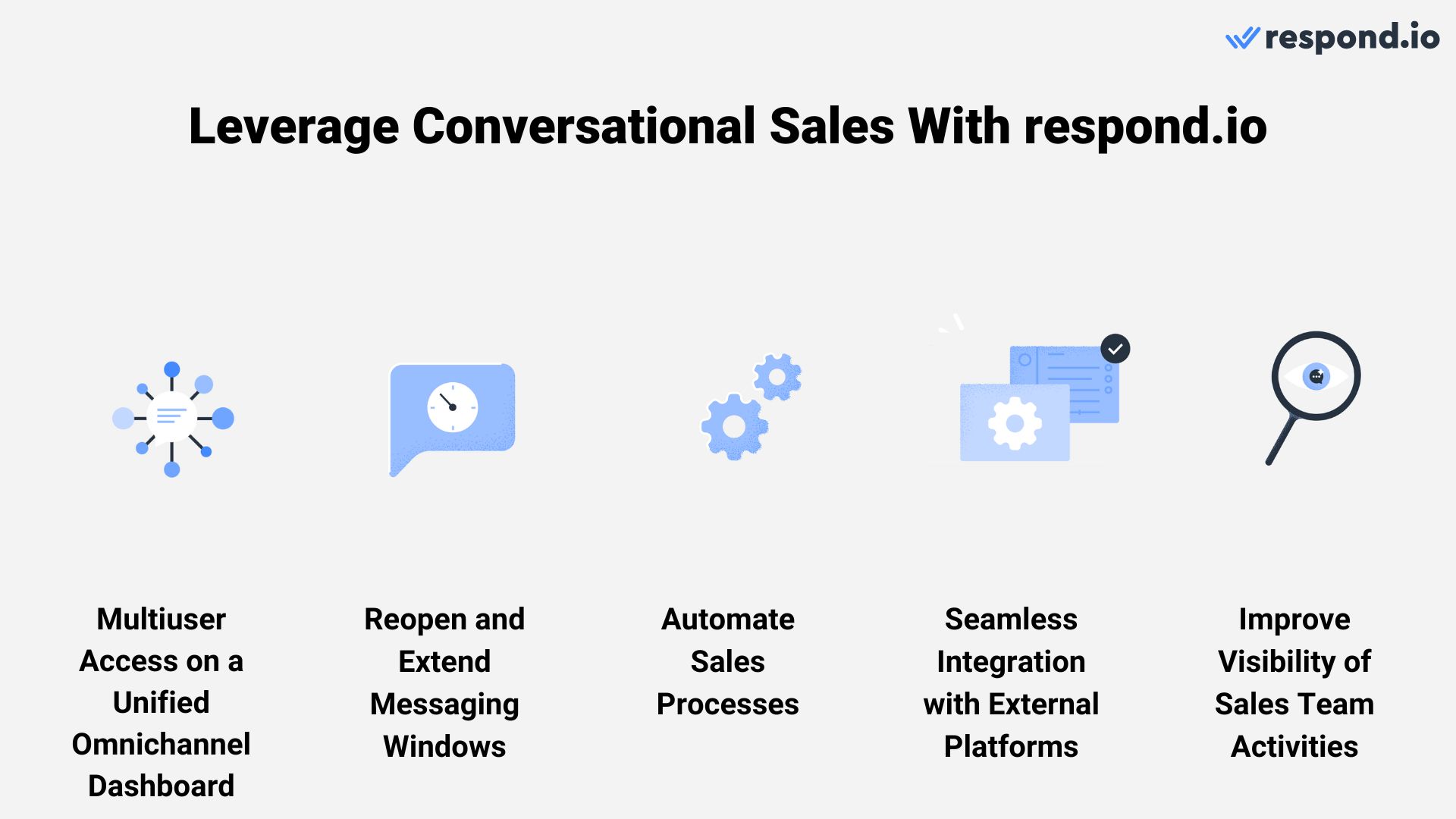
Multiuser access on a unified omnichannel dashboard
Businesses frequently face the challenge of connecting with customers across numerous instant messaging channels. The difficulty lies in managing and juggling different channels simultaneously, which leads to a high risk of missing messages from customers or not responding in time.
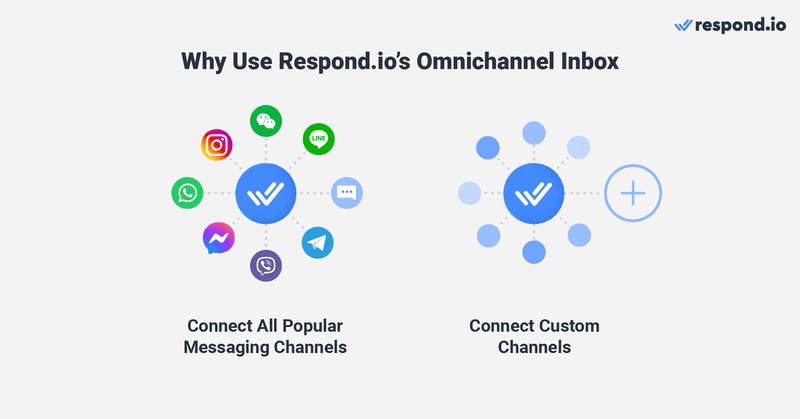
Respond.io is a customer conversation platform that supports WhatsApp, Instagram, Facebook Messenger, TikTok, Telegram, LINE, Viber, WeChat, email and voice calls, including voice over Internet Protocol (VoIP), WhatsApp Business Calling and Facebook Messenger calls in the same thread as the chat. Instead of forcing teams to manage each channel separately, it brings conversations into one workspace with multiuser access so agents can reply quickly without switching tools.
The bigger revenue benefit is continuity. When a buyer moves from Instagram to WhatsApp or from chat to a call, the team still works from one contact record with the full conversation history. Respond.io’s Contact Merge helps unify profiles across channels so AI Agents and human reps can see the same context, route the next step correctly and continue the sale without making the customer repeat information.
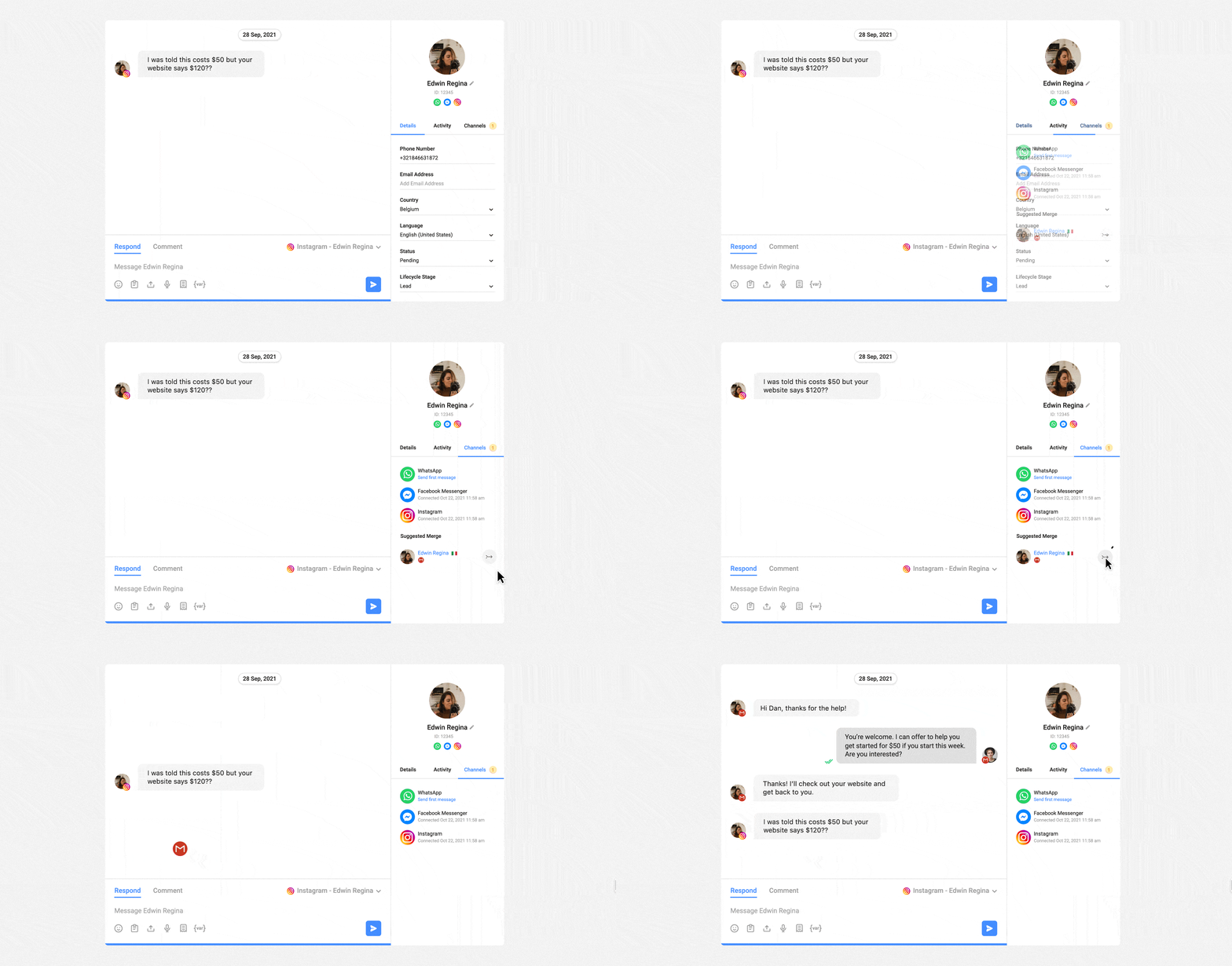
By minimizing clutter and giving sales reps a comprehensive view of customer interactions, businesses are empowered to make more informed customer care decisions and personalize their interactions more effectively.
The result is a seamless customer experience that ensures consistency across all communication channels used by the customer.
Reopen and extend messaging windows
As mentioned earlier, short messaging windows are one of the common challenges in conversational selling. Due to this limitation, sales reps cannot communicate with customers unless customers reopen the messaging windows with a new message.
Respond.io provides businesses with solutions to resume conversations with customers across diverse messaging channels. With respond.io, businesses can create, validate and save WhatsApp API message templates to re-open the WhatsApp API messaging window.
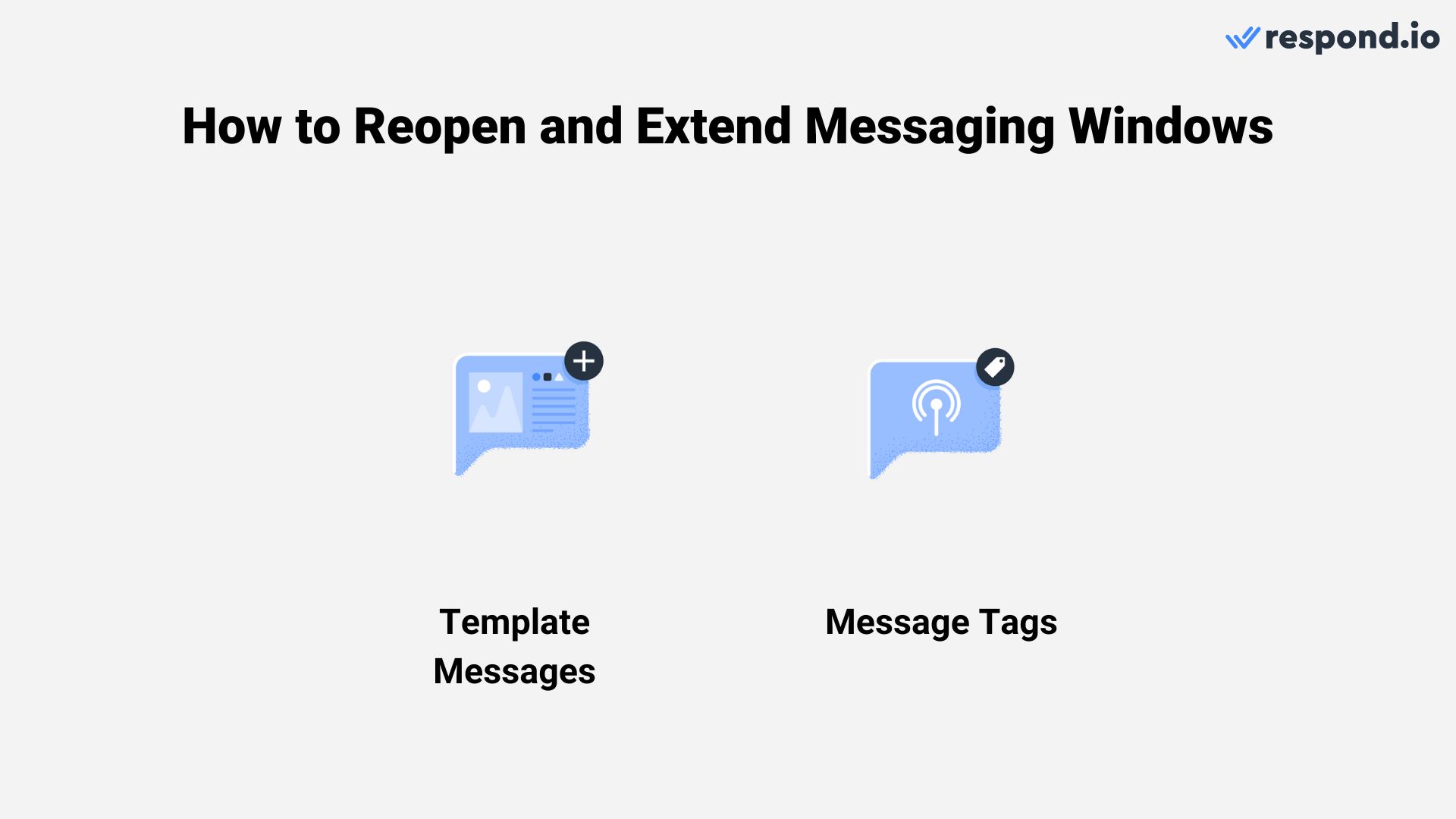
For the messaging window on Facebook Messenger, businesses can use Facebook message templates to send Meta-approved updates and notifications, ensuring compliant outbound messaging as Meta phases out message tags.
In addition, respond.io is one of the few platforms that support the Human Agent tag, which extends Facebook Messenger’s window from 24 hours to 7 days.
Using these solutions to extend messaging windows and navigate conversation restrictions significantly improves ongoing customer engagement and sales interactions.
Use AI Agents to automate sales process
In conversational sales, certain tasks can be repetitive and tedious for sales teams, diverting attention from more important sales activities. By automating these processes, sales reps can be more productive and focus on high-value interactions.
Respond.io’s AI Agents can handle high volumes of inbound conversations, qualifying leads and routing them to an appropriate salesperson.
Effective qualification goes beyond collecting a name and email. For B2C revenue teams, useful qualification questions include product interest, budget range, location or preferred store, language, urgency and whether the contact is a returning customer.
An AI Agent can also check cart value, past purchase history and existing CRM data to score buying readiness in real time. Signals such as product interest, budget range, urgency, language, location and whether the contact is returning should update lifecycle stage automatically, trigger the right workflow and route the conversation to the rep or queue that can act fastest. On respond.io, AI Agents can qualify leads, update lifecycle stages, trigger workflows and route by intent so reps spend less time reviewing low-priority chats and more time on contacts most likely to buy.
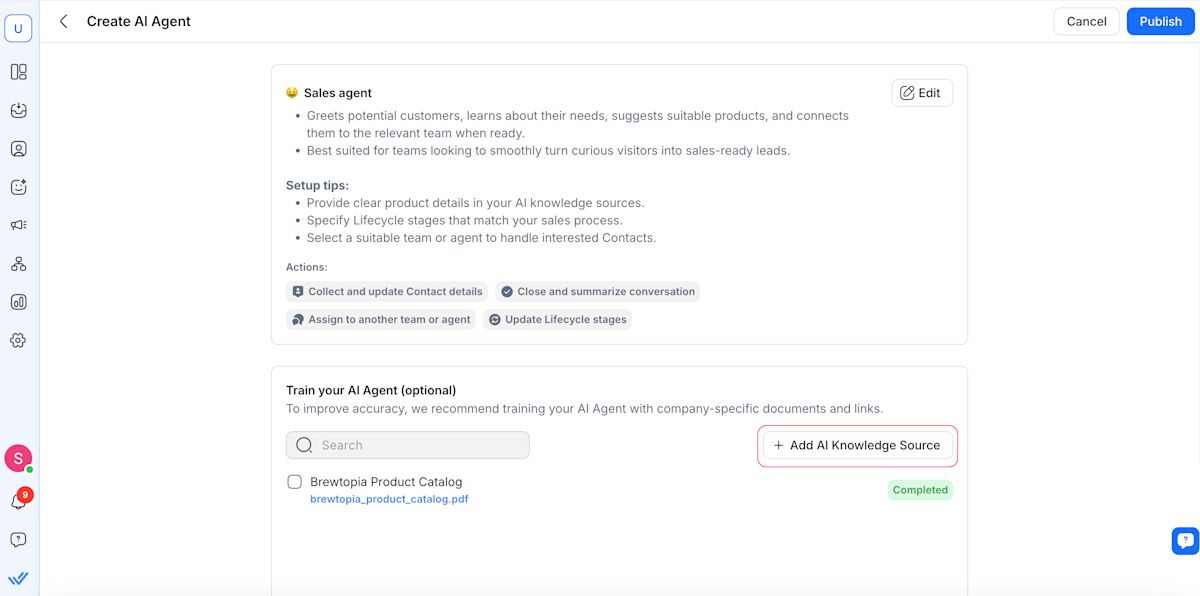
Knowing when to hand off matters as much as having the capability. AI should escalate when a buyer signals high-value purchase intent, asks for negotiation or custom terms, raises an edge-case question the AI cannot answer confidently, expresses frustration, or requests a specialist. The platform should pass full conversation history, qualification data and channel context to the human rep so the customer does not have to repeat themselves. A clean handoff keeps momentum and protects the sale; a clumsy one resets the conversation and risks losing the deal.
Automation streamlines the sales process, enabling sales reps to quickly focus on understanding the needs of potential customers, significantly increasing the chances of a successful sale. Keyboard shortcuts in the Inbox let reps assign, snooze, close or update lifecycle stage without leaving the conversation, keeping momentum during high-volume periods.
Seamless integration with external platforms
Businesses face major challenges with disjointed sales tools, especially the inconvenience of alternating between messaging platforms and CRM systems, leading to disrupted workflows and potential data inaccuracies.
With respond.io, businesses can integrate external CRM platforms such as HubSpot and Salesforce, enabling direct creation and update of customer records and deals without leaving respond.io platform. This integration streamlines conversational selling processes and ensures consistent, up-to-date customer data. Agents can also connect Google Calendar to view a contact's meeting history—including event name, date, host and status—directly in the Inbox sidebar. Teams can also connect Calendly to surface upcoming and past meetings directly in the Inbox, letting agents share the right booking link in one click without leaving the conversation.
When evaluating CRM connectivity, look beyond whether an integration exists. Strong integrations offer bidirectional sync so updates flow both ways, field mapping so conversation data lands in the right CRM properties, and automatic owner assignment so leads route to the correct rep without manual work. Conversation history should be visible inside the CRM record so reps have full context before following up. Weak integrations create data gaps, duplicate records and delayed follow-ups, all of which leak revenue. The tighter the connection between your conversation platform and CRM, the faster reps can act and the cleaner your pipeline attribution becomes.
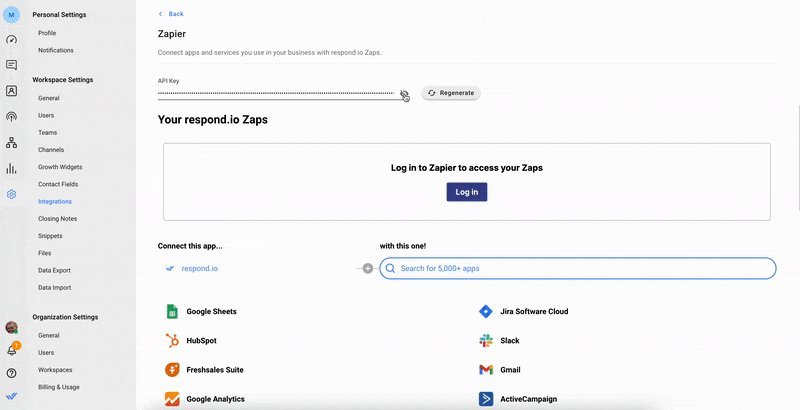
By integrating respond.io with Zapier and Make.com, businesses can connect to various applications, enabling the automation of a variety of tasks beyond CRM.
One notable example is the integration with BigCommerce. This provides real-time updates of customer data between respond.io and BigCommerce and the ability to send messages to customers about their orders and abandoned cart messages to prompt purchases.
Beyond order updates and cart reminders, conversational sales platforms can support the full shopping journey inside messaging channels. Customers can browse product catalogs, ask pre-purchase questions, receive personalized recommendations based on preferences or past behavior, and complete checkout without switching to a browser. Reducing friction between discovery and purchase is where conversational commerce delivers the clearest ROI: fewer abandoned carts, higher average order value and a shorter path from interest to revenue.
Improve visibility of sales team activities
In conversational selling, a common challenge is for businesses to store sales conversation records when their sales reps use personal devices to communicate with customers. This also disrupts the conversation’s continuity with customers when agents change or are absent.
Furthermore, the use of multiple phone numbers by sales teams can lead to confusion for customers as it lacks a unified point of contact, resulting in fragmented communication and potentially impacting the customer experience.
The lack of a shared inbox adversely affects brand image and customer experience and highlights the disadvantages of using personal phone numbers for sales.
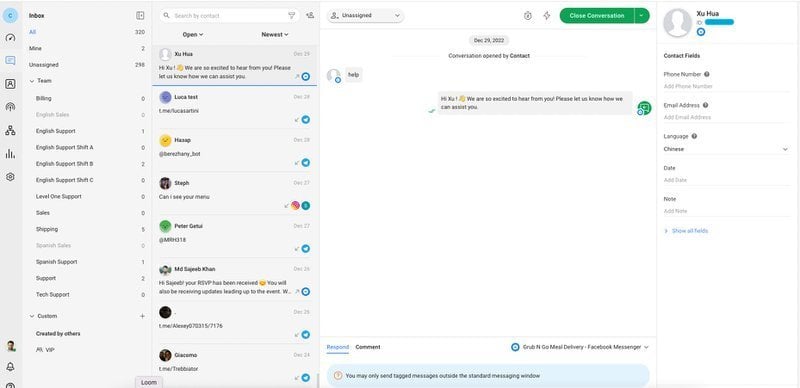
The Messages Module provides a single point of contact for sales reps to monitor and respond to inquiries across multiple channels. This gives businesses more visibility of sales agents’ conversations and activities and allows managers to monitor live conversations in real time.
The Reports Module provides insights into the sales team’s performance, enabling businesses to make data-driven decisions on sales strategies. The metrics that matter most for revenue teams fall into two groups: early health metrics and commercial outcome metrics. Early health metrics include first response time, qualified lead rate, handoff rate from AI Agents to human reps, attended next step rate, common drop-off points in the conversation flow and performance by channel. They show whether demand is being answered quickly, filtered correctly and moved to the right person without friction.
Commercial outcome metrics include conversion to sale, revenue influenced by channel or workflow and rep time saved on repetitive qualification or follow-up. These show whether the platform is improving revenue, not just producing more chats. Leaders should review both groups together by channel and workflow so they can see where response speed, qualification quality or handoff quality is helping sales and where it is leaking demand.
In conclusion, conversational sales represents a potent strategy for businesses seeking deeper engagement with customers. By utilizing platforms like respond.io, businesses can transform their sales approach, fostering stronger customer relationships and driving enhanced sales outcomes.
Looking for a conversational sales platform to take your business to the next level? Try respond.io for free!
Turn customer conversations into business growth with respond.io. ✨
Manage calls, chats and emails in one place!
What channels should a conversational sales platform support?
It should support the channels your customers actually use, ideally in the regions you sell into. For many businesses that means WhatsApp, Instagram, Facebook Messenger, web chat and email at a minimum, with the ability to add more as your mix evolves. Platforms like respond.io are often used here because they let teams consolidate popular messaging channels into one workspace instead of managing each channel separately.
Why does a unified inbox matter for sales?
A unified inbox reduces missed leads, duplicate replies and slow handoffs by keeping conversations centralized and accessible to the team. When a customer switches from Instagram to WhatsApp, or returns weeks later on a different channel, you can still see the full context and respond without restarting the conversation. This tends to improve response times and makes it easier to keep messaging consistent across reps.
How secure is a conversational sales platform for customer conversations?
Security depends on both the platform and the channel connections it uses. Buyers should verify official channel connections, role-based access, audit trails, encryption, clear data ownership and a written policy for how AI uses conversation data.
For a mid-market B2C team, this is not just a compliance check. Weak controls slow approvals, push reps back onto personal devices and break follow-up continuity. A secure customer conversation management platform keeps customer conversations centralized, permissions controlled and sales activity visible without losing speed.
Can multiple sales reps use the same WhatsApp or messaging account?
Yes, but it depends on the setup. Individual messaging apps often limit multi-user access, which creates bottlenecks when several agents need to reply at once. That's why you need a conversational sales platform. With API-based channel setups and a proper platform layer, multiple reps can work from a shared inbox concurrently, which is one of the reasons teams move from the WhatsApp Business App to WhatsApp API via platforms such as respond.io.
How does AI help in a conversational sales platform?
AI is most valuable when it takes repetitive tasks off your team’s plate, especially at the top of the funnel. It can ask qualifying questions, capture key details, filter spam and route high-intent leads to the right rep, so humans spend time where it matters. Some platforms, including respond.io, support AI agents that can run these flows at scale, make live API calls to verify data or trigger actions in external systems, and hand off to a salesperson when a lead is ready.
What is the difference between conversation intelligence and AI Agents?
AI Agents act during the conversation. They qualify leads, update lifecycle stages, trigger workflows, route by intent, escalate high-value opportunities and generate summaries for handovers while the sale is still moving.
Conversation intelligence looks at conversation data after or across interactions to surface patterns such as recurring objections, drop-off points, coaching gaps and the replies that lead to better outcomes. Teams often need both, but analytics does not replace the platform capability required to run live customer conversations.
Will customers know they're talking to AI, and does that hurt conversion?
What hurts conversion is usually not AI on its own but slow, generic or blocked conversations. If the first reply is relevant, the next step is clear and a human is easy to reach, buyers are more likely to stay engaged.
Teams should set AI Agents to sound natural, answer directly and hand off when the conversation becomes urgent, emotional or complex. The goal is not to hide automation. It is to make the buying experience faster and smoother.
Can a conversational sales platform replace human sales reps?
No. AI Agents are best used for repetitive work that slows a team down, such as qualifying leads, updating lifecycle stages, routing by intent, triggering workflows and generating summaries for handovers. Human reps still matter most when a buyer needs negotiation, nuanced objection handling, custom terms, emotional reassurance or a final push to close.
The better model is division of labor, not replacement. When AI Agents handle the early steps and pass full context to the right rep, teams increase coverage and consistency while reps spend more time on conversations that need human judgment.
How do platforms handle WhatsApp and Messenger messaging windows?
Messaging rules can limit when you’re allowed to reengage customers, which can disrupt follow-ups and closing. On Facebook Messenger, businesses now use message templates instead of message tags to initiate compliant outbound conversations. A conversational sales platform helps teams stay compliant while keeping momentum, for example, by using WhatsApp message templates to reopen conversations or using supported Messenger features that allow specific types of follow-ups. This matters for sales because timing is often the difference between a closed deal and a lost lead.
What integrations should a conversational sales platform have?
The most important integrations connect your conversations to your source of truth, usually a CRM. Look for native or reliable integrations with tools like HubSpot or Salesforce so customer data, deals and notes stay updated without reps switching tabs and re-entering information. Many teams also want connectors like Zapier or Make to automate downstream actions, and respond.io supports these kinds of integrations for keeping workflows connected.
How long does it take to implement a conversational sales platform?
Timeline depends on scope. A basic setup with one or two channels, contact import and team access can go live in days. Adding CRM sync, routing logic, AI qualification and agent coaching usually takes longer because each workflow needs testing before launch.
The fastest rollouts start small. Launch one high-volume channel and one revenue workflow first, such as lead qualification or follow-up reactivation, then measure whether response speed, qualified lead rate and handoff quality improve.
Connect the CRM early so contact data, lifecycle stage and ownership stay aligned from day one. Before launch, define when AI Agents should qualify, when they should route and when they should hand off to a human rep so customers always have a clear path to a person. Finally, coach reps on channel-native writing. Short replies, one clear next step and consistent handoff language reduce friction and make the rollout easier to scale once the first workflow is working.
How quickly can a team see ROI from a conversational sales platform?
Teams usually see value fastest when they launch one high-volume channel and one revenue workflow first, such as lead qualification, follow-up recovery or appointment booking. The earliest signs are usually faster first replies, fewer missed handoffs and more qualified conversations reaching the right rep.
The timeline depends on how much setup is involved. A simple rollout can show impact quickly, while deeper CRM sync, routing rules and AI Agent logic take longer because they need testing. Buyers should judge ROI against the first bottleneck they are removing, not against the full platform vision.
Further Reading
Did you find this article useful? If so, here are some other quick reads that might interest you:


