
















 Electronics
 Fashion & Apparel
 Furniture
 Jewelry and Watches
 Afterschool Activities
 Sport & Fitness
 Beauty Center
 Dental Clinic
 Medical Clinic
 Home Cleaning & Maid Services
 Photography & Videography
 Car Dealership
 Travel Agency & Tour Operator


TL;DR - WhatsApp AI 2026 Chatbot Policy
Meta will prohibit general-purpose AI chatbots on the WhatsApp Business Platform (API) starting January 15, 2026. New users have already been subject to these updated rules since October 15, 2025, as part of Meta’s effort to keep the platform focused on business messaging.
Banned: Chatbots offering open-ended or assistant-style interactions (e.g. ChatGPT, Perplexity on WhatsApp).
Allowed: Structured bots for support, bookings, order tracking, notifications and sales.
Respond.io users remain fully compliant, as its AI and automations are built for approved business use cases.
Starting January 15, 2026, Meta will ban general-purpose AI chatbots from the WhatsApp Business Platform (API). What does this mean? Basically, “general-purpose” refers to AI providers who sell or offer general AI services in the WhatsApp Business Platform.
Meta made this change because such bots generated massive message traffic without producing revenue through the WhatsApp Business Platform. In essence, WhatsApp is reinforcing AI’s role as a tool to enhance business messaging, without it becoming the main offering.
Businesses can still use AI for customer service workflows—such as FAQs, bookings, order tracking, and support—so respond.io users remain fully compliant under the new policy.
WhatsApp API 2026 chatbot policy: key dates & who’s affected
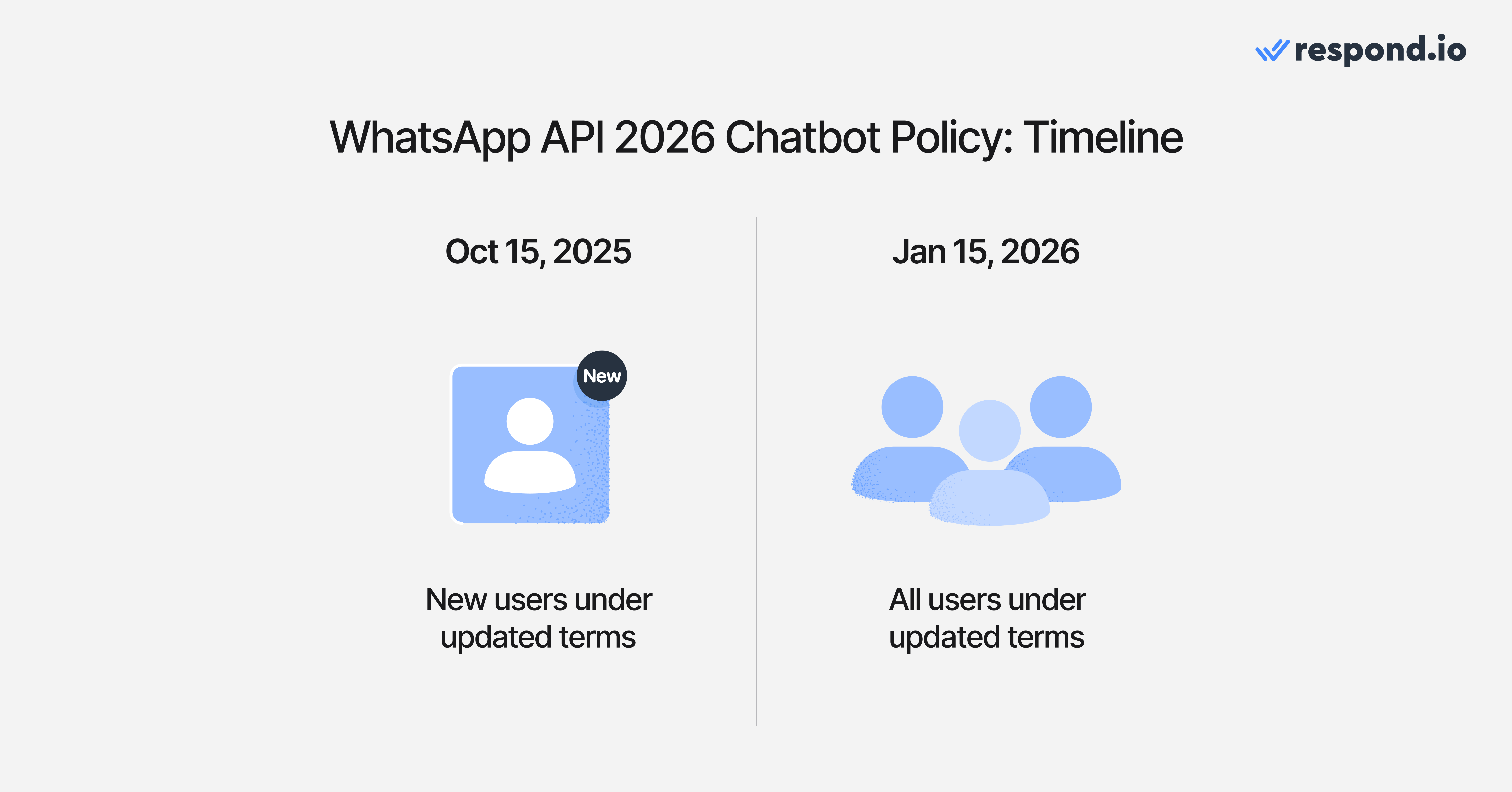
The rollout happens in two phases.
On October 15, 2025, all new WhatsApp Business API users began operating under the new terms.
On January 15, 2026, the update will be rolled out to all existing users.
The impact of this policy depends on what kind of chatbot you operate.
Affected: AI model providers that use WhatsApp as a distribution channel for their assistant, such as ChatGPT on WhatsApp or Perplexity’s conversational bot. These services allow users to ask anything, from “What’s the weather?” to “Summarize this PDF,” making them fall squarely under Meta’s new restrictions.
Not affected: Brands and service providers using WhatsApp to help customers — for example, a travel company managing bookings, a restaurant confirming reservations or a retailer sending order updates. These are exactly the kind of use cases WhatsApp intends to preserve.
For respond.io users, this distinction is crystal clear. Some of respond.io's recommended use cases for AI — support messaging, order tracking, delivery updates, authentication prompts and notifications — all sit firmly within WhatsApp’s intended scope. In other words, your automations are already compliant with the new framework.
What is banned and allowed with the WhatsApp API 2026 chatbot policy
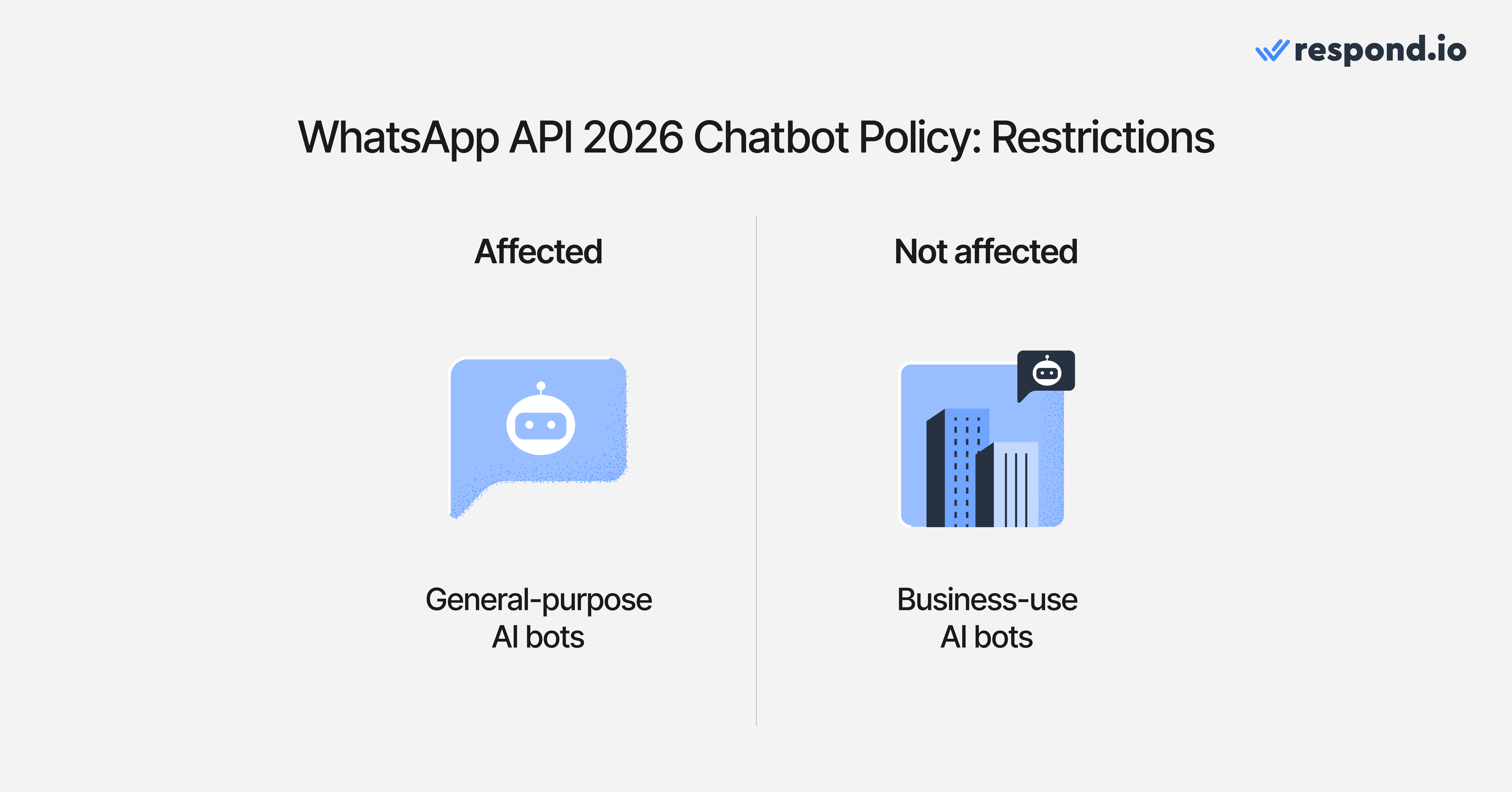
To understand this update, it’s important to know how Meta defines “AI Providers.” These are companies that build or operate AI systems—such as chatbots, large language models or generative AI tools—where the AI is the core product rather than a supporting feature. Under the new policy, these providers are strictly prohibited from using the WhatsApp Business Solution for that purpose.
In practical terms, this means public-facing AI chatbots that function as open-domain assistants are no longer permitted. That includes bots capable of answering arbitrary questions, generating content, or serving as general conversation companions.
However, business-focused chatbots remain welcome. Automations that handle structured tasks — such as confirming orders, triaging support tickets, sending appointment reminders or authenticating logins — are explicitly permitted. The key is that the chatbot’s role must be ancillary to a legitimate business service, not the centerpiece of the interaction.
Respond.io’s automation framework was built with this philosophy in mind. Every feature, from message templates to escalation rules, reinforces WhatsApp’s compliance requirements. Our tools ensure that businesses communicate efficiently without crossing into prohibited territory.
Why Meta is banning general-purpose chatbots
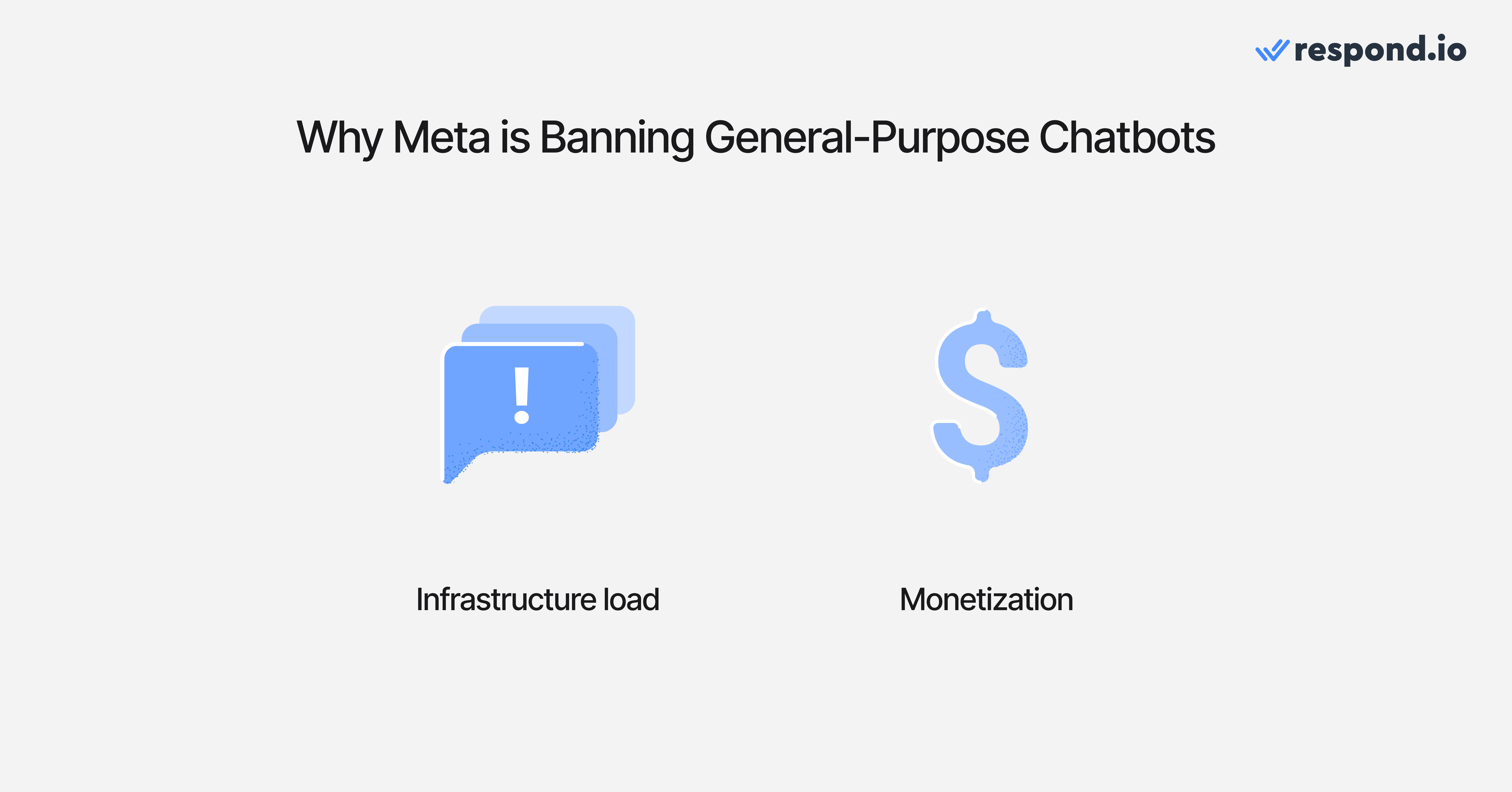
WhatsApp’s Business API was designed for business-to-customer communication, not to serve as an AI distribution platform. Meta made the change for two main reasons.
Infrastructure load: Open-ended AI assistants generated massive message volumes, straining WhatsApp’s systems.
Monetization: WhatsApp’s revenue model relies on template-based billing (marketing, utility, authentication, support). AI bots didn’t fit these categories, meaning Meta couldn’t monetize the traffic.
In short, Meta wants to protect the API’s intended design and ensure that usage aligns with business communication, not consumer-facing chatbot products.
How respond.io keeps you compliant with WhatsApp’s 2026 AI policy
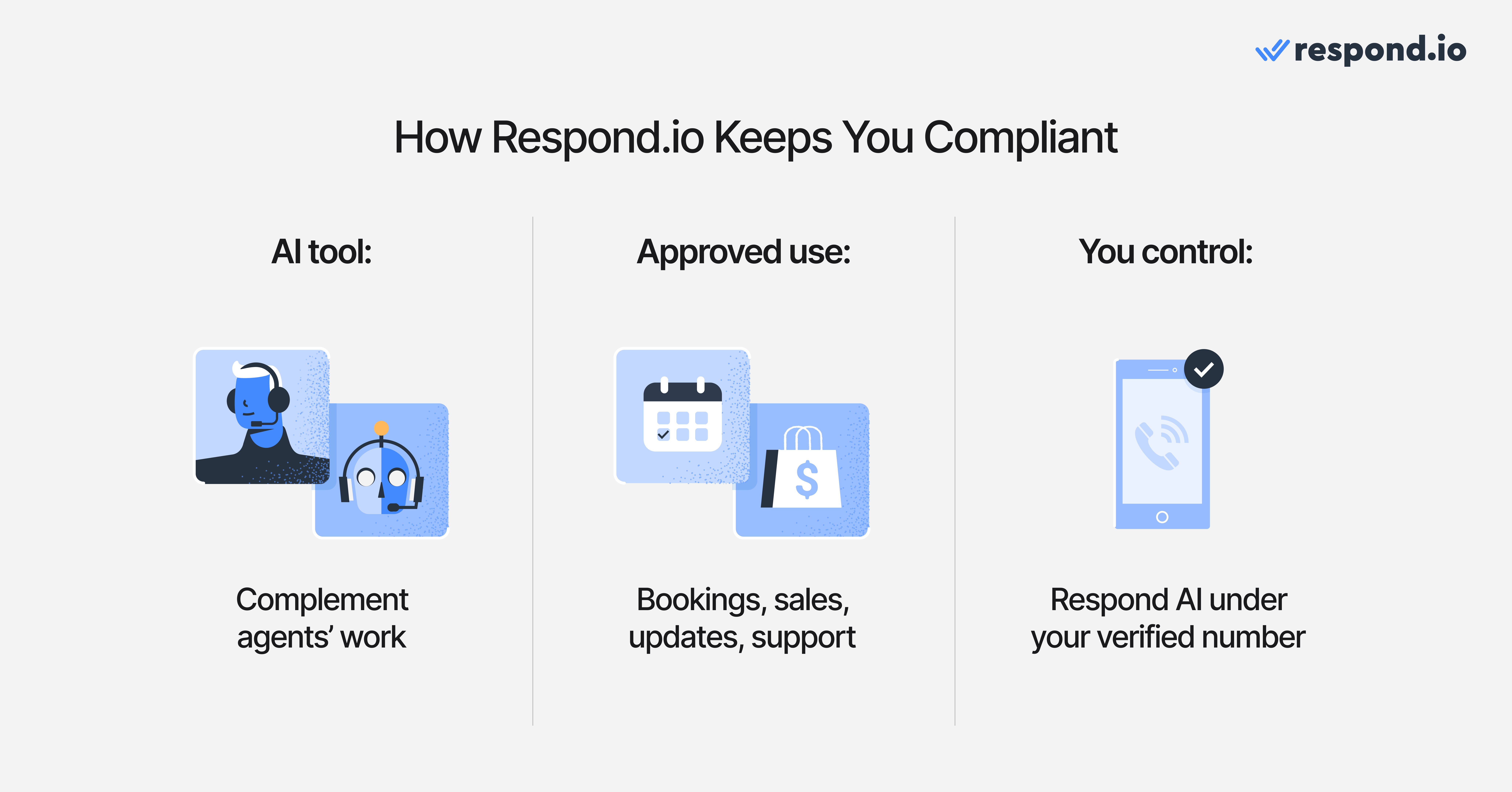
1. AI is used as a complementary tool.
Respond.io’s AI features like AI Agent, AI Prompts and AI Assist are designed to:
Automate repetitive tasks (e.g., FAQs, routing, lead qualification)
Help agents reply faster with suggestions or translations
Support customers
This aligns perfectly with Meta’s intent: AI in a supporting role, not as the main service.
2. AI stays within WhatsApp’s approved use cases.
Respond.io AI features are used for specific use cases such as:
Bookings and sales
Notifications and updates
Order tracking
Customer service
These are approved business functions under WhatsApp’s API policy, so you stay fully compliant.
3. You remain in control of the customer relationship.
Respond.io connects your AI and agents under your verified business number — meaning conversations are always business-led, transparent and compliant with WhatsApp’s Business Messaging Policy.
Quick checklist for customers to ensure compliance
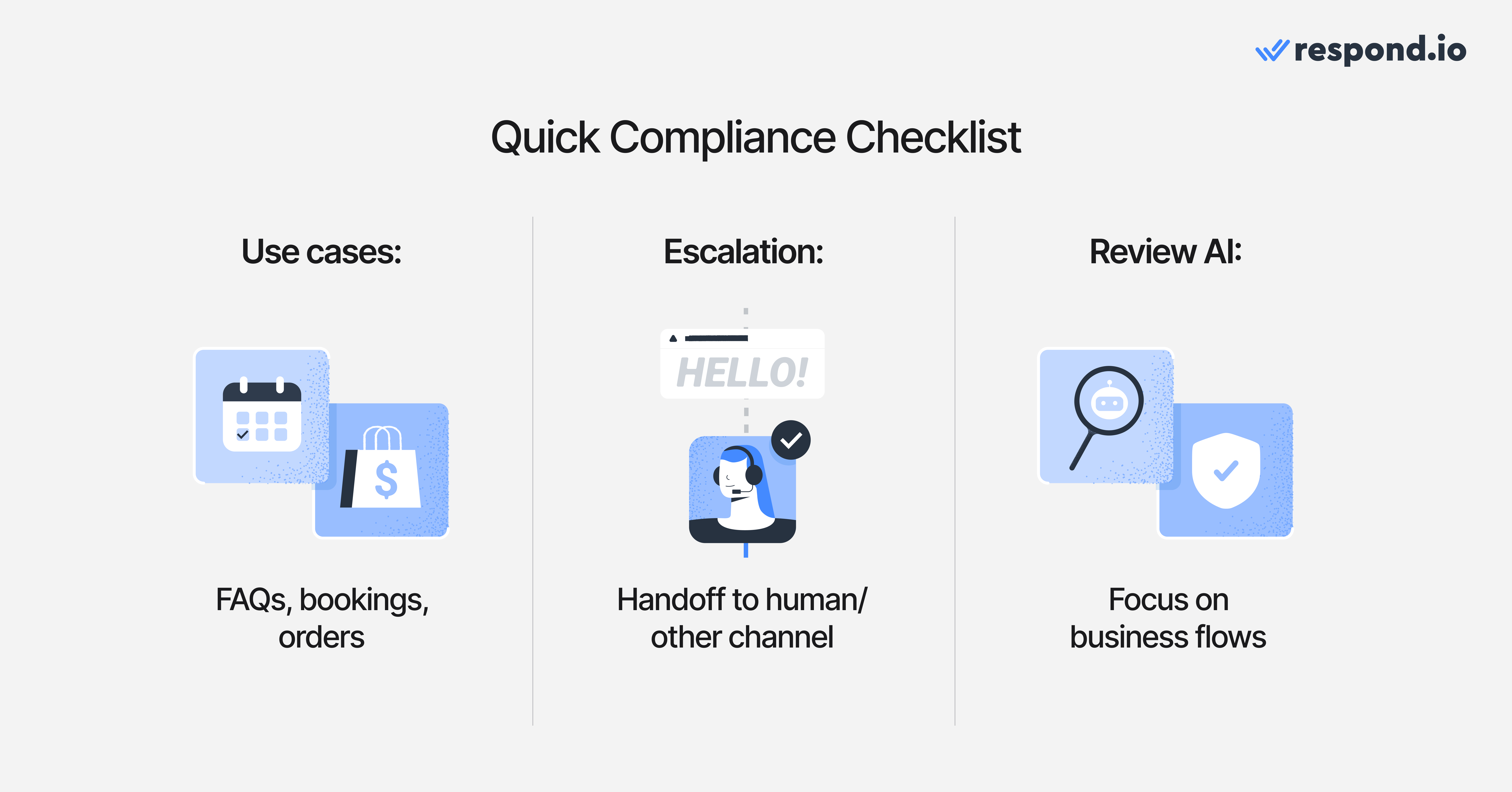
Stick to permitted use cases
Make sure your AI Agent serves specific business functions (e.g., FAQs, lead capture, bookings, order updates) — not general chat or entertainment.
Confirm escalation paths
Include clear handoff options to a human agent or alternative channel (email, phone, web form) when AI can’t resolve a request.
Review existing AI Agents
If you’ve built experimental or general-purpose AI assistants, you will need to rework the prompts for compliant, business-focused flows. You can also remove any prompt instructions asking customers to resend shared locations, catalog items or contact cards.
Clarifying grey areas about the WhatsApp 2026 AI policy
“Concierge” AI assistants
To stay compliant, make sure your bot’s functions are oriented towards support or transactional queries, and can quickly escalate conversations to a human agent when needed.
Other AI applications: AI summaries, suggested replies
These are safe. They operate internally within your helpdesk and don’t distribute an AI assistant through WhatsApp. Respond.io’s AI features, apart from AI Agents, fall into this category.
Keep your WhatsApp workflows policy-compliant, effective and automation-ready. 👉 Sign up for respond.io and stay ahead of WhatsApp’s 2026 compliance updates.
Looking for AI solutions? Use AI Agents instead
Automate greetings, answer questions, and route chats — all without Workflows. Set up the Receptionist template in minutes and unlock more possibilities with AI Agents powered by advanced AI models.
FAQs about the WhatsApp 2026 AI policy
Is WhatsApp banning all chatbots?
No, WhatsApp is only banning general-purpose AI chatbots like ChatGPT-style bots that answer open-ended questions. AI chatbots used for support, sales, notifications and updates, like respond.io’s AI Agents, are still allowed under WhatsApp’s policy.
When does the WhatsApp chatbot ban take effect?
The policy will apply to all businesses using the WhatsApp Business API starting January 15, 2026. New users have been subject to these updated rules since October 15, 2025. Businesses correctly using respond.io’s AI for business messaging won’t be affected by this update.
What is a “general-purpose AI assistant” on WhatsApp?
A general-purpose AI assistant is a chatbot that can answer any question on any topic, like a personal assistant. WhatsApp will now only allow bots that serve a specific business function, such as answering FAQs or processing orders.
Will my respond.io automations be affected?
No. Respond.io’s workflows and AI Agents are fully compliant with WhatsApp's policies. You can continue using automation and AI Agents for support, sales, marketing and customer service without issues.
Can I still use AI with respond.io to WhatsApp customers?
Yes. You can continue using respond.io AI tools such as AI Agents, AI Assist and AI Prompts. These features help you automate customer conversations and journeys, or help your agents generate, summarize and translate messages. They have specific business functions and do not act as public chatbots on WhatsApp, which ensures compliance with Meta’s AI rules.
I’m using a WhatsApp AI chatbot that answers any question. What should I do?
You need to refactor your chatbot into business-specific workflows. Make sure your AI Agent serves clear business purposes — for example, answering FAQs, handling order tracking, qualifying leads, or routing customers to the right team. If you need help, contact your respond.io Customer Success Manager or respond.io support.
Further Reading
If you've foud this article useful, here are some additional readings for you.


