
















 Electronics
 Fashion & Apparel
 Furniture
 Jewelry and Watches
 Afterschool Activities
 Sport & Fitness
 Beauty Center
 Dental Clinic
 Medical Clinic
 Home Cleaning & Maid Services
 Photography & Videography
 Car Dealership
 Travel Agency & Tour Operator

TL;DR — WhatsApp API for the automotive industry
Automotive businesses can’t rely on email or calls anymore — today’s customers expect fast, two-way WhatsApp conversations for sales, service, and support.
WhatsApp API helps dealerships and parts retailers scale communication by organizing chats across teams, automating routine tasks, and integrating with CRMs or Dealer Management Systems.
From lead generation to loyalty campaigns, businesses use WhatsApp API to engage buyers in real time, close deals faster, and streamline operations across locations.
With a platform like respond.io, you can launch, automate and manage WhatsApp conversations with ease, making it possible to scale customer communication without sacrificing speed or quality.
When you’re selling cars or parts, getting communication right is just as important as the product itself. Customers expect fast replies, clear updates, and a smooth experience. Every message matters.
But many automotive businesses still rely on slow, disconnected tools like email and phone calls. Leads go cold before anyone follows up. Sales and service teams use different apps, and no one has a full view of the conversation. As your business grows, these problems get worse — leading to lost sales, unhappy customers and confusion across teams.
Since WhatsApp is the world’s most popular messaging channel, businesses have made the transition to WhatsApp, where their customers are.
But if you’ve been using the WhatsApp Business App, you’re probably encountering its limitations. Although it’s good enough for small businesses that are starting out, when you’re scaling, you’re going to need a lot more. Growing dealerships and parts retailers need more control and visibility. That’s where WhatsApp Business API comes in.
It helps you:
Respond to leads instantly
Keep conversations organized across teams
Automate updates like service reminders or order confirmations
Connect WhatsApp to your CRM or Dealer Management System
This guide walks through how automotive businesses are using WhatsApp API, with real examples, practical use cases and what you need to get started.
Benefits of WhatsApp API for automotive businesses
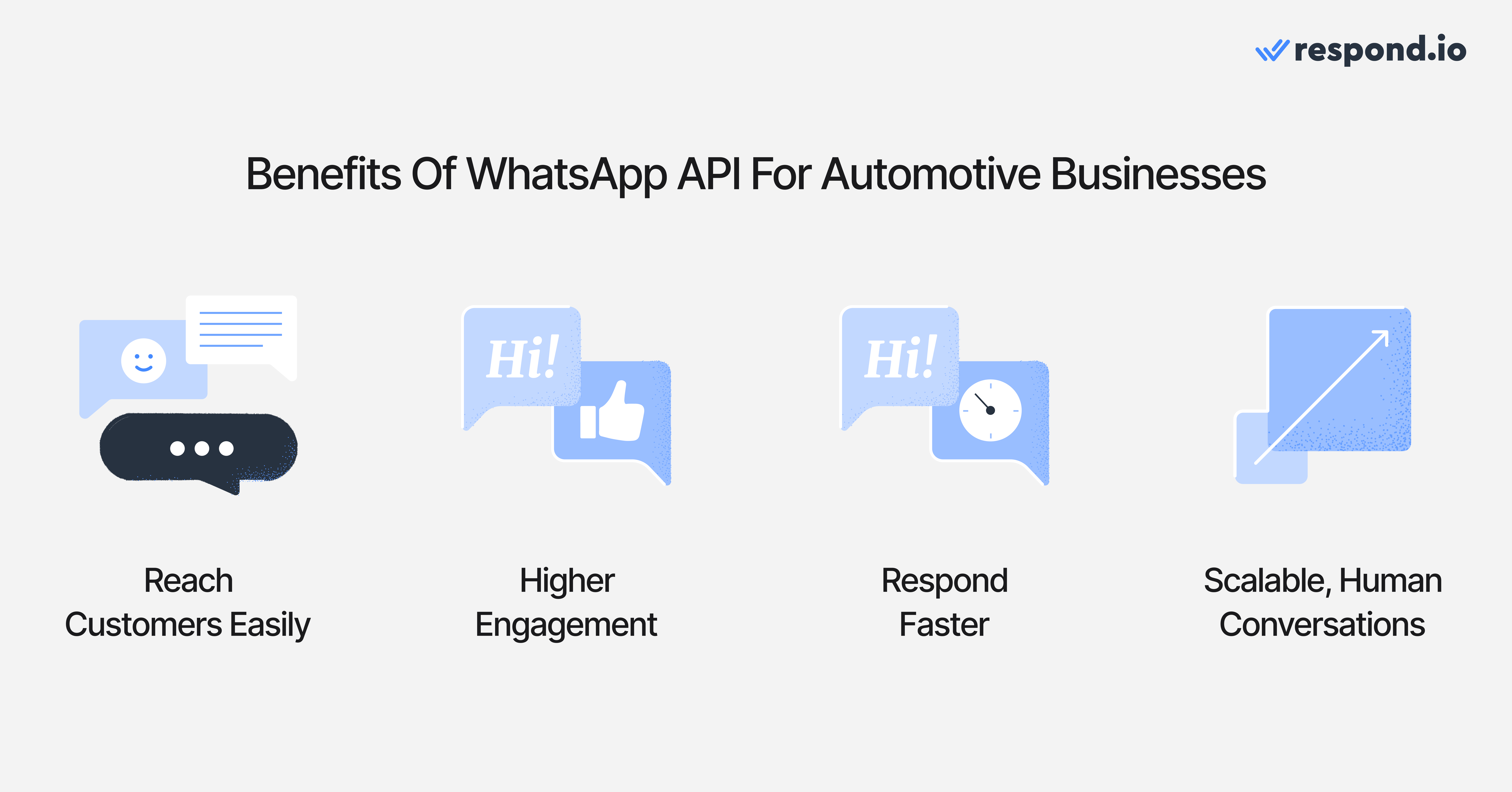
Customers don’t just want good cars or the right parts, they want fast answers and a smooth experience from start to finish. Whether you’re running a dealership or selling vehicle parts, WhatsApp API helps your business deliver better service, faster replies, and more organized conversations.
Meet customers where they start their journey
Most buyers begin their research online and many prefer messaging over phone calls
Customers research, compare and even schedule test drives through chat
With WhatsApp, you can start conversations as soon as they’re interested. Let them ask about pricing, availability, or product details — no forms or callbacks needed
Get seen and get replies
WhatsApp messages get much higher open and response rates than emails or calls
Share product info, photos, videos, brochures and more — all in one conversation
Verified business profiles add trust for both car buyers and parts customers
Keep time-sensitive conversations moving
Buyers often need quick answers about vehicles, pricing, service status, or part availability
WhatsApp enables fast, two-way messaging that feels natural and easy to use
Respond instantly, share updates as they happen and reduce delays that lead to lost sales
Messages are also asynchronous so customers can reply at their own pace without losing context
Scale without losing the human touch
Make sure customers always speak to the right team: route messages by inquiry type or location
Use AI agents to answer FAQs or qualify leads, then hand off to a human when needed
Automate updates for new vehicles, parts, or repair status
Stay consistently in touch to reduce missed leads or no-shows
Keep all conversations organized, even as message volume grows
WhatsApp API use cases for car dealerships and auto parts retailers
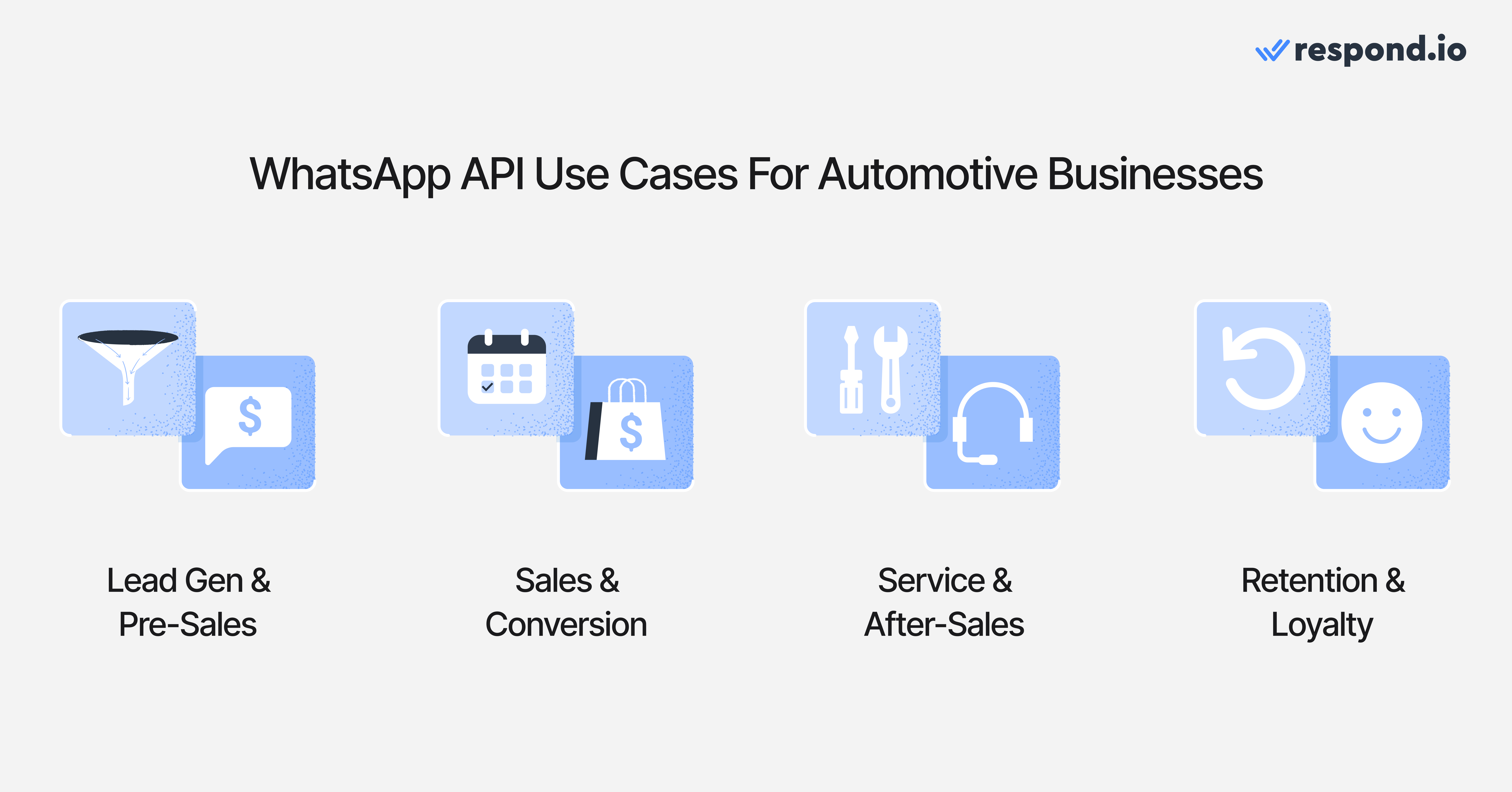
Here’s how car dealerships and parts retailers are using WhatsApp API to engage leads, close sales, provide updates and retain customers.
Use case 1: Lead generation & pre-sales
Capture leads using click-to-WhatsApp ads on vehicle listings or landing pages
Add chat links or QR codes across your website, online marketplaces or in-store displays
Respond instantly to questions about vehicle models, pricing or part availability
Share brochures, inventory lists, or product catalogs, including compatibility charts for parts
Use AI agents to qualify leads based on car preferences, budget, or location, tag them by intent, and route them to the right team
Meet customers at the moment they’re most interested, keep them engaged through convenient conversations and qualify leads faster with minimal manual effort.
Use case 2: Sales & conversion
Send real-time stock confirmations and price quotes for vehicles or parts
Schedule and confirm test drives directly in chat
Conduct trade-in evaluations by collecting photos and vehicle details from buyers
Share financing plans, payment instructions and required documentation
Keep buyers informed with delivery timelines or pickup status updates
Guide customers through the full sales process
By making the buying process faster, clearer, and more convenient, you reduce friction and increase conversion rates.
Use case 3: Service & after-sales
Send automated reminders for service appointments, oil changes or part replacements
Provide real-time repair status updates, including photos or video walkthroughs
Confirm service bookings or parts installation requests via chat
Answer follow-up questions, installation issues or return requests
Notify customers when vehicles or parts are ready for pickup
Offer roadside assistance or emergency support directly through WhatsApp
Proactively keep customers informed throughout the service journey and reduce inbound calls with timely, helpful updates.
Use case 4: Retention & loyalty
Segment your audience by car model, service history, past purchases, or AI-applied intent tags
Send targeted promotions for services, trade-ins or seasonal accessories
Notify customers when frequently ordered parts are back in stock
Share exclusive previews of new vehicle models or product launches
Collect post-sale feedback or service reviews to improve future interactions
Promote referral programs, restock alerts or loyalty incentives via broadcast
Staying top-of-mind with personalized, relevant messages encourages repeat business and gives customers a reason to re-engage, even after the sale.
Success stories: Automotive industry + WhatsApp API
Here’s how real-world dealerships and automotive businesses are using WhatsApp API with respond.io to simplify operations, speed up communication and drive results.
, they centralized messaging in one platform, routed conversations to the right team and ensured full visibility at every step of the buyer journey. This helped them reduce delays, stay consistent across locations and accelerate revenue growth. The result: Faster sales cycles, more organized communication and a better customer experience.](https://assets2-proxy.respond.io/ph8r57dk1q9w/19GqQDZ7r3WPccesIQO0ks/329ed760340966f2e69085631d91fcc9/srikandi.jpg)
Srikandi Group, an authorized Mitsubishi Motors dealer in Indonesia with 47 dealership locations, needed a better way to manage customer communication across teams and branches. Before WhatsApp API, chats were scattered across phones and individual agents.
With WhatsApp API connected to respond.io, they centralized messaging in one platform, routed conversations to the right team and ensured full visibility at every step of the buyer journey. This helped them reduce delays, stay consistent across locations and accelerate revenue growth.
The result: Faster sales cycles, more organized communication and a better customer experience.

Automax, a luxury car dealership located in the United Arab Emirates, saw WhatsApp not just as a support tool, but a key driver of sales. They used WhatsApp API with respond.io to send broadcast messages like limited-time offers and stock updates to segmented customer lists.
With built-in reports and conversation tagging, they tracked which messages led to replies, visits, and sales. Broadcasts became a reliable way to drive engagement, generate leads and increase ROI.
The result: More sales opportunities from past leads, clearer visibility into what works and stronger returns on messaging.
These are just two examples of how automotive businesses are using WhatsApp to reduce missed opportunities, speed up conversations and stay connected — across sales, service and loyalty.
WhatsApp API for your automotive business through respond.io
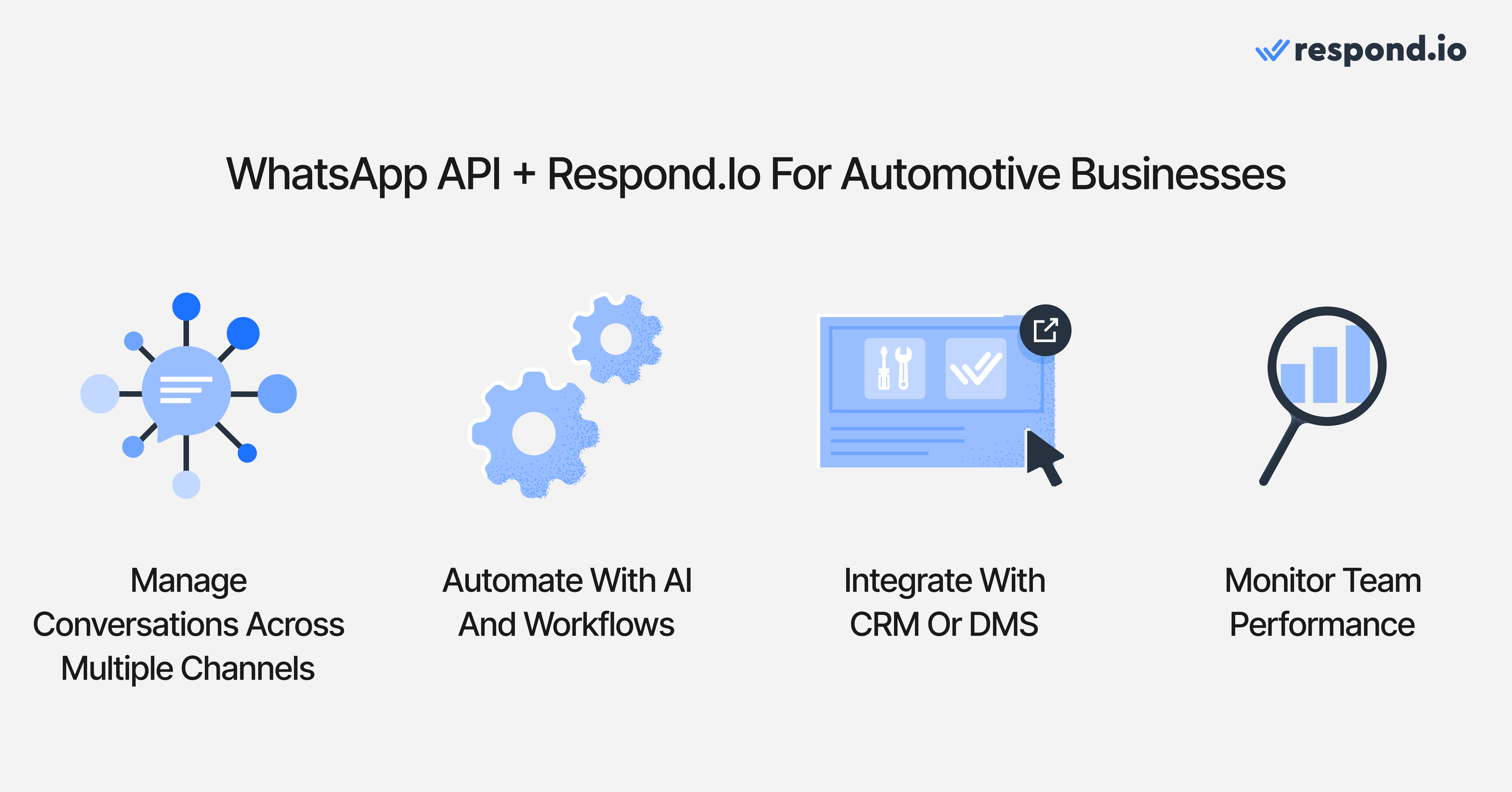
Before you start moving your automotive operations to WhatsApp API, there’s something you need to know: WhatsApp API doesn’t work on its own like WhatsApp Business App. It requires a customer conversation platform to be usable. This is where respond.io comes in. In addition to handling your WhatsApp messages and calls, respond.io has many other features to improve the lives of car businesses. Here’s what you get using WhatsApp API with respond.io:
Manage customer conversations across teams and channels
Centralize chats from WhatsApp, Instagram, Facebook, TikTok, and more — all in one shared inbox
Route inquiries automatically based on location, topic, or customer intent
Track and label customers based on their journey stage
Let multiple agents reply without losing context of the conversation
Automate routine interactions with AI + workflows
AI agents that work alongside human agents, capable of sending product images, brochures and files directly in chat
Use AI agents for FAQs, lead qualification, booking reminders, and order updates
Set up rules to trigger the right messages at the right time
Use AI Agents to trigger Workflows for more complex actions like integrations
Preserve conversation context with AI-generated internal comments for smoother handovers
Integrate with your CRM or Dealer Management System
Sync messages, notes, and tags with tools you already use (CRMs, DMS, inventory or payment systems)
Connect Google Calendar to view a contact's upcoming and past meetings directly in the Inbox sidebar, matched by email across a 12-month window.
Personalize messages based on updates in stock, bookings, or customer profiles
Support calling workflows
Let agents make and receive calls over WhatsApp or VoIP, all within respond.io
Combine messaging and calling for a smoother sales or service experience
Monitor performance across teams and branches
Use built-in dashboards to track agent activity, customer satisfaction and response times
Tag conversations by team, campaign, or location for better reporting
Gain visibility at every level — whether you’re running one outlet or dozens
Transparent, scalable pricing
No hidden fees or surprise usage charges — just transparent pricing that scales with your business
Built for growing teams that handle high messaging volume
Whether you’re a used car dealership, a nationwide auto parts seller, or a multi-location service provider, respond.io gives you the tools to manage WhatsApp conversations without chaos.
6 best practices for automotive businesses using WhatsApp API
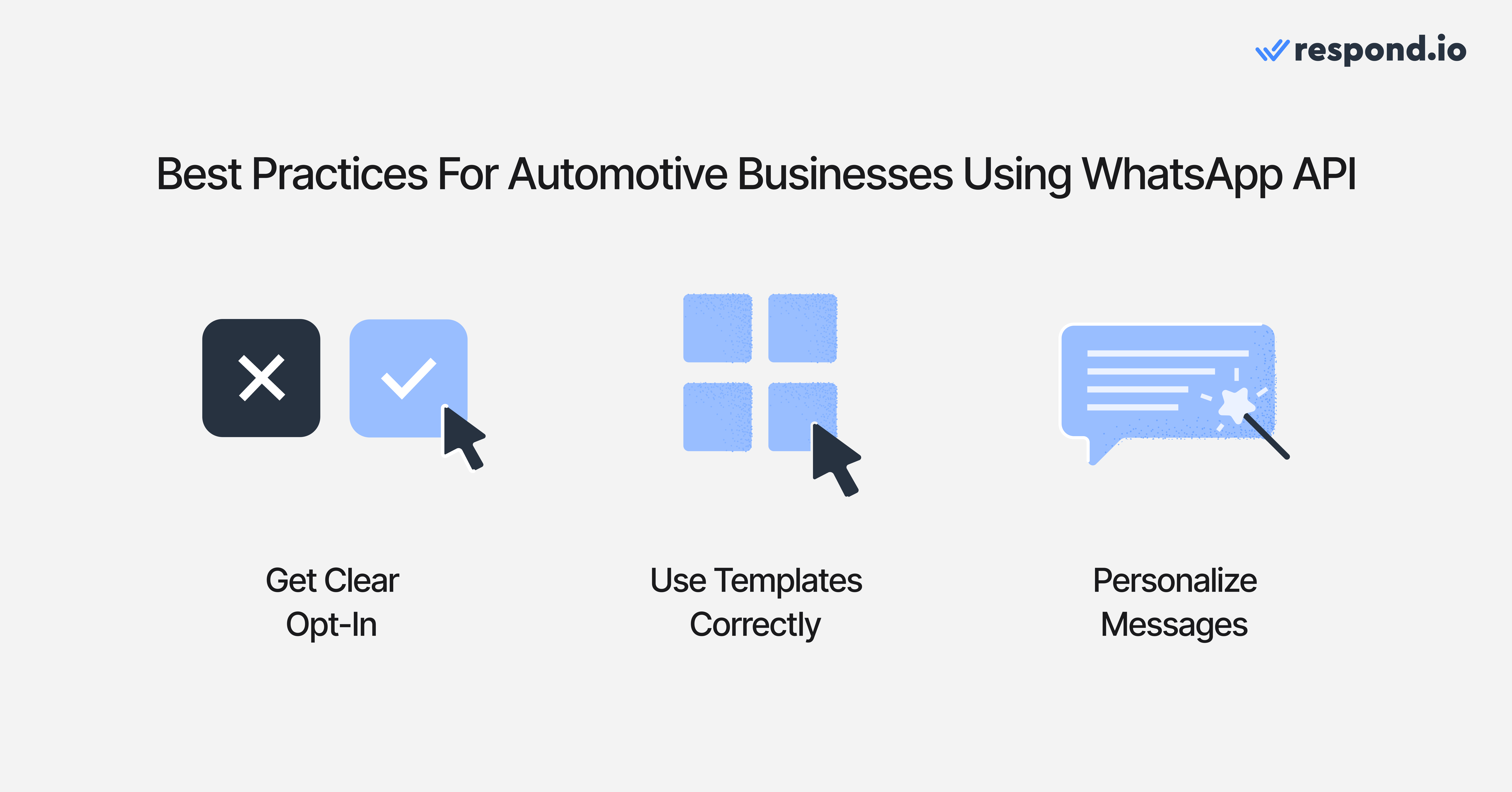
Once you’ve set up WhatsApp API for your dealership or parts business, follow these best practices to get the most out of every conversation:
1. Get clear opt-in
Only message customers who have clearly agreed to hear from you. Use checkboxes on your website, QR codes in-store, or WhatsApp links with pre-filled opt-in text. This keeps you compliant with Meta’s policies and protects your business from restrictions or bans.
2. Use approved message templates correctly
WhatsApp requires pre-approved templates when sending the first message to a customer. These can be transactional (e.g. booking confirmations) or promotional (e.g. special offers). Always use the right type for the right purpose. Misuse can hurt your quality rating or get your account restricted.
3. Personalize every message
Include the customer’s name, vehicle model, service history, or purchase details when possible. Personalized messages feel more relevant and professional and they lead to better response rates.
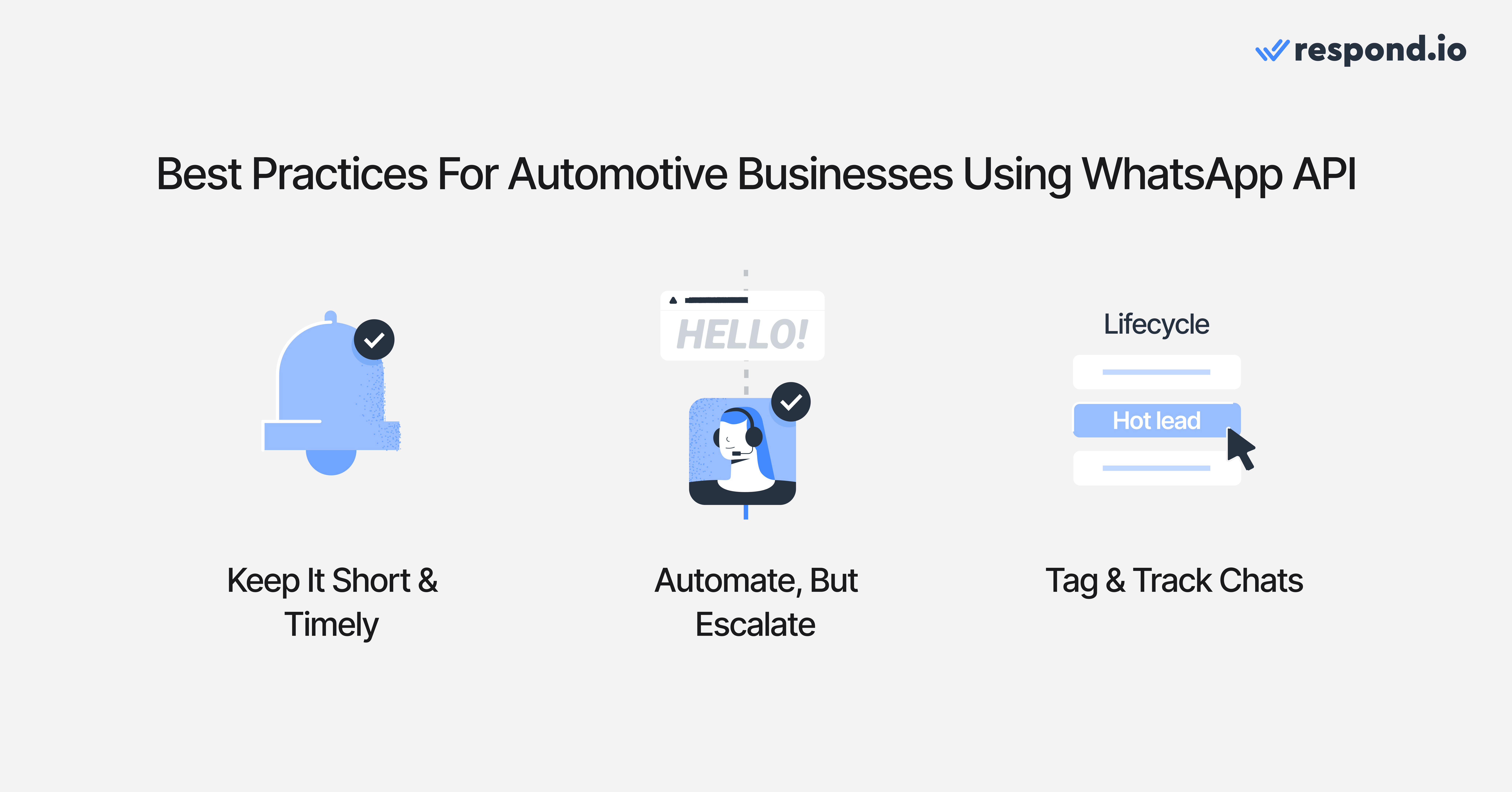
4. Keep it short, helpful and timely
Don’t overload customers with too much information at once. Confirm a booking, send a reminder, or share a file and then follow up if needed. Your customers are busy and short, well-timed updates are more likely to be read and replied to.
5. Automate routine messages but know when to hand off
Use automation for FAQs, lead qualification, or service reminders. But when a conversation becomes complex or high-value, smoothly hand it off to a human. A poor transition is one of the top reasons customers get frustrated.
6. Tag and track conversations
Label contacts or chats by topic (sales, service, parts), lead stage, or urgency. This helps your team stay organized, respond faster and measure performance across teams, branches, or campaigns.
Why automotive businesses need WhatsApp API to scale customer communication
Today’s car buyers and parts customers don’t wait for callbacks. They expect fast replies, clear updates, and real-time support across every stage of their journey.
From lead generation to post-sale service, WhatsApp API helps automotive businesses manage conversations faster, more efficiently, and at scale. With respond.io, you can connect WhatsApp to your existing systems, assign messages across teams, automate routine tasks, and maintain full visibility, all in one place.
Faster replies across teams
Seamless messaging and calling workflows
Personalized, automated customer experiences
Full integration with your CRM or DMS
Whether you’re a dealership, parts distributor, or service center — if your business relies on messaging, it’s time to upgrade how you manage it.
Start with respond.io and turn conversations into conversions.
Turn conversations into customers with respond.io's official WhatsApp API ✨
Manage WhatsApp calls and chats in one place!
FAQs about WhatsApp API for the Automotive Industry
What is WhatsApp Business API and how is it different from the WhatsApp Business App?
WhatsApp Business API is designed for medium and large businesses that handle many conversations across multiple agents. Unlike the free WhatsApp Business App, it doesn’t run on a phone — it connects to a customer conversation platform like respond.io, allowing you to manage messages across teams, automate workflows, and integrate with CRMs or Dealer Management Systems (DMS).
What are the main benefits of using WhatsApp API for automotive businesses?
It helps car dealerships and parts retailers respond faster, manage high message volumes, automate routine updates like service reminders, and give customers a reliable, personalized experience. You can centralize chats, assign them to the right agents, and track every interaction in one place.
What types of automotive businesses can use WhatsApp API?
It’s suited for:
Car dealerships (new and used)
Auto parts retailers and distributors
Service centers and repair shops
Fleet and rental businesses
Car detailing or accessory shops
Any automotive business that sells, services, or supports customers through messaging can benefit from WhatsApp API.
How can I create a WhatsApp link for my dealership or parts business?
You can create a WhatsApp link using the format https://wa.me/<yourphonenumber>. Add this link to your website, online listings, or digital ads so customers can start chatting instantly. Platforms like respond.io can generate and track these links automatically. Check out our link generator to do this easily!
Is WhatsApp API free to use?
No. Meta charges per message, so marketing, authentication and utility templates are billed, along with service messages beyond the first 1,000 each month per phone number. Some platforms may also charge additional usage or seat fees, but respond.io provides transparent pricing with no hidden costs. Visit our pricing calculator to learn more.
Why was my business rejected for WhatsApp API approval?
Meta may reject applications from businesses in restricted or “high-risk” industries, or if the use case isn’t clearly defined. Automotive businesses are generally eligible, but rejections often happen if opt-in or template details are incomplete. Using a verified Meta partner like respond.io can help streamline the approval process.
Can I use WhatsApp as a CRM?
Not by itself. WhatsApp API is a messaging infrastructure — it doesn’t store or manage customer data like a CRM. However, when connected to respond.io, you can track customer history, add notes, tag leads, and sync data with your CRM or DMS. It works alongside your CRM, not as a replacement.
What are the team or user limits for WhatsApp API?
The WhatsApp Business App is limited to four users. WhatsApp API, however, has no fixed user cap — it depends on the platform you connect to. Respond.io allows unlimited users, teams, and locations to manage chats simultaneously through a shared inbox.
Can managers monitor all sales and service conversations?
Yes. On platforms like respond.io, managers can view all conversations in real time, tag chats by agent or location, and monitor performance using dashboards and reports. This ensures accountability across teams and locations. Learn more about our team inbox.
How can I integrate WhatsApp API with my CRM or Dealer Management System?
WhatsApp API integrates via platforms like respond.io, which connects directly to popular CRMs and DMS tools natively or through third-party integrations like Zapier or n8n. You can trigger automated messages from CRM events (like a status change or appointment update) or sync chat history to customer records.
Can I use WhatsApp API for promotional messages or broadcasts?
Yes — as long as recipients have opted in and you use approved message templates. Broadcasts are great for promoting service offers, announcing new models, or notifying customers about restocks. Respond.io allows you to send broadcasts at scale while staying compliant with WhatsApp’s policies.
Further reading
If you found this blog useful, here are more posts to help you explore WhatsApp API in greater depth:


