












 Electronics
 Fashion & Apparel
 Furniture
 Jewelry and Watches
 Afterschool Activities
 Sport & Fitness
 Beauty Center
 Dental Clinic
 Medical Clinic
 Home Cleaning & Maid Services
 Photography & Videography
 Car Dealership
 Travel Agency & Tour Operator

TL;DR - Best WhatsApp Marketing Campaigns
A quick look at the 10 top WhatsApp marketing campaigns and their results, from sales to re-engagement:
Driving revenue – Brands like AUTOMAX, Tatil Tur, and Max Fashion used WhatsApp broadcasts and Click-to-WhatsApp ads to generate high-value sales, boost seasonal revenue and reduce cost per lead.
Boosting engagement – Clarins and Styli ran personalized, time-sensitive campaigns that outperformed email and push notifications in opens, clicks and conversions.
Lead generation – FliQi Education and Arabian Automobiles Company used targeted Click-to-WhatsApp ads to qualify leads and drive bookings in key markets.
Reactivation of dormant users – UA Finance and Telkomsel re-engaged inactive customers with hyper-targeted offers, achieving higher read and response rates than SMS/MMS.
Optimizing ad targeting – VIP Leather Craft increased sales and reduced costs by optimizing WhatsApp ad delivery for purchases instead of conversations.
Traditional marketing relied heavily on email addresses and form submissions. But today, most emails go unopened or get flagged as spam. With customers spending more of their time on instant messaging apps, WhatsApp has become a powerful alternative for building direct and meaningful connections.
In this blog, we’ll explore what makes WhatsApp marketing campaigns successful, walk you through real-world examples, and show you how to launch one effectively, without spamming your audience.
What is a WhatsApp marketing campaign?
A WhatsApp marketing campaign is a chat-based initiative that uses WhatsApp to promote products, engage leads, or drive conversions, typically through targeted messaging to users who have already expressed interest or interacted with the business.
While routine automations, such as order confirmations or cart reminders, can support the customer journey, our focus here is on strategic, time-bound campaigns — whether that’s for lead generation, product promotion, or brand awareness.
Unlike traditional channels like email or SMS, WhatsApp marketing must follow strict opt-in rules. Users must message your business first or explicitly consent before you can reach out to them. This reduces the risk of your messages being seen as intrusive or spammy.
How WhatsApp campaigns get users to opt in
WhatsApp campaigns are built on consent. Meta requires users to opt in or message your business first — violating this policy can lead to restrictions or bans. This means businesses must create compelling reasons for customers to initiate the conversation or agree to receive marketing messages.
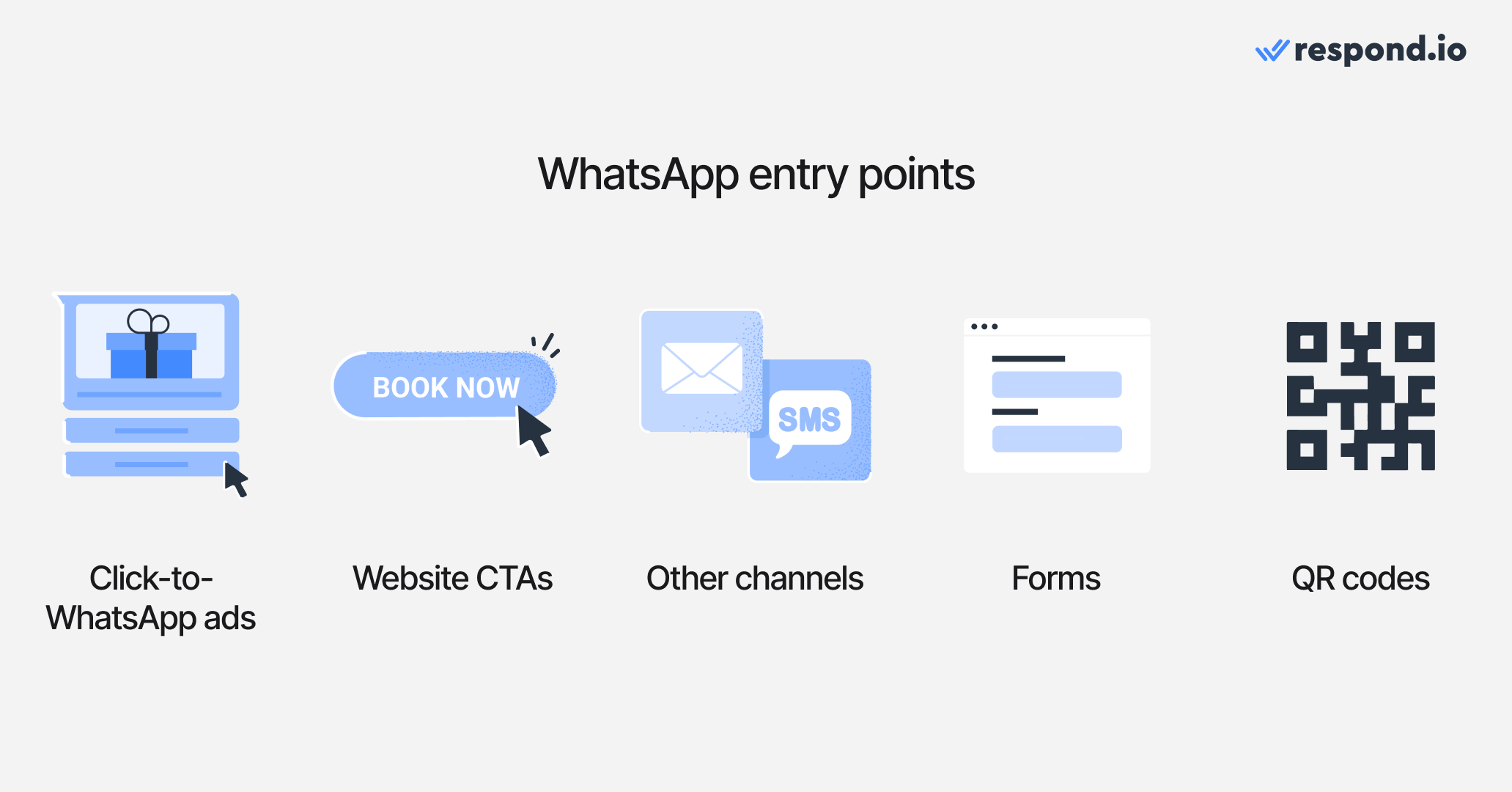
Here are some common ways to do that:
Click-to-WhatsApp ads – Meta ads that open directly into a WhatsApp chat
CTAs on your website – Buttons, widgets, or live chat entry points that lead to WhatsApp
Promos on other channels – Emails or SMS with WhatsApp links
Lead forms and landing pages – With WhatsApp opt-in checkboxes
QR codes in physical spaces – Printed on packaging, posters, or signage that leads to a WhatsApp chat with your business
These entry points don’t just make it easy and natural for customers to start a conversation — they also act as lead generation tools. Once a user messages in, they become a lead you can engage through personalized messaging. And that first message is the foundation of every successful WhatsApp campaign.
Why is WhatsApp marketing so effective?
WhatsApp combines speed, intimacy and reach, making it an ideal channel for marketing campaigns that aim to spark real-time engagement and meaningful conversations.
WhatsApp’s channel strengths
Unmatched open rates: Up to 98%, compared to 20–30% for email
Real-time interaction: Two-way conversations, not static messages
Rich message formats: Include images, video, quick reply and CTA buttons
Customer trust: Users are already familiar with WhatsApp and verified business profiles help reinforce that trust
What types of WhatsApp marketing campaigns can you run?
Since WhatsApp requires users to opt in before receiving marketing messages, campaigns typically target users who’ve already expressed interest or existing customers, making goals like re-engagement, promotion and product education more relevant than cold outreach.
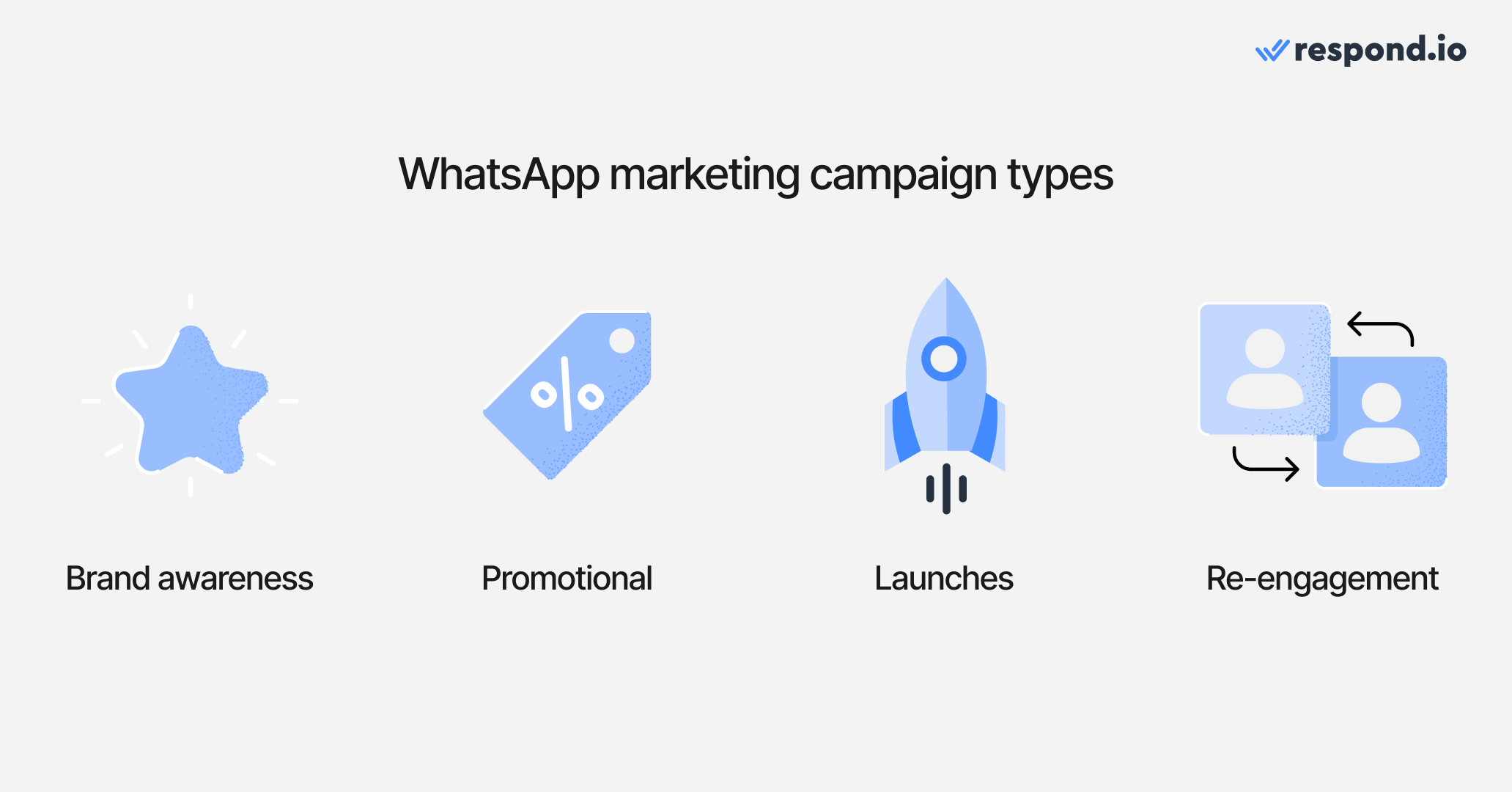
Campaign types:
Brand awareness campaigns – Deliver helpful or interesting content to keep your brand top-of-mind
Promotional campaigns – Announce discounts, loyalty perks, flash sales
Product launches – Teasers, announcements, pre-orders
Re-engagement campaigns – Return promotions, personalized messages to dormant contacts
What does a WhatsApp campaign typically involve?
Now that we’ve defined what a WhatsApp marketing campaign is, let’s break down what actually goes into one.
Here are the key components of a WhatsApp campaign:
A specific audience
A clear goal (e.g. promote a product, retarget ad traffic, drive purchases)
A user-initiated entry point (e.g. ad click, website button, opt-in form)
Structured message flow — pre-planned, automated, or partially manual
Clear measurement criteria — CTR, reply rate, conversions, etc.
10 of the best WhatsApp marketing campaigns
To understand what makes a WhatsApp marketing campaign effective, it is helpful to examine real-world examples. These campaigns demonstrate how different brands creatively used the channel to engage their audience, generate leads, or drive action.
AUTOMAX: Broadcast campaign converts leads into luxury car sales
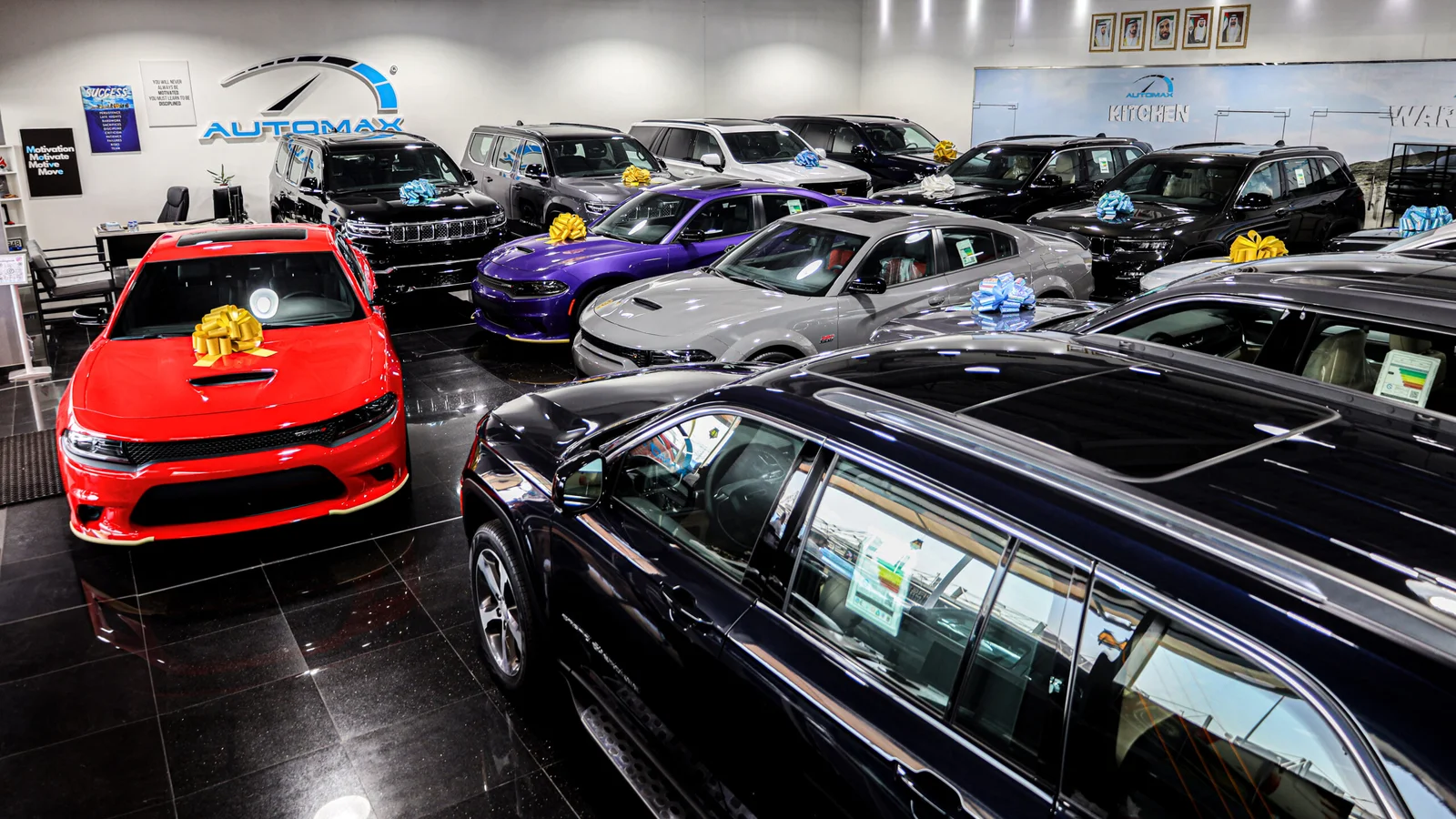
AUTOMAX, a new car dealership in the MENA region, ran a series of WhatsApp broadcast campaigns to re-engage leads and promote limited-time offers. With hundreds of new leads generated daily from Click-to-Chat ads, it was challenging for agents to follow up manually. To stay top of mind with potential buyers, the team utilized WhatsApp broadcasts.
By investing in targeted WhatsApp broadcasts alone, AUTOMAX achieved an average ROI of 42.5X, demonstrating the channel’s impact on driving high-ticket car sales.
Clarins: Personalized WhatsApp campaign outperforms email
Clarins, a French luxury skincare and cosmetics brand, ran a WhatsApp campaign to celebrate National Lipstick Day with opted-in customers in France. Shoppers received a message inviting them to choose their preferred lipstick type, followed by a personalized video and a link to tailored product advice on the Clarins website.
Results: The campaign achieved a 90% open rate, delivering 4.5X higher opens and 7X higher conversion than a comparable email campaign.
Tatil Tur: Click-to-WhatsApp campaign drives bookings
Tatil Tur, a Turkish travel company, launched a campaign using Click-to-WhatsApp ads that opened a chat with a live travel agent. Agents could immediately answer questions about the offer and guide potential customers through the booking process.
Leads who submitted their contact details via lead ads received an automated message on WhatsApp or Instagram, followed by a marketing message 24 hours later to continue the conversation.
The results? Tatil Tur saw 2.9X higher sales from Click-to-WhatsApp ads, while reducing cost per click by 36% and cost per lead by 39% — directly boosting both booking performance and lead conversion.
FliQi Education: Click-to-WhatsApp campaign for rural lead generation
FliQi Education ran a 3.5-month Click-to-WhatsApp campaign to attract qualified leads for its online courses targeting RAS exam aspirants. Ads were targeted to users interested in RAS content and directed them to WhatsApp, where potential students could express interest and purchase study products.
This campaign helped FliQi reach more qualified leads in rural Rajasthan — a key target area — and improved lead quality from the start. After purchase, students received updates and practice materials through both the FliQi app and WhatsApp.
Results? The campaign achieved an 85% lead-to-conversion rate, a 70–80% quarter-over-quarter revenue increase, and attracted 80% of customers from rural areas. Click-to-WhatsApp ads accounted for 60% of the total business during the campaign.
Telkomsel: Hyper-targeted offers via WhatsApp

Telkomsel, an Indonesian mobile provider, launched a WhatsApp campaign that delivers geo-targeted rewards, such as coffee or juice vouchers, to subscribers entering specific areas. Partner brands could customize offers based on location, age, or online behavior, and users could redeem rewards or take actions, such as booking test drives, directly in the chat using workflows.
Compared to an identical SMS campaign, WhatsApp delivered 6X higher read rates, demonstrating its effectiveness for timely, personalized engagement.
Styli: Re-engagement campaign with WhatsApp
Styli, a fashion e-commerce brand, ran a 3-month campaign to win back inactive customers who hadn’t purchased in over 180 days. They sent personalized WhatsApp messages with gender- and language-specific offers, often paired with urgency-driven copy.
Recipients who tapped on the offer were directed to Styli’s app, where a countdown timer encouraged them to complete checkout. WhatsApp reminders were sent within 24 hours if the user didn’t complete their purchase.
Compared to email and push notifications sent during the same period, WhatsApp messages delivered a 67% higher conversion rate than push, 50% higher than email, a 17X higher click-through rate than email and a 6X higher return on ad spend than push notifications.
UA Finance: WhatsApp loan campaign
UA Finance ran a WhatsApp campaign targeting inactive customers with personalized loan offers — a shift from their usual SMS and MMS outreach. Messages included a customized loan amount and an Apply Now button that launched an automated loan application process.
The results: 1.5X more conversions, 6.6X more responses and 3X more same-day disbursements compared to previous SMS/MMS campaigns — all while reducing the resources needed for lead qualification.
Arabian Automobiles Company: Click-to-WhatsApp Ramadan campaign
Arabian Automobiles Company launched a Ramadan campaign using Click-to-WhatsApp ads to drive test drive bookings. They A/B tested ads that linked to WhatsApp only, website only and both — and found that giving users both options delivered the best performance.
When users clicked the ad, they were prompted to send a pre-filled WhatsApp message. AAC used automated replies to qualify leads and offered test drive bookings through WhatsApp workflows.
The result: 2X more leads and 56% lower cost per lead compared to single-destination ads, along with a 4% lower cost per click.
Max Fashion: Targeted campaigns across key seasons
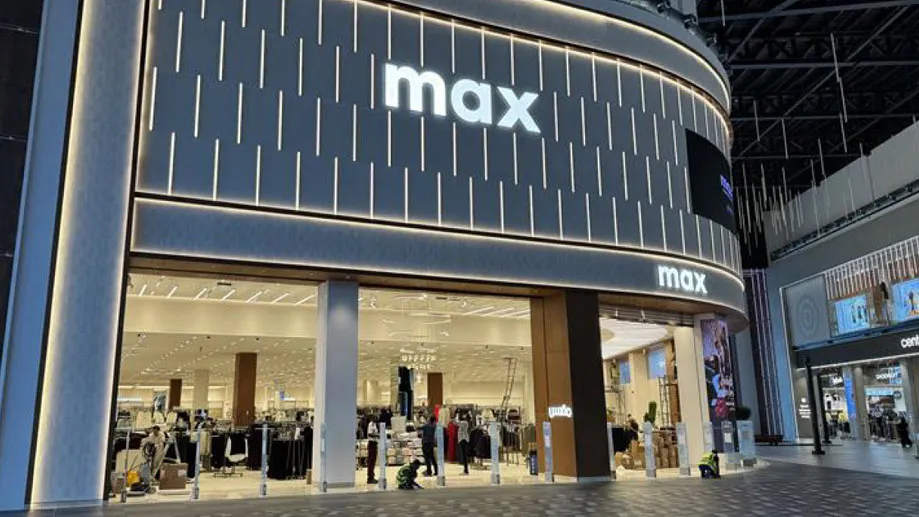
Max Fashion, a major fashion retailer in the UAE, used WhatsApp to deliver personalized, multilingual marketing messages across the Middle East. Campaigns were built using CRM data and tailored by language, purchase history and nationality, with rich formats like carousel images to showcase offers.
Key campaigns included a Ramadan influencer collaboration, a White Wednesday urgency campaign and a first-purchase journey for new customers.
The result? A 30% year-over-year increase in Ramadan sales, 5X higher revenue from WhatsApp vs. SMS during White Wednesday and 40% higher engagement for the new customer campaign compared to other channels.
VIP Leather Craft: Optimizing WhatsApp ads for purchases, not just conversations
VIP Leather Craft, an Indonesian premium leather goods ecommerce retailer, tested a new approach by optimizing its Click-to-WhatsApp ads for purchases instead of conversations. The customer journey remained the same — users clicked from Meta video ads to WhatsApp chats, where the sales team handled questions and completed orders.
By targeting Indonesian adults more likely to buy, the campaign outperformed previous efforts focused on engagement.
Results: Purchase-optimized ads delivered 28% more sales and a 21% lower cost per purchase compared to the brand’s usual approach of optimizing for conversations.
What do successful WhatsApp campaigns have in common?
The best WhatsApp campaigns feel less like marketing and more like a helpful conversation. Here’s what sets them apart:
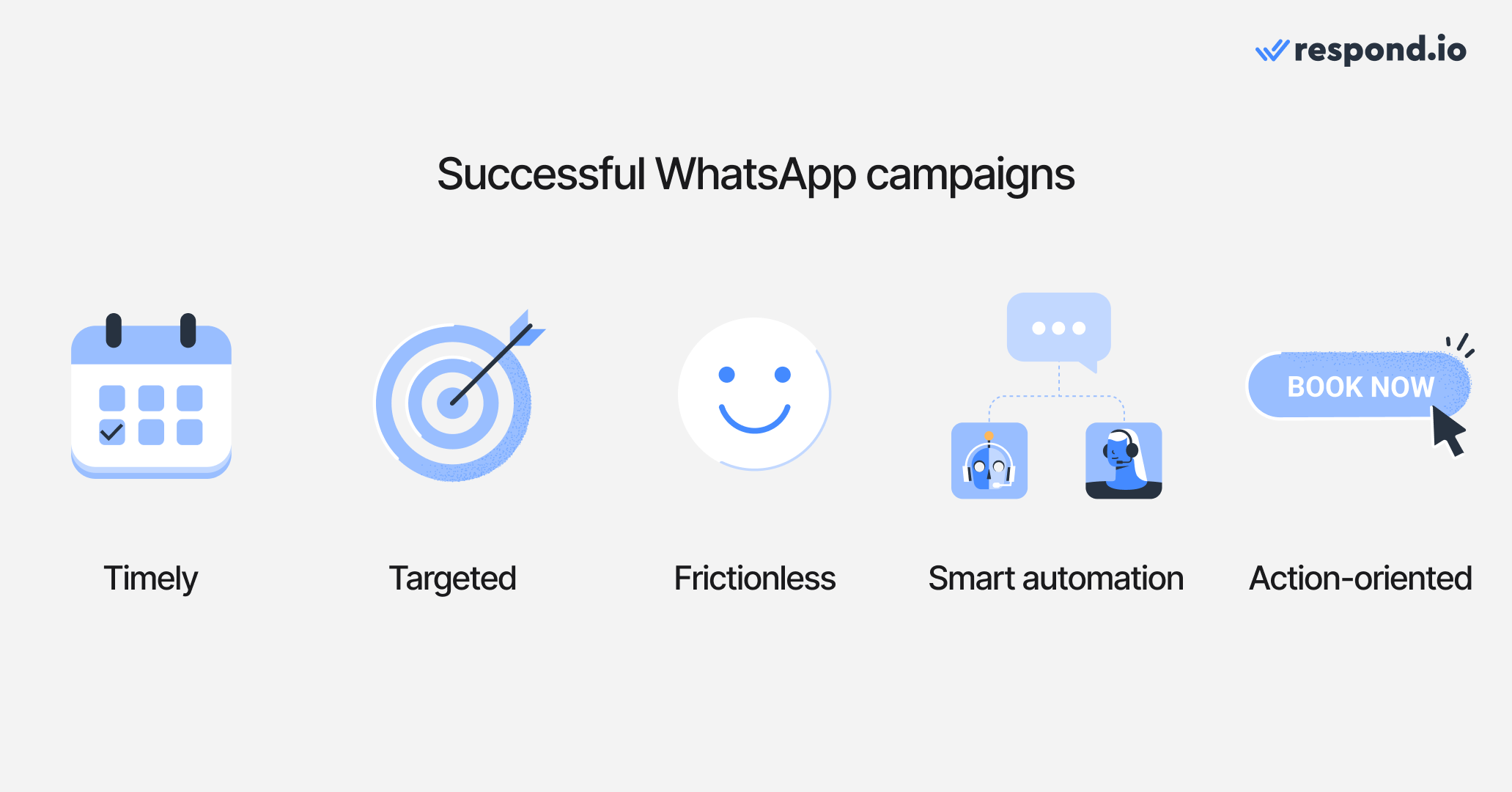
They’re timely — Messages are sent at the right moment, often tied to key seasons or user behavior.
They speak to the right people — Campaigns are segmented by language, interest, or location, so messages feel personal and targeted.
They make it easy to start — Clear entry points like ads or lead forms help users opt in without friction.
They use automation wisely — Bots handle the basics, while humans jump in for high-value leads or complex questions.
They drive action — Strong CTAs like “Book now” or “Chat on WhatsApp” help move people forward.
They don’t stop at one message — a well-timed follow-up, often delivered through drip campaigns, nudges people to complete the action they started
Best practices for WhatsApp marketing
To maximize the effectiveness of WhatsApp as a marketing channel, it’s essential to respect the platform’s conversational nature and user expectations. Here are some proven practices to help you stay effective, compliant and customer-friendly.
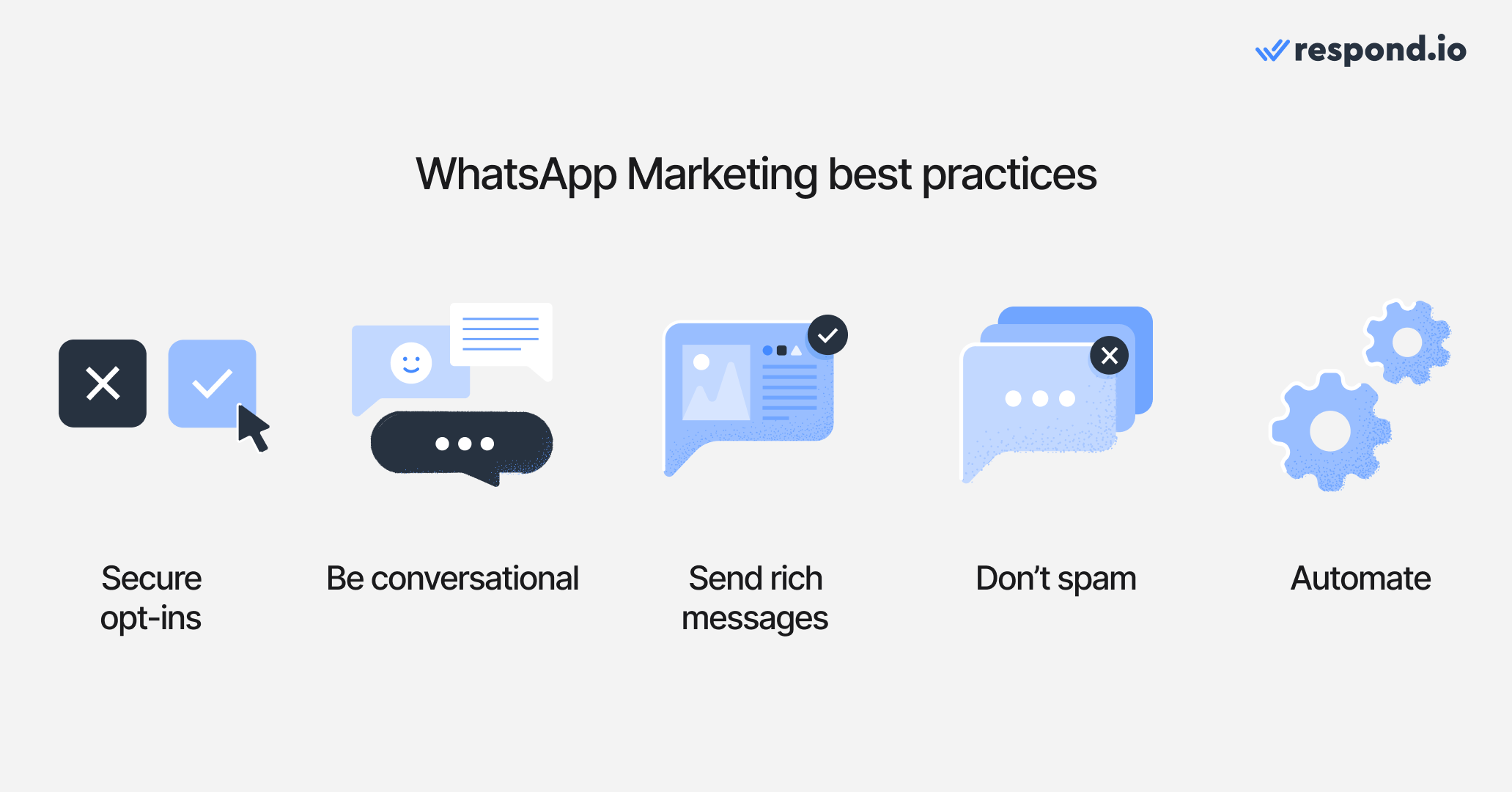
Always secure opt-in before messaging
WhatsApp requires users to explicitly opt in to receive messages from your business. Make the opt-in process clear and valuable — whether through website forms, ad clicks, or in-store prompts. This not only keeps you compliant with Meta’s policies but ensures you’re speaking to people who want to hear from you.
Don’t copy-paste email tactics — WhatsApp is conversational
WhatsApp is not another email inbox. Avoid blasting long, one-way messages. Instead, keep it short, personalized and interactive. The goal is to have a conversation, not to push a monologue.
Use rich messaging formats when they add value
Enhance your messages with media that improves clarity or appeal, like product images, how-to videos, or carousel formats. Quick replies and buttons can also guide users through actions without typing, like choosing options or confirming attendance.
Avoid spamming: message only when it’s relevant and expected
Even if users opt in, messaging too often — or without context — can lead to opt-outs or blocks. Timing matters. Consider: Would you appreciate receiving this message at this moment?
Automate the basics, but let humans take over when needed
Automate repetitive tasks, such as greeting messages, FAQs, or lead capture flows. However, for complex inquiries or sensitive conversations, ensure users can quickly reach a human. That flexibility builds trust and improves experience.
What metrics should you track for campaign success?
Running a campaign is only half the work — measuring its performance is what helps you improve the next one. These are the key metrics to track to understand whether your WhatsApp marketing campaign achieved its goals:
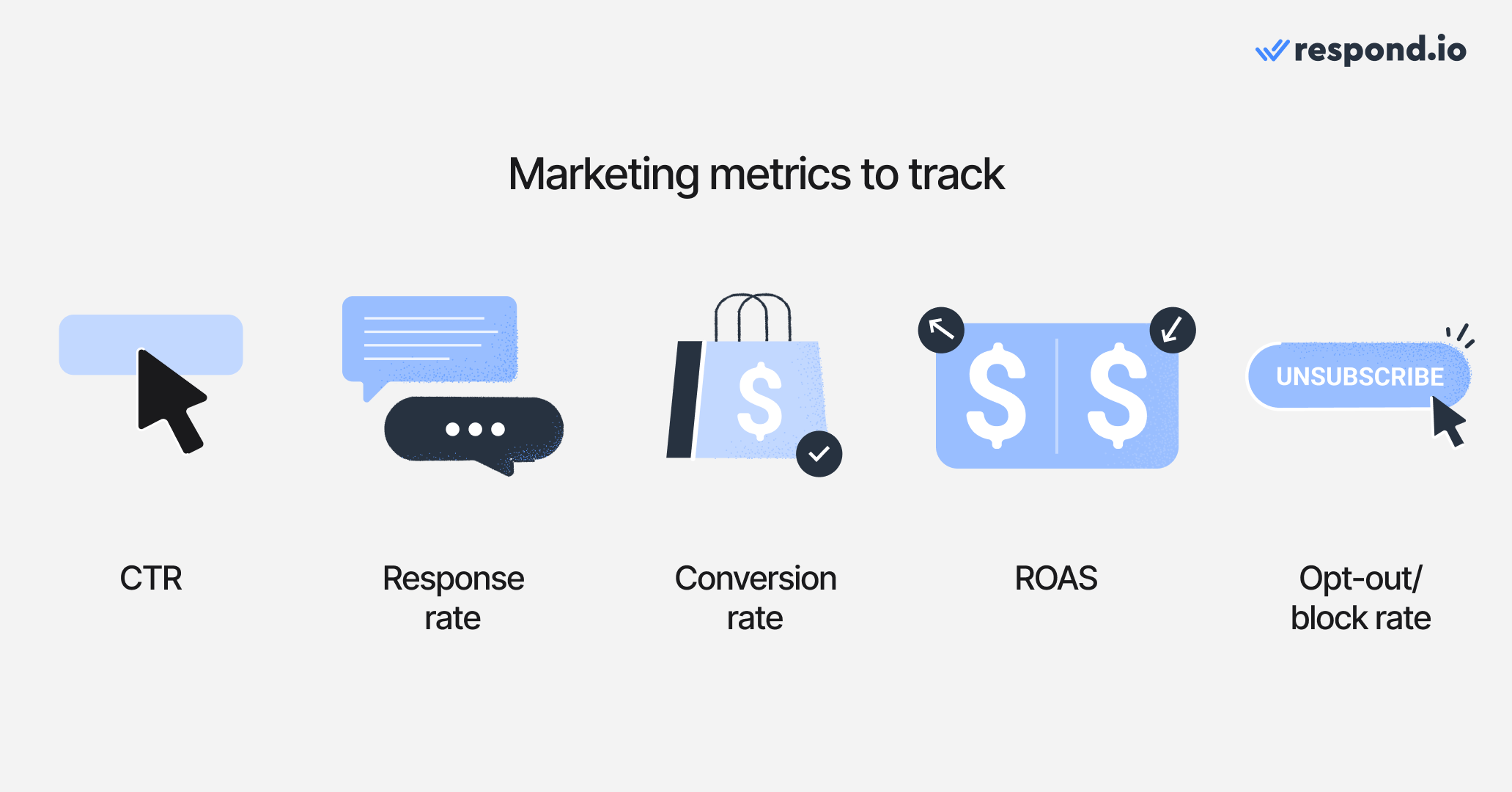
Click-through rate (CTR) – The percentage of users who tapped a link in your message. This indicates how effective your message and CTA were in prompting action.
Response rate – The proportion of recipients who replied to your message. A high response rate indicates strong engagement and relevance.
Conversion rate – How many recipients completed your intended action, such as making a purchase, booking a demo, or filling out a form. This is the clearest indicator of ROI.
Return on ad spend (ROAS) – For campaigns driven by paid ads (like Click-to-WhatsApp), this shows how much revenue you earned compared to what you spent.
Opt-out/block rate – How many users unsubscribed or blocked your number after receiving a message. A spike here may indicate poor timing, irrelevant content, or message fatigue.
Which platform can help you scale your WhatsApp campaigns?
At some point, you’ll need more than just a phone and WhatsApp Business App to manage conversations at scale. Whether it’s sending broadcasts, automating replies, or tracking campaign performance, choosing the right platform makes all the difference.
Why B2C businesses use WhatsApp Business API
As your marketing needs grow, the limitations of WhatsApp Business App become more apparent. With more contacts and higher message volumes, relying on a small team to reply manually quickly becomes unsustainable. That’s where WhatsApp Business API comes in — offering the automation, scalability and integration capabilities needed to run campaigns efficiently.
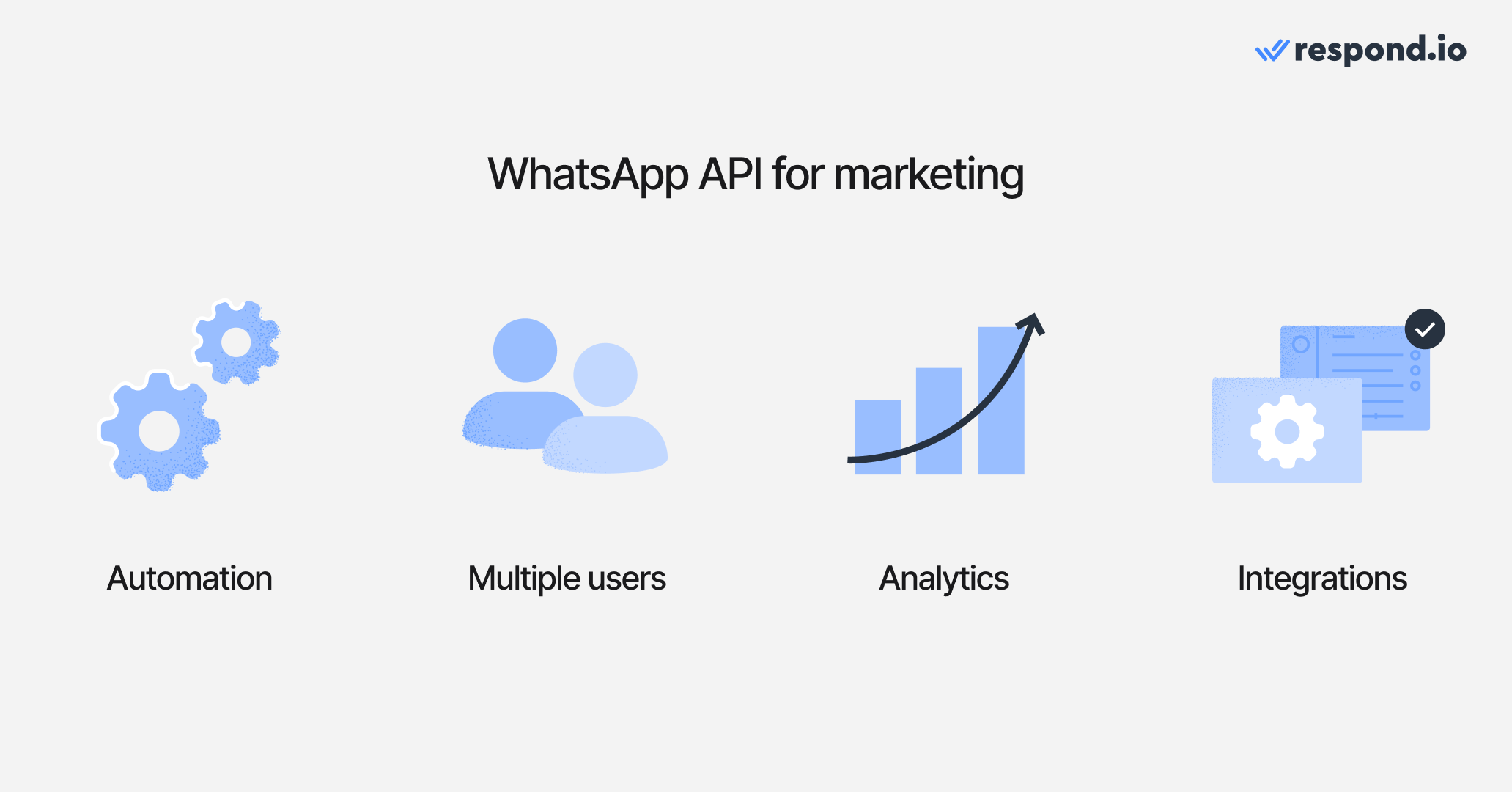
WhatsApp Business App = manual, limited, single-user
WhatsApp API = automation, multi-user, analytics and integrations
Unlike WhatsApp Business App, WhatsApp API doesn’t come with its own interface, so you’ll need a platform to use it effectively. One such option is respond.io, which helps businesses plan, launch and track WhatsApp marketing campaigns at scale.
WhatsApp Marketing on respond.io
Respond.io gives marketers everything they need to run WhatsApp campaigns from start to finish — without coding or juggling multiple tools. From building message flows to tracking performance, respond.io helps teams turn conversations into conversions at scale.
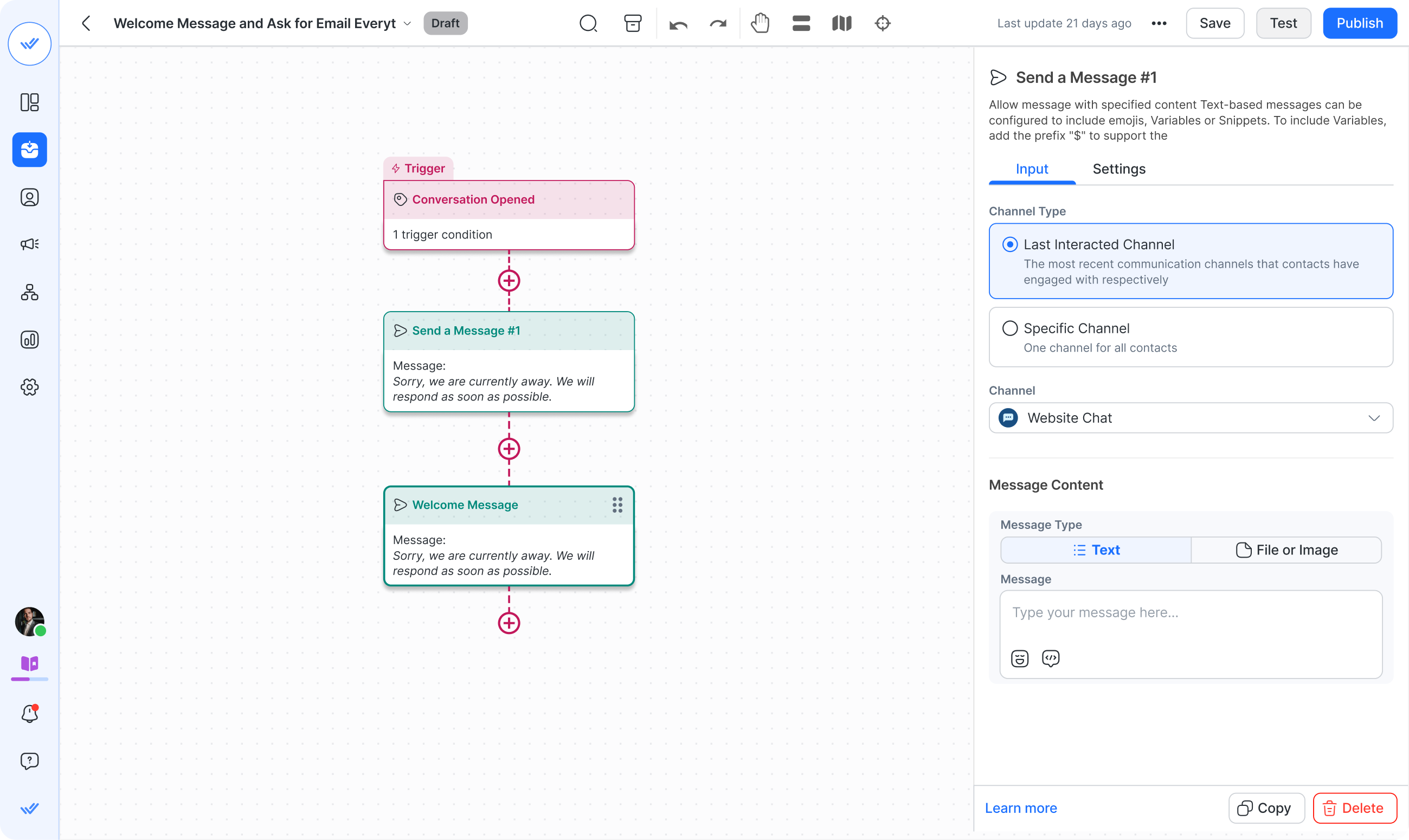
Broadcast messaging tools to send personalized WhatsApp messages to thousands, fast, at scale and with opt-in compliance
Broadcast analytics to track delivery, read rates, and engagement by audience segment
No-code workflow builder for automating campaigns and follow-ups
Advanced chatbots to qualify leads and route conversations instantly
Entry point tracking from ads, web chat and lead forms
Performance analytics to monitor conversations and customer journeys
CRM integrations to personalize messages using customer data
Unlimited users and a shared inbox for coordinating replies during live campaigns
What’s best for you?
The best WhatsApp marketing campaign isn’t just one that follows best practices — it’s one that aligns with your goals, audience and resources.
Just starting out? Focus on building opt-in entry points through ads, forms, or landing pages.
Want to promote a product or sale? Plan a short, focused campaign with clear CTAs and timing.
Looking to re-engage existing contacts? Personalize your message flow and segment your audience.
Running multiple campaigns or managing a growing team? You’ll need a platform that helps you scale while keeping things organized.
Wherever you are in your journey, WhatsApp can be a powerful channel — and with the right setup, you can turn conversations into conversions.
Turn conversations into customers with respond.io's official WhatsApp API ✨
Manage WhatsApp calls and chats in one place!
Try WhatsApp API on respond.io for free today!
FAQs about WhatsApp marketing campaigns
What is a WhatsApp marketing campaign?
A WhatsApp marketing campaign uses WhatsApp messages to promote a product, service, or brand to opted-in users. These campaigns can be used for promotions, product launches, lead generation and more — typically through personalized, conversational messages.
Is WhatsApp marketing better than email marketing?
It depends on your goals. WhatsApp offers much higher open and engagement rates than email, especially for real-time interactions. However, it requires user opt-in and is more conversational in nature. Many businesses use both channels in tandem.
How do I get users to opt in on WhatsApp?
Common opt-in methods include Click-to-WhatsApp ads, web forms with checkboxes, or via a chat message. You must clearly explain what users are opting into.
What are the best types of WhatsApp marketing campaigns?
Popular campaign types include:
Product promotions
Re-engagement messages
New launches
Brand awareness content
Can I use WhatsApp API without coding?
Yes. Platforms like respond.io allow you to access and use the WhatsApp Business API through no-code tools for automation, messaging and analytics.
What tools do I need to run a WhatsApp campaign?
You’ll need a platform connected to the WhatsApp API that allows message automation, entry point tracking and performance measurement — ideally with CRM and team collaboration features, like respond.io!
Further reading
Curious about how to get more out of WhatsApp for marketing? Check out these helpful reads:


