
















 Electronics
 Fashion & Apparel
 Furniture
 Jewelry and Watches
 Afterschool Activities
 Sport & Fitness
 Beauty Center
 Dental Clinic
 Medical Clinic
 Home Cleaning & Maid Services
 Photography & Videography
 Car Dealership
 Travel Agency & Tour Operator


TL;DR - Choosing a customer conversation platform for multi-location B2C teams in Germany
Multi-location clinics, dealer networks and gym franchises in Germany need a customer conversation platform when growing locations and conversation volumes lead to missed conversations, manual handoffs and poor visibility, whether they're replacing a lightweight tool or still managing chats through separate WhatsApp numbers, personal accounts or native social inboxes.
Respond.io is built for B2C teams managing thousands of conversations across channels and locations, bringing omnichannel conversations, AI Agents, routing and customer lifecycle visibility into one platform.
Respond.io is not the right fit if you operate a single location on one channel and handle fewer than 500 conversations a month without problems managing conversations, routing or customer context.
If you run a mid-market B2C business in Germany across more than one branch, this article is about what to do when the WhatsApp-first tool that served its purpose at a single site starts to break as the business expands.
At one location, everyone knows which number customers use, who should answer and where the conversation history lives. Add a second location, however, and that simplicity starts to disappear. Leads get answered twice, too late or not at all, which slows conversions and costs the business revenue.
A patient messages the brand's Instagram account but wants an appointment at another practice. A car buyer asks two showrooms about the same model. A gym prospect speaks to one club, then responds to an ad from the main account. Customers think they are continuing a conversation with one company, while internally, teams may only see separate pieces of it.
This is where lightweight setups start costing more than their subscription suggests. Automation drifts between locations, teams spend more time coordinating ownership and managers have to reconstruct the customer journey from fragmented data. Respond.io is built for the point where those conversations need to scale with the business, across locations and channels, without rebuilding the setup from scratch at every new site.
Where lightweight tools break at multi-location scale
Opening a second location rarely breaks a lightweight tool outright. The messages still arrive and the team still replies. What changes is how much of the operation starts happening around the software instead of inside it: conversations get forwarded, automations are copied between branches and managers develop their own ways of keeping track.
Those workarounds are usually harmless at first. The trouble is that they multiply with every new location, until the business is spending more time coordinating conversations than the original setup was ever meant to require.
1. No cross-location visibility
A customer asks one dealership about a car on WhatsApp, then messages another showroom after seeing an Instagram ad. To the customer, both conversations are with the same dealer group. Internally, two salespeople may now be following up without knowing what the other has promised. Clinic groups see the same thing when a patient reaches the central social account but needs a specific practice, while gym franchises can meet the same prospect twice across a club account and a brand campaign.
This means teams duplicate work, customers repeat themselves and leads sit in limbo while someone works out who should own them. Every branch may have a clear view of its own queue, yet the business still has an incomplete view of the customer.
2. No consistent automation or AI
The second location often begins by copying the first one's setup. Months later, one manager has updated the opening hours, another has changed an offer and a third has adjusted how leads are qualified. Over time, locations can end up giving customers different information, following different qualification processes or collecting different levels of detail.
AI can make those inconsistencies spread faster. If every location maintains different instructions and knowledge, the business can end up automating several versions of itself. The issue is not whether the team has AI, but whether someone can keep what it knows and how it behaves consistent as new locations come online.
3. No unified owner view
The weakness becomes obvious when an owner asks a simple question such as how many inquiries became bookings last month. In a fragmented setup, the answer may live across several exports, each assembled by a manager with a slightly different definition of a lead.
That makes poor performance harder to diagnose. A clinic group may see fewer bookings at one practice without knowing whether leads arrived slowly or were followed up badly while a car dealership may see one showroom behind target without knowing where prospects dropped away. When the customer journey is split across locations, process problems have an annoying tendency of turning into staffing problems, budget problems or "we need more leads" problems before anyone notices what actually broke.
How respond.io supports scaling B2C teams
Respond.io is a customer conversation platform for mid-market B2C businesses managing revenue-critical conversations at scale. It is built for the point where separate location-level setups start getting in the way of the business they are meant to support.
Instead of treating each branch, channel and customer interaction as a separate problem, respond.io brings a centralized omnichannel inbox, AI Agents and CRM capabilities together as layers of one customer conversation platform. Local teams can keep ownership of their conversations while the wider business gets the consistency and oversight it was missing.
Here is how those three layers address the problems that tend to appear first.
Omnichannel: One inbox with a unified view across locations
Customers rarely care how a business has divided its channels internally. Someone might discover a clinic on Instagram, continue on WhatsApp and later call, while expecting the company to remember the conversation throughout.
Respond.io brings WhatsApp, Instagram, Facebook Messenger, TikTok, Telegram, email, website chat and WhatsApp Business Calls into one customer conversation platform, as an official Meta Premier Partner and TikTok Marketing Partner. Teams can then reflect the way locations actually work: Munich staff can focus on Munich's queue, for example, while head office retains a view across the group.
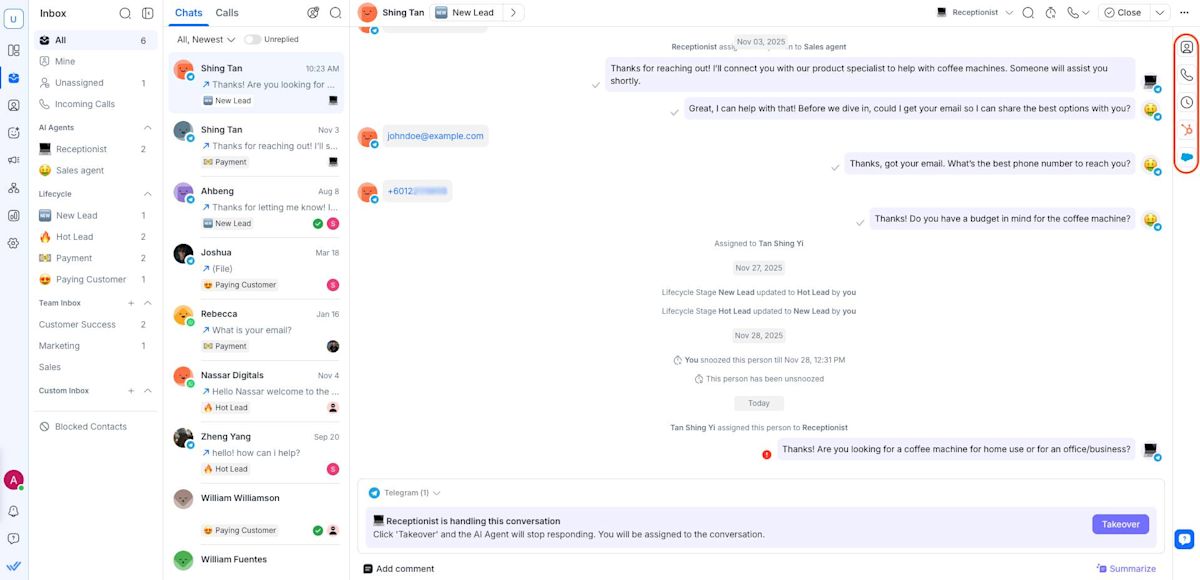
Routing Workflows send inquiries to the right Team based on factors such as the number contacted, postcode, ad source or language, then distribute them among available agents. A Bremen showroom can receive Bremen leads automatically, with fallback logic if nobody is available, rather than relying on forwarded screenshots and group-chat handoffs.
Customer context stays with the contact as well. When someone starts on one channel and continues on another, the next agent can work from the existing history instead of asking them to start again.
Sport Center Los Naranjos shows the impact of bringing these conversations together. The fitness and wellness center receives more than 1,000 inquiries a month, but agents previously had to read each inquiry and manually pass it to the right person. It brought WhatsApp, Facebook Messenger and Instagram into respond.io, where its sales, administration and coordination teams can share customer conversations and data while Workflows route more complex inquiries to available sales agents.

After making the switch, first response times fell from 20 minutes to 5 minutes and the center converted 20% more subscribers from its inquiries.
AI Agents: One shared knowledge base, consistent everywhere
AI does not solve inconsistency if every location gives it different information. Respond.io AI Agents can work from centrally managed knowledge sources, so updates to a consultation price, membership offer or policy do not depend on every branch remembering to make the same change.
For a clinic group, that could mean consistent answers about treatments, opening hours and bookings before handoff to the right practice. A gym franchise can qualify trial requests using the same logic across clubs, while a dealer group can collect useful lead details before a salesperson joins the conversation.

Respond.io AI Agents can also collect customer information, filter spam, qualify leads, route conversations and share booking or payment links. Because AI Agents use the same instructions and knowledge sources, they can respond consistently whichever location a conversation reaches. They can also handle voice conversations through WhatsApp Business Calling or VoIP and transfer them to a human when appropriate.
Praga Medica shows how AI can take repetitive qualification work away from human teams. The medical tourism facilitator uses an AI Agent to collect information from contacts and filter out spam, so only qualified leads are routed to its consultants. The AI Agent also replies instantly to incoming inquiries, including outside working hours.

Praga Medica now filters out 97% of spam and has cut first response times by 50%, giving consultants more time to focus on genuine patient inquiries.
Consistency does not mean making every branch identical. Local differences may be legitimate. What should not drift by accident are the facts, qualification logic and important parts of the customer journey.
CRM: Lifecycle visibility for owners and operations
When conversations are managed location by location, owners can see plenty of activity without necessarily seeing the customer journey. Respond.io's Lifecycle tracking gives that activity structure, so a clinic group can follow inquiries through to consultations, a dealer group can track leads to test drives and purchases, and a gym franchise can see which trials become memberships.
Lifecycle Reports can be filtered by Team, making it easier to compare locations and see where leads stall without stitching together exports. Respond.io also integrates natively with HubSpot and Salesforce, so businesses can keep their existing CRM as the system of record and update them easily so customer information stays available to human and AI agents during conversations.

Respond.io runs on AWS, is ISO 27001 certified and GDPR compliant, with 99.999% uptime to keep customer conversations and records accessible as they move between locations and sit under one platform rather than several.
Switching does require upfront setup. Multi-location teams need to agree on basics such as how leads are routed, what counts as a qualified lead and how Lifecycle stages are defined before those processes can be standardized across the business. Respond.io provides onboarding support to help teams get that structure in place, along with 24/7 human and AI support once the platform is live.
Results: How Srikandi scaled customer conversations across 47 branches
Srikandi shows what this looks like at multi-location scale. The automotive dealer network has 47 branches, each with its own sales and support teams. Before respond.io, agents relied on personal WhatsApp numbers to speak with customers, which made workloads uneven, customer experiences inconsistent and conversations difficult for managers to oversee.
Srikandi moved those conversations onto an official WhatsApp number and Facebook Messenger, then used respond.io to route customers to their preferred branch and assign them to the right sales or support agent. Managers could monitor conversations centrally, while dedicated agent assignment helped customers stay with the same salesperson throughout the sales journey.

Within five months, 88% of conversations were automatically routed to the right branch and agent, helping the business handle a 125% increase in conversation volume.
Srikandi also reported a 23% increase in revenue, showing that central oversight can support local ownership rather than replace it. Srikandi shows that centralized routing and visibility can scale across dozens of branches without taking ownership away from local teams.
When respond.io is the right fit for multi-location B2C teams
The right time to choose respond.io is when missed leads, manual forwarding, inconsistent automation or fragmented reporting start becoming normal parts of managing customer conversations across locations.
For teams already using a lightweight platform, these are signs that the existing setup is becoming difficult to scale. For first-time evaluators still managing conversations through the WhatsApp Business App, personal numbers or native social inboxes, the trigger is the same: too much of the customer journey depends on people manually coordinating conversations between locations.
Respond.io is a stronger fit for mid-market B2C businesses handling more than 500 conversations a month across multiple locations when local teams still need ownership of their customers but the wider business needs consistent routing, AI and a clear view of how leads move from first inquiry to conversion.
If you operate one location on one main channel and handle fewer than 500 conversations a month without missed leads, routing problems or visibility gaps, a lighter setup may still be enough.
If your business is managing high volumes of customer conversations across multiple locations and the workarounds are starting to slow teams down, talk to our team about the right setup for your business, or start a free trial.
FAQs about multilocation B2C teams in Germany
How does respond.io compare with local tools like Superchat and Chatarmin?
Superchat is a German business messaging platform focused on helping local businesses manage customer communication across WhatsApp and other messaging channels. Chatarmin is more focused on WhatsApp marketing and customer engagement for ecommerce businesses in the DACH region, with integrations such as Shopify and Klaviyo.
Respond.io is built for mid-market B2C teams managing high volumes of customer conversations across multiple channels and locations. Its fit becomes stronger when the challenge goes beyond managing messages to include routing conversations between locations, keeping AI and automation consistent, maintaining customer context across channels and tracking how leads progress through the business.
For a business mainly looking for local customer messaging or ecommerce-focused WhatsApp marketing, a specialized platform may cover its requirements. Respond.io is designed for businesses that need to coordinate the wider customer journey across multiple teams, channels and locations.
Can respond.io AI Agents communicate with customers in German?
Yes. Respond.io AI Agents can understand and respond in multiple languages, including German. They can use centrally managed instructions and knowledge sources while responding in the language the customer uses, helping businesses keep core information and qualification processes consistent across locations.
This means a clinic group, dealer group or gym franchise can serve German-speaking customers without maintaining a completely separate AI setup for every location.
Each of our branches uses its own WhatsApp Business App number, and customers who message the wrong branch get passed around. How can we fix this without losing local ownership?
The branches can connect their WhatsApp channels to respond.io while keeping separate Teams for each location. Routing Workflows can use factors such as the number contacted, postcode, ad source or language to send conversations to the right Team, so local staff keep ownership of relevant customers while managers retain visibility across the wider business.
Where locations need stronger separation of users, channels or customer data, separate Workspaces can be used instead.
What consent do German businesses need before sending WhatsApp marketing messages?
In Germany, businesses generally need prior express consent before sending advertising through electronic messages such as WhatsApp. There is a limited exception for marketing to existing customers when the specific conditions under Section 7 of Germany's Unfair Competition Act are met.
Businesses should make it clear what customers are agreeing to receive and give them a straightforward way to object to future marketing. Because the requirements depend on the customer relationship and how consent was collected, businesses should review their specific WhatsApp marketing setup against applicable German requirements.
Further reading
If you found our article helpful you should check out the following reads:


