
















 Electronics
 Fashion & Apparel
 Furniture
 Jewelry and Watches

 Afterschool Activities
 Sport & Fitness

 Beauty Center
 Dental Clinic
 Medical Clinic

 Home Cleaning & Maid Services
 Photography & Videography

 Car Dealership

 Travel Agency & Tour Operator


TL;DR: WhatsApp Team Inbox Setup (whatsapp team inbox)
What is a WhatsApp team inbox? It’s software that integrates with WhatsApp API to bring all WhatsApp conversations and often chats from other messaging apps into a single inbox to be used by multiple team members.
Benefits of a WhatsApp team inbox: All messages in one place, chat automation/AI Agents, improved team collaboration, omnichannel capabilities, reporting across the customer lifecycle
How to set up WhatsApp team inbox: Choose a WhatsApp business solutions provider, set up WhatsApp API and connect to your chosen conversation management platform (team inbox)
Step 1: Get WhatsApp Business Platform access via a BSP.
Step 2: Connect the API to a customer conversation management platform.
Step 3: Add users, roles and routing rules.
Step 4: Configure automation for FAQs or lead capture and reporting.
Step 5: Test message routing, ownership and SLA tracking end to end.
How to use WhatsApp team inbox for sales: Get leads with click to chat ads, answer with AI agents, route leads to agents, make calls and more
How to use WhatsApp team inbox for support: Use AI agents to answer FAQ, route complex inquiries to support agents, collaborate with internal comments, integrate with your CRM
If you’re a mid-market B2C sales or support team handling WhatsApp across multiple agents, managing it from a single shared number with clear ownership, routing and reporting is what separates teams that scale from teams that drop messages. This guide covers what a WhatsApp team inbox is, when you need one, and how to run sales and support workflows inside it.
What is a WhatsApp team inbox?
A WhatsApp team inbox is a shared, multi-agent workspace for one or more WhatsApp numbers, typically via WhatsApp Business Platform, where teams can assign conversations, track ownership and collaborate on replies.
A WhatsApp team inbox is a collaborative messaging inbox that organizes all of your WhatsApp conversations in one place for your team to handle. Let’s find out how your business can benefit from using a team inbox next.
When the WhatsApp Business App stops working
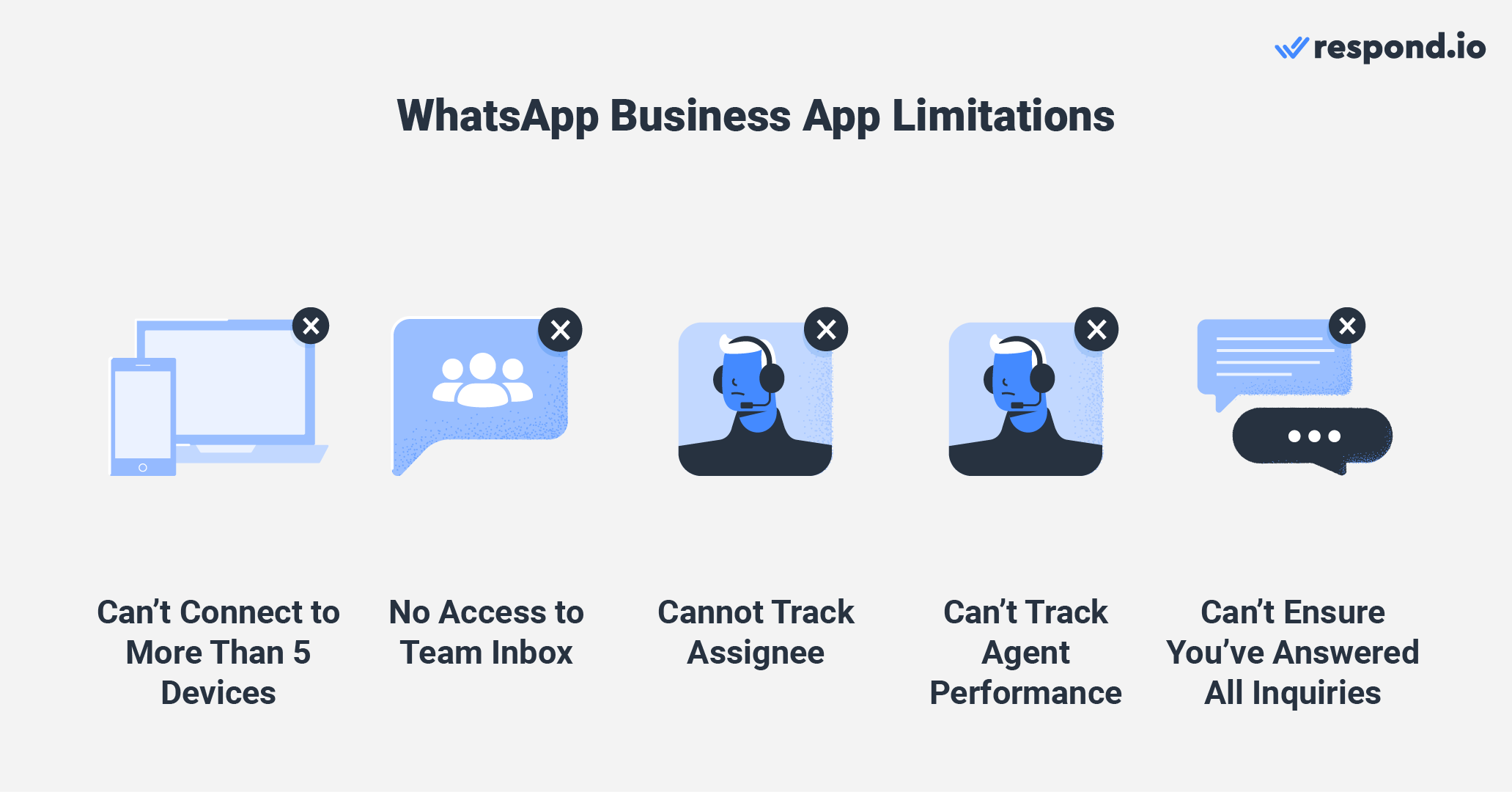
While the WhatsApp Business App can work for one or two people on linked devices at low volume, it starts to break down once multiple agents need to share ownership and follow up quickly. The first problems are practical: two agents can reply to the same lead, no one knows who owns the next step and conversations can end up stuck on one person’s device.
Limited linked devices make coverage fragile when shifts change or teammates are away
No clear owner for each conversation, which leads to missed follow-ups and duplicate replies
No shared queue or status view, so managers cannot see what is waiting, in progress or unresolved
No reliable workload tracking by agent or team, which makes staffing and coaching harder
No central accountability for who replied, who did not and which leads are still unworked
Once WhatsApp becomes a daily sales or support channel for multiple agents, the cost of confusion usually outweighs the cost of moving to a real team inbox.
If you have multiple agents handling a high volume of WhatsApp conversations, you’ll need more sophisticated features to solve the issues stated above. This is where the WhatsApp team inbox via WhatsApp Business API comes in.
Criteria | WhatsApp linked devices | Real WhatsApp team inbox |
|---|---|---|
Device access | Limited linked-device setup | Built for multi-agent access through WhatsApp Business Platform |
Assignment | No structured assignment | Manual, queue-based or automated assignment |
Ownership visibility | No clear conversation owner | Clear owner for each conversation |
Shared history | Partial visibility across devices | One shared conversation record for the whole team |
Conversation status | No reliable team-wide status view | Track open, assigned, escalated or resolved conversations |
Search | Basic device-level search | Team-wide search across contacts and conversation data |
Automation with AI Agents | Not built for scalable team workflows | AI Agents reply to customers, qualify leads, update lifecycle stages and route by intent [CHECK #2: unverified], with summaries for handover [CHECK #3: unverified] |
Reporting | Little to no manager visibility | Reporting by team, agent, queue and response performance |
Pricing model | App-based access with limited team controls | Platform subscription plus separate Meta fees |
Best fit | Very small, low-volume teams | Mid-market B2C teams with more customer chats than the team can handle manually, spread across multiple agents |
What a WhatsApp team inbox actually changes for your team
You can create a WhatsApp team inbox through a messaging platform like respond.io. It allows all team members to respond to customers through a shared dashboard and grants managers visibility into all customer conversations.
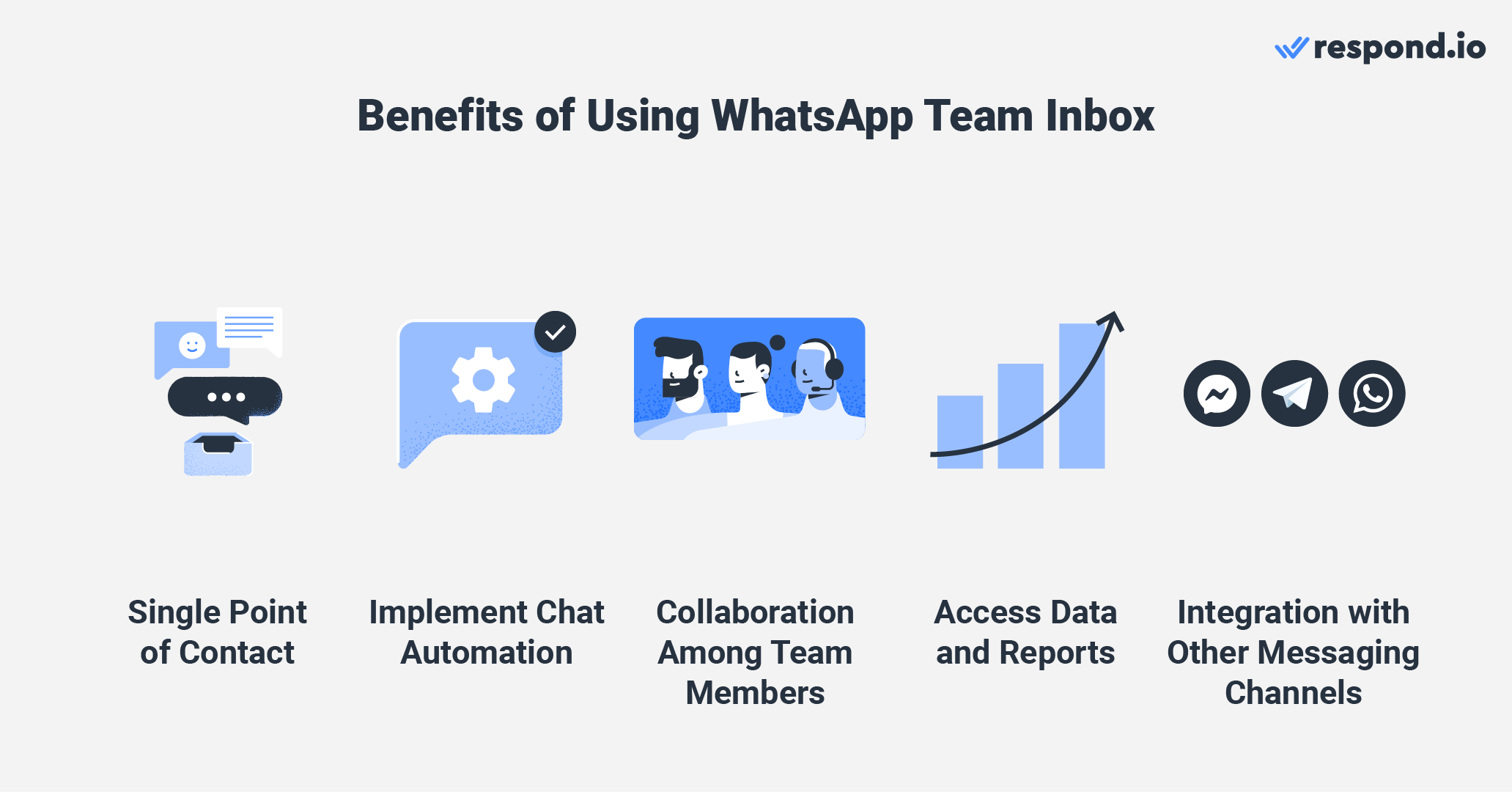
Centralizes all conversations into a single point of contact
A shared inbox provides a single point of contact with each customer for a record of all interactions. Any agent can see the context and reply to the conversation. Since all messages are consolidated in a single inbox, this reduces the risk of overlooking inquiries, thus giving customers a better experience.
Handle high volumes of conversations
When the team gets more customer chats than it can handle manually, combine AI Agents with fast human replies. Respond.io’s AI Agents reply to customers, qualify leads, recommend products, book appointments and move contacts through Lifecycle, which tracks each lead, customer and returning customer by stage. Agents use Snippets, respond.io’s saved replies, for repetitive answers that still need a personal touch.
Inside WhatsApp’s 24-hour customer service window, Snippets help agents reply faster and stay consistent. Once the window closes, the business has to send an approved WhatsApp template message to restart the conversation.
Improve team collaboration
When conversations are spread across multiple WhatsApp numbers, team members lose customer context and reply over each other. In a shared inbox, each conversation has one assigned owner, teammates can see who is handling it and handoffs happen inside the same thread instead of across personal devices.
Agents leave internal comments for follow-ups, mention colleagues or escalate complex cases without sending conflicting replies to the customer. In respond.io, agents can also summarize a conversation with AI inside an internal comment before a handover, see shared files in one view and jump to any contact by name, email, phone number or identifier.
Gather customer lifecycle data and reports
Another benefit is the ability to track the entire customer lifecycle, from the first time a lead contacts you all the way through to retention. In respond.io’s team inbox, you can set and update lifecycle status for full context and personalization. For example, team members would want to prioritize a “hot lead” or someone who’s “pending payment.”
Before you set one up, here is how to judge which WhatsApp team inbox fits your team.
Turn conversations into customers with respond.io's official WhatsApp API ✨
Manage WhatsApp calls and chats in one place!
How to choose the right WhatsApp team inbox
Choose a WhatsApp team inbox by checking seven things before you commit: WhatsApp Business Platform access, assignment controls, roles and permissions, AI agent depth, reporting, channel coverage and support. A wrong choice shows up later as slow first replies, chats with no owner and managers who cannot see which agent or queue is falling behind.
Official WhatsApp Business Platform access: Make sure the provider supports a clean onboarding path and keeps the account stable as the number of chats grows.
Assignment and ownership controls: Every new conversation should land with a clear owner through manual assignment, queues or automated routing so no lead or support case sits unworked.
Roles and permissions: Managers should be able to control who can view, assign, reply to or export conversations, and limit agents to the contacts assigned to them or their team.
AI agent depth: AI agents should reply and act on their own: qualify leads, recommend products, book appointments, update lead stages and trigger workflows, then hand complex or high-value chats to the right person with a summary.
Reporting: Managers need to see response times, workload per agent, unresolved conversations and team performance so they can fix slow queues before customers leave.
Channel coverage: If customers also message on other channels, the platform should cover them in the same workspace, for example Instagram, Facebook Messenger, TikTok, Telegram, LINE, Viber, WeChat, SMS, email and website chat, plus voice through WhatsApp Business Calling and VoIP.
Support quality and rollout confidence: A platform is easier to adopt when onboarding, documentation and ongoing support help teams launch without long setup delays.
A team inbox should do more than let several agents reply from one number. It should give sales and support leads the controls to assign chats faster, coach agents on real response data and add channels and agents without losing track of who is handling what.
How WhatsApp team inbox pricing works
A WhatsApp team inbox has two cost lines: the platform subscription and Meta’s WhatsApp messaging fees. Budget for both, and check how cost behaves as usage grows under each pricing model.
Per-seat pricing: Cost rises with every agent you add.
Per-conversation pricing: Cost rises with message volume and is harder to predict during campaigns and peak periods.
Contact-based pricing: Cost rises with the number of contacts the business actually talks to in a month.
Respond.io uses contact-based pricing: you pay for the contacts you talk to each month, not for each agent seat. Respond.io also does not mark up Meta’s WhatsApp fees, which are charged at cost, and offers a 7-day free trial.
To estimate cost, count how many agents need access, how many contacts message the business each month and how much of that traffic stays on WhatsApp versus other channels.
How to set up a WhatsApp team inbox
Setting up a WhatsApp team inbox requires connecting the WhatsApp Business Platform to a shared workspace where multiple agents can manage conversations. The most efficient way to do this is to create a WhatsApp API account directly via an official WhatsApp Business Solutions Provider (BSP).
However, not all WhatsApp BSPs are created equal. Some, like SleekFlow, for example, charge additional WhatsApp connection fees and users have reported poor onboarding experiences. Consider respond.io, a Meta Premier Partner & TikTok Marketing Partner with 24/7 human and AI support on every plan.
Prerequisites
Before you set up a WhatsApp team inbox, make sure you have:
A Meta Business account with business verification (if required)
A phone number eligible for WhatsApp Business Platform
Access to a WhatsApp BSP
A plan for teams or queues (e.g. Sales and Support)
Basic routing rules based on language, region or availability
A WhatsApp team inbox needs a WhatsApp API account, because the API is what provides multiuser functionality. As the API has no front-end interface to send and receive messages, it has to be connected to a customer conversation platform like respond.io so multiple agents can share conversations, routing and reporting in one workspace. Then you can add team members and use AI Agents, automation tools and integrations in the same place.
This guide assumes you’re moving from the WhatsApp Business App to WhatsApp Business Platform for multi-agent access; if you only need one or two people on linked devices, you may not need an API-based team inbox.
Steps to set up a WhatsApp team inbox
Choose your WhatsApp API path through a BSP that supports your onboarding, billing and long-term stability needs.
Create or verify your Meta Business account and prepare a phone number eligible for WhatsApp Business Platform.
Connect the WhatsApp API to a customer conversation platform so multiple agents can work from one shared workspace.
Add teammates and give each one an access level (Owner, Manager or Agent) so they see the right conversations and controls. Then choose how new conversations are assigned: Manual assignment: a manager reviews each new conversation and assigns it.
Round robin: new conversations are spread evenly across agents in turn, which suits teams where reply speed matters most.
Least open contacts: each new conversation goes to the agent with the fewest open conversations, which keeps workload balanced.
Team routing: Workflows, respond.io’s automation builder, send each conversation to the right team, such as sales or support, before assignment runs.
Turn on “Only assign to online users” so new conversations don’t land with agents who are offline.
Configure automation, then test message routing, assignment and ownership end to end.
Validate the setup: send a test WhatsApp message, confirm it appears in the shared inbox, verify it is assigned to the correct agent or queue, and check that managers can see ownership and response time.
Respond.io advantage for a WhatsApp team inbox
Respond.io is a customer conversation platform built for consumer-facing teams that need multi-agent WhatsApp handling with routing, automation and reporting.
Centralized assignment and lifecycle states help ensure every conversation has an owner and a visible response status. Workflows and AI Agents can qualify leads, answer common questions and route chats to the right queue automatically — without manual triage.
Reporting gives managers visibility into response times, resolution rates and workload by team or agent, so you can spot bottlenecks early and adjust staffing or automation rules.
Connect multiple channels in one inbox: respond.io is a customer conversation platform that includes omnichannel messaging across WhatsApp, Facebook, Instagram, TikTok and VoIP so teams can manage conversations and routing from one workspace. Consolidating a contact’s information and chat history across channels into a single profile gives agents a full overview of the customer.
Best fit: teams handling high volumes of WhatsApp conversations — often alongside other channels like Instagram, Facebook or email — that need operational visibility and control from a single workspace.
Not the best fit: if you only need one or two people on linked devices and do not require routing, automation or reporting, the WhatsApp Business App may be sufficient.
As a badged Meta Business Partner, respond.io supports WhatsApp Business Platform onboarding and ongoing account stability for teams running WhatsApp at scale.
How to use a WhatsApp shared inbox for business on respond.io
After your WhatsApp team inbox is connected, set up lead capture entry points, routing and assignment, automation for FAQs or qualification, and reporting, then run a test conversation to confirm ownership, handover and response tracking. Here, we’ll show you how to use WhatsApp team inbox on respond.io for different use cases, especially for sales and customer support.
WhatsApp team inbox for sales
First, we’ll look at how your sales team can utilize the team inbox.
Boost leads with click to chat ads
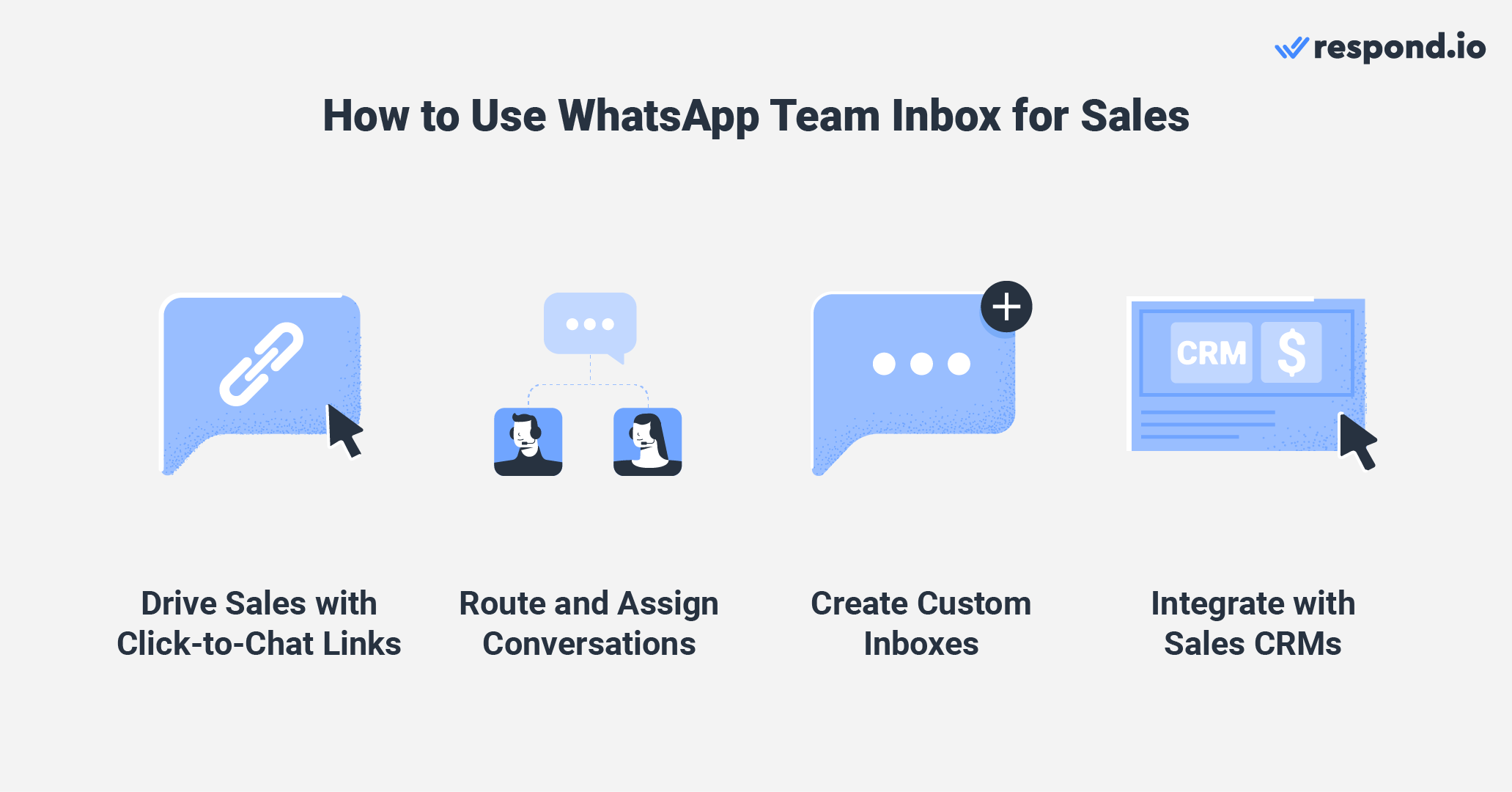
You can easily drive sales conversations and increase the volume of leads by placing WhatsApp click-to-chat links in prominent locations where customers can easily see them. You’ll also want to integrate with Meta’s conversion API (CAPI) to optimize your click to chat ads for conversion.
When leads arrive from these ads, AI Agents automatically receive ad attribution context—including campaign, ad set, and ad name—enabling campaign-aware qualification and routing from the first message.
Instantly reply with AI Agents
A WhatsApp team inbox allows businesses to handle high volumes of conversations efficiently, improving the chances of making a sale. Quickly connecting with your customers prevents them from feeling ignored and checking out your competitors. The best way to do this is with respond.io’s AI Agents.
Build an AI Agent from templates for specific roles like receptionist or sales agent. Train it with company knowledge sources so it can instantly gather lead data, ask and answer basic questions and let you know whether a lead is qualified. That way, team members won’t waste valuable time answering low-quality or spam leads. AI Agents can also tag contacts based on intent during the conversation, preparing qualified leads for automated follow-up workflows.
What’s more, AI Agents are not limited to chat. They can even pick up calls to greet customers, gather preliminary info and answer questions.
Automatically route conversations to the right team or agent
Once the AI agent has qualified a lead, it can send the lead to the right team or agent. For example, it can route based on language, customer lifecycle stage or simply to the next available agent.
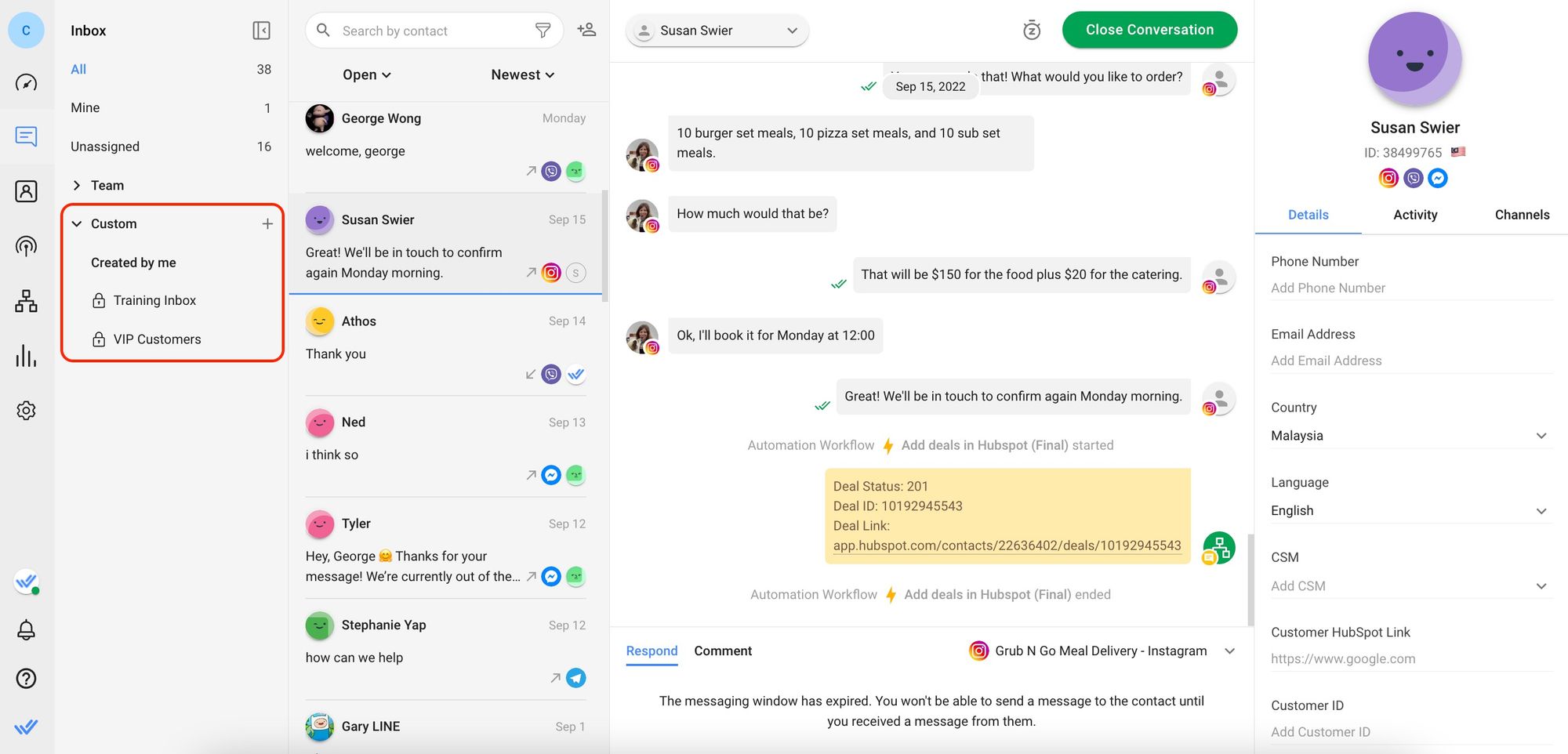
Create custom inboxes for VIPs
Salespeople can use a custom inbox to prioritize VIP customers. It allows managers to filter and view high-value conversations, ensuring the best possible customer experience. This helps build strong relationships and increase customer loyalty.
Integrate your CRM with respond.io
By connecting your WhatsApp sales CRM with respond.io, you can easily transfer data between the two platforms to create deals quickly. AI Agents can also make live API calls to check order status, verify lead details, or trigger CRM updates directly within the conversation. This enables agents to perform sales-related tasks while chatting with customers without having to switch between platforms.
Use the same platform for chat and call to streamline customer experience
While chat and call used to be separate, now, WhatsApp Business Calling API enables businesses to make and receive calls over WhatsApp and keep all chats and calls within the team inbox. This enables businesses to close more deals where a more human touch is required and it removes friction as there’s no need to move from WhatsApp to a phone line. Even beyond WhatsApp, you can reach personal numbers using respond.io’s VoIP integration.
As shown above, you can shorten your sales cycle when you use WhatsApp for sales. In the next section, we’ll show you how to improve customer service with a WhatsApp team inbox.
WhatsApp team inbox for customer service
Now, let’s take a look at how businesses can use a shared inbox to improve customer service over WhatsApp.
Use AI Agents to answer FAQs
In respond.io, set up a Support AI Agent template to answer all FAQs about your product or common troubleshooting. That means customer inquiries can be answered at any time, and all but the most complex issues can be resolved without needing to involve a human team member.
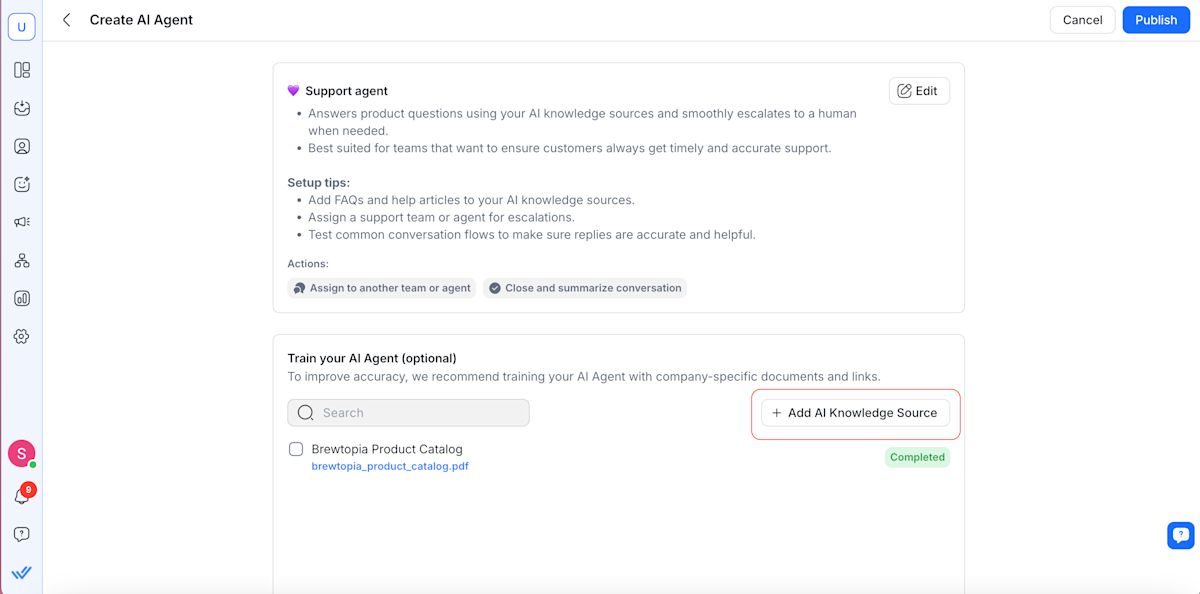
Inquiries that cannot be handled by the AI Agent can be routed to an appropriate, available team member. With routine inquiries managed by AI, human support agents will have more time to dedicate to solving serious inquiries, leading to greater customer satisfaction.
Integrate your CRM with respond.io
You can also integrate your existing CRM to respond.io to allow support agents to create tickets while chatting with customers without leaving the conversation.
Collaborate on complex issues as a team
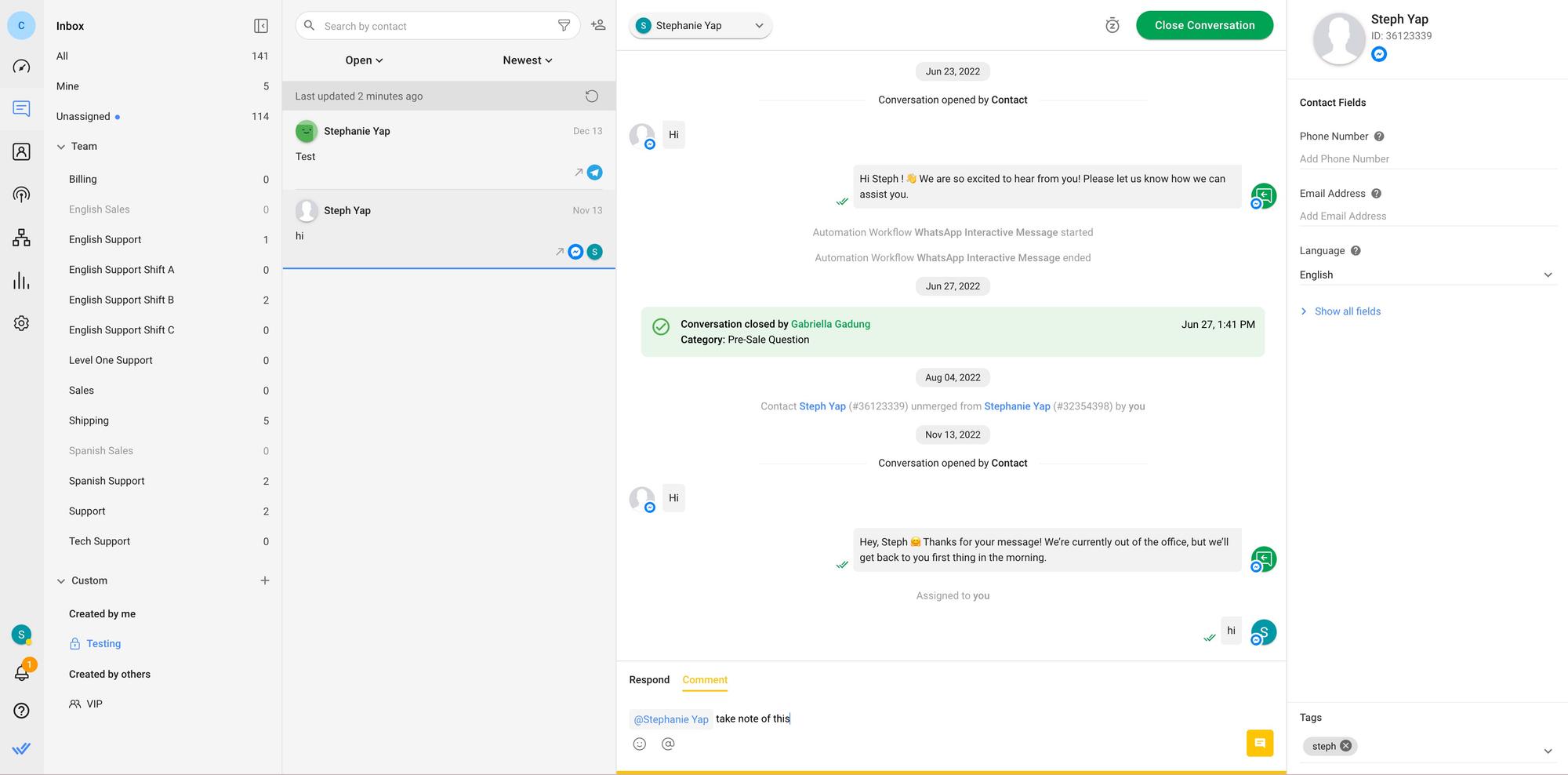
The Comments feature in respond.io allows agents to collaborate and resolve inquiries more efficiently. Alternatively, you can implement an escalation Workflow to automatically escalate complex or high-priority inquiries to the right team or agent.
Get detailed reports on support response times
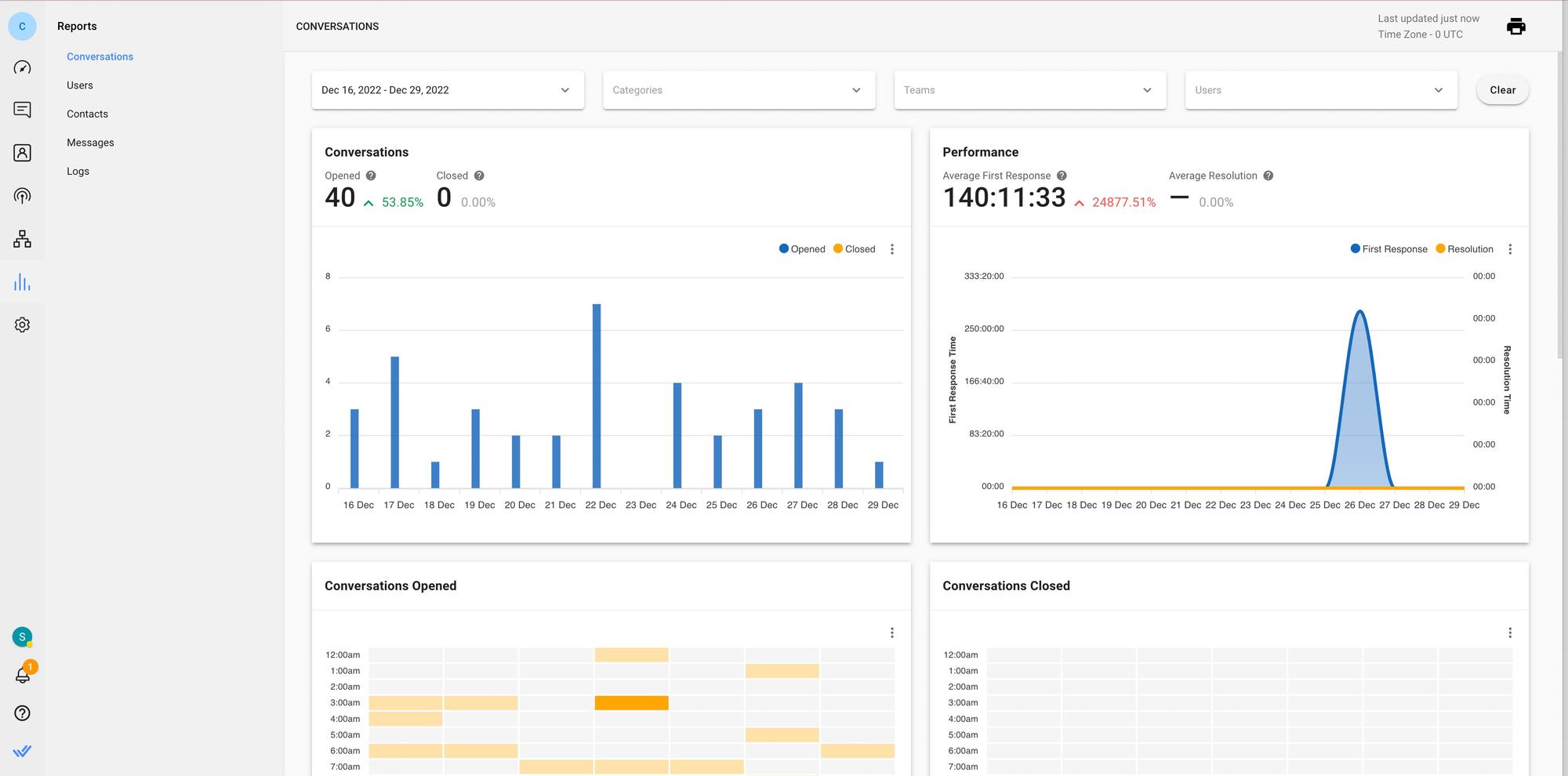
Track response times, not just reply counts. Respond.io’s Reports module shows how many contacts each agent is handling, how quickly they respond and how efficiently they resolve conversations, so managers can see which agent or team is falling behind before customers wait too long.
Use that data to set first-response targets for each team, move agents to busy queues earlier and catch slow replies before they turn into lost customers.
Next: run a 10-message test across sales and support queues, verify routing and ownership, then review response-time reports after one week and adjust automation and assignment rules.
Turn conversations into customers with respond.io's official WhatsApp API ✨
Manage WhatsApp calls and chats in one place!
Is a WhatsApp team inbox right for your business?
A WhatsApp team inbox is best for sales and support teams that need multiple agents to share one number with clear routing, ownership and reporting.
Done well, setup means your WhatsApp Business Platform account is connected, teammates and queues are configured, automation is running, and test messages reach the right owner with visible response tracking.
Next, review performance after launch and refine automation, assignment rules and queue design as volumes grow.
Ready to run a WhatsApp team inbox with routing, automation and reporting? Sign up for respond.io, a badged Meta Business Partner, and connect your WhatsApp Business API account to get started.
FAQs about WhatsApp team inbox
Do I have to have WhatsApp API to use a WhatsApp Team Inbox?
In most cases, yes. A WhatsApp Team Inbox is typically built for the WhatsApp Business Platform so multiple teammates can share one number, route chats, track ownership and automate workflows. If you need multi-agent access, choose a WhatsApp BSP and connect the API to a customer conversation platform such as respond.io to run routing, assignment and automation. If you’re using the free WhatsApp Business App, you’ll be limited (it’s designed mainly for one device + a few linked devices, not a real multi-agent inbox).
What’s the difference between WhatsApp linked devices and a team inbox?
Linked devices let one or two people share a WhatsApp Business App account across a few devices; a team inbox lets a whole team work one WhatsApp number with assignment, queues, automation and manager reporting. Linked devices are enough when one person owns every chat and volume is low. Once several agents share the number, a team inbox connects WhatsApp Business Platform to a customer conversation platform such as respond.io, so every conversation has an owner and managers can see response times by agent.
Can I have more than one WhatsApp number in a WhatsApp team inbox?
Yes, some teams use multiple numbers for different brands, countries, departments, or campaigns—all inside the same shared inbox, each as its own channel. The specifics vary depending on the WhatsApp API provider; some providers charge per-number fees. Respond.io does not charge any connection or per-number fees.
How does conversation assignment work in a WhatsApp team inbox?
Conversation assignment decides which agent owns each new chat, either manually or automatically. In respond.io, Workflows can assign new conversations round robin, to the agent with the fewest open contacts or to a specific team, and can skip agents who are offline. Round robin suits teams where reply speed matters most; least open contacts suits teams where balanced workload matters more. Manual assignment works for small teams where a manager reviews every new chat.
Can a WhatsApp team inbox work for mobile or field teams?
Yes. Respond.io’s mobile app lets agents reply to customers away from a desk and sends push notifications for incoming messages, contacts assigned to them and mentions in comments. Tapping a mention opens the conversation, where the agent can keep messaging the contact and see their details. It suits agents who need to answer assigned chats while on the road or on site, such as field sales or showroom staff.
Can I use chatbots in a WhatsApp team inbox?
Yes—if the inbox supports automation and you’re using WhatsApp Business API. You can run chatbots for things like:
FAQs and instant replies
Lead capture and qualification
Routing to the right team
Appointment booking/order status
Handover from bot to human agents
Through its Cal.com and Google Calendar integrations, respond.io lets agents view a contact's full meeting history directly from the chat window. And with AI Agents that can make live API calls, access real-time data, and trigger actions across CRMs and booking tools, the platform moves well beyond basic automated replies.
What’s the difference between a WhatsApp team inbox and AI agents?
A WhatsApp team inbox is where people work conversations; AI Agents work conversations on their own. In respond.io, the team inbox is the shared workspace where agents see who owns each chat, leave comments and hand over. AI Agents run inside that same workspace: they reply to customers, qualify leads, recommend products, book appointments and update Lifecycle stages without waiting for an agent, then pass complex or high-value conversations to the right person with the full conversation history. Most teams use both, so AI Agents take repetitive chats and agents focus on closing sales and resolving complex issues.
Further reading
Looking for more articles on how WhatsApp benefits your business? Here are some blogs that might help you.


