
















 電子
電子 時尚與服裝
時尚與服裝 家具
家具 珠寶和手錶
珠寶和手錶
 課後活動
課後活動 運動與健身
運動與健身
 美容中心
美容中心 牙科診所
牙科診所 醫療診所
醫療診所
 家庭清潔與保姆服務
 攝影與攝像
攝影與攝像
 汽車經銷商
汽車經銷商
 旅行社與旅遊運營商


TL;DR: Respond.io 重新構建其行動應用以支援高流量 B2C 客戶對話。
消除應用程式卡頓:Respond.io 的全新 React Native 架構專為處理大量訊息高峰而打造,可避免其他行動收件匣常見的介面當機或凍結。
接近完美的穩定性:利用 React Native 的 JSI 與 Fabric 技術,提供 99.939% 的無當機率,實現直接且即時的執行。
加快客服回應:實現 畫面切換速度提升 54.2% 與 聊天互動速度提升 64%,讓客服能在更短時間內管理更多客戶。
針對舊機種優化:將 記憶體使用量降低 41%,即使在競爭對手難以載入大量媒體的裝置上亦能確保順暢效能。
許多客戶對話平台將行動應用視為桌面工具的輕量附屬,但在多客服使用、大量對話負載與多媒體密集的工作流程下容易失效。
respond.io 應用程式經工程設計,可在旺季期間保持快速、穩定與即時回應,使團隊能從任何地點以大規模方式快速且可靠地處理對話。
respond.io 如何在行動裝置上處理高流量的聊天與來電?
Respond.io 透過重建的行動架構處理大量 B2C 訊息,即使在流量高峰期間也維持 99.939% 無當機率。 採用現代執行模型後,應用程式消除了桌面優先收件匣工具常見的介面凍結與延遲,確保客服人員能在處理並發會話與多媒體密集的聊天時性能不受影響。
在 B2C 業務中,行動效能在創造收入的關鍵時刻最為重要,例如產品發佈、快閃促銷、季節性活動,以及廣告驅動的潛在客戶激增。 客服人員仰賴行動存取以快速回應、評估潛在客戶,並在無需等待桌面存取的情況下結束對話。

為消除在流量高峰時干擾客服人員的介面凍結與延遲,我們設計了能處理傳統行動收件匣無法支援之並行 B2C 工作負載的架構:
零延遲訊息:採用React Native 新架構,以直接執行路徑取代舊有的 JS–Native Bridge,大幅降低延遲並提升渲染流暢度。
Media-heavy fluidity with an efficient image caching strategythat optimized decoding, storage and memory handling to reduce bandwidth usage and eliminate UI slowdowns in media-heavy chats.
Scalable architecture with code-level optimizationsthat reduce unnecessary re-renders, defer non-critical API calls, modernize core packages and remove legacy dependencies for streamlined execution.
Together, these upgrades form the complete foundation behind the app’s new performance gains.
適用於 B2C 規模的最穩定行動解決方案:為何傳統架構會失敗(以及我們如何修復)
Earlier versions of the respond.io mobile app struggled under high conversation loads, and some users experienced slowness or lag. These were legitimate issues caused by limitations in the previous mobile architecture, which is commonly used by chat apps. 我們專門打造了新架構,以可靠支援大量且多位客服並行的工作流程。
Capability | Legacy Architecture (Standard Inboxes) | New Architecture (Respond.io Mobile App) | User and Business Impact |
Communication path | Single serialized bridge | Direct execution via JSI | Agents experience faster interactions under peak traffic, reducing delays when replying to customers at scale. |
Rendering | Slower, bottleneck-prone | Modern Fabric renderer | Screens render smoothly even with media-heavy conversations, preventing UI freezes during chats. |
Workload handling | Queue congestion | Concurrent processing | Teams can handle higher conversation spikes without performance degradation. |
Responsiveness | Lag under heavy use | Smooth UI under load | Agents switch between chats faster, maintain quick response speed, and avoid missed or delayed replies that impact revenue. |
Before: Our legacy architecture lagged under peak traffic
Previously, the mobile app, like most standard chat apps, relied on the legacy React Native JS–Native Bridge in which all communication between JavaScript and native code was routed through a single, serialised pathway. Under high conversation volumes or multi-agent usage, this created queue congestion that slowed rendering, delayed navigation, and caused inconsistent performance, especially when agents switched screens or handled media-heavy chats. This was not a traffic issue alone, but an architectural constraint that prevented parallel work under sustained load.
之後:我們的新並行架構提供零延遲效能
We rebuilt our mobile architecture to enable direct execution through the JavaScript Interface (JSI), allowing JavaScript to communicate with native modules without serialisation overhead. Combined with the Fabric renderer for more predictable UI updates and TurboModules for on-demand native module loading, the app can process more operations in parallel rather than forcing them through a single execution path.
This reduces latency, improves responsiveness, and keeps performance stable during peak activity. A unified execution model across iOS and Android also ensures consistent behavior across devices.
A simple way to understand the difference
According to respond.io mobile team lead Bilal Shah, the old architecture behaved like a single-lane road, where every operation had to wait its turn and one slowdown blocked everything behind it.
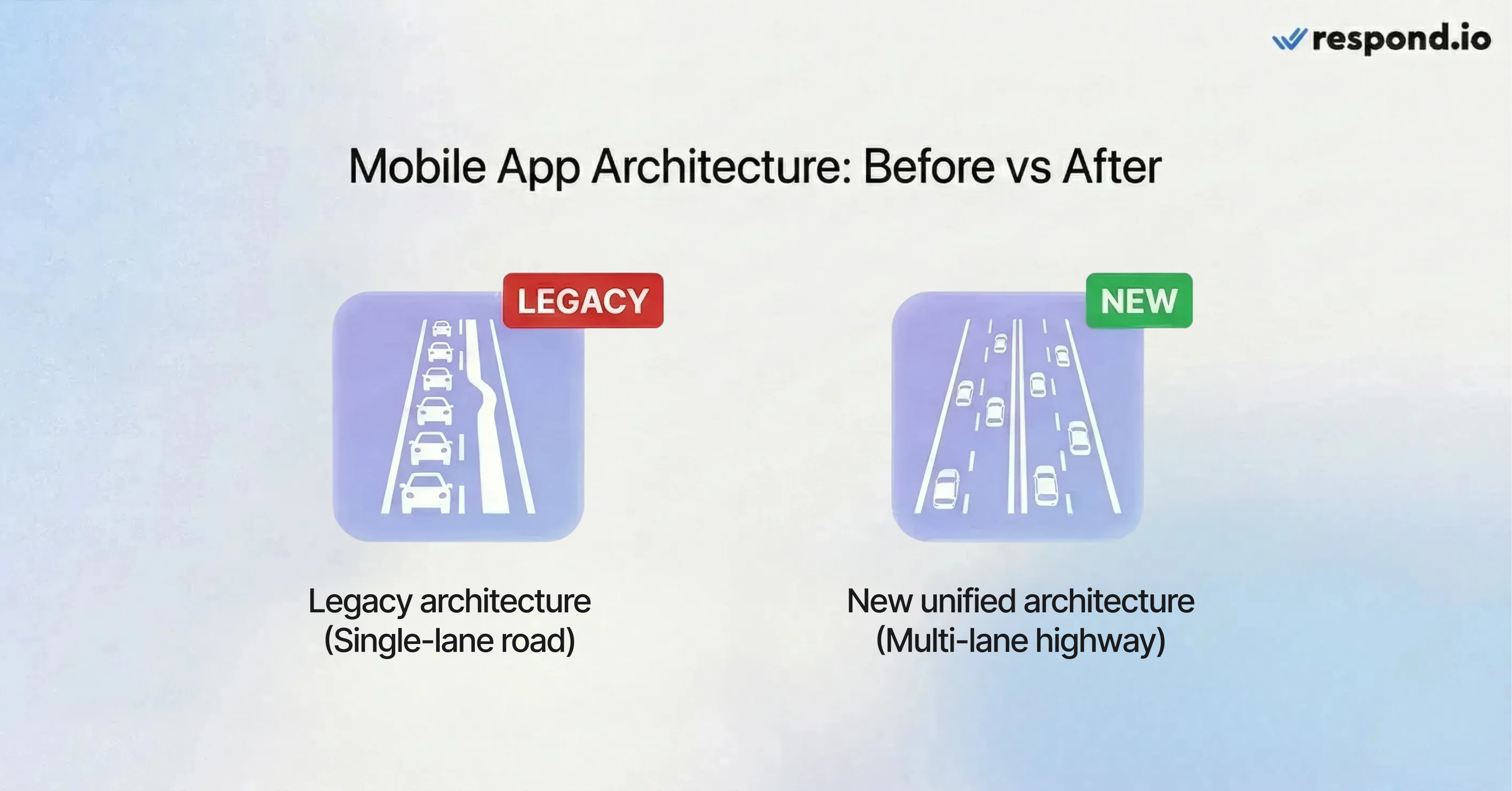
The new architecture functions like a multi-lane highway, where multiple operations can run in parallel. This is why screens load faster, navigation feels instant, and the app remains responsive under heavy workloads.
Verified results: Industry-leading performance with 99.939% crash-free rate, high speed and reliability under load
We monitored real-world performance via Sentry to verify the impact of our architecture. The data proves that our platform outpaces standard mobile inboxes in reliability and speed.
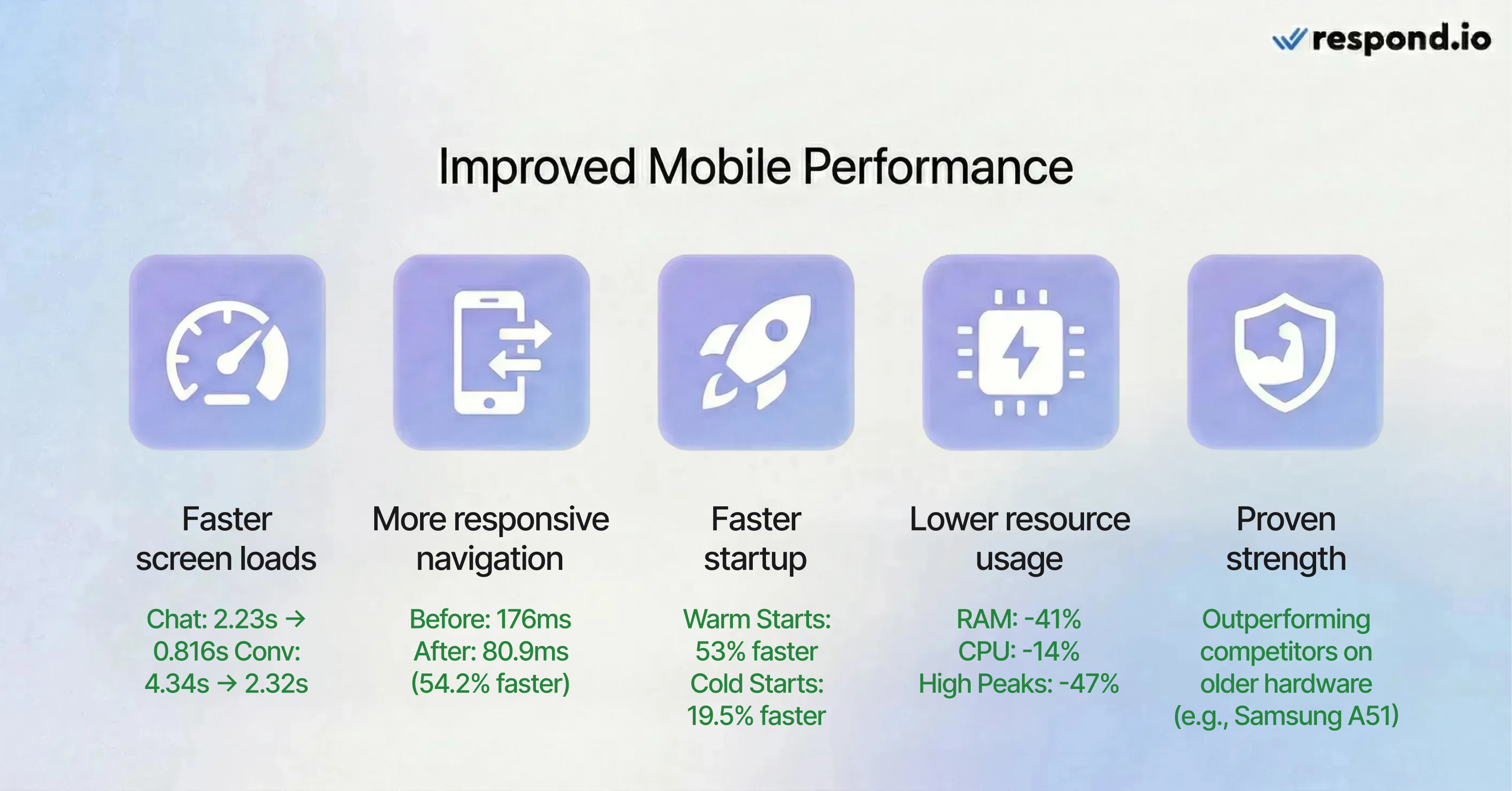
近乎完美的穩定性:達成 99.939% 的無當機率,確保營收關鍵工作流程持續可用。
Faster chat interactivity: Response times improved by 64% on Android and by 18% on iOS.
對話載入加速:載入時間降至 iOS 為 1.07 秒(從 3.73 秒降至)及 Android 為 2.32 秒(從 4.34 秒降至)。
Responsive navigation: Screen-switching latency reduced by 54.2% (to 80.9ms), enabling instant switching between chats.
資源效率:將 RAM 使用量減少 41% 並將高 CPU 峰值降低 47%,有助保護客服裝置的電池續航。
Faster startup: Warm start times improved by 53% and cold starts by 19.5%, allowing agents to resume work instantly.
Reliable on older devices: Outperforms industry peers in navigation speed and cold starts on older hardware (e.g. Samsung A51), ensuring speed on any device.
The net effect of these results is higher mobile agent throughput and fewer stalled conversations during traffic spikes.
UX improvements enabled by the mobile app optimization
The new architecture also delivered usability and efficiency gains across key mobile workflows.
Efficient image caching: Reduces redundant decoding and GPU/RAM usage to stabilize rendering in media-heavy conversations.
Smoother scrolling under load: Benchmarks confirm 35% lower RAM usage during continuous 100-message scroll tests.
Consistent UI performance: A leaner codebase minimizes background work, ensuring smooth, rapid task switching.
Clearer notification flows: Provide notification context, display permission statuses and log behavior for easier troubleshooting.
Respond.io 的行動應用專為 B2C 團隊最重視的情況打造:高聊天與通話量、多客服並行,以及像 WhatsApp 等頻道的高峰活動流量,能在這些條件下保持快速、穩定且即時回應。
By combining a modern mobile architecture with UX optimisations, it enables agents to handle more conversations on the go without lag, crashes, or dropped interactions. For teams evaluating mobile apps to support revenue-driven chat and call workflows at scale, respond.io offers a level of mobile speed, stability and reliability that is difficult to achieve without a purpose-built architecture. 立即免費試用.
FAQs about respond.io’s mobile app
Does the respond.io mobile app still have performance or lag issues?
Previous reviews mentioning mobile lag or instability refer to respond.io's legacy app and do not reflect the current mobile experience. Respond.io rebuilt its mobile app on a new React Native architecture designed to handle sustained load and high conversation concurrency.
This removed the execution bottlenecks that caused lag in earlier versions and resulted in significantly faster screen loads, smoother navigation, and near-perfect stability under real-world usage. Its new high performance is validated by real Sentry data from real-world usage, reflecting actual agent behavior under live workloads, including high conversation volumes, frequent screen switching, and use on older devices.
How does the respond.io mobile app maintain high performance at scale?
Respond.io uses a React Native New Architecture, enabling direct execution paths through JSI, concurrent rendering, and on-demand module loading. The full tech stack of the React Native New Architecture:
JavaScript Interface (JSI): Direct JS–native calls reduce latency and improve responsiveness
Hermes engine: Mobile-optimized execution for better performance
TurboModules: Load modules on demand to lower startup time
Fabric renderer: More predictable layout and improved threading for efficient rendering
Codegen: Generates native bindings automatically
Combined, these changes reduced latency, lowered memory and CPU usage, and stabilised performance during peak workloads.
How does respond.io’s mobile app compare to other chat or inbox apps?
Unlike legacy chat tools or lightweight inbox apps that are desktop-first or designed for low message volumes, respond.io’s mobile app is built for high-volume B2C operations. Its architecture is optimised for sustained concurrency, fast navigation, and reliable performance during campaigns, peak seasons, and agent-heavy workflows.
What is the best mobile app for high-volume B2C sales teams?
The best mobile app for B2Cs that manage high customer conversation volumes is one that stays fast, stable, and responsive under sustained multi-agent conversation load. Respond.io’s mobile app is built specifically for this use case, maintaining reliable chat and call performance during peak campaigns and high concurrency where most mobile chat and inbox apps slow down or crash.
Can mobile performance affect sales over chat and calls?
Yes. In high-volume campaigns on channels like WhatsApp, TikTok, Instagram and Facebook Messenger, slow mobile performance delays replies, increases lead drop-off, and reduces conversion rates. This is especially true in high-consideration businesses like automotive purchases, luxury retail, healthcare, beauty, travel or education, where answering questions to clarify concerns and build trust is critical. Respond.io’s mobile app is built to stay fast and stable during spikes, allowing agents to respond in real time and maintain momentum from ad interest to sales.
Will my team experience slowness if we have 30+ agents working on mobile simultaneously?
No. Traditional mobile CRM apps are built for single-user workflows. Unlike standard mobile inboxes that rely on legacy serialized bridges, respond.io is the only mobile solution purpose-built for high-volume B2C scale, maintaining a 99.939% crash-free rate during peak traffic spikes. Its concurrent processing model and efficient image caching ensure that mobile performance remains smooth even as your team and conversation volume grow.


