
















 อิเล็กทรอนิกส์
 แฟชั่นและเครื่องแต่งกาย
 เฟอร์นิเจอร์
 เครื่องประดับและนาฬิกา
 กิจกรรมหลังเลิกเรียน
 กีฬา & ฟิตเนส
 ศูนย์ความงาม
 คลินิกทันตกรรม
 คลินิกการแพทย์
 บริการทำความสะอาดบ้านและสาวใช้
 การถ่ายภาพ & การบันทึกภาพ
 โชว์รูมรถยนต์
 ตัวแทนท่องเที่ยวและผู้ประกอบการทัวร์

TL;DR — How to use a WhatsApp chatbot for healthcare
WhatsApp healthcare chatbots automate patient communication without handling protected health information (PHI) directly in chat. They reduce administrative workload, improve patient response times and deliver 24/7 support on a channel patients already use.
High-value use cases include booking workflows, clinic information, routing, education, non-clinical alerts, surveys and secure-result notifications.
To build one: choose a chatbot platform, get WhatsApp Business API access, build your WhatsApp chatbot, integrate with your patient systems and test before launch.
For a secure, scalable implementation built specifically for healthcare workflows, consider a proven performer like respond.io.
Healthcare teams are under pressure. Patient volumes are rising, staff are stretched, and people now expect the same instant, always-on service from clinics and hospitals that they get from consumer apps.
At the same time, a huge part of healthcare communication is repetitive: appointment booking, reminders, lab reports, FAQs, simple triage questions and follow-up checks.
A WhatsApp chatbot for healthcare sits exactly at this intersection. It automates routine conversations on the channel your patients already use every day, while keeping doctors and nurses focused on care instead of admin.
In this guide, you’ll learn:
What a WhatsApp healthcare chatbot is (and what it’s not)
How it benefits both patients and providers
High-value healthcare use cases on WhatsApp
How to build and deploy a safe, compliant WhatsApp chatbot for healthcare
Best practices, challenges and the future of AI in healthcare messaging
Let’s dive in.
What is a WhatsApp chatbot for healthcare?
A WhatsApp chatbot for healthcare is an automated conversational assistant that interacts with patients through WhatsApp.
It’s built on the WhatsApp Business Platform (API) and uses AI to understand patient intent, automate workflows and send structured responses.
WhatsApp chatbots don’t replace medical or administrative staff. Instead, they take over repetitive front-desk and coordination tasks so service teams can work more efficiently and clinicians can stay focused on diagnosis, treatment and complex cases.
Types of WhatsApp chatbots for healthcare
Healthcare organizations use different kinds of chatbots depending on how much automation, flexibility and complexity they need. There are two types of WhatsApp chatbots.
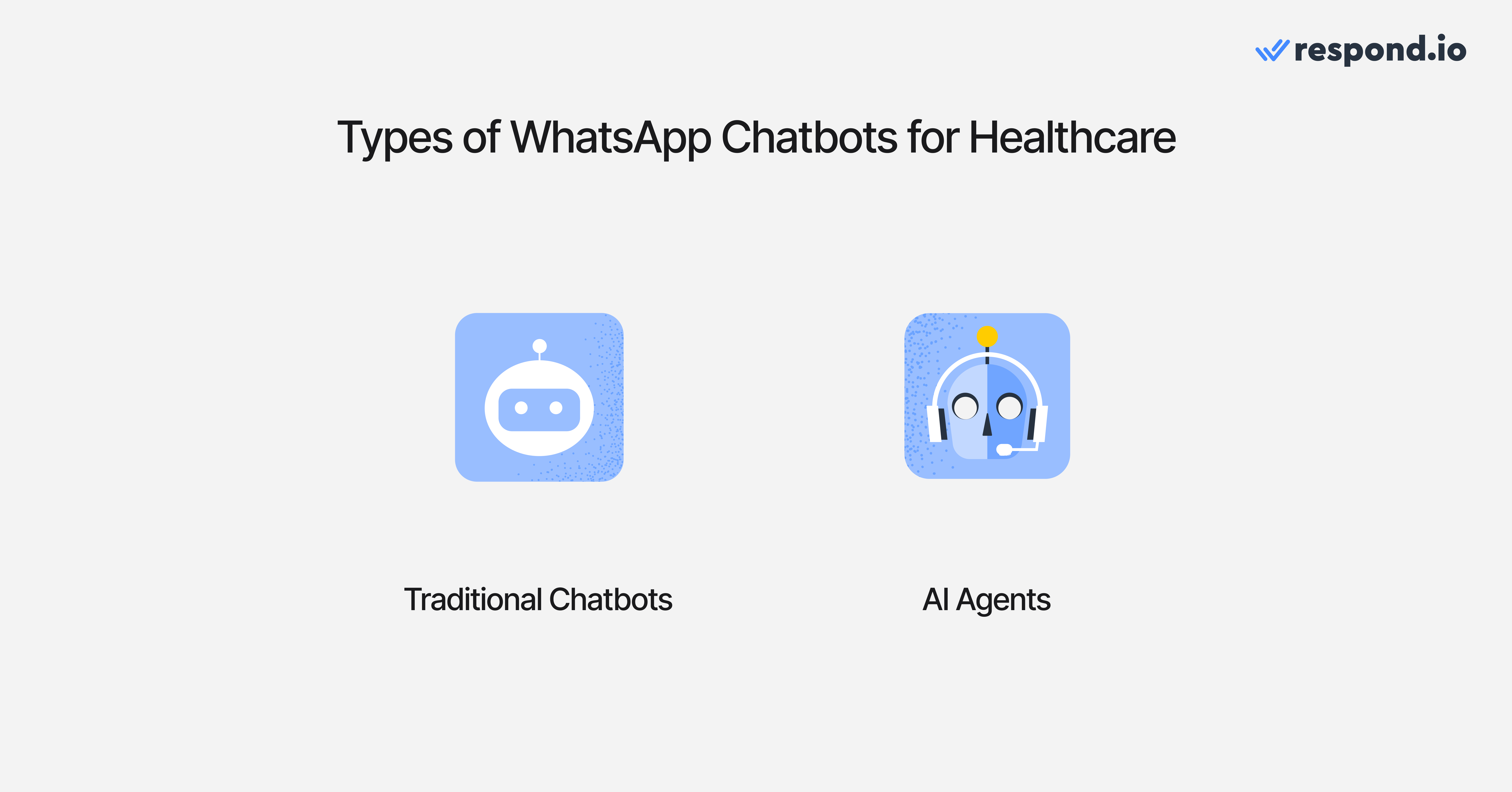
Traditional chatbots
These are rule-based or scripted bots that follow predefined flows. They work like digital receptionists or interactive FAQ menus, common in many clinics and hospitals.
Functions
Use fixed logic: menus, button choices, simple yes/no or multiple-choice flows.
Well-suited for predictable, high-volume administrative tasks — appointment booking/rescheduling, FAQs (opening hours, documents needed, directions, insurance info) and basic logistics.
Low technical risk: because responses are controlled, it’s easier to keep compliance, data-handling and privacy under control.
Reliable for non-clinical, structured interactions: good for “static” information and administrative workflows where variability is limited.
Traditional chatbots are often a first step — they deliver immediate value with minimal setup and are low-risk for compliance issues.
AI Agents
These are more advanced — they combine automation with natural-language understanding, machine learning or other AI innovations. They’re able to interpret free-text messages, detect intent, look up relevant information from knowledge bases and generate relevant, contextual responses. Most importantly, some of them can pick up calls.
Functions
Understand varied or unstructured patient inputs (not just menu buttons). Patients can type questions in natural language.
Support more complex workflows: Intelligent routing, follow-ups, reminders, multi-step interactions, and live API calls to check external systems or trigger actions in real time.
Enable 24/7 support at scale: AI agents can manage thousands of conversations concurrently, even outside office hours.
Improve patient experience: Fast responses, fewer delays, instant clarifications — leading to better satisfaction and less burden on frontline staff.
Preserve handover context automatically: AI agents leave internal comments that summarize key details and next steps so staff can step in with full clarity.
AI chatbots represent a more “human-like” front desk or virtual assistant, especially useful in complex environments or when patient queries vary widely.
Chatbots vs AI chatbots / AI Agents
Here’s a side-by-side comparison of the two models.
Feature / Consideration | Traditional Chatbot | AI Agent |
Input handling | Predefined flows, buttons/menus, limited to covered scripts | Natural-language understanding, flexible free-text input & responses |
Flexibility | Good for routine, predictable tasks; limited variability | Handles varied queries via chat and call, complex workflows beyond chatting with customers |
Use-case suitability | Appointment scheduling, FAQs, reminders, static info sharing, basic routing | Same as traditional chatbots + Intelligent routing, follow-ups, reminders, multi-step interactions, dynamic data lookup and retrieval |
Compliance risks | Easier to control — if you limit to non-clinicalissues, risk is low | Higher complexity demands careful configuration — must ensure patiend data isn't mishandled |
Implementation effort | Harder to build and maintain | Requires more accuarate setup: knowledge base, maintenance of content and guardrails |
In practice, many healthcare providers benefit from a hybrid approach: use a traditional chatbot for routine, structured workflows (booking, FAQs, reminders), and layer an AI Agent on top for flexibility. However, you can use only one depending on your needs.
Why use a WhatsApp chatbot for healthcare
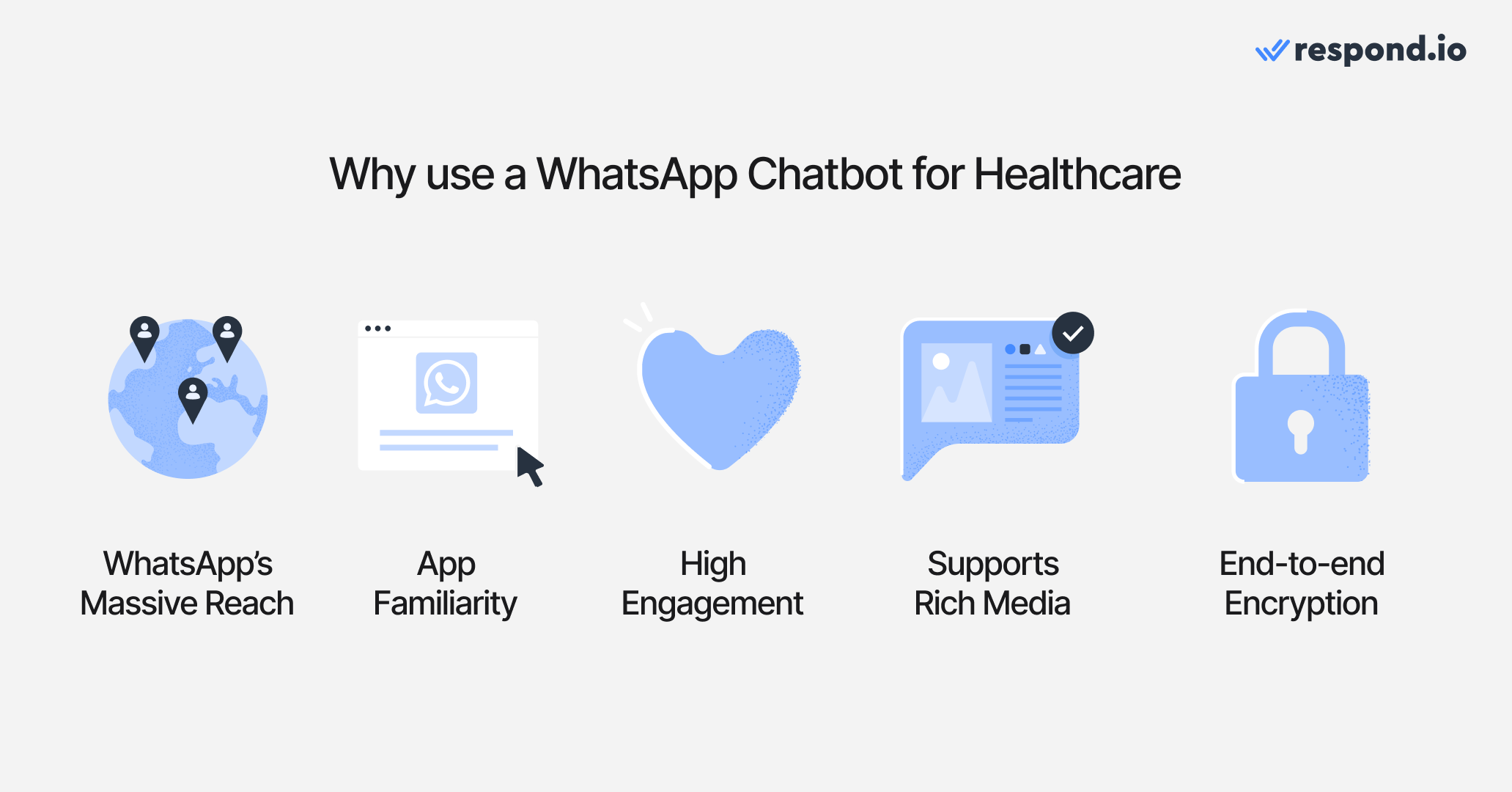
You can deploy chatbots on websites or mobile apps, but adoption is often the bottleneck. Patients don’t want another app, login or password.
WhatsApp solves that problem:
Massive reach: Over 2 billion users globally. In many markets, WhatsApp is the default communication app.
App familiarity: Patients already know how to use it. No onboarding or training needed.
High engagement: WhatsApp messages typically see much higher open and response rates than email or SMS.
Supports rich media: Send prescriptions, lab results, PDFs, images, short videos and care instructions in one place.
End-to-end encryption: Conversations are encrypted in transit, supporting privacy and confidentiality when combined with proper backend security.
For healthcare providers, that means you can meet patients where they already are, with minimal friction.
Benefits of WhatsApp chatbot for patients
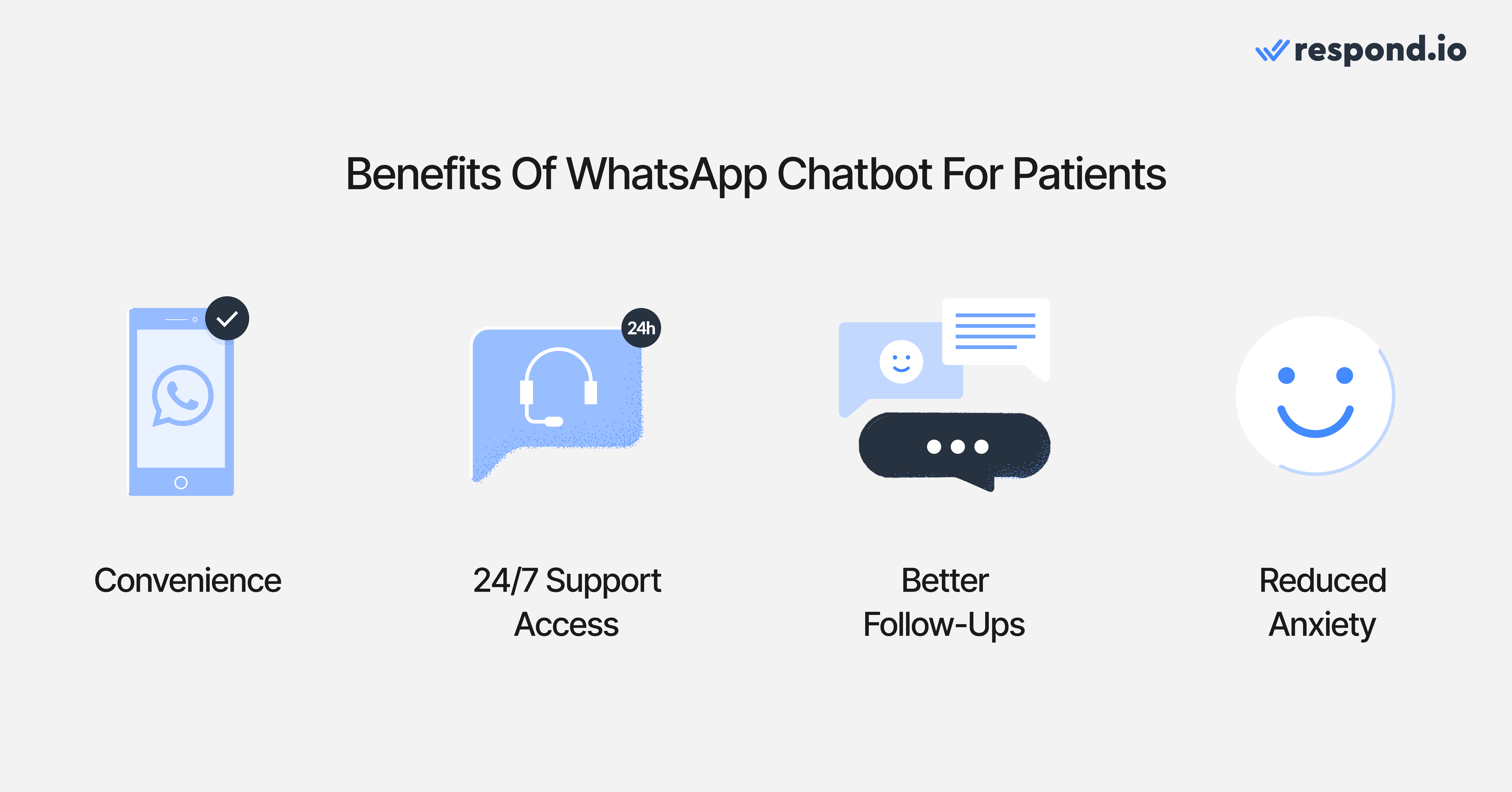
Convenience: Communication happens on an app they already use and trust, making engagement easy, fast and accessible from their phone.
24/7 access to support: Patients receive immediate support and answers to routine questions at any time. This gets rid of long and frustrating waits.
Better follow-ups: Automated reminders for appointments, medication and care plans help patients stay on track and follow their treatment.
Less anxiety around results and instructions: Patients receive their results or instructions on their phone as soon as they’re ready. Fast delivery of secure links and clear guidance helps them feel more confident and less anxious.
Benefits of WhatsApp chatbot for healthcare providers
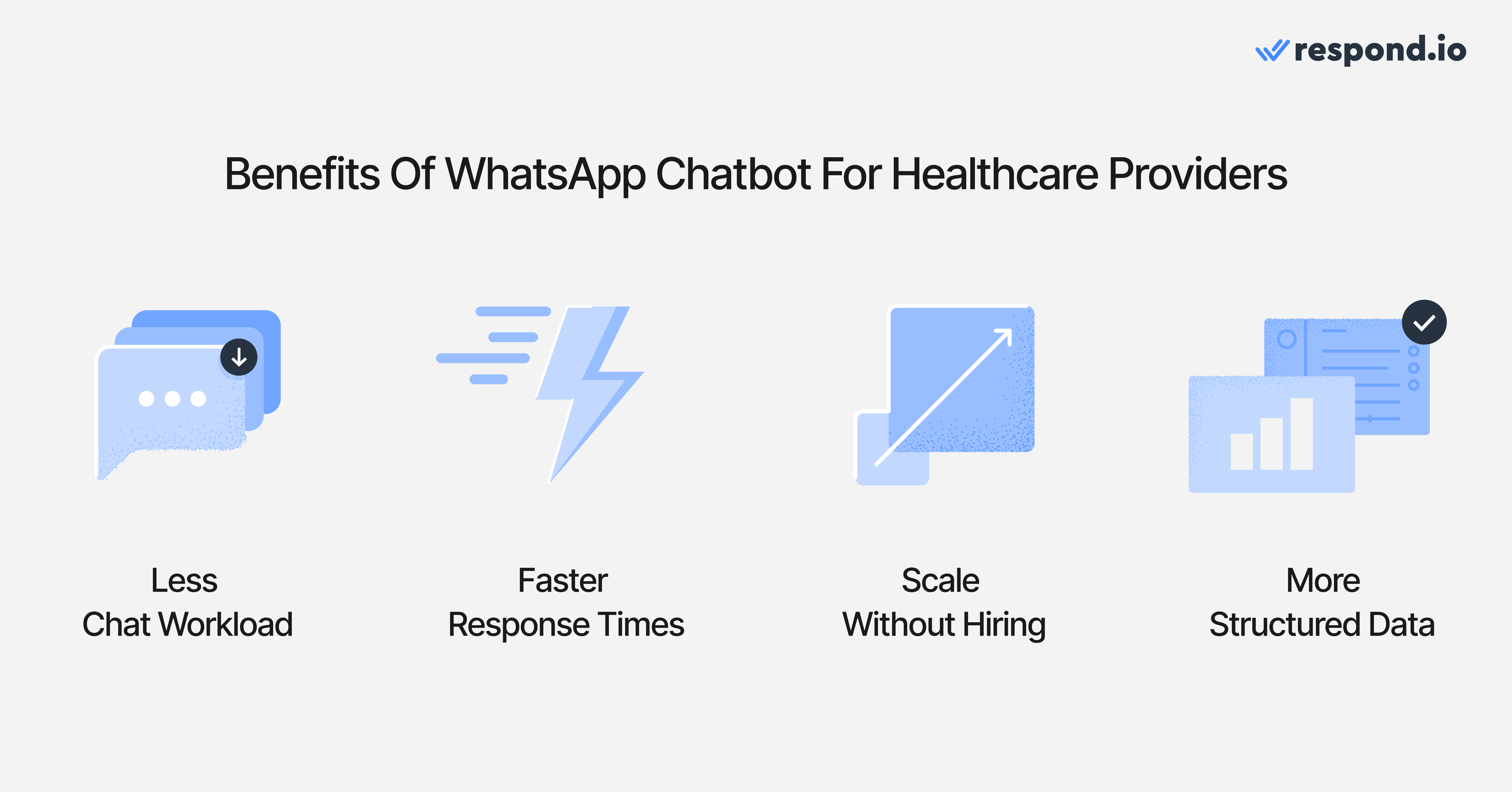
Less chat workload: Chatbots handle high-volume, non-clinical tasks (like FAQs and appointment management), freeing up staff for other tasks that require human input.
Faster response times: Instant replies and chatbot-led routing drastically cut the time it takes for a patient to get an initial answer. This, in turn, helps healthcare businesses process more conversations.
Scale without hiring: With chatbots, organizations can manage massive increases in patient inquiries (e.g., during campaigns or crises) without needing to hire proportionally more staff.
More structured data: Conversations can be automatically tagged, categorized and synced to a CRM, providing structured data that is easy to analyze and retrieve.
7 High-impact use cases of WhatsApp chatbots in healthcare
Given the sensitive nature of healthcare services, businesses must be absolutely clear on the approved use cases for WhatsApp automation.
Bernardo González, Head of Support at respond.io, has extensive first-hand experience working with healthcare businesses. We asked him to detail which applications of WhatsApp chatbots are permitted in this sector. He shares seven important use cases.
1. Appointment booking, reminders & follow-ups
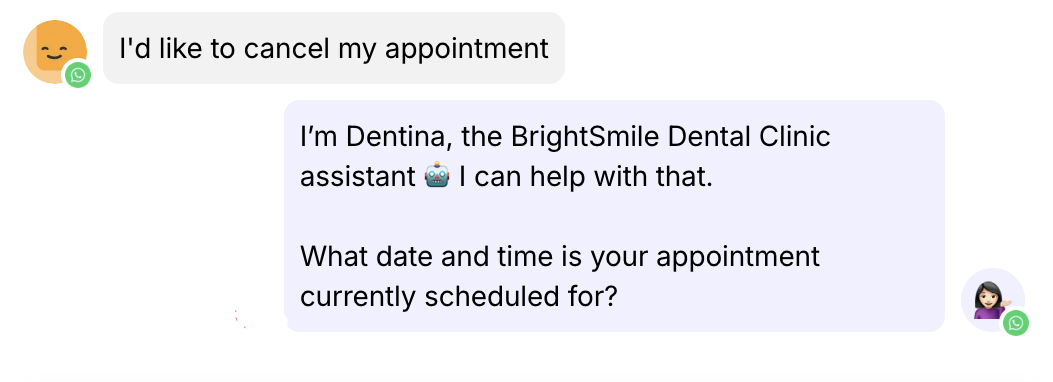
Automating appointment booking, reminders & follow-ups is the most effective way to combat patient no-shows, which can cost your business. Integrating a WhatsApp chatbot with a health information system allows for real-time scheduling and instant, two-way reminders, letting patients confirm or reschedule with a single tap. For example:
Booking, rescheduling, and canceling appointments.
Sending appointment confirmations with date/time/doctor/location.
Reminders for vaccinations, routine check-ups, and screenings.
Automated reminder systems can signify a 20–30% drop in no-show rates. This efficiency gain is crucial, especially compared to simple phone reminders, which are less effective at this.
2. Clinic/hospital information & FAQs
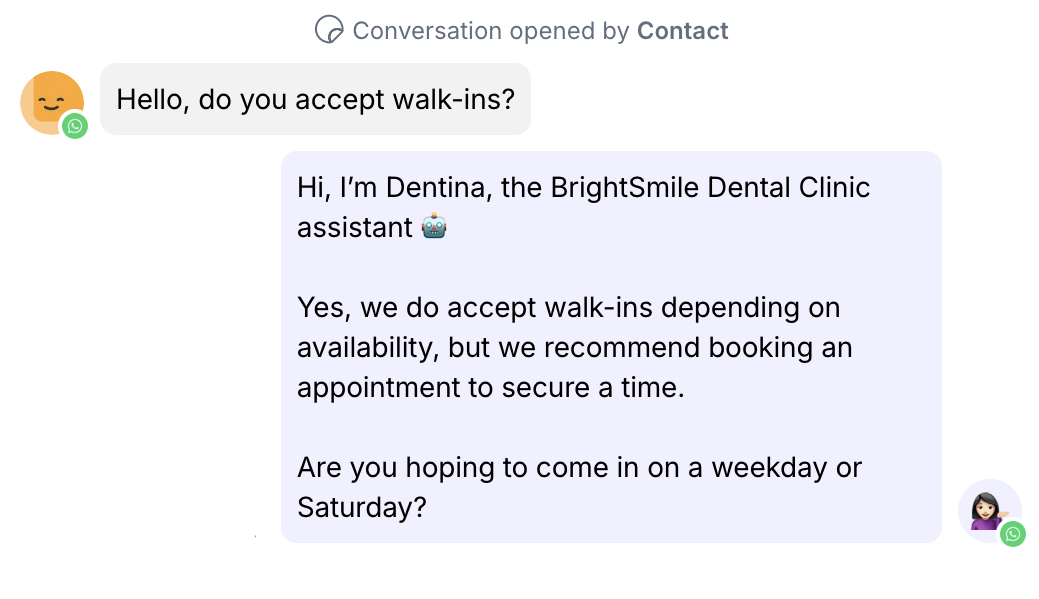
AI chatbots are reported to reduce routine administrative inquiries by 42% by reducing administrative burdens.
A robust FAQ AI chatbot acts as a scalable, 24/7 Level 1 support agent, instantly handling the highest volume of routine administrative questions and freeing up valuable human resources. You can automate information sharing like this:
Opening hours, address, parking, and directions.
Insurance panels, required documents, and how to prepare for a visit.
FAQ-style chatbot for common non-clinical questions.
3. Receptions & routing to the right team
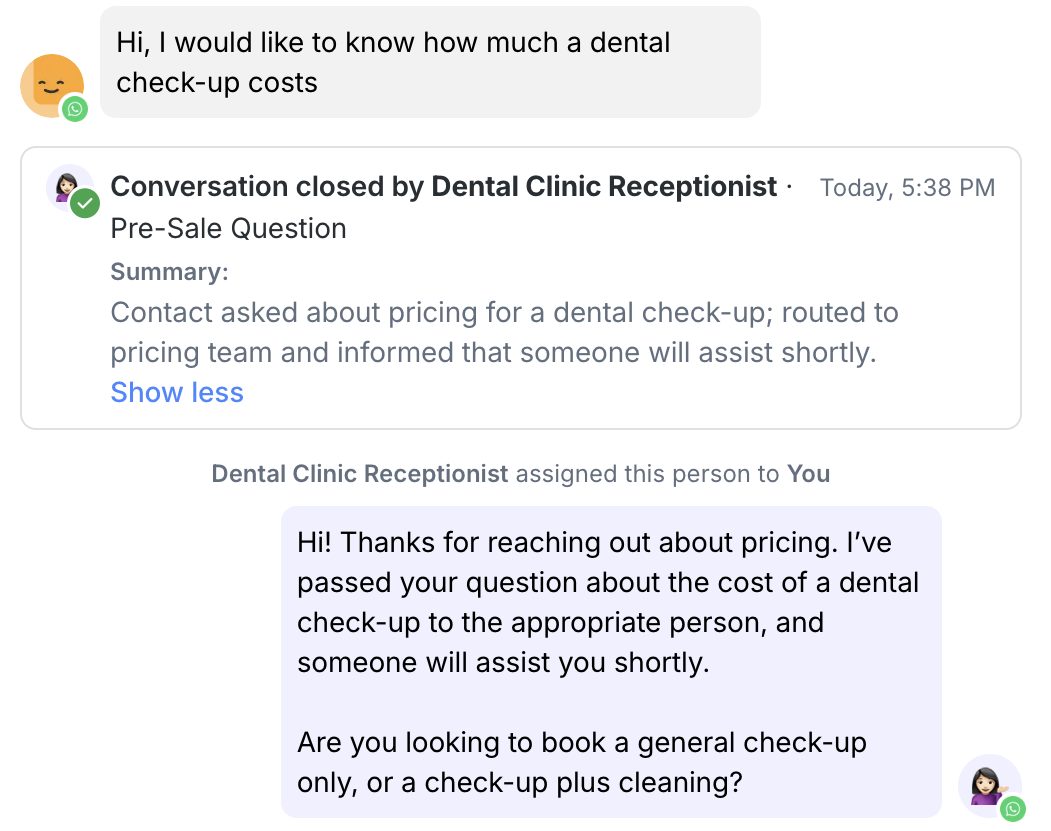
An intelligent triage bot guarantees patients are routed to the most appropriate specialized human agent or automated flow instantly, drastically cutting internal transfer time and ensuring the fastest path to resolution. Here are two possibilities you can implement:
Bot routes to the correct human team based on patient intent.
An in-chat menu with interactive buttons like: “Book appointment”, “Insurance & billing”, “Talk to nurse line.”
Using conversational AI for triage and routing means agents can focus on other important tasks, improving resolution times.
4. General health education (non-personalized)
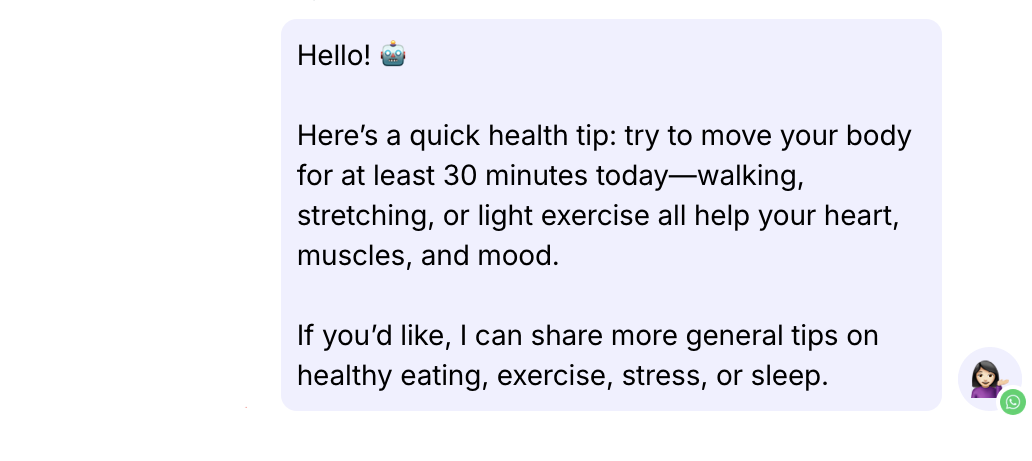
This use case uses WhatsApp’s large audience and high engagement to share helpful health information with many people at once. Clinics and hospitals usually send these messages when they want to raise awareness or encourage healthy habits — without sharing anything personal about a specific patient. You can use this for:
General reminders about prevention, health campaigns or awareness days.
Simple lifestyle tips like healthy eating, exercise or stress management.
5. Non-clinical notifications
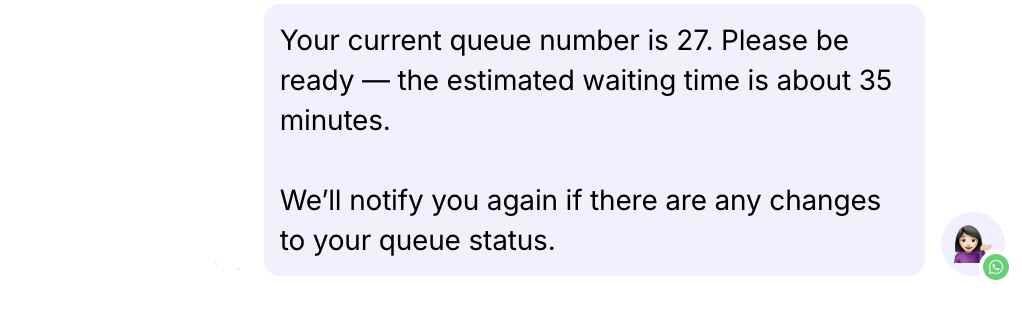
Automating status updates helps manage patient expectations and dramatically reduces the workload on agents fielding repetitive status-check inquiries. Here are some notification types you could send:
Insurance/billing status updates.
Document readiness.
Queue numbers.
6. Service feedback & satisfaction surveys
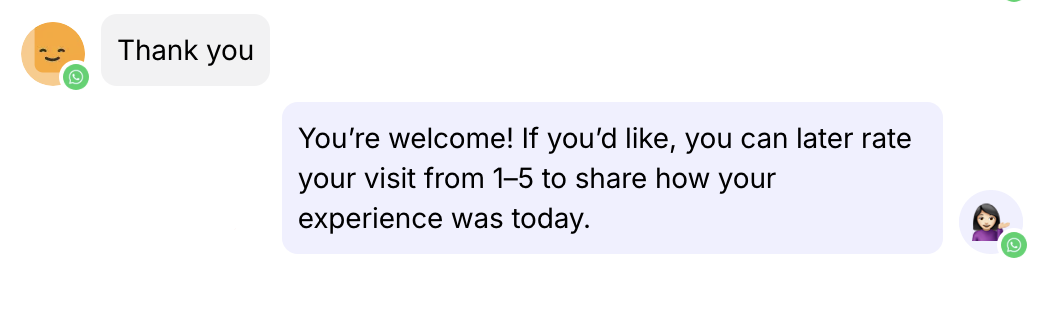
The immediacy and conversational nature of WhatsApp let providers capture high-quality feedback right after the service delivery, maximizing the response rate and data accuracy. There are many types of surveys; the simplest is a rating (1–5) after a medical appointment.
WhatsApp boasts open rates of 98%. For this reason, survey completion rates over platforms like WhatsApp are consistently high.
7. Sending lab reports and document notifications
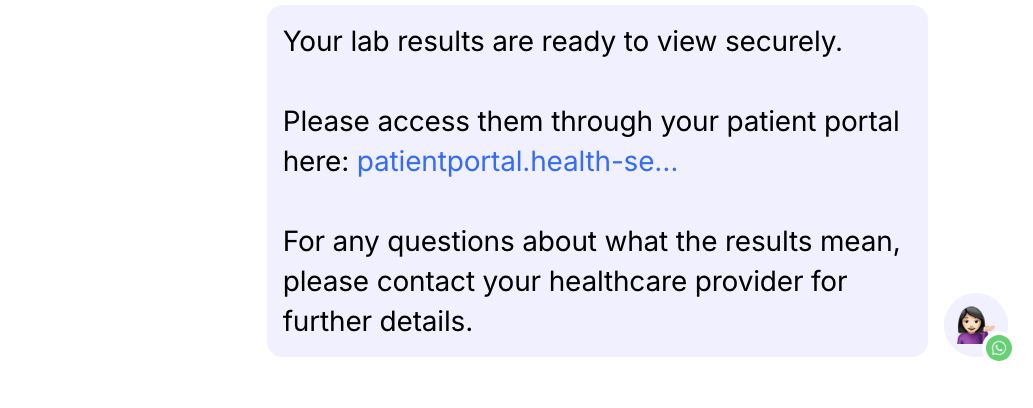
This use case prioritizes rapid notification of results, directing the patient to the secure, authenticated portal. This ensures patient satisfaction through speed while strictly adhering to data privacy and protected health information compliance standards.
What you can’t do with a WhatsApp chatbot for healthcare
Bernardo González also warns healthcare businesses about discouraged practices that can result in your WhatsApp number being banned.
The restrictions on WhatsApp chatbots in healthcare are driven by two major factors: Data privacy regulations (like HIPAA and GDPR) and WhatsApp's own Commerce and Business Policies, which strictly govern commercial conduct and PHI (Protected Health Information).
1. Selling or promoting medical & healthcare products
WhatsApp's Commerce Policy strictly prohibits the direct sale or promotion of certain healthcare items, including most medical devices, prescription drugs and certain services.
While manufacturers and service providers are allowed to use the platform for non-selling support and informational purposes, they are disallowed from selling any items related to their business (e.g., a pharmacy cannot sell pharmaceuticals directly via WhatsApp Commerce features). The core purpose is to prevent the sale of unregulated, counterfeit, or restricted medical goods.
2. Purely automated bot with no clear handoff option
Automation is intended to support, not replace, human interaction. If a chatbot encounters a complex, urgent or emotional query, or if the user explicitly requests a human agent, the system must provide an escalation path to a human agent.
Ignoring a direct request for a human leads to frustration and violates the spirit of effective customer service.
3. Requesting highly sensitive identifiers in chats
While WhatsApp features end-to-end encryption for the message content, the chat interface is not designed as a secure form-filling application for sensitive data storage or transmission at rest.
To maintain security and avoid compliance issues, the bot must not ask for full Social Security Numbers (SSN), full credit card numbers or proprietary account login details.
If such information is necessary, the bot must redirect the user to a secure, encrypted web portal hosted by the healthcare provider for input.
4. Sharing any health information (PHI) in chats
This is the most critical constraint due to HIPAA (US) and GDPR (EU) compliance. WhatsApp does not sign a Business Associate Agreement (BAA) with healthcare providers.
A BAA is a legal requirement for any third party that stores or processes PHI on behalf of a healthcare provider. The absence of a BAA means that the platform is not contractually obligated to safeguard PHI under HIPAA rules, rendering it non-compliant for sharing patient-specific clinical data.
The only compliant way to communicate patient-specific information is to send a notification (e.g., "Your lab results are ready") and a secure, authenticated link to the organization's certified patient portal.
How to build a WhatsApp chatbot for healthcare in 4 steps
Building a robust WhatsApp chatbot for a clinic, hospital, or wellness provider is a structured process that prioritizes patient security, regulatory compliance and proper integration.
Step 1: Choose the right chatbot builder
To handle the sensitive nature of patient data, compliance mandates and high-volume operations, your conversational platform vendor must satisfy these four core requirements:
1.1 Offers official WhatsApp API & feature support
Your chatbot builder should give access to the official WhatsApp Business Platform (API) for enterprise features and guarantee compliance with Meta’s policies.
1.2 Has advanced AI for complex workflows
Look for AI and automation capabilities to manage multi-step, complex healthcare workflows and real-time data integration.
1.3 Supports seamless voice/human handoff (Calling API)
Must support the WhatsApp Business Calling API to guarantee transition to human voice support when needed.
1.4 Ensures robust scalability and security
Architecture must reliably scale with high volume and include necessary security features to complement your compliance framework.
Step 2: Get WhatsApp Business API access
Once you have chosen a WhatsApp chatbot platform, you’ll need WhatsApp AI access. The easiest way to get it is through a WhatsApp BSP like respond.io.

Respond.io is an excellent chatbot platform for healthcare businesses, and as a badged Meta partner, also provides a smooth onboarding to the WhatsApp Business Platform (API).
To complete steps one and 2, start a respond.io free trial and get access to the WhatsApp Business Platform (API) in minutes.
Step 3: Design patient-centric WhatsApp chatbots
Setting up your healthcare chatbot successfully means focusing on safety, compliance, and clear communication—not just the technology. Because chatbot builders operate differently, we’ll focus on nontechnical aspects that are applicable to most of them.
3.1 Define a specific, non-clinical role
Give the bot one clear, non-medical job, like being a receptionist or a first-line support agent. Ensure its mandate strictly prevents it from offering any clinical advice.
3.2 Integrate with patient data systems
To provide personalized service (like appointment lookup or status checks), you must integrate your WhatsApp chatbot with your healthcare CRM or patient data bank (EHR/HIS).
3.3 Train with approved knowledge sources
You must train the bot on everything it needs to know using your healthcare business's own official documents (like PDFs or verified website pages); this guarantees that every answer it gives is accurate and approved.
3.4 Prioritize PHI security
Your chatbot must be able to send a secure link to your private portal; it should never share sensitive results or Protected Health Information (PHI) directly in the chat window.
3.5 Guarantee immediate human handoff
The bot must be trained to recognize requests for help and immediately facilitate a human handover. Anyone with a complicated, urgent or emotional question should be able to request assistance from a human staff member upon request.
Step 4: Test and launch
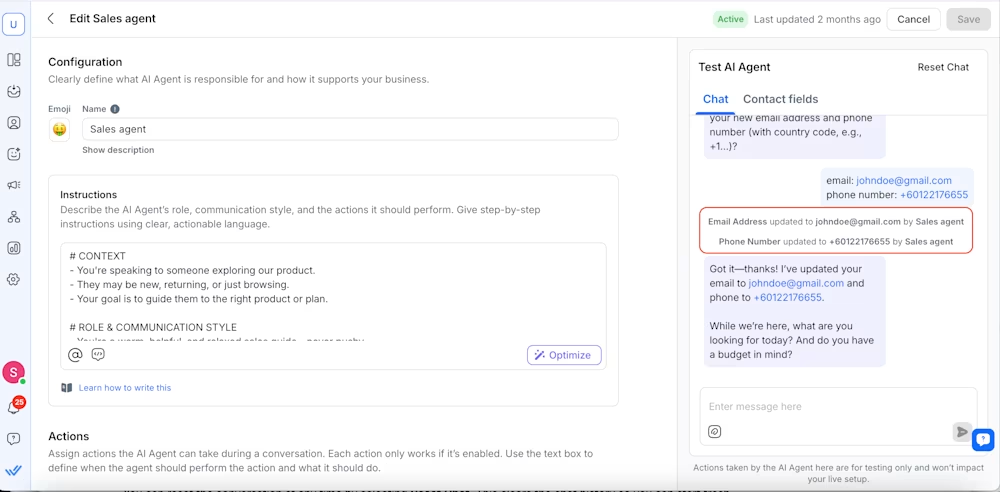
Test your WhatsApp chatbot before deploying it to spot undesired behaviors. Once fixed, publish it and keep an eye on its performance. Some platforms, like respond.io, come with AI Agent analytics to make this easier.
Best practices for patient-centric WhatsApp chatbots
To ensure your chatbot enhances the patient experience, focus on these four core principles:
Sound human and empathetic:
Use natural, conversational language and acknowledge the patient's concern before proceeding with administrative steps, reflecting the sensitive nature of healthcare.
Set expectations upfront:
The welcome message must clearly state the bot’s capabilities and, crucially, immediately disclaim its inability to provide clinical advice or handle emergencies.
Design for mobile:
Optimize the experience for mobile users — remember that WhatsApp is much more popular on mobile than it is on desktop.
Offer human handoff immediately:
Ensure a clear, accessible option to transfer the patient to a human agent, particularly when the bot detects urgency, complexity or emotional distress.
How Praga Medica recovers 70% more global leads with respond.io WhatsApp chatbots
Previously, we mentioned how proven performance was important when choosing a WhatsApp chatbot platform for healthcare. Here, we share how Praga Medica used respond.io WhatsApp chatbots for business growth.
Praga Medica solved its WhatsApp lead problem by giving a key job to an AI Chatbot (or AI Agent). This smart automation was set up to be the first point of contact, collecting basic details and deciding which chats were real, qualified leads.
Because of this, the AI Agent successfully caught and tossed out 97% of all spam, meaning human staff didn't waste time on irrelevant messages.
The AI was also responsible for sending instant replies to everyone, no matter the time zone, so potential customers always felt immediately welcomed.
This system, relying heavily on the AI for sorting and speed, resulted in a 50% faster response time overall. Co-founder David Fiala explained that once the AI took over the simple, routine questions, the human team could focus entirely on the important, high-quality patients, making the whole process much smoother and more successful.
Why build your WhatsApp healthcare chatbot on respond.io?
Choosing a platform for healthcare demands stability, security, and intelligence—all areas where respond.io excels:
Unmatched Reliability and Scalability: With 99.999% stability, the platform's scalable AI handles high patient volumes and increasing complexity without breaking down, crucial during peak seasons or crises.
Enterprise-Grade Security: Respond.io protects patient data with mandatory 2-factor authentication (2FA) and customizable role permissions, supporting your compliance requirements.
Advanced AI Agent Capabilities: Respond.io's AI Agents are purpose-built for complexity:
Expert Training: Train agents instantly with your official PDFs and URLs for guaranteed, accurate and compliant answers.
Full Functionality: Agents pick up voice calls, can efficiently answer FAQs, route conversations to human agents, trigger workflows, understand voice audios, images and PDFs and provide deep insights via chatbot analytics.
Scale your healthcare business with WhatsApp chatbots using the most reliable platform. Try respond.io for free.
Looking for AI solutions? Use AI Agents instead
Automate greetings, answer questions, and route chats — all without Workflows. Set up the Receptionist template in minutes and unlock more possibilities with AI Agents powered by advanced AI models.
FAQs about WhatsApp chatbots for healthcare
Which AI chatbot is best for medical?
The best AI chatbot for medical use is one that supports the official WhatsApp Business API, offers strong automation tools, and keeps patient communication safe and compliant. Clinics and hospitals should look for features like reliable appointment workflows, queue updates, triage questions, routing, knowledge-based responses, team collaboration, and integrations with their existing healthcare systems.
AI Agents that can call external APIs in real time to check bookings, verify patient status or trigger actions in connected systems offer even greater value for end-to-end task handling.
If you’re looking for a platform that meets these requirements and is built for healthcare teams, respond.io is a strong option. It supports the official WhatsApp API, offers robust automations, and includes AI Agents that can be trained on your approved content. Admin staff, nurses, and doctors can also share the same inbox, assign cases, leave notes, and track conversations across channels. Respond.io integrates with CRMs, booking tools, and healthcare systems, helping reduce manual work and speed up response times.
Are WhatsApp healthcare chatbots secure?
Yes — WhatsApp healthcare chatbots can be secure, but only when they’re set up correctly.
WhatsApp provides end-to-end encryption (E2EE) for messages in transit, meaning only the sender and receiver can read them. However, E2EE does not cover what happens once the message reaches the business inbox. That means the security of a healthcare chatbot depends heavily on the platform you use to manage those conversations.
To stay compliant, a secure WhatsApp healthcare chatbot platform should offer:
HIPAA/GDPR-aligned data practices
Encrypted data storage
Role-based access control
Audit logs for tracking access
Secure integrations with EMRs/EHRs
Data minimization and strict retention rules
It’s also important to build your automations safely — for example, using verified WhatsApp templates for sensitive notifications and avoiding the transmission of PHI directly in chat.
If you’re looking for a platform that combines these security measures with AI automation and official WhatsApp API support, respond.io is a reliable option for healthcare teams.
Can I share lab results or prescriptions over WhatsApp?
No, you should not share lab results or prescriptions directly over WhatsApp. Even though WhatsApp messages are end-to-end encrypted, the platform does not sign a BAA and is therefore not HIPAA/GDPR compliant for transmitting PHI.
Healthcare providers can use WhatsApp to send non-clinical notifications, such as:
“Your lab results are ready.”
“Your prescription is available.”
But the actual medical files must be accessed through a secure, authenticated patient portal, not inside the chat.


