
















 Electronics
 Fashion & Apparel
 Furniture
 Jewelry and Watches
 Afterschool Activities
 Sport & Fitness
 Beauty Center
 Dental Clinic
 Medical Clinic
 Home Cleaning & Maid Services
 Photography & Videography
 Car Dealership
 Travel Agency & Tour Operator


TL;DR - What are the best Zoko alternatives?
Zoko is an ideal option for small to medium businesses that need an affordable WhatsApp and Shopify CRM with basic automation and setup. Businesses look for Zoko alternatives when they require more channels, deeper automation or scalability.
Top Zoko alternatives: Respond.io, Interakt, Sleekflow, Trengo and Wati.
Recommendation: Choose respond.io if you're a mid-market B2C team handling high chat volume across multiple channels and need advanced routing, automation and reliability. Choose Interakt or Wati if you're WhatsApp-first with simple workflows and a smaller budget.
That said, respond.io is not the best fit if you only need a simple WhatsApp-and-Shopify setup with basic broadcasts and minimal workflow complexity.
Zoko is a strong platform for Shopify-first businesses that focus on WhatsApp. It offers a multi-agent shared inbox, catalog sync, broadcasts, automations and a commerce-friendly workflow that helps early-stage B2C teams get started quickly.
However, growing B2C teams often outgrow Zoko when chat volume rises, more channels are needed or automation demands become more complex. Choosing the wrong platform can mean missed leads, slower response times and lost sales when volume spikes or new channels are added.
This guide compares the best Zoko alternatives in 2026 for teams that rely on chat to drive revenue and support customers at scale.
Why businesses look for Zoko alternatives
Zoko’s approach is an advantage for small teams but becomes restrictive for companies managing higher volumes or multi-channel engagement.
Here are the most common reasons teams evaluate alternatives:
WhatsApp-heavy focus
Zoko works well for businesses focused only on WhatsApp but limits teams looking to expand across other popular channels such as TikTok, Instagram, VoIP and more.
Shopify-heavy focus
If you’re not Shopify-first, Zoko’s ecommerce features will feel less relevant for your business.
Limited workflow depth
Zoko provides basic flows, abandoned cart nudges and simple automation triggers. Businesses wanting more conditional logic, multi-channel journeys or multi-team workflows quickly hit limits.
Basic AI capabilities
Zoko includes template-based AI assistance, but not full AI Agents.
Reporting limitations
Reporting in Zoko becomes a switching reason when teams can no longer connect conversations to outcomes. Buyers should look for campaign-level performance, agent response and resolution metrics, source attribution, lifecycle conversion tracking and revenue visibility tied to chat activity.
Reporting shows which channels, campaigns and teams are creating qualified leads, closed sales and repeat purchases, so leaders can invest in what is working instead of guessing.
Scalability concerns for mid-market teams
Pricing complexity and limited concurrency support make it harder for large B2C teams to scale confidently.
If you’re starting small and managing mostly WhatsApp commerce, Zoko still works well. But if your team is growing, you’ll likely want a platform built for broader automation and predictable scaling.
Key factors to consider when choosing a Zoko alternative
When evaluating Zoko alternatives, these are the areas that matter most if you want a platform to scale with your business:
Channel coverage beyond WhatsApp
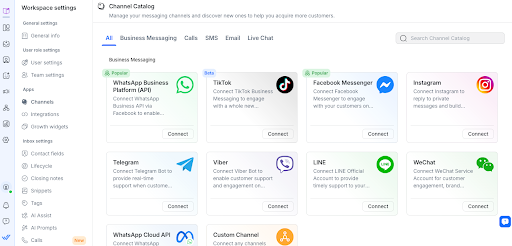
Choose a platform with strong native channel support to help future-proof the setup and avoid migration later. Team coordination matters just as much. Buyers should look for role-based access, clear assignment visibility, internal notes, collision prevention and service-level response rules so the right person can respond fast with full context.
Conversation history should follow the contact across channels, and high-volume teams should be able to tag, filter and prioritize work without bottlenecks. A team workspace only protects revenue when it reduces lead leakage and keeps handoffs between sales and support clean.
Automation and workflow depth
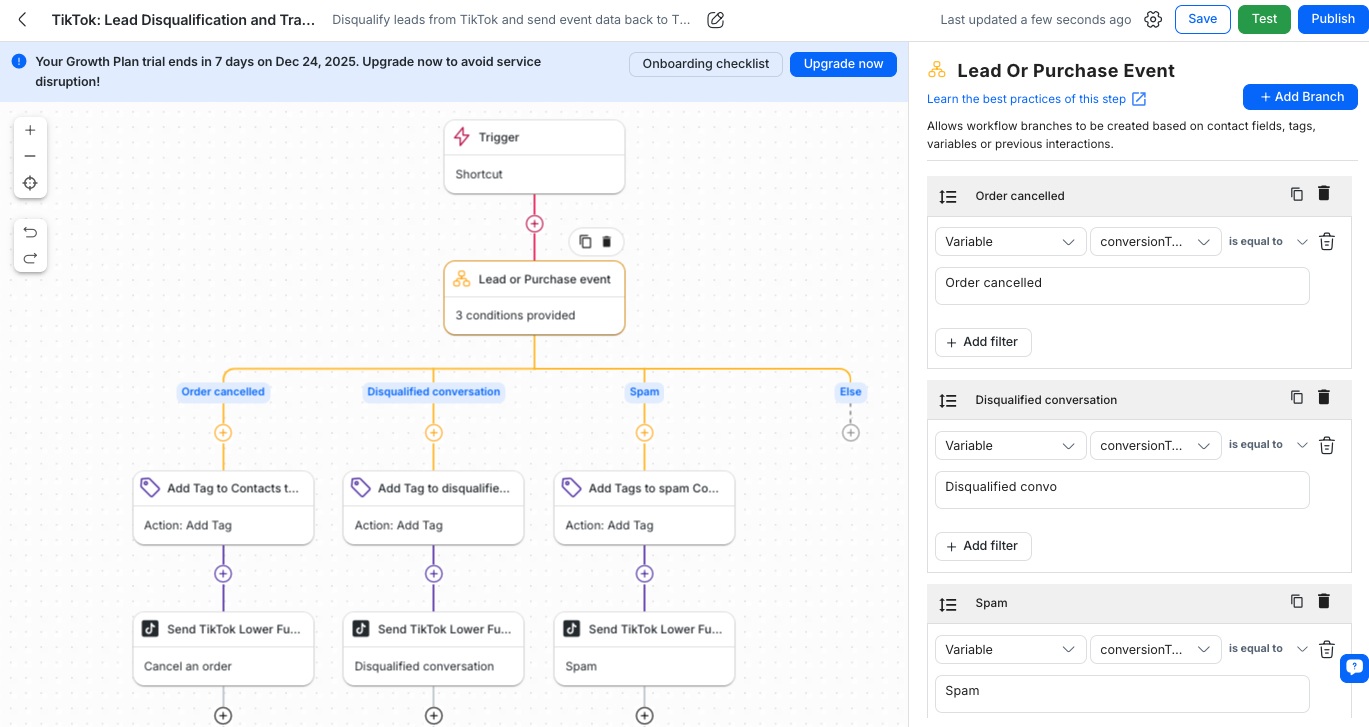
Look for tools that automate full customer journeys which include lead capture and qualification, not just simple triggers. The best platforms let marketing and sales teams launch no-code workflows for abandoned cart recovery, cash on delivery confirmation or prepaid conversion, order updates, payment reminders, post-purchase follow-up, reactivation campaigns and broadcast sequences without engineering support. Each journey should support conditions, delays and reply-based branching so the workflow can handle objections, offer the next best action and route a high-intent shopper to sales when needed.
This level of workflow depth affects revenue directly. It helps teams recover more stalled checkouts, reduce manual follow-up on order and payment questions and create more repeat-purchase opportunities after delivery instead of relying on one-off reminder blasts.
Behavior-based triggers — such as abandoned browse, repeat purchase or inactivity — should be easy to configure so teams can keep leads moving without adding headcount. Evaluate whether the platform supports drip sequences, conditional branching and multi-step journeys that adapt based on customer responses.
Campaigns should continue as two-way conversations after the initial send, with replies triggering the next step, qualifying intent or routing to a human with full context. Buyers should also evaluate campaign messaging beyond bulk send capability — audience segmentation, send scheduling, reusable template management and personalization rules all affect whether campaigns create revenue or just generate message volume.
The strongest platforms turn replies into action by qualifying interest, routing hot leads to sales or continuing nurture flows, so campaign spend creates more qualified conversations and less wasted follow-up.
Also consider builder usability. Marketing teams should be able to launch common flows — welcome sequences, lead qualification, appointment booking and cart recovery — without waiting on developers. Look for no-code flow builders with prebuilt templates that can be customized and deployed quickly. The faster your team can launch and iterate on automation, the faster you see revenue impact.
Promotional automation: coupons, payment links and cart recovery offers
The best platforms let teams automate promotional mechanics that drive conversions. For cart recovery, buyers should look beyond a single reminder and check for configurable reminder sequences, timing controls, incentive escalation, payment links, the ability to route a high-intent shopper to sales when they reply and whether the platform caps the number of follow-up messages.
Longer-consideration purchases often need more than a short sequence, so message caps can reduce recovered revenue and limit testing of better-performing follow-up paths.
The same workflow should support dynamic coupons and stage-based offers that adapt to cart value or buying intent, so teams recover more revenue instead of simply sending more reminders.
Advanced AI capabilities
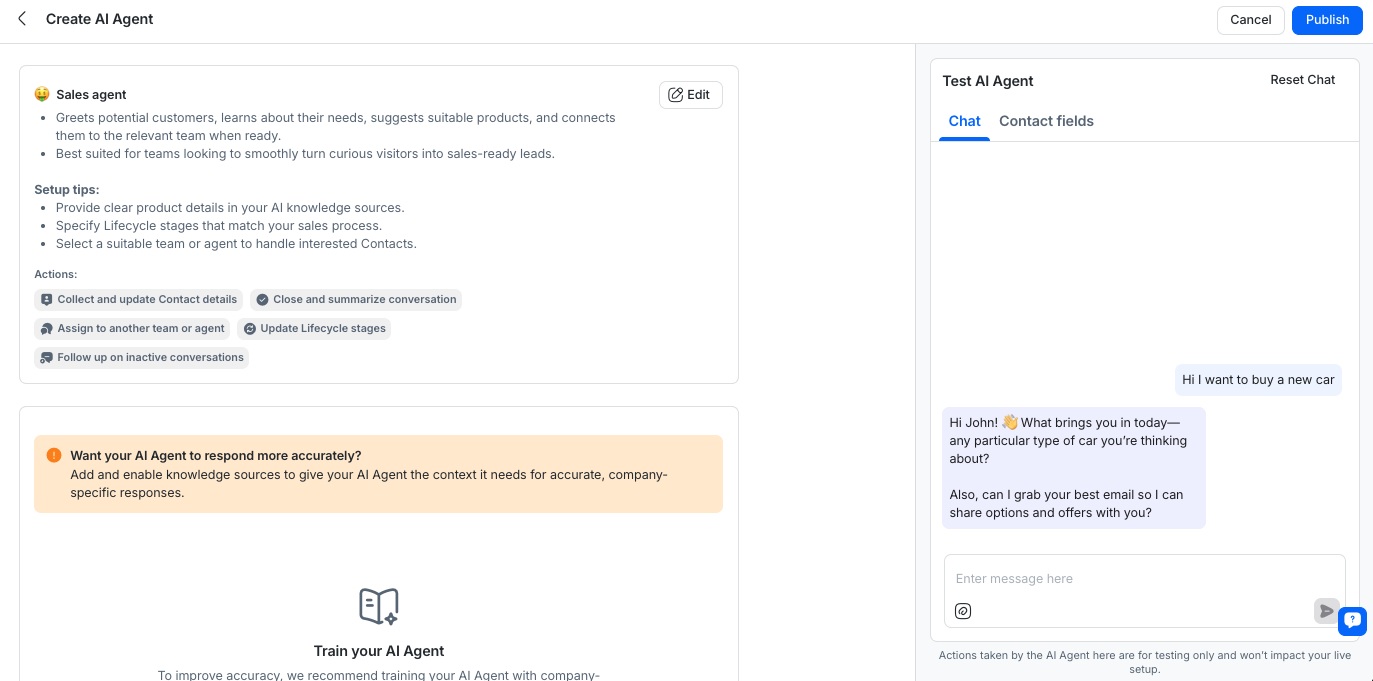
Advanced AI should be evaluated as execution, not as an add-on. Buyers should look for AI Agents that can qualify leads, collect missing details, update lifecycle stages, route conversations by intent and escalate high-value opportunities to a human with a clear summary. The strongest platforms keep AI Agents working consistently across the channels customers use, so context is not lost when a conversation moves between WhatsApp and other touchpoints.
A useful test is whether the AI can handle a conversation that changes direction midstream without falling back to rigid keyword replies. If a prospect asks a buying question, requests a callback or raises an issue before purchasing, the platform should keep context, trigger the right workflow and pass the conversation to the right team when needed. That is the difference between basic automation that only replies and AI that helps revenue teams keep sales moving.
Integrations with software stack
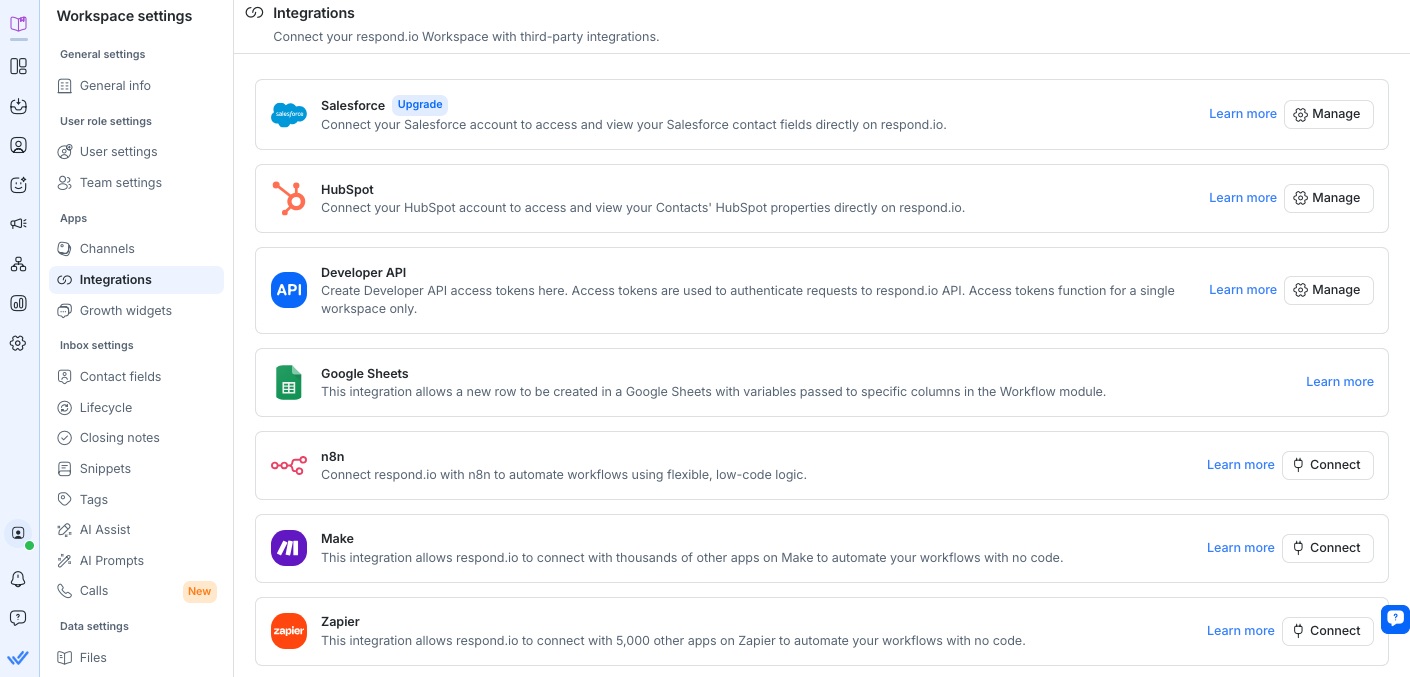
Integration depth has a direct effect on conversion and follow-up quality. Buyers should expect strong connections to core systems such as Shopify and WooCommerce for ecommerce, customer relationship management systems such as HubSpot and Salesforce and automation tools such as Zapier and Make.
A Shopify-first tool can be enough when the business sells through one store and mainly needs cart recovery, order updates and catalog workflows inside WhatsApp. The decision changes when the team also runs WooCommerce, sells across more than one system or wants the same conversation workflows to use cart data, order status and product information across sales, support and retention.
In that case, a more flexible customer conversation platform is the safer choice because it can connect store data to AI Agents, routing and follow-up journeys without forcing another migration as revenue operations expand.
The most useful integrations sync more than contact records. Buyers should look for unified customer profiles that combine purchase history, cart status, lead owner, lifecycle stage and interaction history in one view.
That data should also support segmentation by behavior or purchase history, bidirectional customer relationship management system sync and lifecycle stage updates so sales and marketing teams can qualify leads faster, prioritize follow-up and measure which conversations create revenue instead of just message volume.
Buyers should also check whether the platform can capture leads from Facebook and Instagram Click-to-WhatsApp ads, preserve the ad source and trigger instant qualification or routing when a paid lead starts a chat. When ad source, conversation data and conversion outcomes stay connected, revenue teams can see which campaigns create qualified conversations, sales opportunities and closed revenue instead of treating paid traffic as untracked chat volume.
Fast replies also cut cost: replying within 24 hours to a Click-to-WhatsApp ad chat opens a free entry point window lasting up to 7 days, and a Facebook Page WhatsApp button chat opens one for 72 hours.
Platform reliability
As message volume grows, uptime and onboarding quality both affect revenue. Buyers should confirm that the vendor supports official WhatsApp Business API setup, makes ownership of templates and billing clear and gives guidance on verificationsss, template submission and rejection handling so campaigns do not stall before launch.
Support quality should be tested as carefully as the product. Buyers should ask what onboarding help is included, when live support is available, whether migration assistance is hands-on, how template issues are escalated and what happens when routing, campaigns or calling workflows fail during busy periods.
Fast vendor support protects revenue because it shortens cutover delays, reduces lead leakage and keeps sales and support handoffs moving when volume spikes. For teams that expect ongoing automation changes after launch, respond.io backs its customer conversation platform with 24/7 human and AI support across all plans.
Predictable long-term costs
Entry pricing matters, but the monthly invoice usually has more than one layer. Buyers should model the platform subscription, Meta's WhatsApp fees, any vendor markup on those fees, added user or feature charges and paid automation or AI add-ons before they compare monthly totals.
Since October 2026, Meta also charges for service messages beyond 1,000 per phone number each month and for utility templates sent inside the 24-hour customer service window, so model support volume too.
That breakdown matters because campaign margin can shrink even when the headline plan looks affordable. A platform with Monthly Active Contacts pricing is easier to forecast for mid-market B2C teams because spend follows the contacts engaged in a month instead of stacking seat-based charges or workflow add-ons as teams scale.
Respond.io uses Monthly Active Contacts pricing, with Starter at $99 per month, Growth at $199 per month, Advanced at $349 per month and Enterprise pricing available on request. Buyers should still separate platform fees from Meta charges, but contact-based pricing gives leaders a clearer view of how conversation volume affects cost and profitability.
Turn customer conversations into business growth with respond.io. ✨
Manage calls, chats and emails in one place!
Zoko alternatives comparison table
Below is a quick overview to help you compare the top options.
Platform | Channels | Automation and AI | Pricing for mid-tier plans (paid monthly) | Customer ratings |
|---|---|---|---|---|
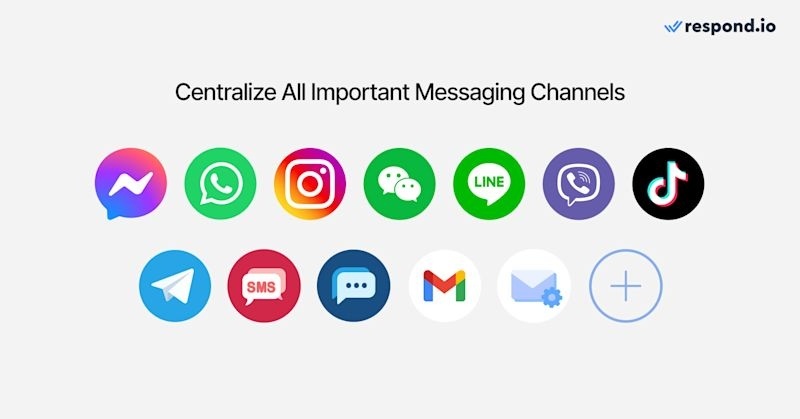
Respond.io | WhatsApp, WhatsApp Business Calling, Instagram, Facebook Messenger, Telegram, TikTok, webchat, SMS, voice, email, WeChat, Viber, LINE, custom channels | Advanced workflows, mature AI Agents and AI Assist | Growth plan: $199/month | G2 (4.8/5) |
Interakt | WhatsApp, Instagram | Basic simple flows and AI Agents via Haptik | Growth plan: $55/month | G2 (4.5/5) Capterra (4.4/5) |
Trengo | WhatsApp, Instagram, Facebook Messenger, email, voice, live chat | Solid workflow builder, AI Agent and automation | Pro plan: $695/month | G2 (4.3/5) Capterra (4.1/5) |
Wati | WhatsApp, Instagram, Facebook Messenger, WhatsApp Business Calling | Good WhatsApp automation and AI Agents | Pro ($149), with additional add-ons for users and AI | G2 (4.6/5) Capterra (4.6/5) |
SleekFlow | WhatsApp, Instagram, Telegram, Facebook, WeChat, Viber, LINE | Good flow builder and AI Agents | Premium plan: $349/month | G2 (4.6/5) Capterra (4.5/5) |
In other words, the table above points to a simple pattern:
Shopify/D2C retention teams should compare respond.io, Wati and SleekFlow for ecommerce integrations, cart recovery and post-purchase engagement workflows.
Omnichannel lead response teams should prioritize respond.io if they need broader channel coverage, advanced routing and AI-powered automation across WhatsApp, Instagram, TikTok, calls, email and web chat.
Support-heavy teams should consider Trengo for collaborative inbox workflows, while respond.io is stronger for teams that need support, sales and marketing automation in one customer lifecycle platform.
Budget WhatsApp-first teams may prefer Interakt or Wati for affordable entry points focused primarily on WhatsApp marketing and support.
5 best Zoko alternatives and competitors
Now let’s look at each Zoko alternative in more detail.
Respond.io (Best overall Zoko alternative)
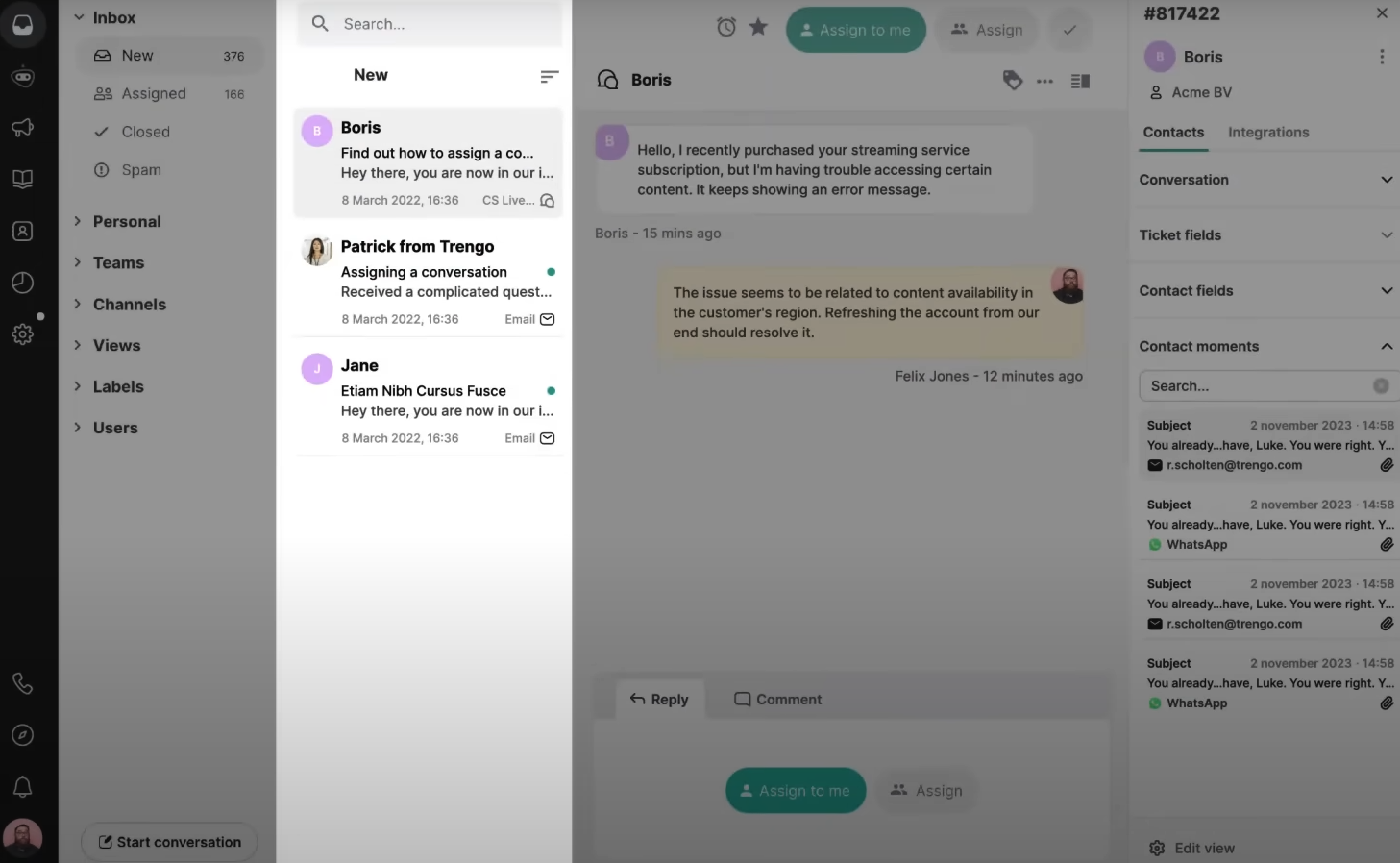
Respond.io is a customer conversation platform for mid-market B2C teams that need to manage high volumes of customer conversations across channels with routing, automation and lifecycle workflows. It’s designed specifically for scale, managing customers throughout their entire lifecycle journey.
Best for
Mid-market and growth-focused B2C businesses that need automation, mature AI, omnichannel coverage and enterprise reliability.
Respond.io pros
Supports all major channels and custom channels, including WhatsApp, TikTok, Facebook Messenger, Instagram, voice and web chat.
Supports deep integrations with HubSpot, Salesforce, Zapier, Make and more. Respond.io also offers voice channels like VoIP, Facebook Messenger calls and WhatsApp Business Calling API
Offers advanced workflows with conditional logic and routing.
Provides advanced AI Agents that handle both chat and calls. They are able to extract answers from the full company knowledge source.
Provides mature AI Assist that delivers fast, accurate responses that boost sales and support cases.
Provides customer lifecycle management to track, segment and engage customers across their full journey
Reliable, responsive customer support, including 24/7 human and AI assistance across all plans.
Respond.io cons
More advanced in setup, so if you only need a simple WhatsApp-and-Shopify inbox with basic broadcasts and no multi-team routing or multi-channel journeys, respond.io may be more platform than you need.
Enterprise-grade features may be more expensive for heavier volumes.
Respond.io pricing
Respond.io’s mid-tier plan starts at the Growth plan ($199 paid monthly), and total cost scales with monthly active contacts, users and add-ons as conversation volume grows. Enterprise plans can be customized based on your needs. With MAC-based pricing, you only pay for the contacts you interact with in a month.
Customer sentiment and rating
Sentiment highlights omnichannel support, workflow flexibility and great customer service quality. Customers also commend on quick implementation.
G2 (4.8/5 rating with 394 reviews)
Capterra (4.6/5 rating with 43 reviews)
Interakt
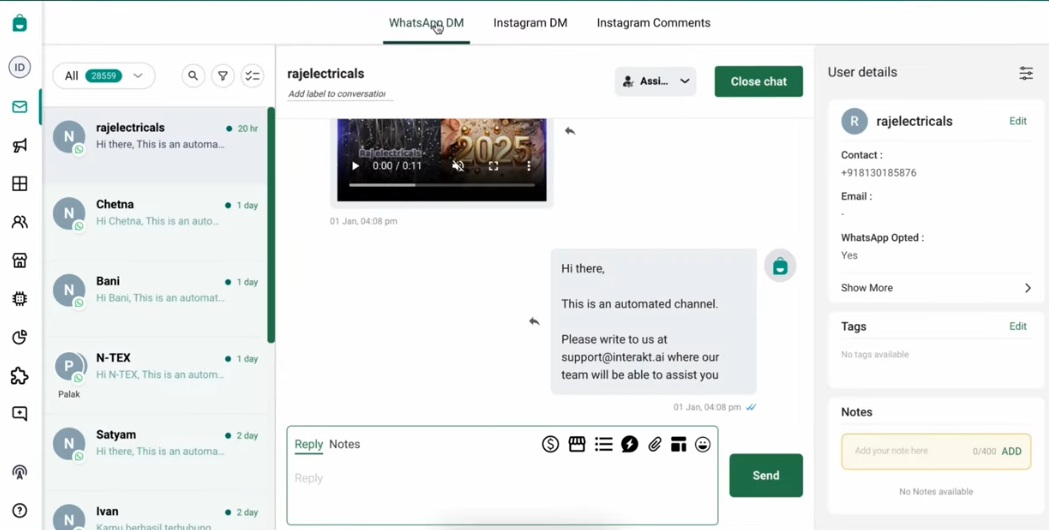
Interakt is a WhatsApp-first business CRM built for small businesses with emphasis on Instagram and AI Agents. It also offers simple automation, broadcasts and basic CRM features, while its shared inbox supports collaboration across teams.
Best for
Small businesses needing affordable WhatsApp and Instagram messaging with minimal friction and setup
Interakt pros
Low barrier to entry and quick setup, without heavy technical setup.
Shared team inbox which allows agents to handle messages collaboratively.
Offers AI Agents via Haptik.
Interakt cons
WhatsApp-first with limited channel coverage. It has expanded to Instagram, but teams that need TikTok, calls, email, web chat or broader social messaging may struggle to manage all customer conversations in one place.
Interakt AI Agents are still new, so teams with complex sales or support workflows may need more testing before relying on them for high-volume automation.
Not designed for large-scale operations, so high concurrency, large broadcast volumes and multi-team workflows may create bottlenecks as the business grows.
Interakt pricing
Interakt offers two types of tiered plans, and total cost can rise as you add seats or choose separate feature hubs for marketing, support and sales use cases. Its “Marketing & Support Hub” Growth plan starts at $55 paid monthly, while its “Sales CRM” Starter plan starts at $49 paid monthly and prioritizes lead tracking and sales pipeline management.
Customer sentiment and ratings
Customers praise it for affordability and ease of use, but limited in automation depth.
G2: (4.5/5 rating with 63 reviews)
Capterra: (4.4/5 rating with 12 reviews)
Trengo
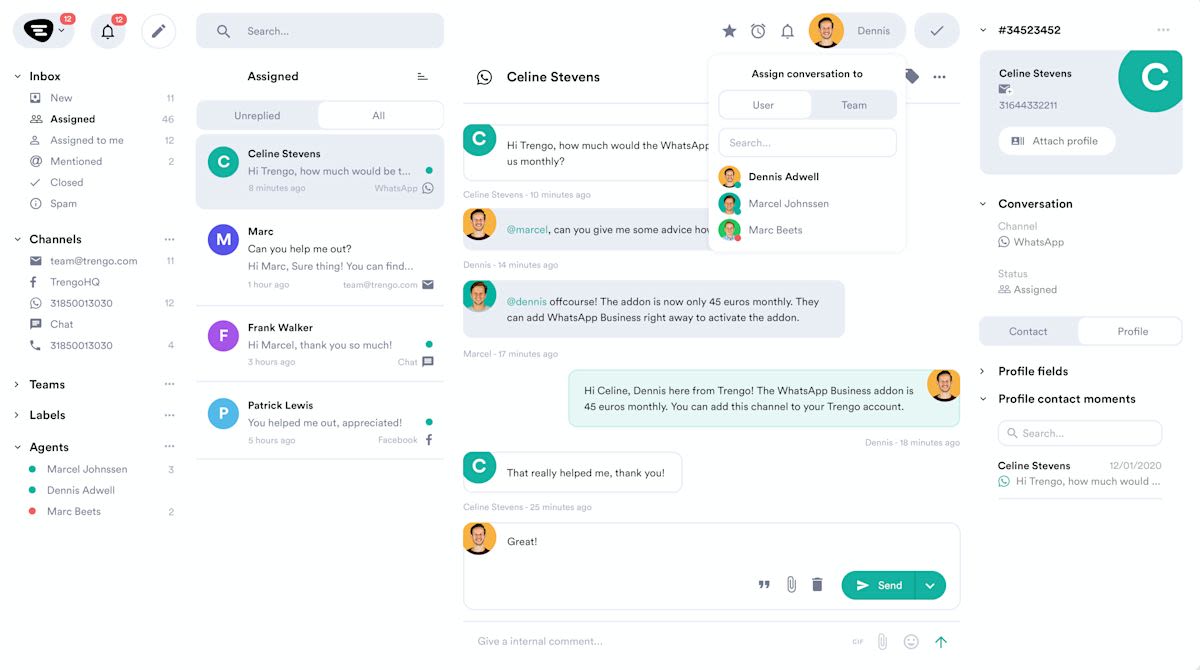
Trengo is an omnichannel shared inbox platform built around collaboration and team alignment.
Best for
Customer support teams that prioritize collaboration.
Trengo pros
Multi-channel support such as WhatsApp, Instagram, Facebook Messenger, email, SMS and more, including VoIP.
Supports CRM integration such as HubSpot, Salesforce, Shopify, Magento and WooCommerce.
Provides AI Agent to automate conversations and workflows.
Strong shared inbox features and good for internal collaboration.
Trengo cons
Pricing plans are above average, which can make Trengo expensive for growing teams that need more users, broadcasts or voice capabilities.
No support for WhatsApp Business Calling API, which limits teams that want to manage WhatsApp chats and calls in the same customer workflow.
Automation is less advanced and may not support complex sales, marketing or lifecycle journeys without manual workarounds.
Customer support has limited availability around Central European working hours, which can slow issue resolution for teams operating across regions.
No native mobile app — replaced with a browser-based PWA in 2025.
Trengo pricing
Trengo has higher-tier pricing, and total cost can increase further with additional seats, broadcasting, voice and other add-ons as usage scales. Its Pro plan starts at $695 paid monthly, and higher plans scale significantly.
Customer sentiment and rating
Users cite its organization and ease of use.
G2 (4.3/5 rating with 243 reviews)
Capterra (4.1/5 rating with 26 reviews)
Wati
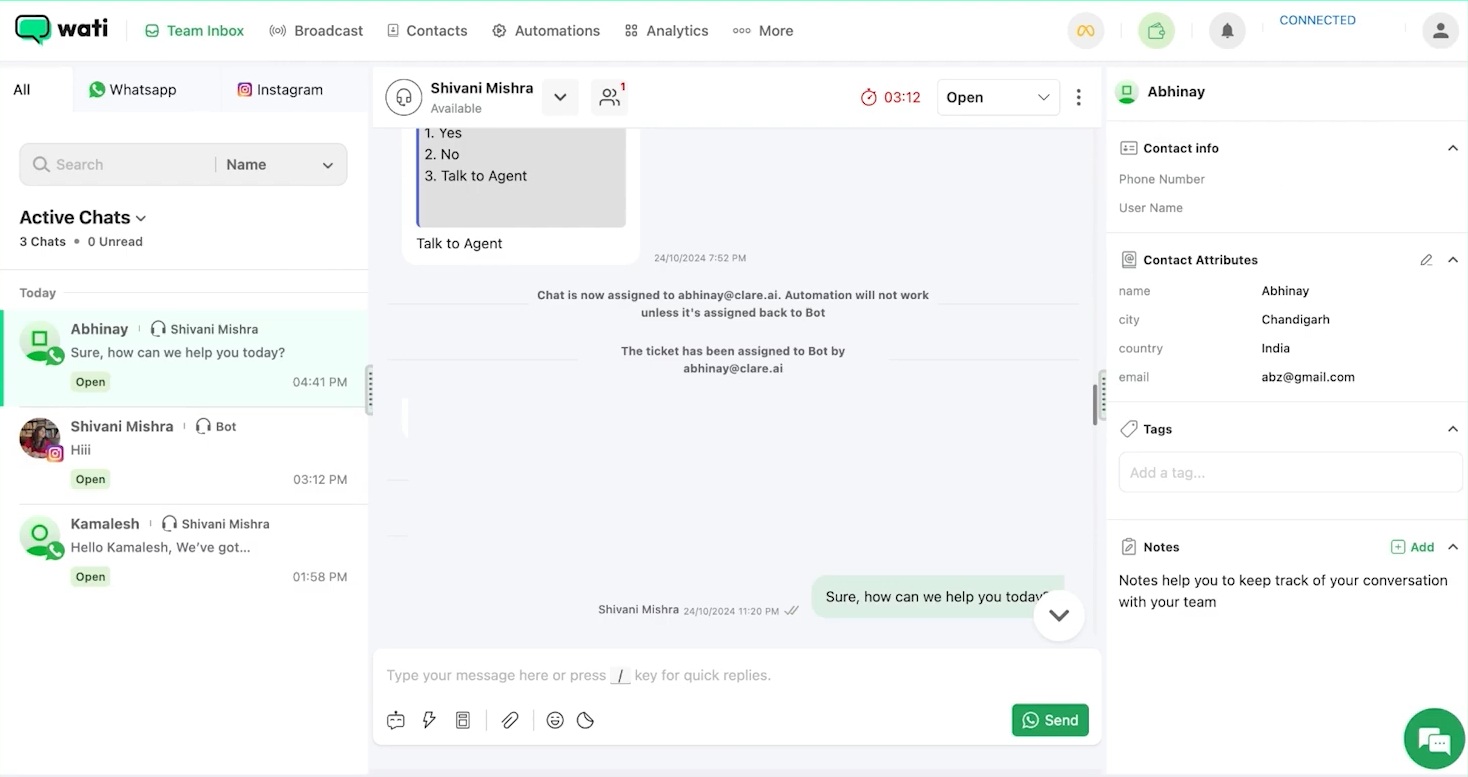
Wati is a WhatsApp-first engagement tool offering simple automation and accessible pricing.
Best for
Budget-conscious small businesses with a WhatsApp-first strategy, focused on marketing and support cases.
Wati pros
Even though it’s WhatsApp-first, it also supports Instagram and Facebook Messenger.
Affordable, ideal for budget-friendly businesses.
Good WhatsApp features such as WhatsApp Catalog and WhatsApp Broadcasts.
Good basic workflows to send instant replies, including chatbots.
Offers AI Agent to automate conversations.
Wati cons
Not a full omnichannel platform, so teams expanding beyond WhatsApp, Instagram and Facebook Messenger may need separate tools for other customer channels.
Adds markup on WhatsApp API charges set by Meta, which can make messaging costs less predictable as volume grows.
Not ideal for scaling teams because add-ons, such as additional Astra AI Agents, can pile up as automation needs increase.
Wati pricing
Wati has a lower entry tier, with the Pro plan starting at $149 paid monthly, but total cost can climb with extra seats, AI add-ons and WhatsApp API markup as volume increases.
Customer sentiment and rating
Users commend ease of use and automation features.
G2 (4.6/5 rating with 421 reviews)
Capterra (4.6/5 rating with 185 reviews)
SleekFlow
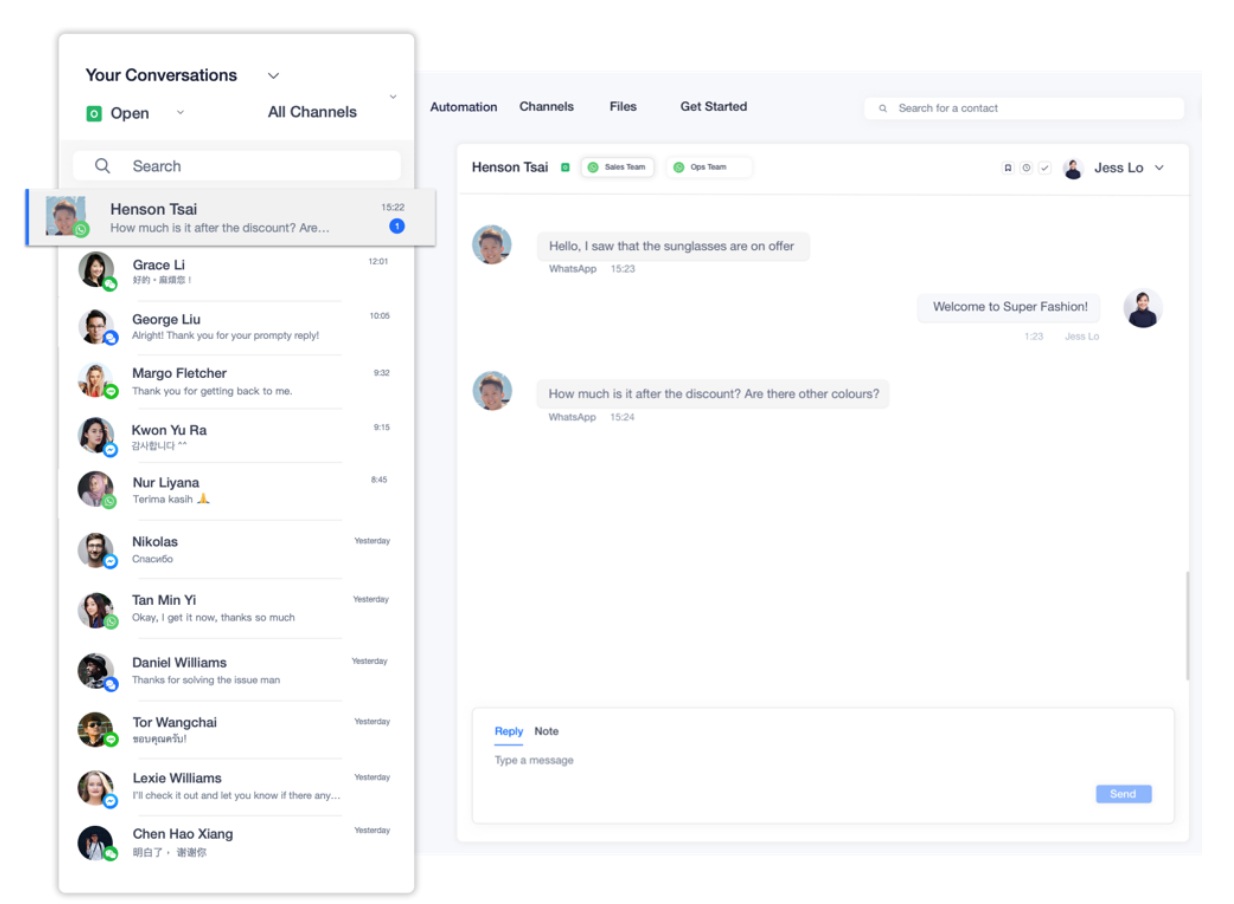
SleekFlow is a multi-channel customer engagement platform popular in Asia, with ecommerce-focused features and automation capabilities.
Best for
Low-volume businesses that need social messaging, a structured omnichannel inbox and AI-powered automation.
SleekFlow pros
Clean omnichannel inbox and supports major channels such as WhatsApp, Instagram, Facebook Messenger, Telegram and SMS.
Ecommerce-focused native integrations with HubSpot, Salesforce and Shopify. It also integrates with other software via Make and Zapier.
AI Agent “AgentFlow” is capable of interacting with customers to conversion based on your company’s knowledge sources.
SleekFlow cons
Some channels are not available such as WhatsApp Business Calling API.
SleekFlow offers email and chat support on standard plans, but some customers have reported issues with support quality. This is reflected in the case study of GETUTOR, an education business that switched from SleekFlow to respond.io after struggling with slow and unhelpful technical support.
Users have reported slow load times due to bandwidth-heavy file handling (G2).
SleekFlow pricing
SleekFlow's Premium plan starts at US$349/month (10 users, starting at 1,000 monthly active contacts) on a Monthly Active Contacts model, with WhatsApp Business API numbers billed separately at US$15/month each. Enterprise pricing is available on request.
Customer sentiment and rating
Customers praise it for user-friendly inbox features.
G2 (4.6/5 rating with 188 reviews)
Capterra (4.5/5 rating with 4 reviews)
Free Trial Availability
Before committing to a platform, most revenue-focused B2C teams want to test automation quality and inbox usability firsthand. Here’s how each alternative handles trial access:
Platform | Free Trial | Trial Length | Credit Card Required |
|---|---|---|---|
Respond.io | Yes | 7 days | No |
Interakt | Yes | 14 days | No |
Trengo | Yes | 14 days | No |
Wati | Yes | 7 days | No |
SleekFlow | Yes | 7 days | No |
For teams evaluating multiple options, starting with a free trial lets you validate workflow depth, AI quality and inbox experience before entering a sales cycle.
E-commerce depth matters if you sell through WhatsApp
For teams running WhatsApp commerce, native ecommerce depth determines how much revenue you can recover and grow. Here’s how each platform compares:
Platform | Native Shopify Integration | Abandoned Cart Recovery | Order Notifications | Catalog Sync | Upsell/Cross-sell Support |
|---|---|---|---|---|---|
Respond.io | Yes, via integrations | Yes | Yes | Yes | Yes |
Interakt | Yes | Yes | Yes | Yes | Limited |
Trengo | Yes | Limited | Yes | No | No |
Wati | Yes | Yes | Yes | Yes | Limited |
SleekFlow | Yes | Yes | Yes | Yes | Yes |
Teams focused on D2C retention should prioritize platforms that support automated cart recovery, product recommendations and post-purchase flows inside WhatsApp conversations.
Pricing Transparency & Hidden Costs
Finally, before making a decision, note that entry pricing tells only part of the story. Here’s what to watch for as your team scales:
Platform | Billing Model | WhatsApp Fee Markup | Known Add-ons | Cost Scales By |
|---|---|---|---|---|
Respond.io | Monthly Active Contacts | No markup | Users, add-on features | Contacts engaged |
Interakt | Tiered plans | Possible markup | Users, advanced features | Plan tier |
Trengo | Per-user + add-ons | No markup | Users, broadcasting, voice | Users + features |
Wati | Tiered plans | Yes | Users, AI agents | Plan tier + add-ons |
SleekFlow | Monthly Active Contacts | No markup | WhatsApp phone number hosting | Contacts engaged |
When forecasting costs, check whether the platform charges per user, per contact or per feature. Watch for WhatsApp API markups and add-on fees that can increase spend as message volume grows.
Verdict: Which Zoko alternative is best?
Choose respond.io when you need multi-channel scale, advanced routing and automation, and mature AI Agents with reliable performance. Choose Interakt or Wati if you are WhatsApp-first with simpler workflows and a smaller budget. Choose Trengo if your priority is support inbox collaboration, and choose SleekFlow if you need ecommerce and social messaging workflows in-region.
All of them provide automation and AI to some extent, but respond.io is the best fit when you need deeper automation, omnichannel customer journeys, mature AI Agents, high message volume support and enterprise-grade reliability.
Respond.io offers more flexible and advanced workflow logic, a unified inbox for every channel, and predictable long-term costs — all supported by 24/7 support. This is why scaling teams upgrade from Zoko to respond.io across every step of the customer journey.
If respond.io fits your use case, book a demo or start a free trial to validate omnichannel routing, automation and AI workflows with your real team setup.
Turn customer conversations into business growth with respond.io. ✨
Manage calls, chats and emails in one place!
FAQs about Zoko alternatives
What is the best Zoko alternative for growing teams?
The best Zoko alternative depends on your business goals, channels and growth plans.
For most growing B2C teams that are expanding beyond WhatsApp commerce, respond.io is the best Zoko alternative. It supports omnichannel messaging, advanced workflows, mature AI Agents and enterprise-grade reliability, making it well-suited for teams preparing to scale.
How should buyers compare two WhatsApp-first options?
When comparing two WhatsApp-first options, buyers should look past entry price and check workflow depth, channel expansion, account ownership and how costs change once volume rises.
If the team expects to stay narrow and only needs simple WhatsApp workflows, a WhatsApp-first option may be enough. If the business is already outgrowing a Shopify-first setup and needs broader channel coverage, AI Agents and lifecycle routing, respond.io is usually the stronger long-term move.
Which alternative is best for Shopify abandoned-cart recovery?
For Shopify abandoned-cart recovery, the strongest option is the one that can trigger reminders from cart events, send payment links, share relevant products and route high-intent replies to sales without losing conversation context.
For mid-market B2C teams, respond.io is a strong fit because AI Agents and workflows can qualify shoppers, trigger follow-up sequences and hand off to a human when a buyer is ready to complete checkout. Buyers should also confirm whether the platform supports catalog-based product sharing, order data and post-purchase follow-up rather than just a single reminder message.
Which alternative is best for cash on delivery confirmation?
For cash on delivery confirmation, the best platform is the one that can send confirmation requests automatically, branch based on the customer's reply and route exceptions to a human before the order fails.
Respond.io is a strong fit for mid-market B2C teams because AI Agents and workflows can handle confirmation, collect missing details and escalate high-value orders when manual follow-up is needed.
Which alternatives support payment workflows like cash on delivery confirmation and payment reminders?
Payment workflows need more than a single reminder. Buyers should look for journeys that can send cash on delivery confirmation, payment links, reminder sequences and post-reply routing from the same workflow.
Respond.io is a strong option when those flows need conditions, lifecycle updates and handoff logic across WhatsApp and other key messaging, social, voice and email channels rather than one-off messages.
Which alternatives support customer relationship management and lifecycle management?
The strongest options are the ones that combine messaging with unified customer data, lifecycle stage tracking and follow-up automation. Buyers should look for one profile that shows conversation history, purchase context, lead owner and current stage so teams can prioritize the right contacts and measure revenue impact.
respond.io is a strong fit for mid-market B2C teams because AI Agents and workflows can qualify leads, update lifecycle stages and route conversations using that context.
Which alternative is best for Shopify-first teams?
For Shopify-first teams, the best fit is the platform that can turn cart events, order updates and catalog data into two-way WhatsApp conversations without heavy manual work.
For mid-market B2C teams, respond.io is usually the stronger long-term choice when Shopify workflows also need AI Agents, routing and follow-up across WhatsApp and other key messaging, social, voice and email channels. A narrower store-first option can still work if the team only needs simple cart recovery and post-purchase messaging.
Why do businesses switch from Zoko?
Teams switch once they need more channels, deeper automation, better AI or predictable scale. Zoko works well for early-stage Shopify businesses, but mid-market teams often outgrow its limits.
At that stage, platforms like respond.io becomes a natural next step. Respond.io offers broader channel support, more advanced automation and better infrastructure for growth.
How should buyers compare platform pricing before switching?
Buyers should look beyond the entry plan and model how costs change as contacts, channels and automation usage grow. The main checks are billing model, messaging markup, charges for added users or advanced workflows and whether support or integrations sit outside the base plan.
For teams expecting higher campaign volume and more complex routing, a Monthly Active Contacts model is usually easier to forecast than pricing that rises with every conversation or add-on. Respond.io uses Monthly Active Contacts pricing, with Starter at $99 per month, Growth at $199 per month, Advanced at $349 per month and Enterprise pricing available on request.
Why can a WhatsApp bill end up higher than the platform subscription?
A higher bill usually means the subscription is only one part of total cost. Teams may also pay Meta's WhatsApp messaging fees, vendor markup and add-ons for capabilities such as AI or extra usage. Meta also charges for service messages past 1,000 per phone number a month and for utility templates sent inside the 24-hour window, so support volume adds to the bill too.
Before switching, leaders should ask for a full cost model that separates platform fees, Meta charges and any markup so monthly spend can be forecast as contact volume and campaign activity grow.
Should buyers treat a free plan as a major deciding factor?
For mid-market B2C teams, a free plan is usually less important than realistic trial access and clear long-term pricing. The better test is whether the vendor lets the team validate routing, automation, reporting and rollout fit before committing.
Respond.io does not offer a free plan, but it does offer a 7-day free trial and Monthly Active Contacts pricing. That makes it easier to test real workflows and forecast costs before rollout.
Do Zoko alternatives provide official WhatsApp Business API access and template approval support?
Not always. Buyers should confirm whether the provider supports official WhatsApp Business API onboarding, helps connect the WhatsApp Business Account and Meta Business Manager correctly and gives clear guidance on template submission, rejection handling and verification steps when needed.
For mid-market B2C teams, this matters because weak onboarding can slow launch readiness and create avoidable friction before campaigns go live. respond.io is a strong benchmark because the customer conversation platform supports official WhatsApp setup and gives teams a clearer path from number onboarding to template readiness. Buyers should ask every vendor who owns the account, what approval support is included and what happens if templates are rejected.
Which Zoko alternative supports true omnichannel messaging?
True omnichannel messaging requires one workspace that natively supports multiple channels and keeps conversation context unified for routing and reporting. Respond.io and Trengo both offer broad channel coverage, but respond.io is typically a better fit when you need deeper workflow automation and AI for high-volume operations.
Which alternative is best for WooCommerce or multi-store teams?
Teams using WooCommerce or more than one commerce system should prioritize flexibility over a narrow single-store setup. The right platform should sync order status, cart context and customer data into routing and follow-up workflows so sales and support do not work from separate records.
For mid-market B2C teams, respond.io is usually the safer choice when WooCommerce needs to work alongside customer relationship platform, lifecycle workflows and additional channels.
Which platform is most scalable or future-proof?
A platform that scales well and is future-proof is one that supports multiple channels, handles high message volume, offers advanced automation and provides clear reliability guarantees.
Respond.io is built with these in mind. It offers enhanced workflows, advanced AI and integrations that support long-term growth. Respond.io also offers a published 99.999% uptime and dedicated infrastructure, so that you can handle complex operations with less risk.
What hidden costs should buyers check before choosing a platform?
The most common surprises are charges tied to added users, automation add-ons, premium support, messaging markup and usage limits that force upgrades as volume grows. Buyers should also check whether campaign tools, AI features or integrations are priced separately from the main plan.
Predictable pricing matters because revenue teams need to forecast spend as more contacts move through sales, support and retention workflows. Respond.io also offers a 7-day free trial, which helps teams test routing, AI Agents and workflow depth before committing to a paid plan.
Can I switch from Zoko without losing my WhatsApp number?
Yes. Your number stays in your own WhatsApp Business Account, so switching doesn't require migrating it, but buyers should still treat the switch as a checklist.
Before signing, confirm Meta Business Manager access and who owns the templates and billing account. Templates don't carry over automatically, so document which approved templates need to be moved or recreated, export contacts…
Teams should also check how catalog setup, CRM sync, lifecycle stages and reporting continuity will be rebuilt or preserved after cutover. The safer move is the provider that can map these items before launch so sales, support and retention journeys keep running without dropped leads or stalled handoffs.
What should onboarding include when switching from Zoko?
Strong onboarding should cover number migration guidance, contact and template import, conversation history expectations, CRM or ecommerce integrations, reporting continuity and rebuilding the workflows that protect pipeline continuity, such as lead routing, follow-up sequences and escalation rules.
The best providers also help teams map lifecycle stages, assignment logic, channel setup and agent training before launch so sales and support can go live with minimal disruption. Clear implementation guidance matters because a fast technical migration alone does not protect revenue if conversations, ownership rules, reporting or follow-up journeys break during the switch.
How do Zoko alternatives handle WhatsApp opt-ins and bulk messaging compliance?
Look for platforms that provide opt-in capture tools to help you collect and store consent before sending broadcasts.
This is critical for maintaining deliverability and avoiding blocked messages. Strong platforms should track opt-in status per contact, support double opt-in flows and make it easy to manage unsubscribes. Clean consent records protect your sender reputation, improve campaign reach and ensure your broadcasts reach customers who actually want to hear from you.
How long does it usually take to migrate to a new platform?
The timeline depends on what needs to move with the number. A simpler migration with limited templates and workflows is usually faster than a setup that also includes CRM sync, catalog data, routing rules, AI Agents and reporting continuity.
Before committing, buyers should ask the provider to scope the migration in stages: number ownership and WhatsApp Business Account access, templates and contacts, critical workflows, integrations and cutover support. A clear migration plan matters more than a promised speed because it reduces the risk of lost leads, broken follow-up journeys and campaign delays.
Which alternative is best for AI automation and lead qualification?
For mid-market B2C teams, the strongest option is the platform where AI Agents can qualify leads, collect missing details, update lifecycle stages, route conversations by intent and escalate high-value opportunities with a clear summary for handover.
Respond.io is usually the best fit when AI needs to execute across WhatsApp and other key messaging, social, voice and email channels rather than only assist with replies. Buyers should test whether the AI can keep context, trigger the right workflow and hand conversations to sales or support without manual cleanup.
Which alternative is best for WhatsApp campaign automation and segmentation?
The better choice is the platform that can do more than send a broadcast. Buyers should look for audience segmentation by lifecycle stage, purchase behavior, lead source and engagement history, plus workflows that turn replies into qualification, routing and follow-up.
Respond.io is a strong fit for mid-market B2C teams because AI Agents and workflows can launch targeted campaigns, continue the conversation after the first message and route high-intent contacts to the right team. That helps marketing spend create qualified conversations instead of disconnected message volume.
Further reading
If you've found this article interesting, have a look at:


