
















 Electronics
 Fashion & Apparel
 Furniture
 Jewelry and Watches
 Afterschool Activities
 Sport & Fitness
 Beauty Center
 Dental Clinic
 Medical Clinic
 Home Cleaning & Maid Services
 Photography & Videography
 Car Dealership
 Travel Agency & Tour Operator


TL;DR - What is the Best AI Sales Automation Software?
There is no single "best" AI sales automation software, as the ideal choice depends on specific needs. They help businesses streamline sales workflows across multiple channels, from lead qualification and outreach to engagement and pipeline management. Here’s a quick comparison of top platforms and their strengths:
Respond.io: Medium to large B2C businesses that want to merge conversations across messaging channels and calls. Ideal for AI-powered conversations, lead qualification, broadcasts, scheduling and workflow automation.
Kommo & SleekFlow: Multichannel messaging with automation and AI features for businesses.
Apollo, Reply.io, Regie.ai & Braze: Automate multi-touch outbound outreach via email, LinkedIn and phone. Suitable for cold outreach, multi-channel engagement, CRM workflows, broadcasts and analytics.
Dialpad Sell, Trellus & Momentum: Focus on voice calls, real-time AI coaching, and enterprise-level engagement. Perfect for sales coaching, call analytics, AI-assisted workflows and campaign management.
What is AI sales automation software?
An AI sales automation software uses artificial intelligence to automate repetitive tasks, analyze data, and streamline workflows to boost sales efficiency. Common functions include:
Lead generation and qualification
Answering product questions
Recommending products
Updating contact records
Routing or assigning contacts and handing off to humans
Lead prospecting
AI-driven lead research
Intent detection
Unlike other traditional automation tools, AI systems learn from data and outcomes, helping sales teams predict customer behavior, personalize outreach and close deals faster.
Benefits of AI sales automation software
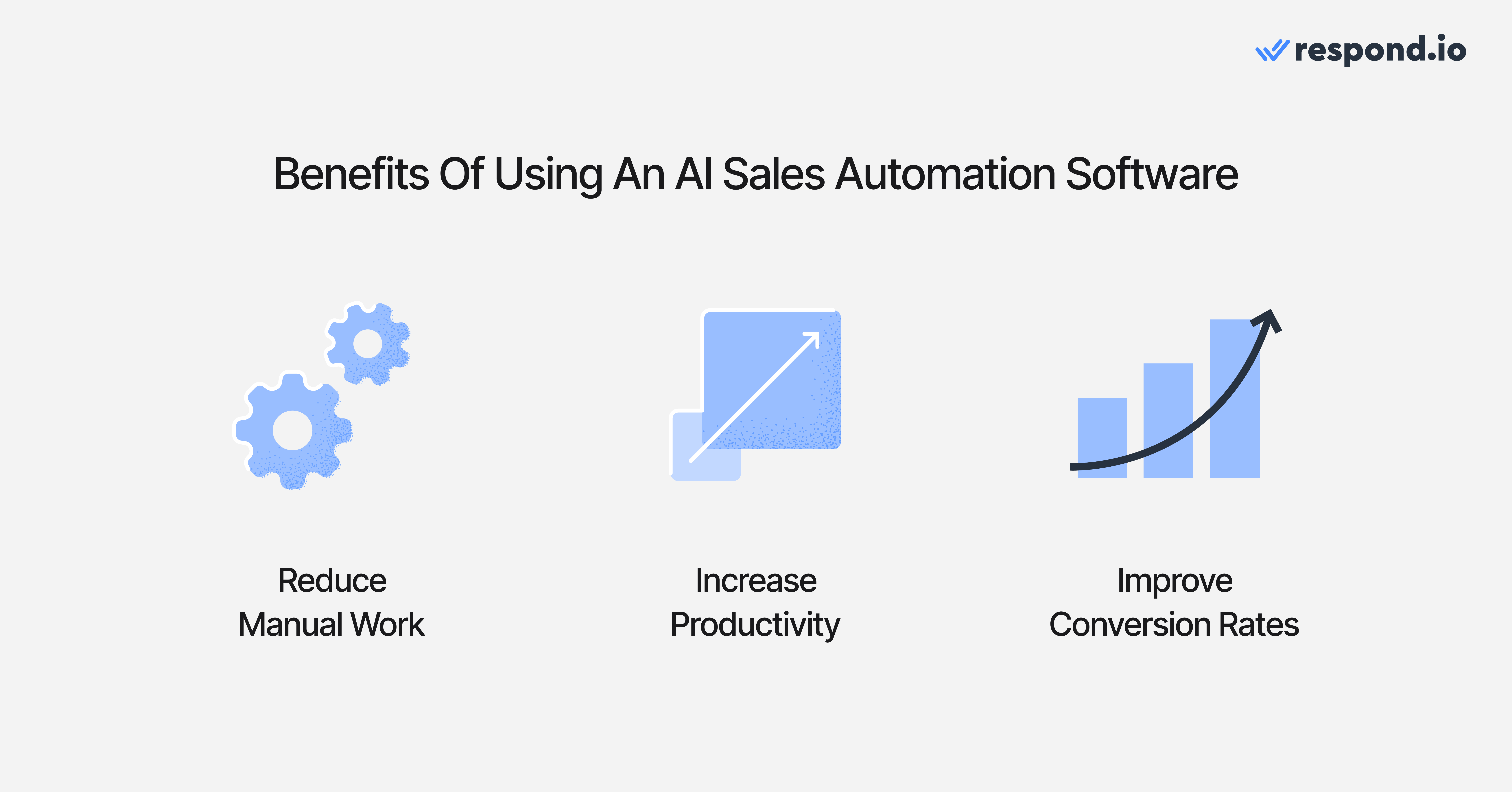
AI-powered sales automation tools give businesses a major edge. These are some of the benefits of using them.
Reduce the manual work of time-consuming tasks such as asking qualifying questions, updating CRM records, logging call notes and scheduling follow-ups. Instead of juggling multiple tools or doing administrative work, sales reps can spend their time nurturing relationships and closing deals.
Increase productivity not only by freeing sales reps from repetitive tasks but also by amplifying their impact in innovative ways. For instance, AI can suggest the optimal responses and generate context-aware outreach or follow-up messages. This keeps the sales pipeline moving efficiently while letting reps focus on high-value interactions.
Improve conversion rates with data-backed personalization and predictive lead scoring. By analyzing customer intent, engagement history and behavioral patterns, AI helps sales teams with relevant responses, more meetings booked and higher conversion rates.
What makes a good AI sales automation software
The ideal AI sales automation should have strong integration with your existing tech stack to ensure correct data flow across CRM, marketing and communication tools.
It should also automate repetitive work and provide actionable insights that help your team close more deals efficiently. Here’s what to look for:
1. Autonomous AI agents
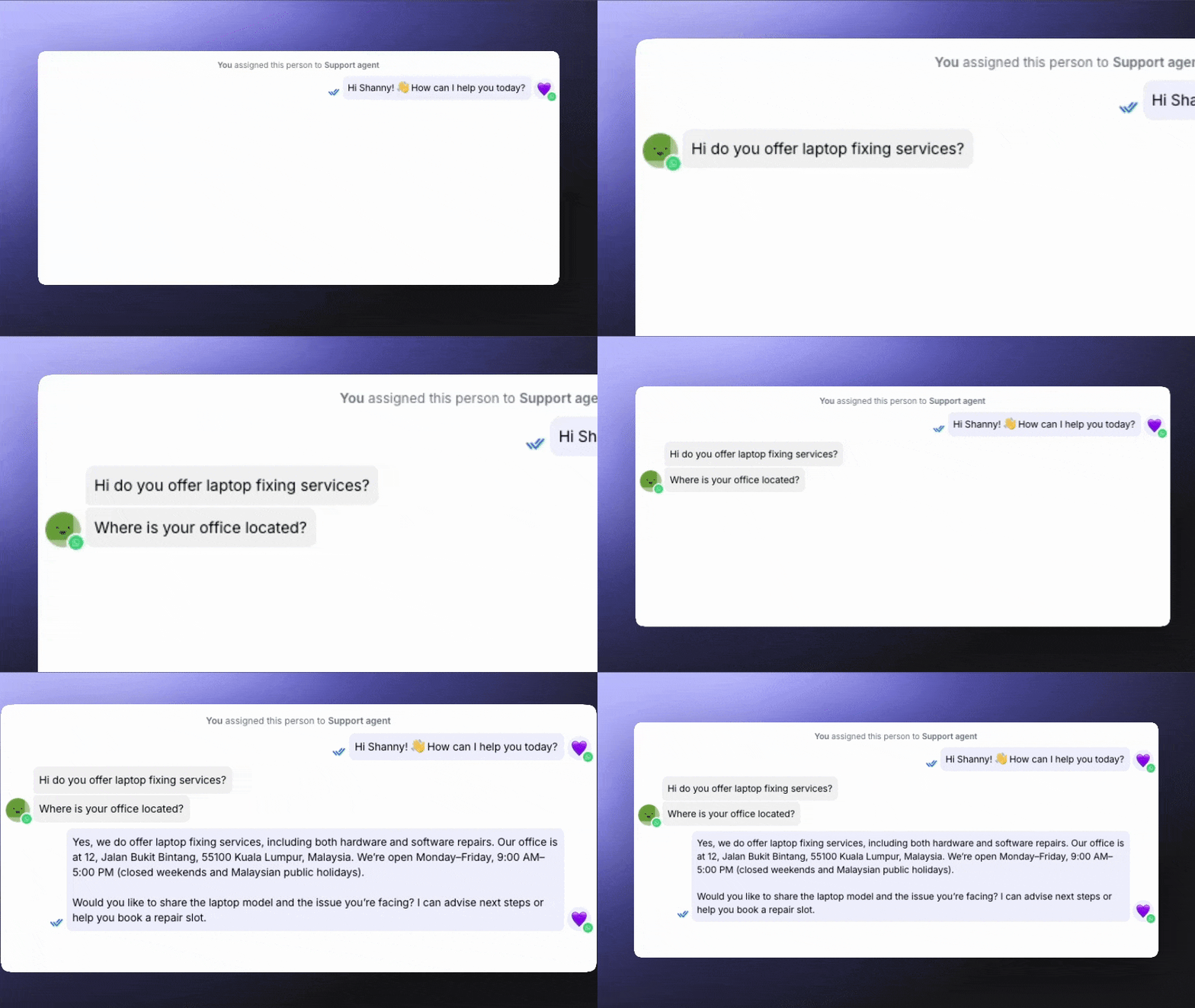
Modern AI agents go far beyond traditional chatbots. Instead of just answering FAQs, they can take actions like sending payments or booking links, updating CRMs, qualifying leads automatically and handling live calls all on their own. These autonomous agents act as full-fledged digital sales assistants, guiding customers through the funnel and ensuring conversations translate into conversions.
Sales automation also relies on internal notes. AI Agents can leave internal comments that capture context automatically, removing manual logging and helping sales teams act faster. AI Agents also read richer message types, including WhatsApp catalog products and orders, card carousels and quick replies.
2. AI training features
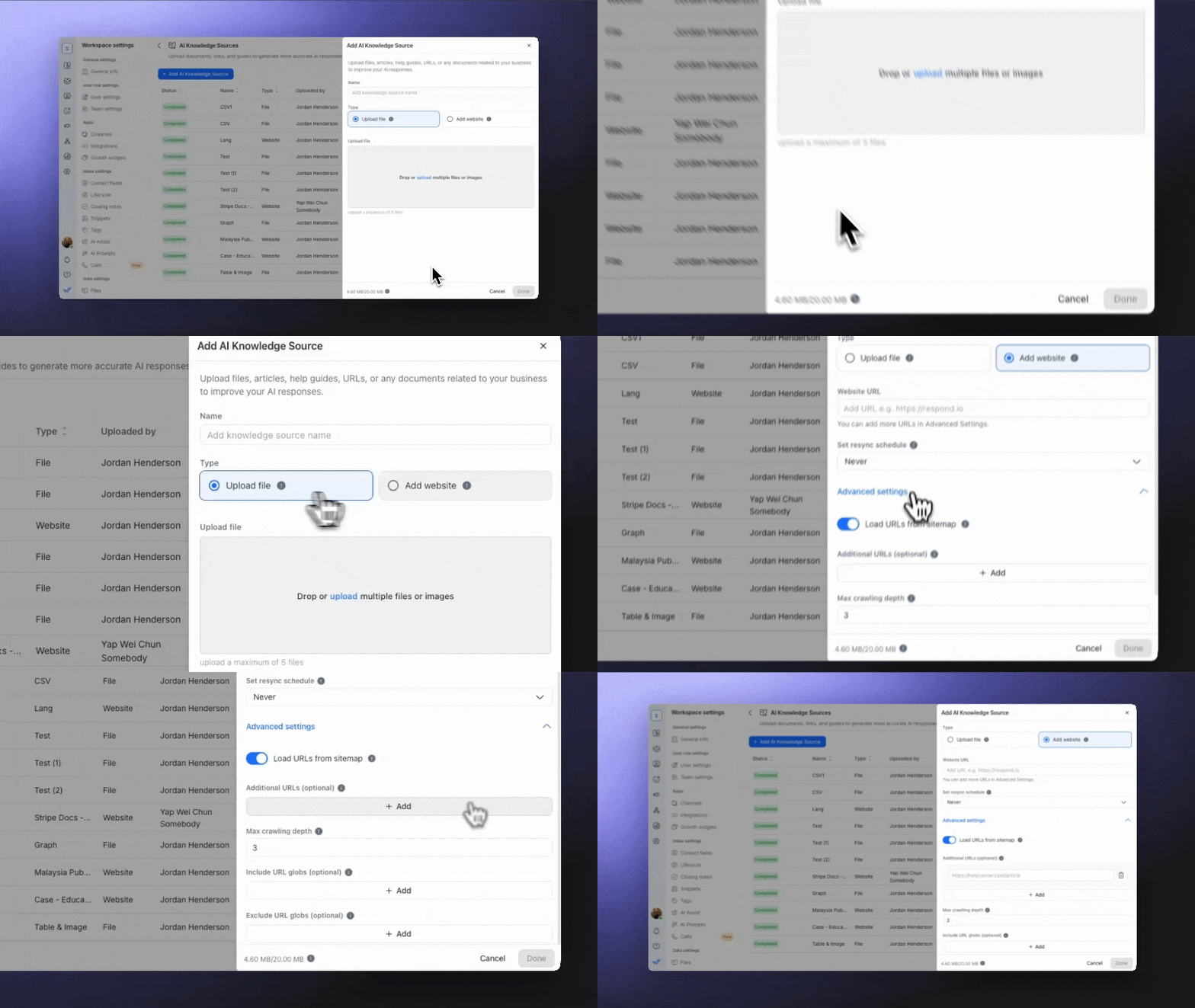
The best AI platforms let you train models on your own business data, such as documents, FAQs, websites, and internal playbooks.
This allows the AI to deliver brand-aligned, contextually accurate answers while preserving your company’s tone and expertise.
3. AI-powered message composition
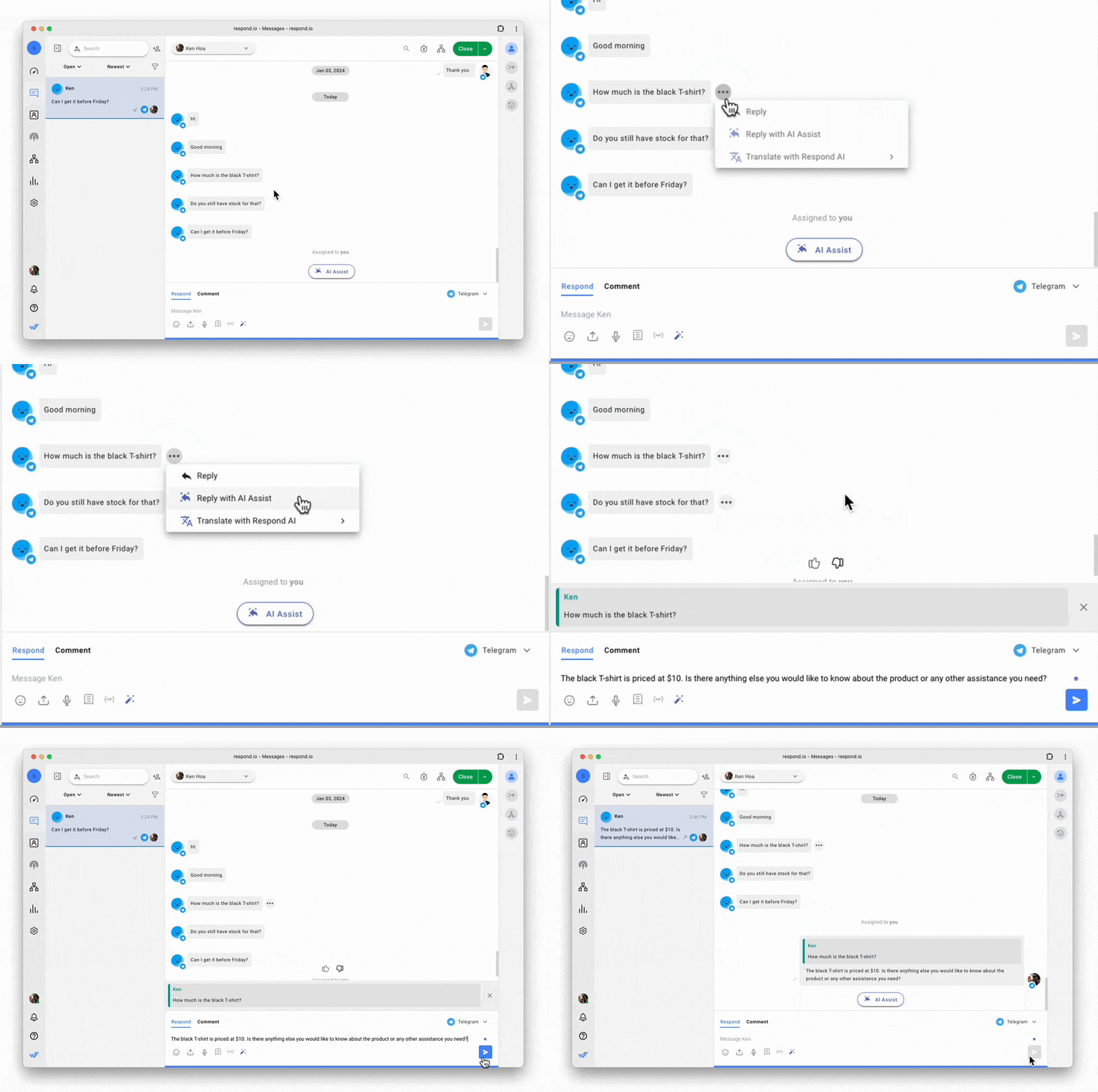
AI can help craft and personalize messages at scale. From drafting contextual responses to suggesting the most effective message tone or content for a specific lead, these features ensure every communication feels human and relevant.
4. AI-assisted lead management
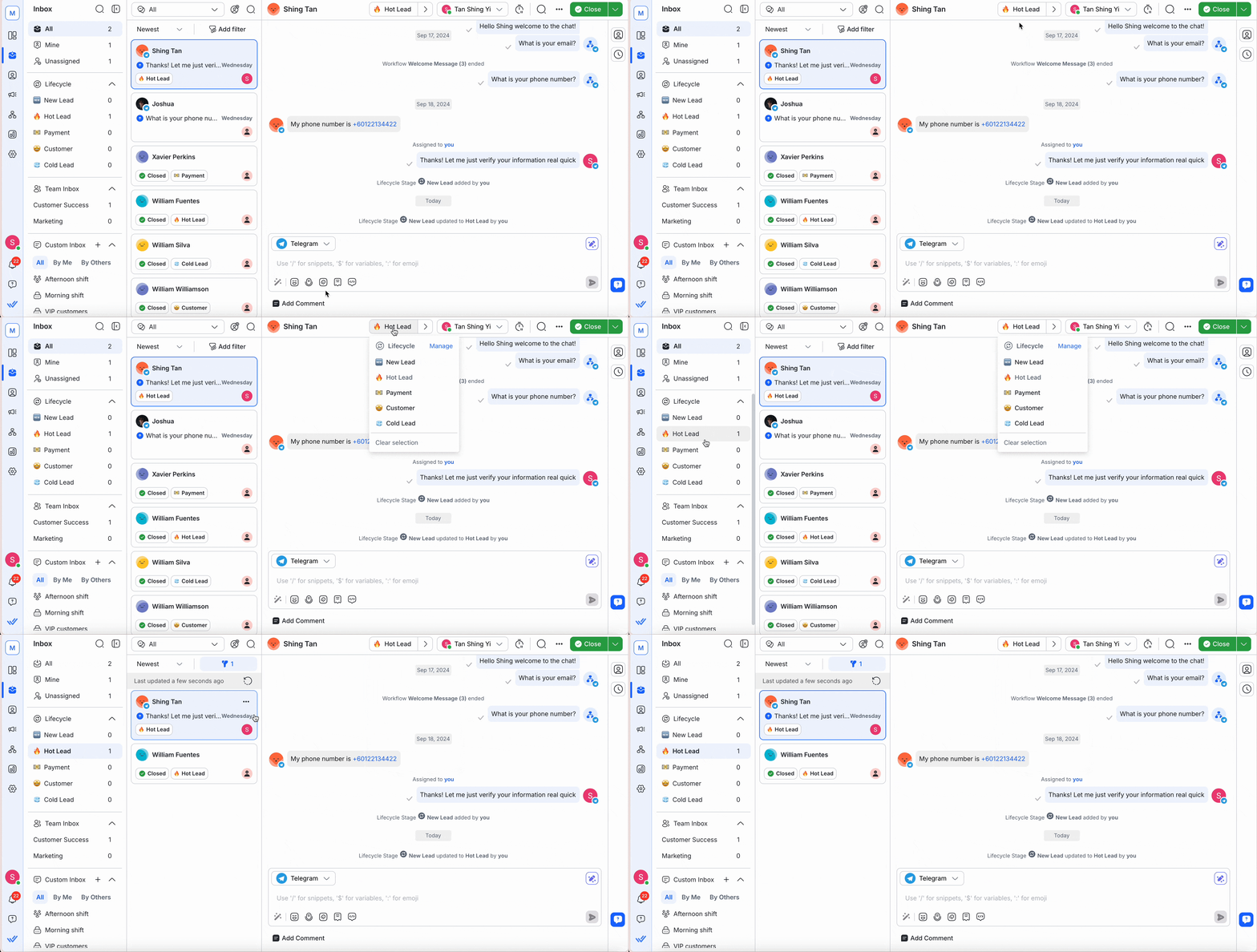
AI-driven platforms can automatically categorize and prioritize leads based on engagement, behavior and funnel stage. AI Agents can also add or remove contact tags during conversations to support segmentation and trigger downstream workflows. This helps your sales team know who to follow up with, when and how, so that no opportunity slips through the cracks. It’s the difference between reacting to leads and managing them strategically.
5. In-depth analytics & insights
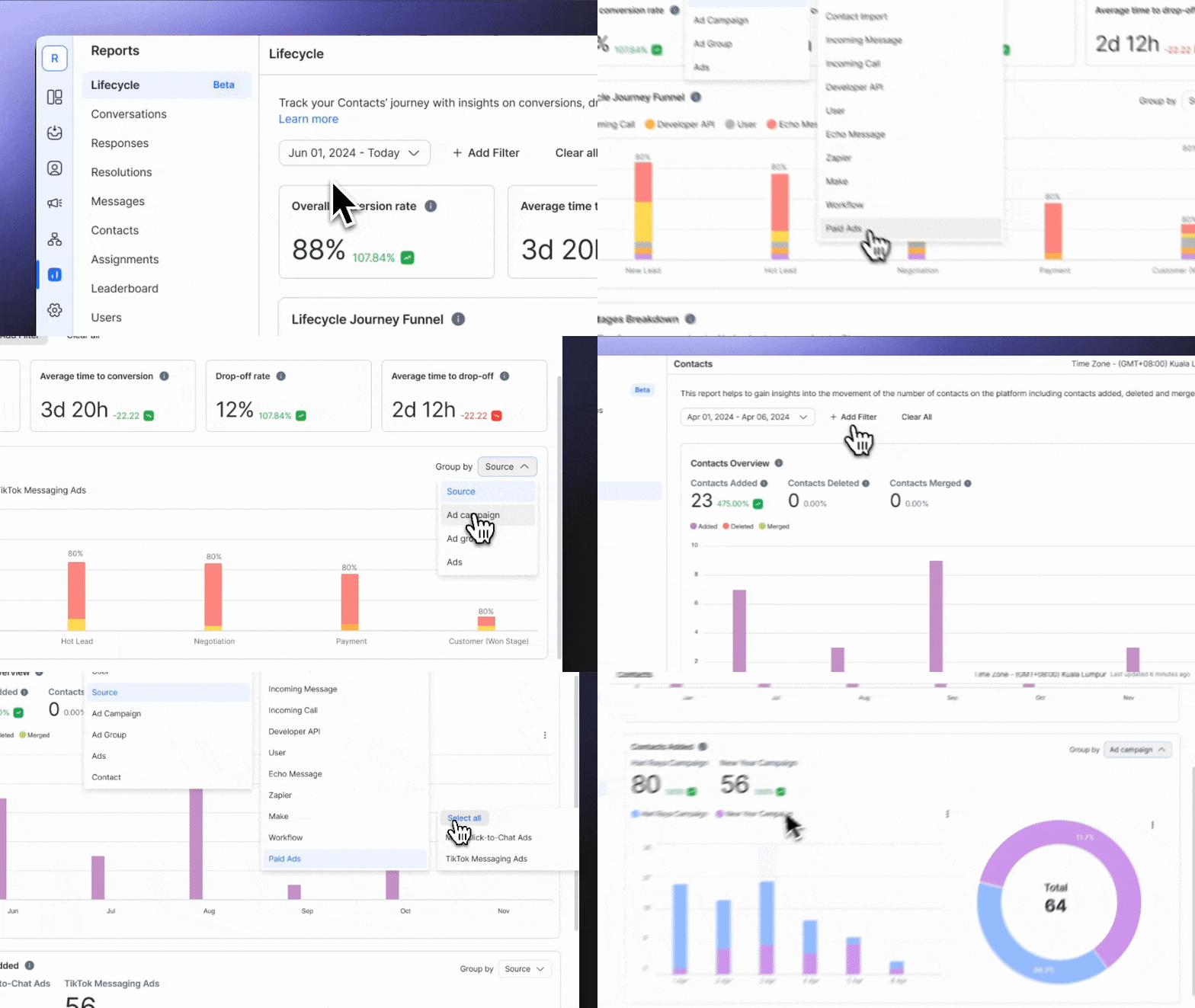
Real-time dashboards empower your team to make smarter decisions. Track AI performance metrics, forecast sales and identify at-risk deals before they stall. With AI-driven insights, you can optimize your sales strategy continuously rather than relying on hindsight.
6. Advanced automation
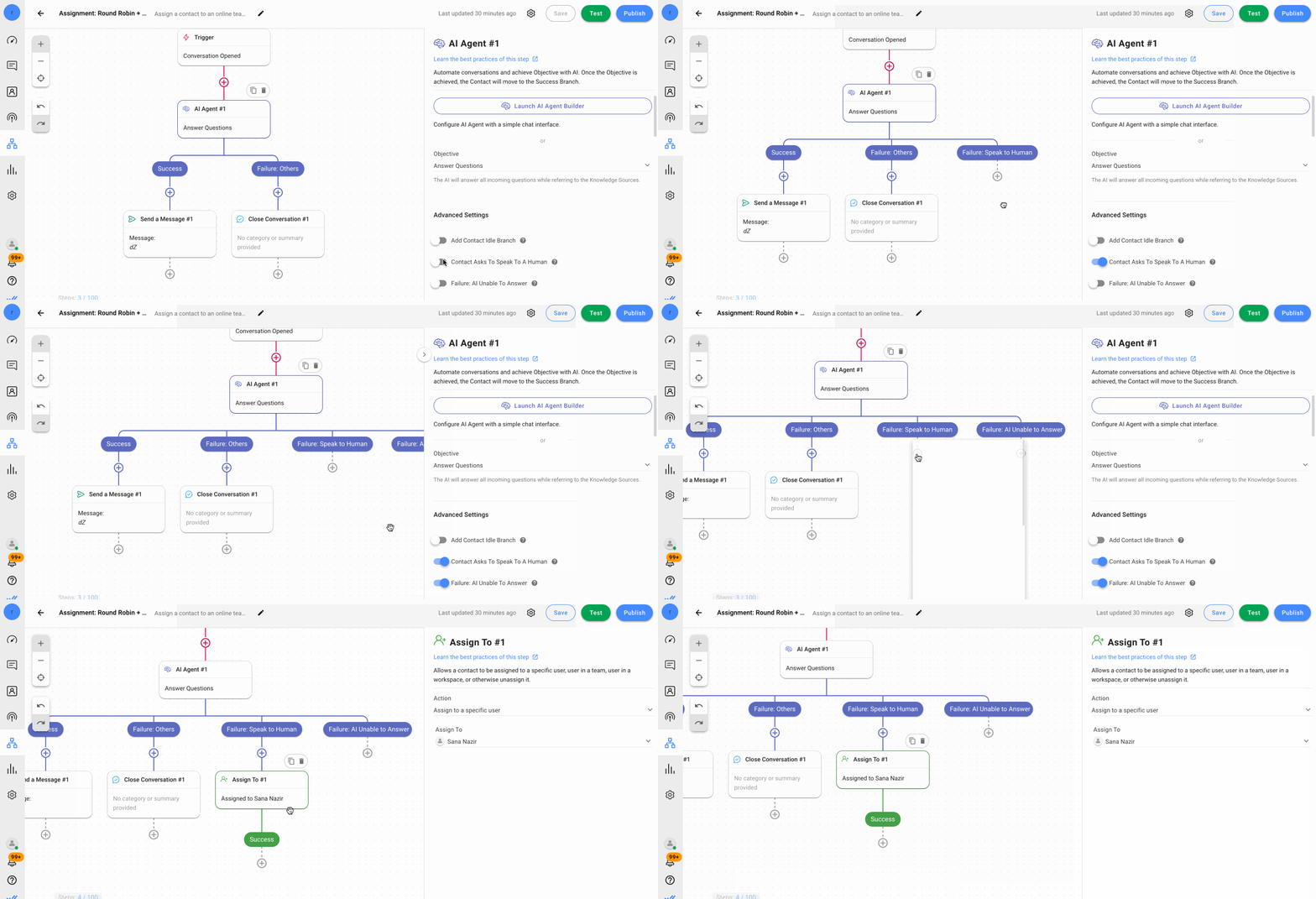
A robust automation builder lets you create workflows to automate routine business processes quickly and consistently without relying on agents. Some platforms let you integrate AI in automated workflows under your preferred conditions. This allows your AI agent to step in at the right moment and take the wheel.
7. Integrations with tech stack
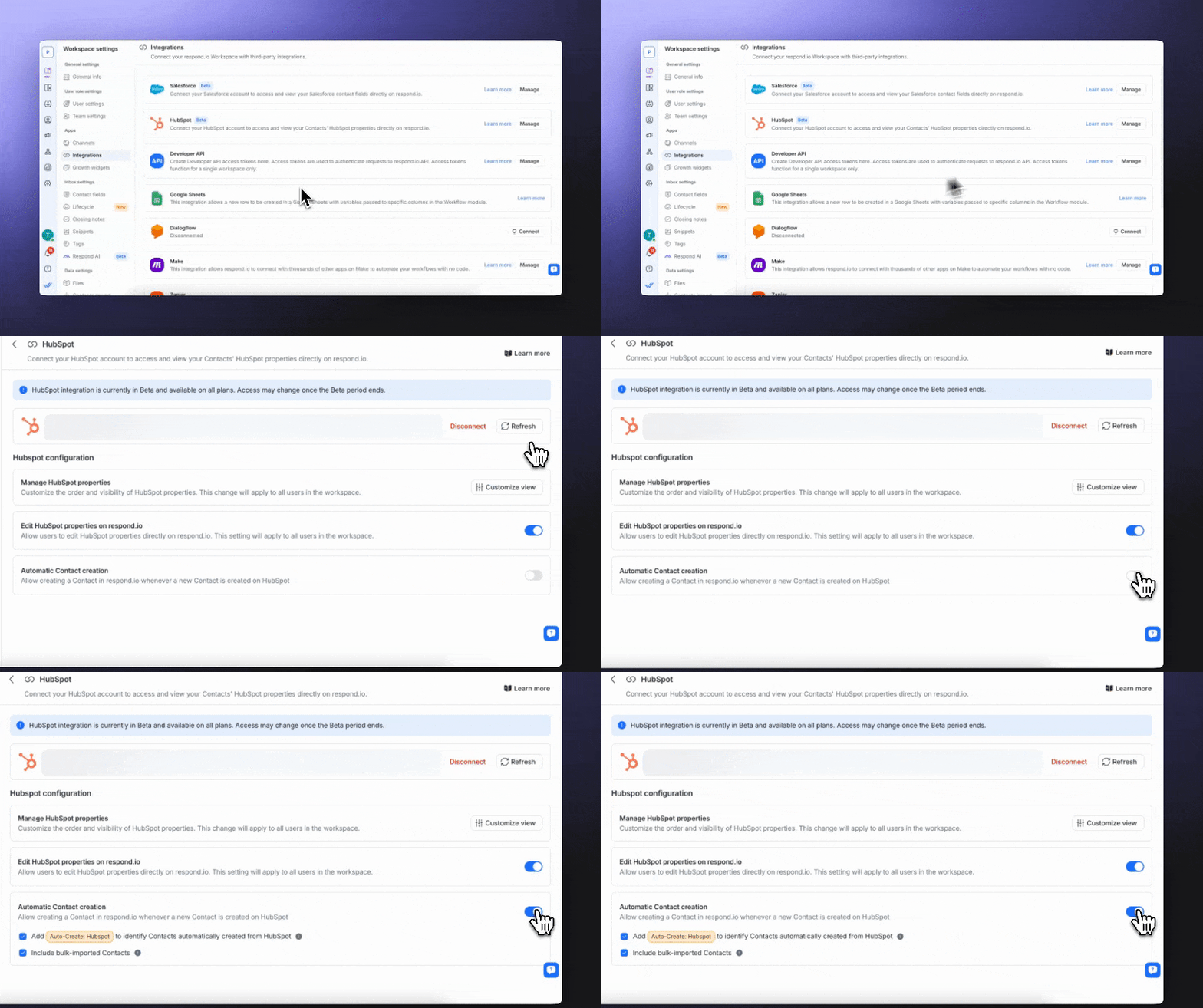
To be effective, AI sales platforms should integrate seamlessly with your sales CRM like Salesforce and HubSpot. These integrations enable a single source of truth across departments and ensure your team always has the right context to close deals. Voice call data—including transcripts, recordings, and AI summaries—can also be sent to external systems via webhook for unified reporting and compliance.
8. Omnichannel capability

Customers today move seamlessly between WhatsApp, Instagram, Messenger, email and even phone calls. A great platform should bring all those conversations together in one place — so your team can deliver consistent, timely responses across every channel. The more channels you cover, the more opportunities you have to connect and convert.
9. Support and platform reliability
None of these features matter if the platform isn’t reliable. Reliability includes high uptime, fast performance and responsive support to keep your workflows running smoothly. Look for providers with proven uptime records and multilingual support — because when sales stop, revenue does too.
Turn customer conversations into business growth with respond.io. ✨
Manage calls, chats and emails in one place!
Top 10 AI sales automation software
Now, we’ll look at the top 10 AI sales automation platforms—their core features, pros, cons, ratings, and more. For a quick overview, here’s the list of categories and the software that fall under each, so you can jump straight to the ones most relevant to your needs.
Type of Software | Description | Linked Use Cases | Overall winner |
|---|---|---|---|
Omnichannel Messaging & AI Sales Automation e.g. Respond.io, Kommo, SleekFlow | Unifies conversations from multiple channels and uses AI to automate lead qualification, routing, and workflows. | - Multi-channel outreach - AI-powered conversations and virtual agents | Respond.io |
B2B Sales Engagement & Outreach Automation e.g. Apollo, Reply.io, Regie.ai, Braze | Automates multi-touch outbound outreach via email, LinkedIn, and phone, helping teams prioritize leads and track performance. | - Email automation and cold outreach | Regie.ai |
AI Sales Calls & Enterprise Engagement e.g. Dialpad Sell, Trellus, Momentum | Focuses on voice calls, AI coaching, and enterprise-level engagement, including automation and analytics. | - Real-time sales coaching and call assistance | Dialpad Sell |
1. Respond.io – Best omnichannel messaging & AI sales automation software
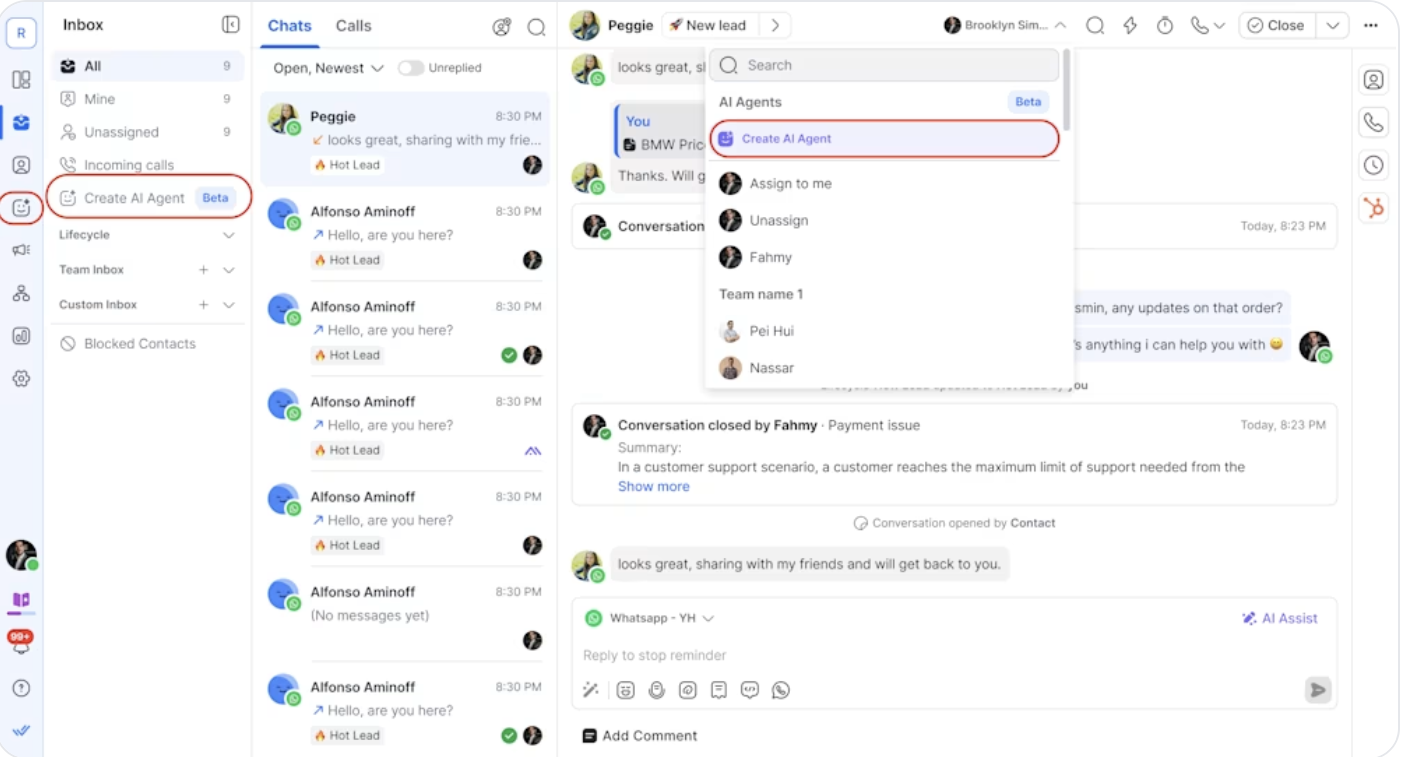
Best for: Scaling B2C brands looking for advanced AI features to grow their revenue in weeks through conversational sales.
G2 rating: 4.8/5
G2 customer sentiment: Users praise respond.io for its intuitive interface, multi‑channel integration, and excellent support, while noting pricing and some feature gaps as drawbacks.
Capterra rating: 4.6/5
Capterra customer sentiment: Reviewers highlight ease of use, automation, and productivity gains, but point out occasional performance issues and limitations in certain functionalities.
How it works: Respond.io is an omnichannel business customer conversation platform that centralizes communication from multiple channels — including website chat, WhatsApp, Messenger, Instagram, phone calls and more — into one unified inbox. It contains advanced features for all businesses looking to scale.
Features
Channels: Supports channels like WhatsApp, Facebook Messenger, Instagram, Viber, Telegram, TikTok, WeChat, SMS, email, and calls via WhatsApp, Facebook Messenger, Telnyx and n8n.
Workflow automation: Use the automation builder to capture leads, send follow-ups, route messages and assign tasks.
AI capabilities: Use AI Agents to automate conversations, qualify leads and support team members in real time.
Voice AI Agents answer, transcribe, and transfer calls to a human agent with a summary for context when needed
AI Agents read WhatsApp catalog products and order details to resolve pricing and availability questions
MCP: Hosted MCP server lets sales teams manage contacts and configure AI Agents directly from Claude or ChatGPT via OAuth
Broadcasts: Send targeted mass messages and campaigns using the Broadcasts module.
Dashboards and reports: Measure team efficiency, AI impact and campaign performance.
Integrations: Sync data across Salesforce, HubSpot, Zapier, Make and other connected tools.
Customer support: 24/7 human and AI support
Stability: 99.999% uptime
Pros
Manage all messaging and call channels with AI across supported platforms, including WhatsApp, Facebook Messenger, Instagram, TikTok and VoIP.
Deploy AI agents that handle chats, send payment links, update contact details and summarize conversations.
Use prebuilt AI roles or train custom agents on your own data from PDFs, websites or internal resources..
Access built-in analytics to monitor team performance and AI effectiveness.
Tracks leads and conversion progress with Lifecycle.
Integrate with sales CRMs and tools such as Hubspot, Salesforce, Zapier and Make.
Scale confidently with enterprise-grade reliability and uptime.
Enterprise features include multi-workspace support, webhooks and SSO for advanced control.
Highly rated customer support.
Cons
The initial setup and customization may take time and require some technical expertise.
The performance of AI-driven features depends on the quality of training data and requires ongoing monitoring to ensure accuracy.
Monthly pricing
The Growth plan begins at $159 per month for 10 users. It includes unlimited workflows, unlimited AI credits, advanced reporting and onboarding assistance via chat or call.
2. Kommo – AI-powered sales CRM
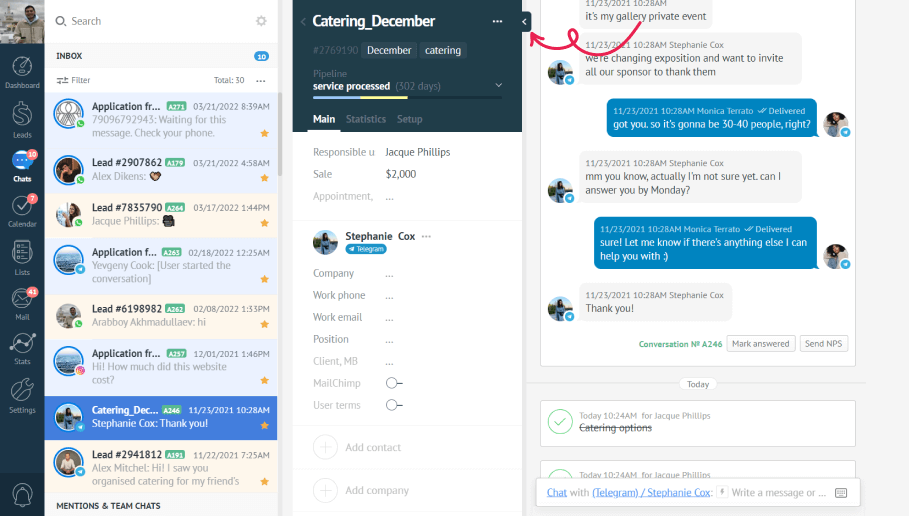
Best for: Small to medium-sized businesses seeking a CRM with integrated messaging capabilities.
G2 rating: 3.8/5
G2 customer sentiment: Users appreciate Kommo for its robust integrations, lead‑management automation, and clean multichannel CRM interface, while citing price concerns and limited reporting/customization options.
Capterra rating: 4.3/5
Capterra customer sentiment: Reviewers value Kommo’s ease‑of‑use, well‑designed workflows and chat‑based CRM capabilities, though some note the mobile app lacks full feature parity and certain features need clearer documentation.
How it works: Kommo centralizes customer interactions from various messaging platforms into a unified inbox, enabling businesses to manage leads, automate workflows, and track sales pipelines efficiently.
Key features
Channels: Supports WhatsApp, Facebook Messenger, Instagram, Viber, Telegram, Skype, WeChat, Apple Chat, SMS and email.
Workflow Automation: Automates repetitive tasks such as lead assignment, follow-ups, and notifications.
AI Capabilities: Offers code-free chatbot builders for 24/7 customer support.
Broadcasts: Facilitates sending messages to multiple contacts simultaneously across various channels.
Reports: Provides advanced analytics and reporting tools to track sales performance and team productivity.
Integrations: Integrates with various third-party applications, enhancing its functionality.
Customer Support: Offers free setup assistance and multichannel support during business hours.
Stability: Provides a reliable platform with consistent performance.
Pros
User-friendly interface for small to medium teams.
Comprehensive messaging channel coverage.
Workflow automation tools for lead management.
Basic AI for chatbots.
Responsive support for setup.
Cons:
Lacks advanced AI for full customer journey management.
No WhatsApp calling feature.
Pricing goes up quickly for businesses with larger teams.
Pricing requires a minimum 6-month commitment, limiting flexibility.
Monthly Pricing
Advanced Plan: $25 per user/month, which includes features like no-code Salesbot, pipeline automation, and triggered SMS & emails.
3. Sleekflow - Multichannel messaging hub
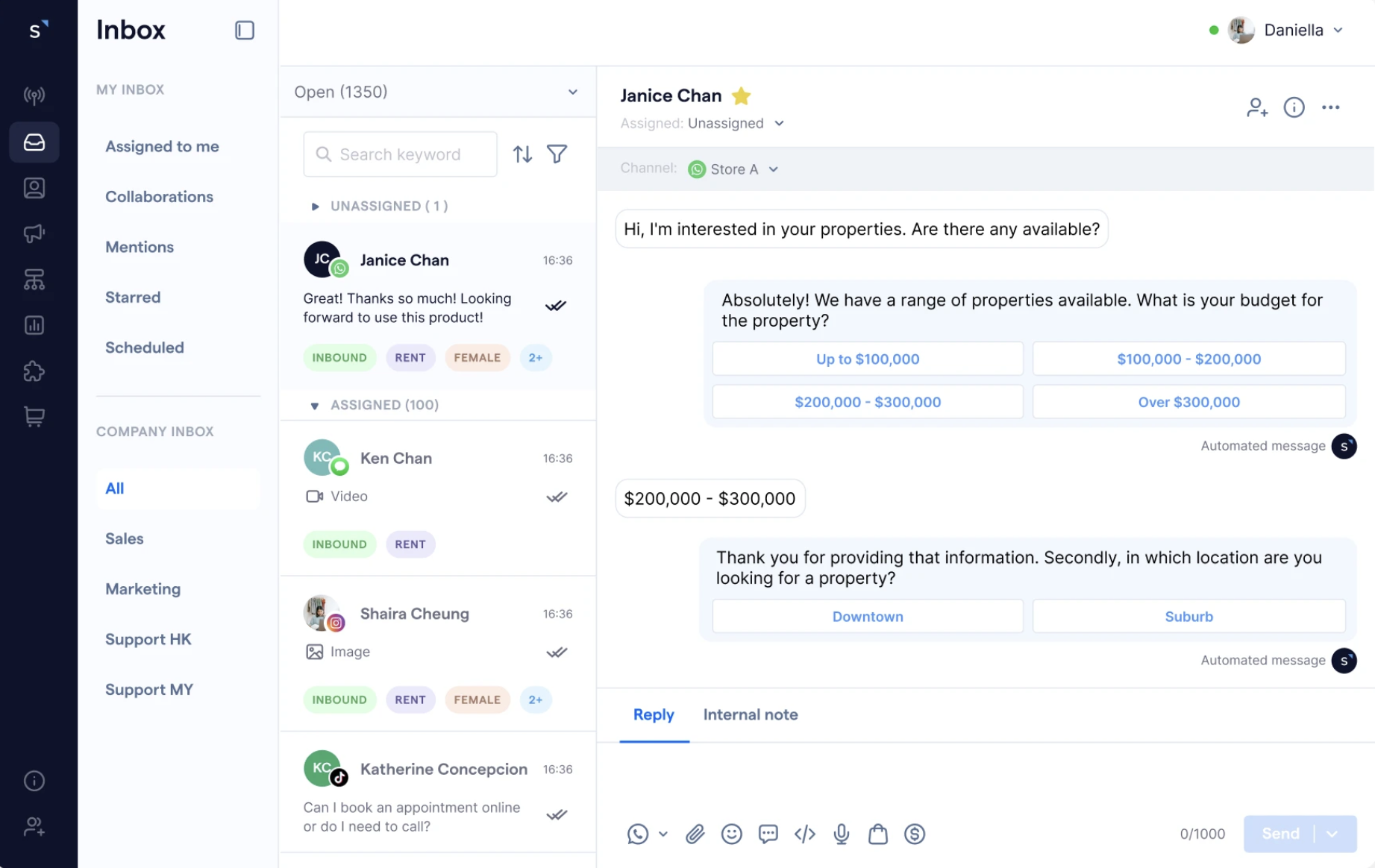
Best for: Businesses looking for a WhatsApp-centric multichannel messaging platform with automation and AI-assisted customer communication.
G2 rating: 4.6/5
G2 customer sentiment: Users say SleekFlow excels at simplifying omnichannel messaging—integrating WhatsApp, Instagram, Facebook, etc., in one inbox with smart automation and intuitive design—but some criticize its pricing, limited analytics, and occasional UI bugs or slow load times.
Capterra rating: 4.5/5
Capterra customer sentiment: Reviewers appreciate SleekFlow for its unified platform and ease of setup, especially for social‑commerce workflows, though they point out that advanced features are locked behind higher tiers and deeper customization.
How it works: SleekFlow unifies customer conversations from WhatsApp, Instagram, Facebook Messenger and other channels into one shared inbox. It helps small teams reply faster, send broadcasts, and automate workflows for sales and support.
Key Features
Channels: WhatsApp, Facebook Messenger, Instagram, Telegram, Viber, SMS and email included.
Workflow Automation for routing, tagging and follow-ups.
AI Capabilities: Chatbot builder, AI message suggestions and AI Agents.
Broadcasts: Send bulk messages or campaigns to segmented contact lists.
Reports: Analytics for messages, team performance and response time.
Integrations: Connects with Shopify, WooCommerce and other e-commerce tools..
Customer Support: Email and chat support during business hours
Stability: Performs well for small-scale operations. Some G2 users report slower performance at higher message volumes
Pros
Intuitive shared inbox and multichannel setup.
Strong WhatsApp and e-commerce integrations.
Affordable for small teams.
Cons
Automation and AI features are focused on messaging use cases.
Customer support can be slow for complex requests.
Monthly Pricing (US)
Premium AI plan starts at US$399/month (5 users, 1,000 contacts included, capped at 12,000) on a Monthly Active Contacts model.
WhatsApp Business API numbers billed separately at US$15/month each.
4. Apollo – B2B sales engagement platform
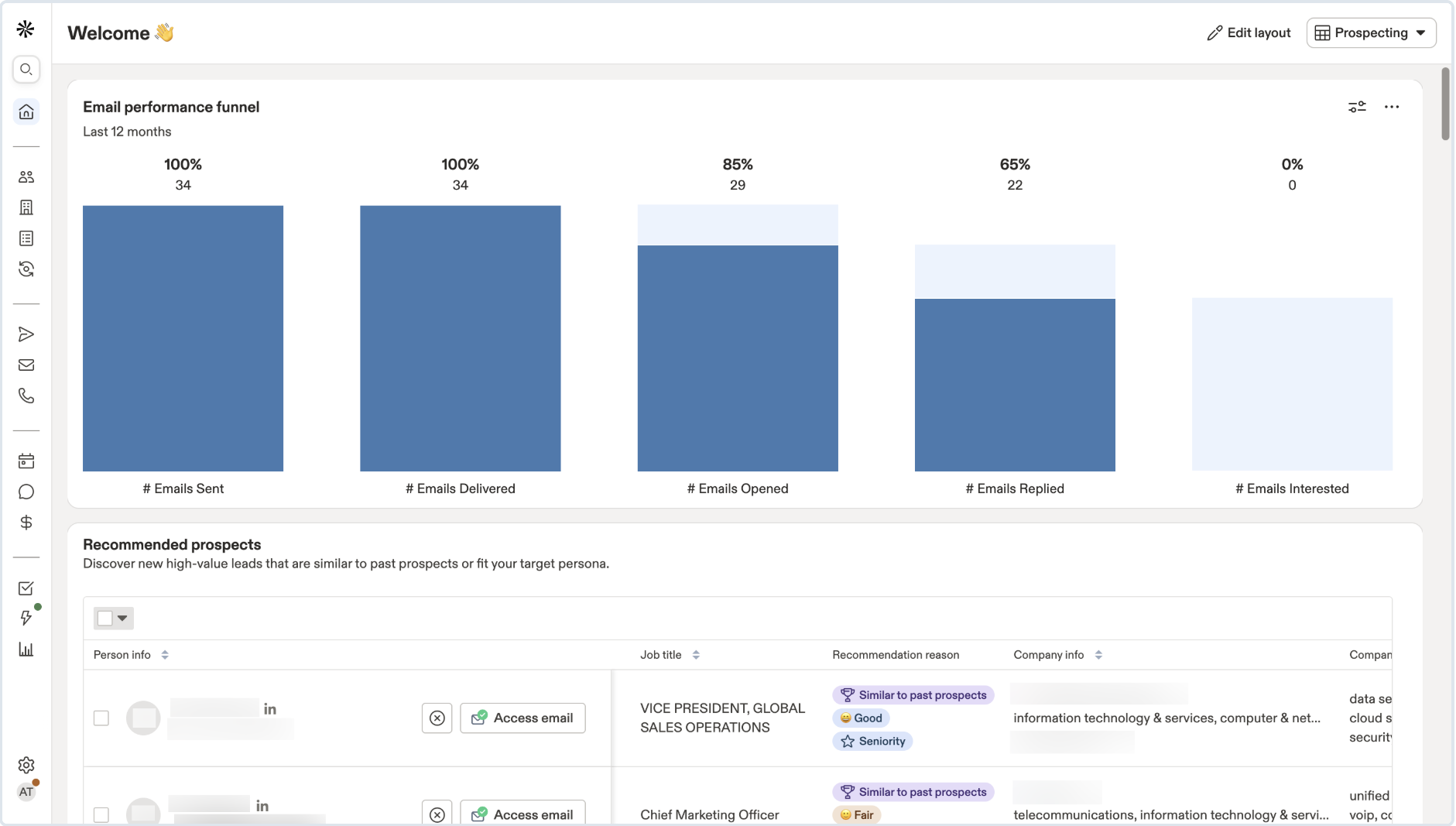
Best for: B2B teams needing data-driven lead generation and outreach automation.
G2 rating: 4.4/5
G2 customer sentiment: Users highly rate Apollo.io for its robust prospecting tools, intuitive interface, and seamless CRM integration, though many still express concerns over data accuracy and a steep learning curve.
Capterra rating: 4.3/5
Capterra customer sentiment: Reviewers commend Apollo.io’s ease of use, strong automation features, and ability to save time on outreach, while noting limitations in data quality and feature depth for enterprise needs.
How it works: Apollo leverages a database of 265+ million contacts and AI-driven insights to identify high-potential prospects, automate multi-channel outreach (email, phone, LinkedIn), and prioritize follow-ups. AI analyzes interactions to deliver pre-meeting insights and optimize sales engagement.
Key Features
Channels: Email, phone, LinkedIn.
Workflow automation: Multi-touch sequences, call logging, CRM syncing.
AI Capabilities: Call/email analysis, pre-meeting insights, AI-assisted workflow suggestions.
Broadcasts: Limited to outreach sequences, no mass messaging like WhatsApp.
Reports: Pre-built and customizable for outreach performance.
Integrations: CRM and productivity tools.
Customer Support: Standard ticketing and knowledge base.
Stability: Reliable for B2B teams.
Pros
Access to a massive contact database for lead generation
Automates outreach across multiple channels
AI-driven insights to prioritize high-value prospects
Streamlines logging, call tracking and CRM updates
Cons
Primarily designed for B2B; limited applicability for B2C or real-time messaging.
No support for instant messaging channels like WhatsApp.
AI cannot be trained on company-specific resources or custom workflows.
Monthly pricing
Professional Plan at $99/user/month, includes 4,000 credits per user and multi-touch AI-assisted outreach; add-ons available for additional credits.
5. Reply.io – Automating cold outreach
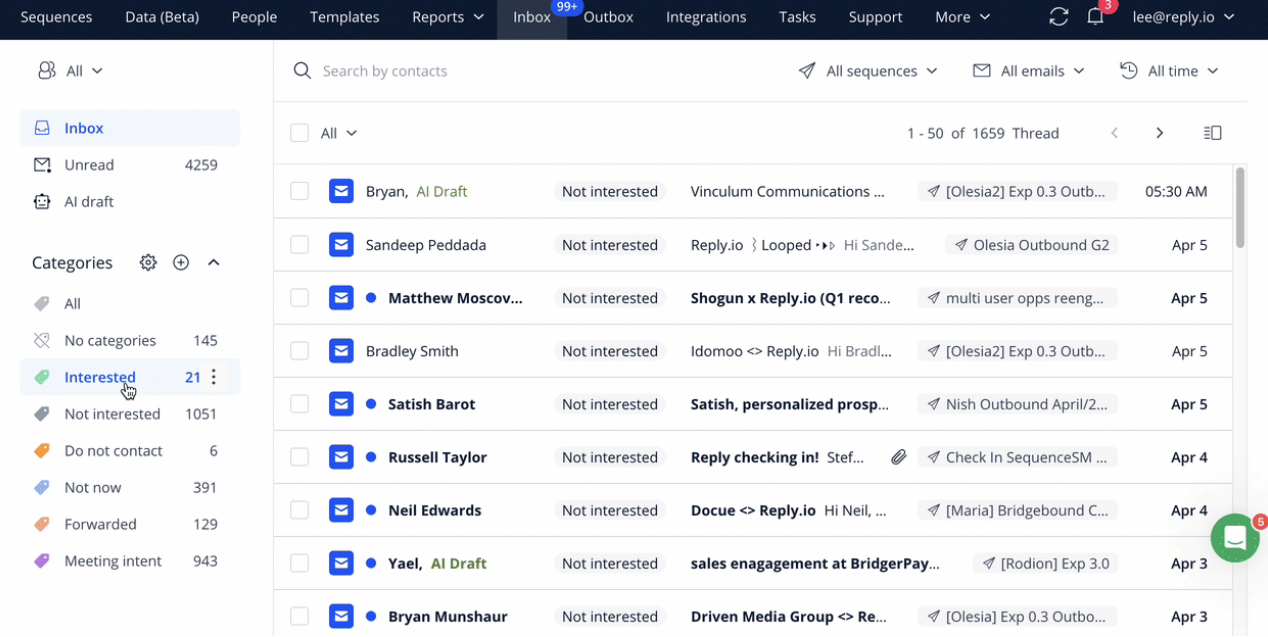
Best for: Sales teams seeking AI-driven multichannel outreach, including email, LinkedIn, SMS and voice calls.
G2 rating: 4.7/5
G2 customer sentiment: Users rate Reply.io at 4.6 / 5, praising its intuitive interface, excellent customer support, and robust automation for multichannel outbound outreach; common complaints include gaps in Outlook integration and a steeper learning curve.
Capterra rating: 4.6/5
Capterra customer sentiment: Reviewers highlight Reply.io’s ease of use in automating outreach and booking meetings, but some point to occasional bugs, pricing concerns, and missing advanced features as drawbacks.
How it works: Reply.io automates B2B sales outreach through AI-powered sequences across multiple channels, including email, LinkedIn, SMS and voice calls. It offers tools for lead generation, follow-ups and analytics, aiming to streamline the sales process and improve engagement.
Key features
Channels: Email, LinkedIn, SMS, voice calls.
Automation: AI-driven sequence creation, multichannel follow-ups.
AI Capabilities: Icebreaker generation, reply categorization, personalization.
Broadcasts: No dedicated mass messaging, sequence-based outreach.
Reports: Email, LinkedIn, call and team performance analytics.
Integrations: CRM and productivity tool integrations.
Customer Support: Live chat and onboarding with CSM.
Stability: Scalable for high-volume outreach.
Pros
Comprehensive multichannel outreach capabilities.
AI-driven personalization and automation features.
Detailed analytics and reporting tools.
Strong customer support with dedicated onboarding.
Scalable infrastructure suitable for growing teams.
Cons
No support for instant messaging channels like WhatsApp.
Pricing may be considered high for small teams or startups.
Additional costs for certain features like LinkedIn automation and dialer.
Some users report unexpected charges and difficulties in canceling subscriptions.
Monthly pricing
Multichannel plan at $99/user/month, offering unlimited emails, AI email assistant and 50 live data credits per month.
6. Regie.ai – AI-written sales copy
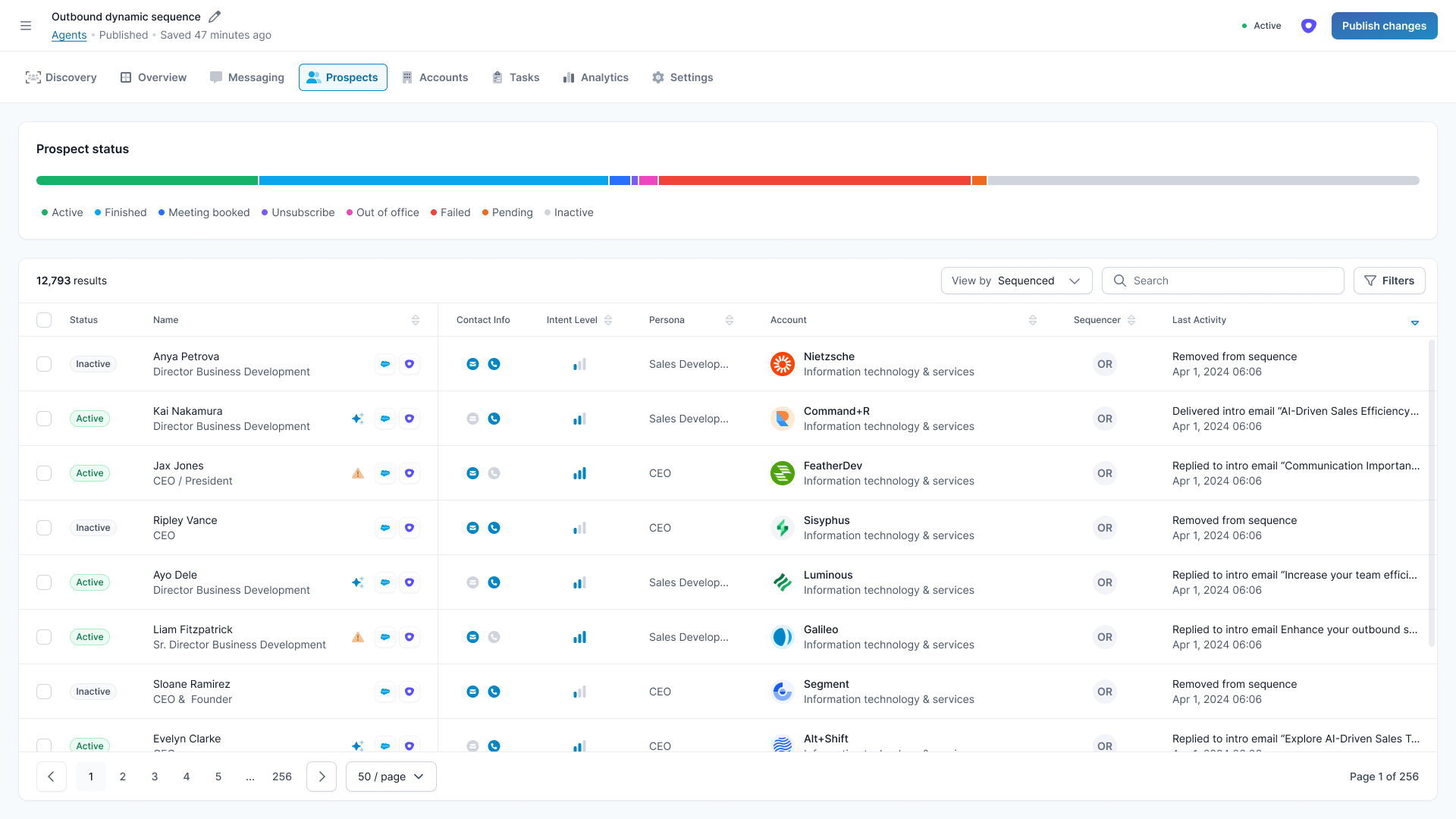
Best for: Enterprise sales teams seeking an AI-native platform for autonomous prospecting and multi-channel outreach.
G2 rating: 4.4/5
G2 customer sentiment: Users praise its ability to personalize outreach, accelerate campaign creation and boost productivity — while some note that generated content can require significant editing, pricing is high, and integrations are still evolving.
Capterra rating: 4/5
Capterra customer sentiment: Reviewers appreciate the tool’s ease of use and time‑savings for message creation, but point out limitations in channel diversification, sequence transfer, and value for money.
How it works: Regie.ai offers an AI-powered prospecting platform that combines AI agents and a parallel dialer to automate lead generation, content creation and outreach across multiple channels.
Key features
Channels: Email, voice calls, social media.
Automation: Lead discovery, content creation, outreach sequences, task execution.
AI Capabilities: Personalized outreach, intent-based lead scoring, adaptive engagement.
Broadcasts: Sequence-driven but no platform-wide broadcast.
Reports: Campaign analytics, engagement metrics, pipeline insights.
Integrations: Limited third-party CRM integrations.
Customer Support: Knowledge base and service channels.
Stability: Enterprise-ready infrastructure.
Pros
Comprehensive AI-driven automation for sales prospecting.
Multi-channel outreach capabilities.
Generative AI for personalized content creation.
Advanced analytics and reporting features.
Scalable infrastructure suitable for enterprise teams.
Cons
No support for instant messaging channels like WhatsApp.
Pricing may be considered high for small teams or startups.
Complex setup process requiring extensive configuration.
Limited integrations with third-party CRM systems.
Monthly pricing
Enterprise plan at $35,000/year, offering AI agents, AI dialer and multi-channel outreach capabilities.
7. Braze – AI-driven customer engagement at scale
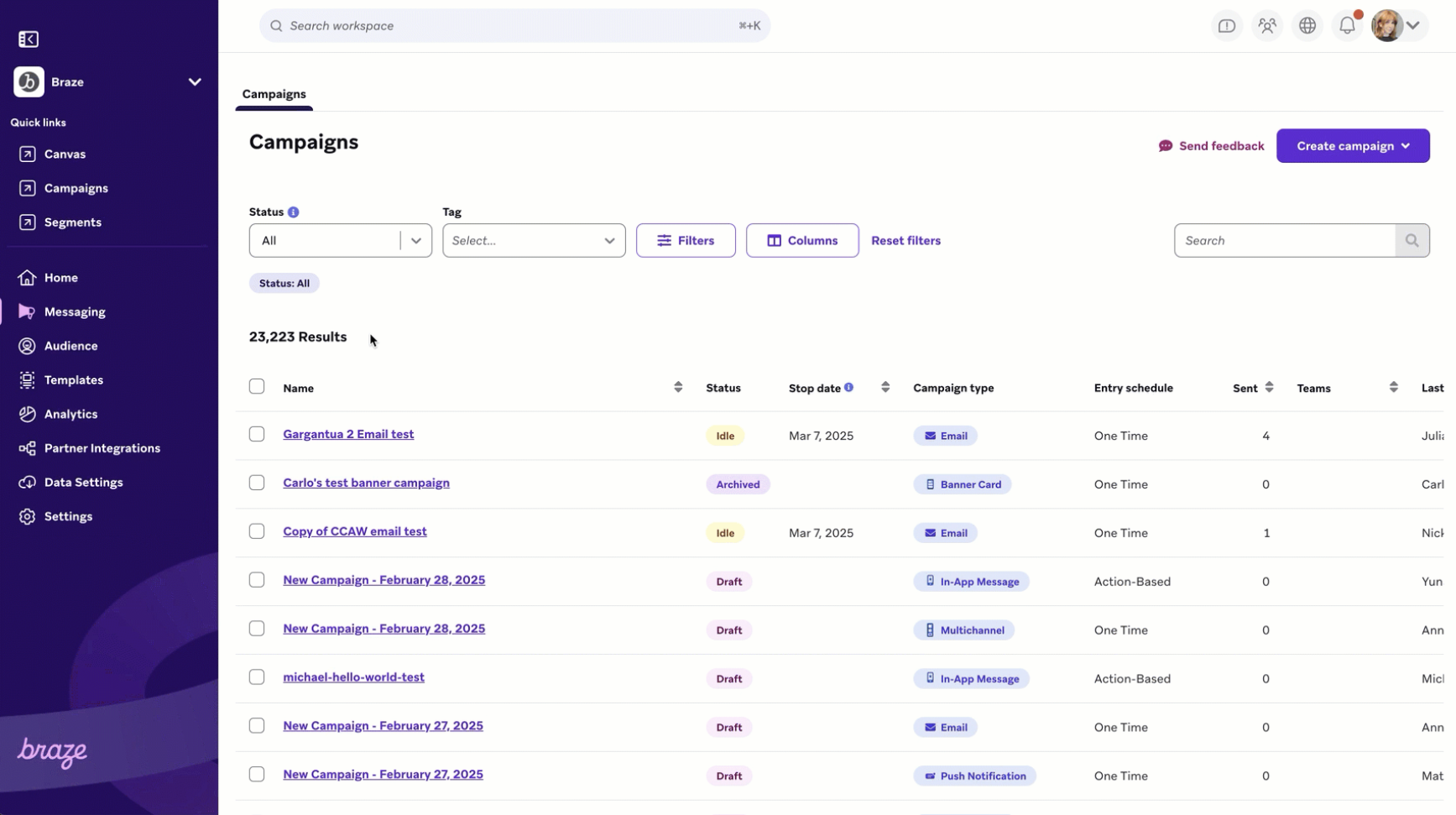
Best for: Mid-to-large enterprises seeking robust, AI-powered customer engagement across multiple channels, including email, push notifications, SMS and in-app messaging.
G2 rating: 4.5/5
G2 sentiment analysis: Users commonly praise Braze for its intuitive interface, strong multichannel campaign capabilities (especially email, push, and mobile notifications), and effective AI-driven personalization and automation. At the same time, customers frequently point out a relatively steep learning curve, higher cost, and slower onboarding or support responsiveness.
Capterra rating: 4.6/5
Capterra sentiment analysis: On Capterra, reviewers highlight Braze’s robustness and flexibility in delivering cross-channel engagement at scale, especially for marketing teams, while noting that setup can be complex, some advanced features require developer input, and the cost may be high for smaller players.
How It Works: Braze enables brands to deliver personalized, real-time messaging through a unified platform. It integrates with various data sources to create comprehensive customer profiles, allowing for targeted campaigns and automated journeys.
Key Features
Channels: Email, push, SMS, in-app, WhatsApp; 150+ partner integrations.
Automation: Journey orchestration, automated messaging, real-time triggers.
AI Capabilities: Send-time optimization, behavior prediction, content personalization with BrazeAI.
Broadcasts: Supports bulk and targeted campaigns across channels.
Reports: Comprehensive analytics dashboards for campaigns, engagement, retention.
Integrations: Extensive partner ecosystem and API connections.
Customer Support: 24/7 live chat/email.
Stability: Enterprise-grade uptime and scalable infrastructure.
Pros
Comprehensive channel support lets brands reach customers through multiple channels from a single platform.
Advanced AI features leverage artificial intelligence to optimize messaging and predict customer behavior, improving personalization.
Extensive integrations provide a wide range of connections with technology partners, enabling seamless data flow and campaign execution.
Scalable infrastructure is designed to handle the needs of large enterprises with high-volume messaging requirements.
Cons
Pricing may be considered premium compared to some competitors and could be a barrier for smaller businesses.
The platform's extensive features can create a learning curve for new users to fully utilize its capabilities.
The effectiveness of AI-driven features depends heavily on the quality and completeness of the integrated data.
Monthly pricing
Standard Plan: Pricing is customized based on the specific needs and scale of the business. Interested parties are encouraged to contact Braze directly for a personalized quote.
Depending on the chosen plan and usage, there may be extra costs for premium features, additional channels, or advanced analytics.
8. Momentum – Pipeline insights and deal intelligence
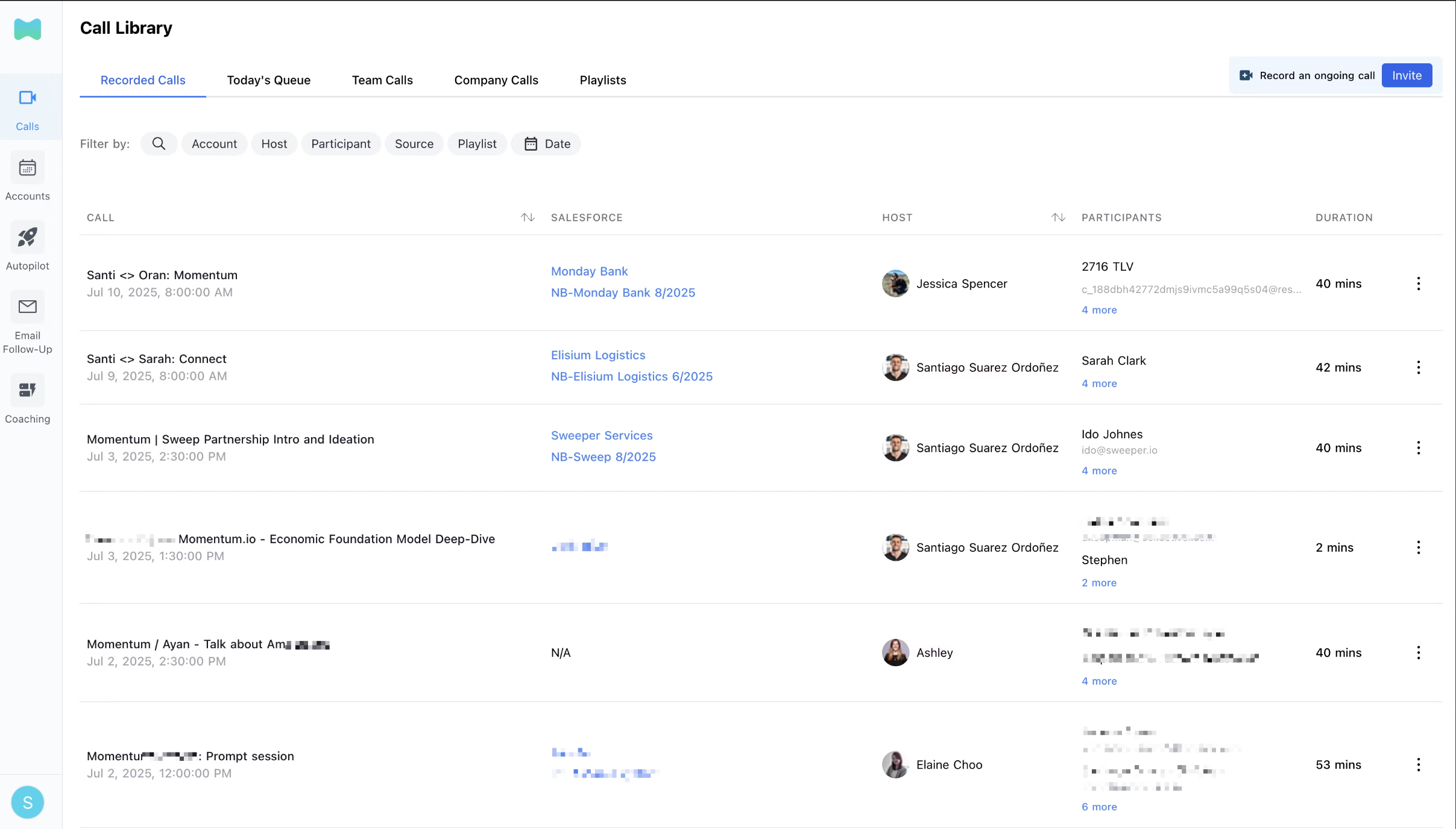
Best for: Revenue teams seeking AI-powered orchestration across the entire sales cycle, from deal execution to customer retention.
G2 rating: 4.6/5
G2 customer sentiment: Users praise Momentum for its AI-driven call summaries, automated CRM updates, and seamless Slack/CRM integrations. Common drawbacks include a learning curve, limited customization and occasional quirks with non-English languages.
Capterra rating: 4.7/5
Capterra customer rating: Reviewers highlight fast support and strong integration capabilities, though they note the app can be resource-heavy and performance may drop when toggling between screens during calls.
How it works: Momentum serves as an AI-powered orchestration layer that integrates with existing CRM and sales tools to automate workflows, capture buyer intent signals and provide real-time insights. It aims to streamline sales processes and enhance team productivity.
Key Features
Channels: Email, Slack, Salesforce, other CRM platforms.
Automation: Workflow automation for follow-ups, task assignment, data entry.
AI Capabilities: Call summaries, action items, executive briefs, intent detection.
Broadcasts: Supports notifications and updates via integrated channels.
Reports: Analytics on sales performance, deal progression, team activities.
Integrations: Deep CRM and collaboration tool integrations.
Customer Support: Slack-based support with premium options.
Stability: Reliable integration with existing tech stacks.
Pros
Comprehensive AI-driven sales orchestration.
Seamless integration with existing CRM and sales tools.
Real-time insights and alerts.
Customizable workflows to fit specific sales processes.
Scalable solution suitable for teams of various sizes.
Cons
Requires initial setup and customization.
Pricing may be considered high for small teams or startups.
Limited omnichannel support; primarily focuses on email and CRM platforms.
Monthly pricing
Business plan at $99/user/month, offering AI-driven sales orchestration and integration with existing tools.
9. Dialpad Sell – AI sales calls and coaching
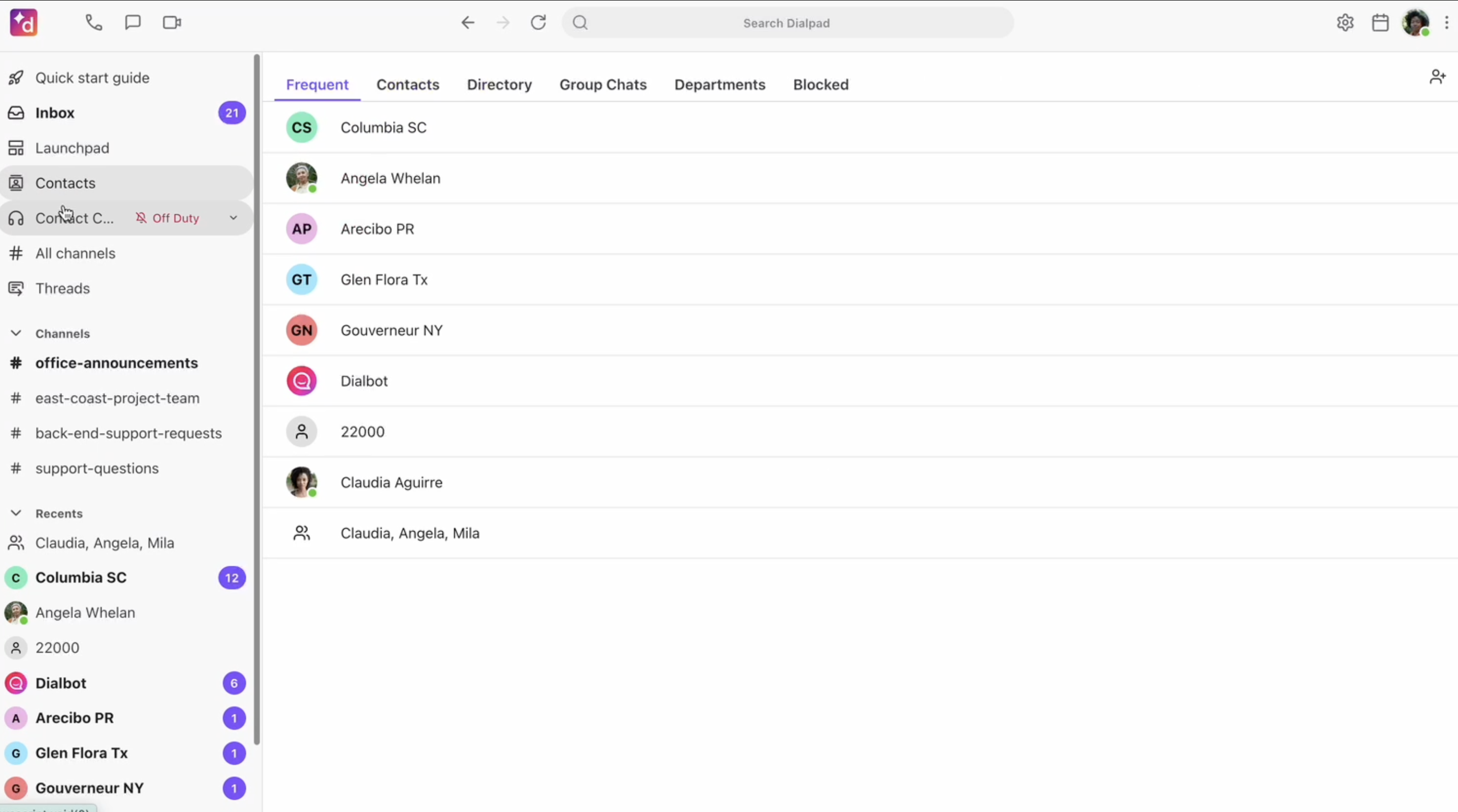
Best for: Sales teams that rely on voice calls and want real-time AI assistance for coaching, objection handling and conversation insights.
G2 rating: 4.4/5
G2 customer sentiment: Users appreciate Dialpad Sell for its unified platform with voice and messaging, AI‑powered call transcription and strong mobile/desktop experience; however, many raise concerns about inconsistent CRM integrations, occasional call quality issues and support responsiveness.
Capterra rating: 4.5/5
Capterra customer sentiment: Reviewers highlight Dialpad’s ease of use, flexible calling tools, and AI features as significant advantages, while pointing to limitations in setup complexity, advanced reporting and slower support for large or complex deployments.
How It Works: Provides AI-powered voice and video calling with real-time transcription, sentiment analysis, and live coaching prompts. Automatically generates call summaries and updates CRM data to streamline post-call tasks.
Key Features
Channels: Voice, SMS, MMS, email.
Automation: Real-time assist prompts, voicemail drops, call summaries, smart routing.
AI Capabilities: NLP transcription, sentiment analysis, objection handling, coaching cards, post-call insights.
Broadcasts: Not applicable; call-focused.
Reports: Call analytics, sentiment dashboards, team performance.
Integrations: CRM and productivity tool integrations.
Customer Support: 24/5 chat & email, 24/7 on higher plans.
Stability: Enterprise-grade infrastructure with a 99.9% uptime commitment.
Pros
Excellent real-time voice intelligence and live coaching.
Strong reporting and analytics for call quality and performance.
Reliable platform performance for enterprise teams.
Seamless CRM integrations and automated post-call actions.
Cons
Limited coverage of non-voice channels like WhatsApp or social media.
AI features and advanced analytics available only on higher plans.
Add-ons (extra numbers, call recording) can increase costs.
Requires onboarding to fully leverage AI tools.
Monthly pricing
Pro Plan: ~$95–110 per user/month (billed monthly). Includes AI call transcription, live coaching, voicemail drop, CRM sync and analytics.
Additional costs may apply for premium AI features, local presence dialing or extra phone numbers.
10. Trellus – Backend sales ops AI agents
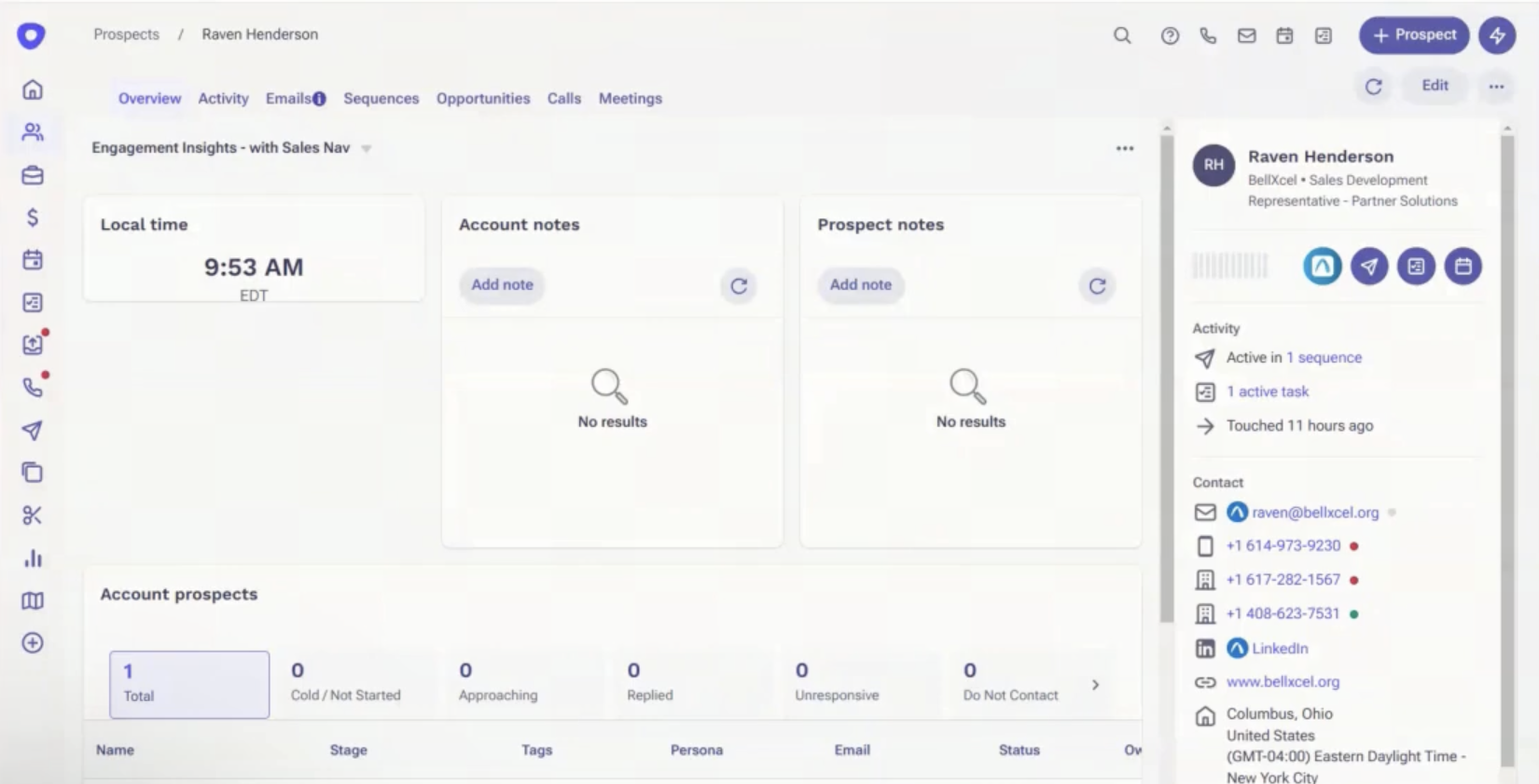
Best for: Sales teams seeking real-time AI coaching during calls, automated dialing, and seamless CRM integration.
G2 rating: 4.5/5
G2 customer sentiment: Users commend Trellus for its simplicity of onboarding, responsive support, and noticeable impact on increasing call-engagement rates, while some mention that it still lacks certain features.
Capterra rating: Not available.
Capterra customer sentiment: Direct insights are limited due to minimal review data, making it difficult to draw a clear sentiment profile at this time.
How it works: Trellus.ai integrates with existing sales platforms like Salesloft, Outreach, and HubSpot, providing real-time AI coaching, automated dialing, and performance analytics to enhance sales productivity.
Key Features
Channels: Voice calls; integrates with CRM and sales engagement platforms.
Automation: Auto dialing, voicemail drops, CRM updates.
AI Capabilities: Real-time call feedback, objection handling, performance insights.
Broadcasts: Not applicable; call-focused.
Reports: Call analytics, objection tracking, sales metrics dashboards.
Integrations: Salesloft, Outreach, HubSpot.
Customer Support: 24/7 live chat/email.
Stability: Reliable integration with major sales platforms.
Pros
Real-time AI coaching enhances sales call effectiveness.
Seamless integration with popular sales engagement platforms.
Reduces manual tasks through automation, increasing productivity.
Provides actionable insights through performance analytics.
Cons
Primarily focused on voice calls; limited support for other communication channels.
Requires integration with existing sales platforms, which may involve setup time.
Advanced features may require higher-tier plans.
Monthly pricing
Power Plan: Priced at $39.99 per user per month, offering unlimited dialing, voicemail drops on select platforms, and access to past transcripts.
How businesses use AI sales automation software
JU Productions enhances lead quality with AI-driven spam filtering
JU Productions, a digital marketing agency in Singapore, improved lead quality by using respond.io’s AI agents to automatically filter spam and low-intent messages. The AI agents reviewed flagged conversations daily before blocking them, ensuring that only high-value leads reached the sales team.
As a result, JU Productions reduced spam messages by 92% and increased qualified lead conversion by 38%, saving hours of manual filtering each week and letting the sales team focus on closing deals.
Automax achieves 42.5x ROI with AI-powered WhatsApp broadcasts
Automax, a leading automotive retailer, enhanced their WhatsApp marketing by integrating respond.io’s AI-powered workflows for lead qualification and multilingual routing. The AI agent managed thousands of incoming inquiries efficiently, improving response times and engagement.
By combining automated lead filtering with targeted WhatsApp broadcasts, Automax achieved a 42.5x return on investment, increased lead-to-sale conversion by 57%, and reduced manual follow-up efforts by 65%, demonstrating the measurable impact of AI on both efficiency and revenue.
Turn customer conversations into business growth with respond.io. ✨
Manage calls, chats and emails in one place!
FAQs about AI sales automation software
Can AI sales software create orders and send payment links to customers automatically?
It depends on the type of AI sales software you use. Basic AI outreach tools or CRMs often focus on lead generation, email sequences, or messaging automation and don’t handle transactions directly.
This capability can be achieved with an omnichannel messaging & AI sales automation platform. These platforms let you automate the sales process end-to-end: the AI can qualify leads, generate an order and send a payment link to the customer — all within the same conversation. The system tracks interactions, updates your CRM and ensures a smooth, fully integrated payment process.
Respond.io, for example, supports this type of workflow by combining AI automation, omnichannel messaging (WhatsApp, Instagram, TikTok, web chat), and payment link delivery in one unified platform, enabling businesses to close deals faster while maintaining a seamless customer experience.
Can AI sales software automatically reply to leads and schedule appointments?
Yes, as long as you choose the right tool. Respond.io, for example, is an AI sales automation software that can reply instantly to new leads, qualify them through conversation and guide them toward scheduling an appointment. When a customer sends a message, the system detects their intent and automatically replies with relevant information, asks pre-qualification questions, and, once the lead meets certain criteria, shares a booking link or calendar integration to schedule a meeting. After the appointment is booked, the conversation can be handed off to a human sales representative for personalized follow-up.
Can AI sales assistants handle multiple languages or voice messages?
Yes, as long as you’re using a suitable tool like respond.io. With it, AI sales assistants can recognize and reply in multiple languages depending on the AI model and training data. For example, if a customer messages in Spanish, French or Malay, the system can detect the language and respond appropriately. Businesses can also train the AI using their own multilingual resources, like FAQs or website content, to improve accuracy and tone.
Regarding voice messages, agents can manually transcribe inbound audio using a Transcribe button in the Inbox, converting voice notes to readable text that is shared across the team for easier review and handovers.
Can human sales agents take over the conversation from an AI Sales Agent if needed?
It depends on the software. With some software, the AI will continue talking even when a human steps in, which leads to a poor customer experience. Respond.io, on the other hand, allows for a seamless conversation takeover. The human agent can step in, gain full context of the conversation, and the AI Agent will stop.
Further Reading
If you've found this article interesting, have a look at:


